

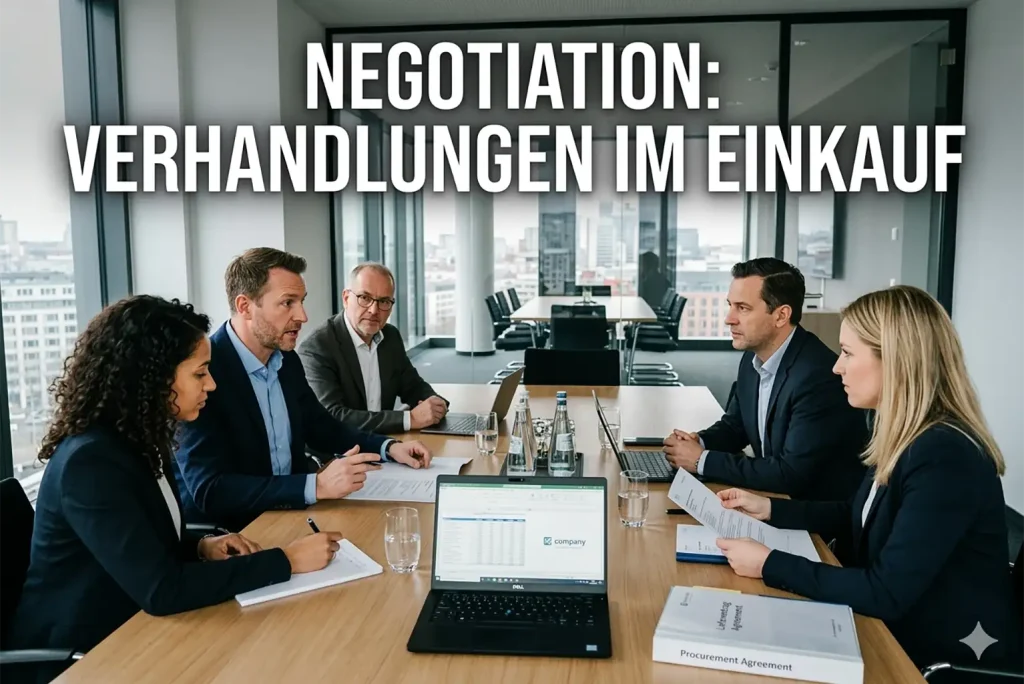
Key facts about purchasing negotiations
- Preparation: Analyze hard facts (prices, indices) and soft facts (motives of the other party).
- BATNA: Define your best alternative (Best Alternative to a Negotiated Agreement) in advance.
- Harvard concept: Separate factual issues from personal issues and focus on interests.
- TCO focus: Don't just negotiate the price, but also delivery terms, payment terms, and quality.
- Trend 2026: Use AI-powered market analysis for real-time benchmarks during conversations.
1. The psychology of negotiation: More than just numbers
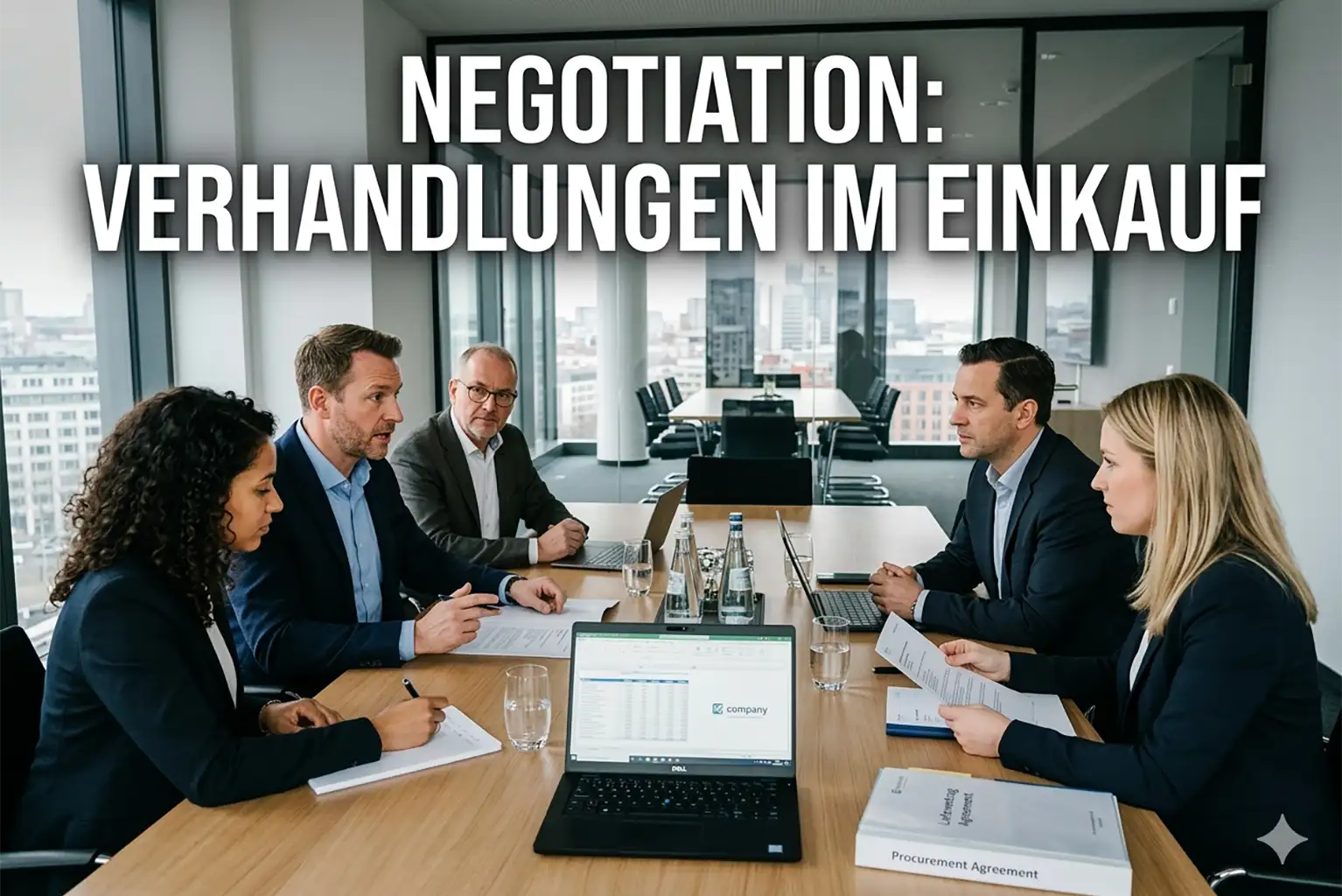
- Anchor effect: The first number mentioned often sets the framework. Whoever sets the first anchor wisely dominates the scope.
- Reciprocity: Small, planned concessions on your part often provoke an unconscious concession from the supplier.
- Framing: Present cost increases not as a problem, but as a shared challenge for process optimization.
"Negotiations are not about getting the biggest piece of the pie, but about working together to make the pie big enough to satisfy both sides."
2. Phases of negotiation preparation
In professional purchasing, preparation is divided into three main pillars:
- Data analysis (hard facts): Use spend analysis and real-time market prices (commodity indices). Know the LPP (last price paid).
- Goal definition: Set your maximum goal, your realistic target goal, and your walk-away point (break-even point).
- Strategic tools: Determine your BATNA (your best alternative if the deal falls through). The stronger your BATNA, the more confident your position will be.
3. Methods & Strategies: The Harvard Concept
Away from the bazaar style, toward objective negotiation. The Harvard concept provides the framework for sustainable results:
- Interests instead of positions: Ask "why." A supplier who insists on a high price may simply need security in the form of longer contract terms.
- Develop options: Look for creative solutions (e.g., logistics optimization instead of pure price reductions).
- Objective criteria: Use neutral benchmarks to take emotion out of the price discussion.
4. Deep Dive: Game Theory in Purchasing – Utilizing the Nash Equilibrium
In complex negotiations, game theory helps to strategically predict the behavior of the other party. A key point is the Nash equilibrium: a state in which neither partner can improve their position by making a unilateral change.
- Creating transparency: Open book policies enable both sides to find an optimal solution that reduces the overall costs of the supply chain.
- Incentives: If the supplier knows that they can keep a portion of the savings they generate, they will proactively seek out opportunities for optimization.
5. Tactics for advanced users (mobile-optimized)
Use these tactics sparingly to control the momentum:
- The salami tactic: making demands bit by bit when the deal is almost done. (Caution: relationship risk!)
- Good Cop/Bad Cop: One negotiator is strict, the other is understanding. Effective in team negotiations.
- Remain silent: Remain silent after making an offer. This often forces the seller to improve their offer.
- Higher authority: "I would agree, but my board is blocking it." Helpful for buying time.
6. Practical example: Successful defense against a 12% price increase
Scenario: A supplier demands a 12% increase in price for an assembly due to increased energy costs.
Procedure: The buyer validates the claim using AI tools. Result: Energy accounts for only 15% of the total costs. The claim is not mathematically tenable.
The solution: Instead of 12%, the parties agree on:
- 3% price adjustment (corresponds to the actual cost).
- Switch to a consignment warehouse (liquidity advantage for the supplier).
- Extension of the framework agreement by 24 months (planning security).
Result: Cost increase reduced by 75% while simultaneously improving processes.
7. Shopping in 2026: Sustainability and AI
Today, the pure price is often secondary to resilience and compliance.
- ESG negotiations: CO2 footprint and social standards are fixed items on the agenda (keyword: LkSG).
- AI-assisted negotiation: Modern tools simulate scenarios and provide tips during the conversation based on market changes.
- Resilience over price: In volatile times, purchasing primarily negotiates capacity guarantees and alternative logistics routes.
8. Bonus: The ultimate checklist for preparation
- Data: Price history, market benchmarks, and TCO model checked?
- Goals: Maximum, target, and walk-away point set in writing?
- BATNA: Is the specific alternative to the current supplier ready for use?
- Psychology: Are the roles within the team (who says what) clearly defined?
- Interests: What does the salesperson really need (e.g., sales at the end of the quarter)?
9. Conclusion on negotiation: Successfully concluding negotiations in purchasing
By 2026, negotiation in purchasing will be a data-driven discipline. The key lies in striking a balance between empathy and hard facts. Those who do their homework in preparation, understand game theory, and use TCO models will evolve from cost center managers to strategic value creators.
"The best negotiation is one where both sides walk away feeling like they've won—but only one side knows the other side's actual numbers."
10. FAQ – Important questions about negotiation: Negotiations in purchasing
How should I respond to a supplier's monopoly position?
Increase your attractiveness as a customer (e.g., through prestigious projects) or look for technological alternatives (substitution) to reduce dependency in the long term.
What is the most common mistake in purchasing negotiations?
Revealing your budget or time constraints too early. Anyone who signals that they "need to buy urgently" loses their position of power.
When should I break off negotiations?
As soon as your walk-away point is exceeded or the supplier violates basic compliance or ESG standards.
Does AI really help with negotiation in purchasing?
Yes, especially when analyzing huge amounts of data and simulating "what-if" scenarios for optimal pricing.