




Reduce purchasing costs
Businesses can their Reduce procurement costs sustainably by an average of 8 % to 12 %, by eliminating hidden inefficiencies in the supply chain and establishing strategic supplier management. Kloepfel Consulting realises these potentials through a specialised 360-degree approach, often based on a „no cure, no pay“ model – thus achieving measurable liquidity advantages with no upfront financial risk.

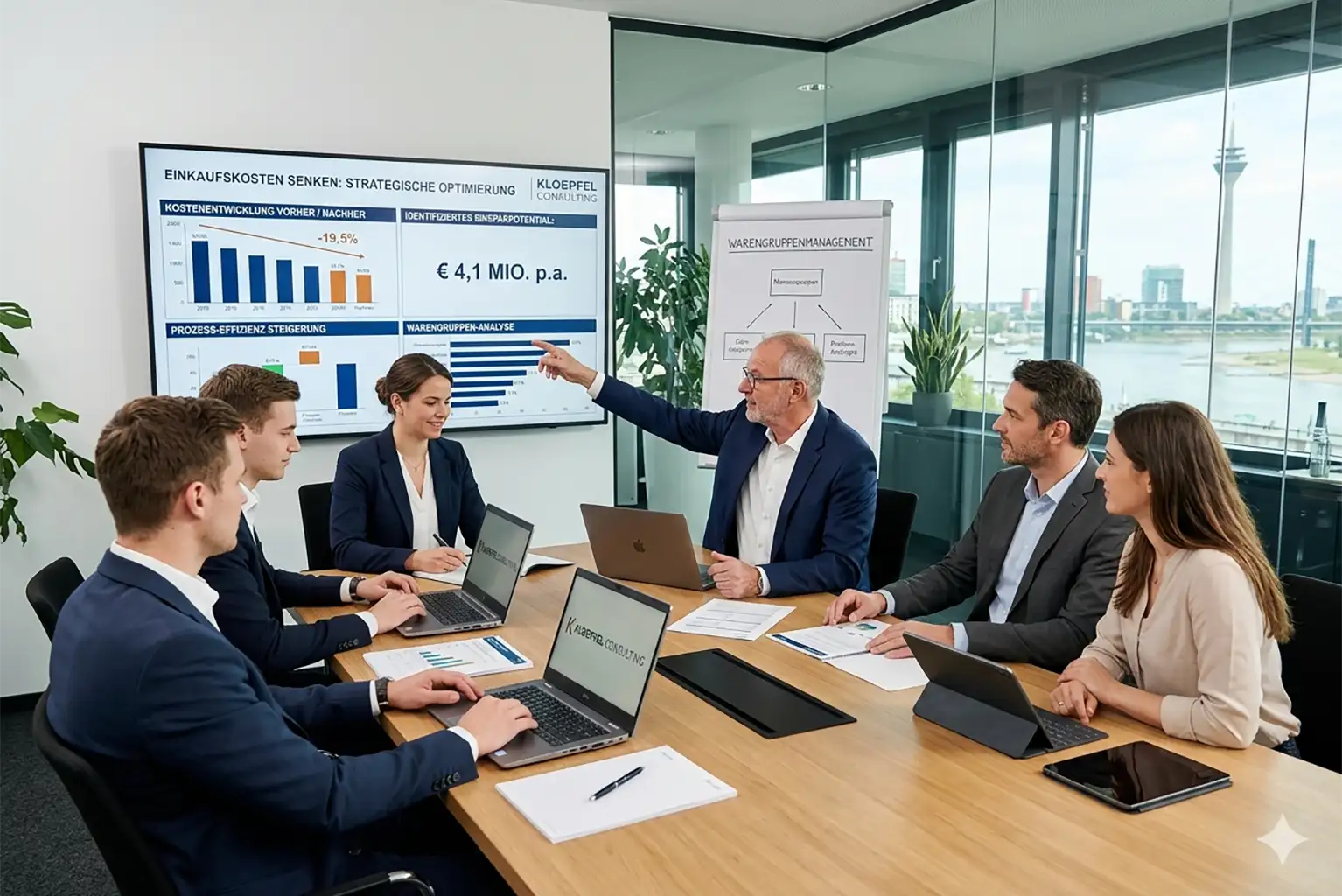
Strategies for sustainably reducing your procurement costs
Effective cost optimisation in purchasing is not solely about renegotiating prices. To secure long-term competitive advantages, we examine the entire value chain and identify cost drivers in both direct and indirect product groups. By combining market expertise, technical know-how, and digital process optimisation, we create a transparent cost structure that allows for immediate savings and future-proofs your purchasing organisation.
Key levers of cost optimisation:
- Global Sourcing & Supplier Benchmarking: Exploring international procurement markets and systematically comparing existing conditions with the current market level.
- Volume Bundling: Aggregating demand across different locations or product lines to leverage economies of scale and improve negotiating positions.
- Technical Cost Optimisation (Value Engineering): Analysis and adjustment of product specifications to reduce manufacturing costs without loss of quality.
- Process automation: Streamlining operational procurement processes (Source-to-Pay) to significantly reduce indirect costs per order.
- Contract and Risk Management: Securing prices and supply capability through optimised contract structures and proactive supplier monitoring.
Savings in procurement of 5% to 15%
Are you looking for a procurement expert who not only identifies potential but also sustainably implements it together with your employees and suppliers? We have industry experience, are pragmatic and down-to-earth. Our remuneration is 100%% based on success achieved, meaning: no savings – no fee. Over 1,000 clients from more than 2,000 projects have already benefited from our entrepreneurial and collaborative approach.
Sustainable reduction of all direct material costs
Sustainable reduction of all indirect costs (including material and overhead costs)
Because overhead costs (e.g. energy, insurance, cleaning services, security, marketing) are often insufficiently considered, there are significant savings potential in this area. Purchasing departments are usually so heavily committed to centrally procured goods that overhead costs remain unchecked. In some companies, they are not even managed by purchasing but are handled by other departments (accounting, dispatch, assistants, etc.).
This often leads to contract extensions without the terms being reviewed and negotiated. By using the necessary procurement tools based on a transparent analysis and selecting the right partners, savings in the double-digit percentage range can be achieved.
No savings, no fee
Our remuneration is 100%% based on the success achieved, meaning no savings – no fee.

Improvement of payment terms
Cost structure analyses and supplier workshops
Many purchasers often lack knowledge of their suppliers' cost structures. A transparent supplier cost structure is the best defence against price increase demands. Through accurate analysis of price increase requests and purchasing prices, a basis can be created for successful negotiations and improved processes at the supplier. This requires figures and facts, which no supplier willingly discloses. Kloepfel Consulting solves this with the five-time award-winning software, Cost Control. This software includes all available manufacturing modules and is specifically tailored to the needs of a manufacturing company. The Cost Control tool thus represents a valuable system for the exact and comprehensive analysis of any manufacturing costs.
Further costs can be revealed through so-called supplier workshops. The workshop is conducted with close involvement of the suppliers, to identify and realise cost potentials, thereby strengthening renegotiations.
Would you like to reduce your procurement costs or do you have other questions about KLOEPFEL Consulting?

Global Procurement
The list of good reasons for global sourcing is long: low prices, adaptable suppliers, and the development of new markets. Standard and spare parts in particular can be produced abroad cheaply and to a high standard. Buyers who are faced with sourcing the best goods at the cheapest prices every day are therefore increasingly relying on global sourcing. For example, more than half of all German companies purchase from China.
However, the quality standards of German-speaking medium-sized companies can often stand in the way of some business. Continuous risk management, prevention of know-how drain, quality management, and stringent supplier development are therefore important. Annoyances can also be avoided through a deeper understanding of culture. If this is mastered, it is possible, for example, to order purchased parts such as cast or forged parts, as well as manually manufactured engines, on favourable terms.
Formation of purchasing consortia
Collective purchasing can secure price advantages and discounts. The interconnectedness of companies through goods management systems and the exchange of experience serves as an early warning system to reduce decision-making risks. Purchasing communities can be used for economisation in central company areas such as purchasing, marketing, human resources, financing, and legal departments.
Delivery time optimisation
File optimisation
To analyse the extent of excessive inventory levels, an ABC/XYZ analysis is helpful. If this is supplemented by inventory ranges and the distribution of inventory values, the complexity of C-parts is reduced and expertise in planning is specifically built up, buyers can finally breathe a sigh of relief. The slow-moving items can usually be identified quickly.
Long-term and sustainable inventory optimisation requires process optimisation along the entire value chain. The topics for the specialist departments are then, for example:
- Product life cycle,
- File responsibility,
- Target ranges,
- C-parts management,
- Legal costs,
- Kanban,
- Framework agreements,
- Mechanisms for inlet and outlet control,
- Standardisation in construction,
- optimal product mix considering manufacturing capacities,
- Assembly costs and
- Internal logistics.
When all departments are integrated into this process and have internalised their contribution to success, this paves the way for sustainable optimisation of inventory levels.
Further services relating to
Cost optimisation

Freight cost optimisation

IT Procurement

Indirect purchasing
FAQ: Important questions about reducing purchasing costs
How quickly can initial savings in procurement be realised?
The first „quick wins“ are often visible within the first 3 to 6 months. While process optimisations take time, targeted renegotiations and spot market analyses lead to immediate liquidity effects.
Das „No Cure, No Pay“-Prinzip ist ein Vergütungsmodell, bei dem der Dienstleister, in diesem Fall ein Berater für Kostenoptimierung, nur dann bezahlt wird, wenn er nachweislich Kosteneinsparungen für den Kunden erzielt. Wenn keine Einsparungen erzielt werden, fallen für den Kunden keine Kosten für die Dienstleistung an.
This means zero financial risk for you. Our fee is solely based on the actual savings achieved. If we do not achieve measurable success, you will incur no consulting costs.
Will reducing the cost of our purchases affect the quality of my products?
No. Our focus is on Total Cost of Ownership (TCO). The objective is to identify unnecessary costs in the chain or to tap into alternative sources with identical or better quality standards.
Purchasing optimisation is beneficial for which industries?
The methods for cost reduction can be applied across industries – from manufacturing and the automotive sector to retail and the service sector. Wherever external demands need to be met, there are potential savings.
Do you also provide support for the digitalisation of purchasing?
Yes. Modern procurement reduces costs through transparency. We will guide you in selecting and implementing e-sourcing tools and digital dashboards to ensure your savings remain sustainable after the project has ended.