

Key points at a glance:
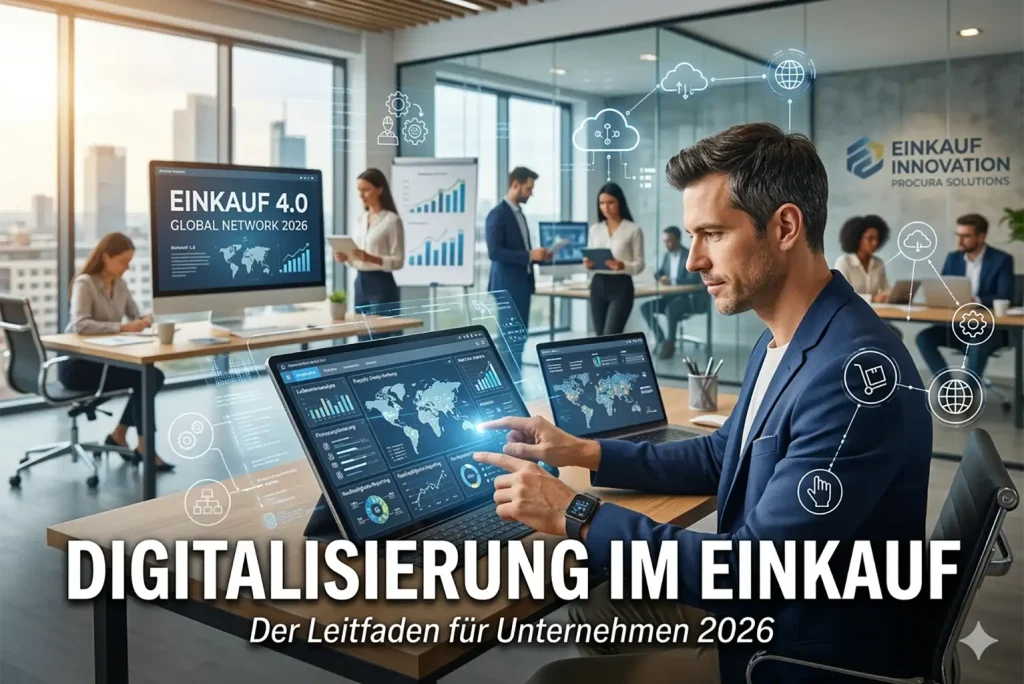
By 2026, digitalization in procurement will be a prerequisite for resilience and ESG compliance. Through the use of autonomous AI agents and real-time data analytics, procurement is transforming from an administrative cost center into a strategic value creator. Companies that fully digitize now will reduce their process costs by up to 40% and proactively safeguard their supply chains against global volatility.
Key Facts on Digitalization 2026
- AI Integration: Autonomous agents already handle 70% of operational tenders.
- Compliance: Monitoring of the Supply Chain Act (LkSG) is fully automated and takes place in real time.
- Efficiency Boost: Digitalized departments achieve a 3x higher profit margin through predictive costing.
- Skill Shift: Data literacy is more important today than traditional negotiation skills.
1. Definition: What does digitalization in procurement really mean?
The definition is based on three key characteristics:
- Connectivity: Seamless data exchange between companies, suppliers, and logistics partners within a cloud infrastructure.
- Intelligence: The ability of systems to identify patterns in vast amounts of data and make strategic predictions.
- Autonomy: The delegation of decision-making authority to software agents within predefined parameters.
“Information is the most valuable asset of our time, but it is only through digitalization that it becomes a currency with which procurement can pay for real strategic value.”
2. Deep Dive: Agentic AI – When Procurement Goes Autonomous
A major technological leap in 2026 is the transition from simple automation to agentic AI. While traditional tools merely executed commands, AI agents now act as independent actors in the procurement process.
This technology (AI in procurement) enables procurement to scale in entirely new ways:
- Autonomous negotiations: Agents conduct price negotiations via API interfaces, using game theory to secure optimal terms.
- Self-Healing Supply Chains: The system proactively detects disruptions in the supply chain and automatically initiates corrective actions, such as activating alternative suppliers.
- Präventives Risikomanagement: Die KI analysiert Nachrichten, Wetter und Geopolitik, um Lieferrisiken zu bewerten, bevor sie entstehen.
3. The Status Quo in 2026: Why Waiting Is No Longer an Option
We are in an era of “permanent polycrisis,” in which manual processes pose an existential risk. The requirements for transparency—driven by the EU’s CSDD and the pressure to decarbonize—can no longer be met manually.
Today, the procurement department must tackle the following challenges simultaneously:
- Real-time compliance: Seamless documentation of ESG criteria across all stages of the supply chain.
- Data Explosion: Processing terabytes of market data to make informed sourcing decisions.
- Skills Shortage: Offsetting the shortage of operational staff through intelligent automation solutions.
Would you like a brief consultation on this matter?
4. The Three Pillars of Digital Transformation in Procurement
To achieve a comprehensive transformation, companies must build their strategy on three solid pillars. Only when these areas are aligned can a true competitive advantage be achieved.
These pillars form the foundation of modern procurement:
- Operational Excellence (Procure-to-Pay): Radically simplifying day-to-day ordering through “no-touch invoicing” and automated procurement.
- Strategic Sourcing (Source-to-Contract): The use of big data to identify the best global partners while taking costs and ethical considerations into account.
- Supplier Value Management: The digital integration of suppliers as innovation partners to jointly improve products and share risks.
5. Key Technologies: From AI to Blockchain
Technological innovations are the driving force behind digitalization. By 2026, certain tools will have become an indispensable standard in the industry.
These technologies are driving efficiency in procurement:
- Predictive Analytics: Predictive models for commodity prices and demand peaks based on global market indicators.
- Blockchain protocols: Ensuring the integrity of certificates of origin and proof of delivery for the Digital Product Passport (DPP).
- Digital Twins: Virtual representations of the entire supply chain that can be used to simulate crisis scenarios without risk.
“Anyone who still tries to manage the complexity of modern global supply chains manually has already lost the race against time.”
6. Case Study: “No-Touch” Procurement at a Machine Manufacturer
The theoretical benefits are best illustrated by real-life success stories. A medium-sized mechanical engineering company with 800 employees demonstrates what this transformation looks like in practice.
After switching to an AI-based system in 2025, the company achieved the following results:
- Process speed: The time from purchase requisition to purchase order was reduced from 3 days to less than 3 minutes.
- Level of automation: Over 95% of indirect procurement is now handled without manual intervention from the purchasing department.
- Strategic Focus: The team was able to free up 2,000 working hours per year, which are now dedicated exclusively to ensuring the strategic security of critical components.
7. Step-by-Step Implementation Guide
The path to digital shopping is not a sprint, but a methodical transformation. Success depends largely on following the right sequence during implementation.
A proven roadmap for 2026 looks like this:
- Master Data Maintenance: The consolidation and cleansing of all supplier and material data as a prerequisite.
- Platform selection: Choosing a modular cloud solution (SaaS) that can scale with the business.
- Change Management: The targeted retraining of employees from administrative managers to data-driven strategists.
- Agile scaling: Starting with a pilot project in a non-critical product category before rolling out to core production.
8. E-E-A-T Check: Identifying Risks and Building Trust
As experts, we recommend not viewing digitalization as merely an IT project. The quality of the implementation determines whether the technology is accepted and operates reliably.
Please note the following critical success factors for trustworthy procurement:
- Benutzerzentrierung (UX): Systeme müssen intuitiv bedienbar sein, um den Einkauf am System vorbei (Maverick Buying) zu verhindern.
- Cyber resilience: A “zero trust” security approach is essential to protect highly sensitive supplier data from espionage.
- Ethical AI: Algorithms used for supplier selection must be programmed in a fair and transparent manner to prevent discrimination.
9. Conclusion: Why Digitalization in Procurement Will Be Inevitable by 2026
In summary, procurement in 2026 is the new heart of corporate management. It has evolved from an administrative function into a state-of-the-art data hub. Companies that have completed the transition to digital procurement operate faster, more sustainably, and significantly more profitably than their analog competitors. Technology finally enables people to focus on what matters most: building stable partnerships and shaping the future.
10. FAQ – Frequently Asked Questions About Digitalization in Procurement
Do small and medium-sized enterprises (SMEs) also need fully automated procurement?
Yes, because automation is the only way for SMEs to meet the complex requirements of the new supply chain laws without having to hire a large number of new employees.
What kind of ROI can be expected from digitization in procurement?
Most companies reach the break-even point within 12 to 18 months. The savings result from lower process costs, fewer incorrect orders, and optimized purchasing terms achieved through AI analysis.
How secure is sensitive supplier data in the cloud?
Modern cloud providers for procurement offer security standards that internal IT departments can hardly match anymore (e.g., ISO 27001). Today, a professional cloud infrastructure is the gold standard for data security.
What new skills will buyers need in 2026?
The most important skill is “data literacy”—the ability to read and interpret data and make strategic decisions based on it. Traditional negotiation techniques remain important, but are now complemented by data-driven reasoning.