

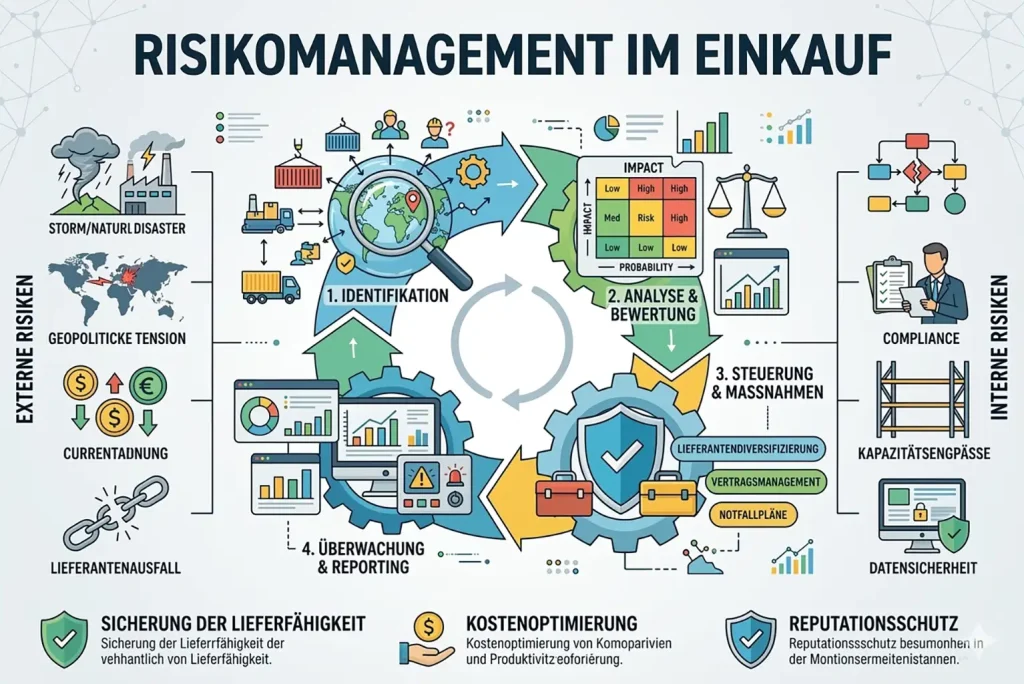
Key points at a glance:
Effective risk management in procurement is based on the continuous identification, assessment, and control of potential risks throughout the entire value chain. By 2026, simple cost optimization (just-in-time) will have been replaced by the principle of resilience (just-in-case). Those who rely on multi-sourcing, digital early-warning systems, and transparent tier-n monitoring secure decisive competitive advantages.
Key Facts zum Risikomanagement im Einkauf
- Key objective: Ensuring operational delivery capability while maintaining cost control.
- Top methods: Kraljic Matrix, FMEA analysis, supplier scoring, and SWOT.
- Challenges for 2026: Geopolitical instability, ESG compliance (LkSG), and cyber risks.
- Technology Focus: Using AI for real-time analysis of global event data.
1. Definition: What is risk management in procurement?
“Those who fail to recognize danger before it strikes will be overwhelmed by its consequences; but those who anticipate it can keep it under control.”
This is not a one-time initiative, but rather an ongoing management process. It encompasses both operational risks (e.g., supplier failure) and strategic risks (e.g., technological dependencies or geopolitical shifts).
2. Why proactive risk management is essential today
Stable supply chains are the foundation of any profitable business. Neglecting risk management today leads more quickly than ever to:
- Supply disruptions: Even the failure of a small supplier of C-parts can bring entire assembly lines to a halt.
- Legal Consequences: The Supply Chain Due Diligence Act (LkSG) requires complete transparency.
- Cost Spikes: Short-term spot market purchases during shortages wipe out margins.
3. The four-step risk mitigation process
A methodical approach distinguishes professional management from mere crisis-driven reactionism:
- Identification: Systematic identification of cluster risks, country risks, and financial indicators.
- Assessment: Classification based on the severity of the damage and the likelihood of occurrence.
- Management: Defining strategies (risk avoidance, risk transfer, or risk minimization).
- Monitoring: Ongoing monitoring using KPI dashboards and news alerts.
Would you like a brief consultation on this matter?


4. Best practices for analysis and evaluation
The following tools have become established for objective risk assessment:
The Kraljic Matrix
It categorizes the portfolio into strategic, leverage, bottleneck, and non-critical items. Intensive risk management in procurement is essential, particularly for bottleneck items (high supply risk).
FMEA (Failure Mode and Effects Analysis)
In this process, a risk priority number (RPN) is calculated for potential incidents. The formula is:
RPZ = Probability of occurrence × Severity × Probability of detection.
This allows for a clear prioritization of measures, as high values indicate an urgent need for action.
5. Strategic Measures for a Resilient Supply Chain
To reduce their reliance on individual sources, leading procurement departments rely on:
- Dual or multi-sourcing: Distributing demand among multiple suppliers in different geographic regions.
- Nearshoring: Relocating production closer to the sales market to reduce logistics risks.
- Inventory Management: Targeted increase in safety stock levels for critical A-components.
6. Deep Dive: Tier-n-Transparency – The Risk Behind the Supplier
In modern supply networks, visibility with the direct contractual partner (Tier 1) is just the tip of the iceberg. The real risk often lies in the “invisible” chain (Tier 2 through Tier n). To ensure supply stability in 2026, procurement risk management must extend deep into these levels.
The phenomenon of critical nodes (cluster risk)
Companies often feel secure because they source from two different Tier 1 suppliers (dual sourcing). However, a deeper look often reveals that both of these suppliers source their raw materials from the same Tier 3 specialist. If an incident occurs there (e.g., a natural disaster or a strike), the entire supply chain collapses despite the multi-sourcing strategy.
The Bullwhip Effect
Small fluctuations in end-customer demand can snowball significantly due to a lack of transparency across the supply chain. Without insight into upstream suppliers’ inventory levels and capacities, this can lead to artificial bottlenecks or massive excess inventory, which ties up capital and reduces flexibility.
Strategic Roadmap for Achieving Tier-n Transparency
- Criticality Check: Focus on products with a high risk priority number (RPN). Not every supply chain needs to be traced back to its source immediately.
- Contractual safeguards: Include clauses in contracts that require the disclosure of key suppliers.
- Using Risk Intelligence: Leverage AI platforms that visualize connections between millions of companies worldwide, eliminating the need to manually survey every subcontractor.
- Collaborative audits: Conduct spot checks on strategically critical Tier 2 suppliers, particularly to ensure compliance with ESG standards.
7. Case Study: A Successful Resilience Strategy in the Electronics Industry
A medium-sized manufacturer of control units used the Kraljic Matrix to identify a high concentration risk associated with microchips from Taiwan.
The implementation:
- Multi-sourcing: Qualifying a second supplier in Europe within 12 months.
- Inventory: Increase in the lead time for critical semiconductors from 2 to 6 months.
- Monitoring: Implementation of an AI tool for real-time monitoring of port strikes.
“The strength of a chain is not measured by its strongest links, but by how well it protects its weakest.”
The result: When logistical delays occurred in the Suez Canal, production remained stable thanks to the backup supplier and increased inventory levels, while competitors had to deal with delivery disruptions.
8. Digitalization: AI as an Enabler for Modern Retail
By 2026, risk management without AI will be virtually unthinkable. Modern systems offer predictive analytics for delivery delays, automated audits of supplier finances, and full Tier-n visibility by scanning global event data in real time. Internal ERP data is seamlessly integrated with external sources such as weather reports, news tickers, and port activity to create a comprehensive overview of the entire supply chain. This enables procurement to proactively activate alternative scenarios even before a disruption physically reaches their own production facilities.
9. Conclusion: Long-term success through risk management in procurement
The days when procurement was defined solely by price are over. Today, modern risk management in procurement is a key driver of value. It not only protects against financial losses but also enables companies to maintain their ability to deliver even in times of crisis and gain market share from less prepared competitors. Transparency and agility are the most important assets in this regard.
10. FAQ: Frequently Asked Questions About Risk Management in Procurement
How do I identify hidden risks with Tier 2 suppliers?
Use digital mapping tools that aggregate supplier data, and require your direct partners (Tier 1) to provide transparency regarding their key sources.
Isn't multi-sourcing significantly more expensive than single-sourcing?
Initially, the process costs may be higher. However, when considering the total cost of ownership (TCO), including the potential costs of a production outage, multi-sourcing is often the more economical choice.
How does the LkSG assist with risk management?
The law requires a detailed risk analysis of the supplier base with regard to social and environmental standards, which indirectly enhances operational stability and reputation.
How often should a risk analysis be conducted?
Strategic analyses should be conducted annually or whenever market conditions change. Operational monitoring (financial data, news alerts), on the other hand, should be automated and conducted in real time.