




First and foremost:
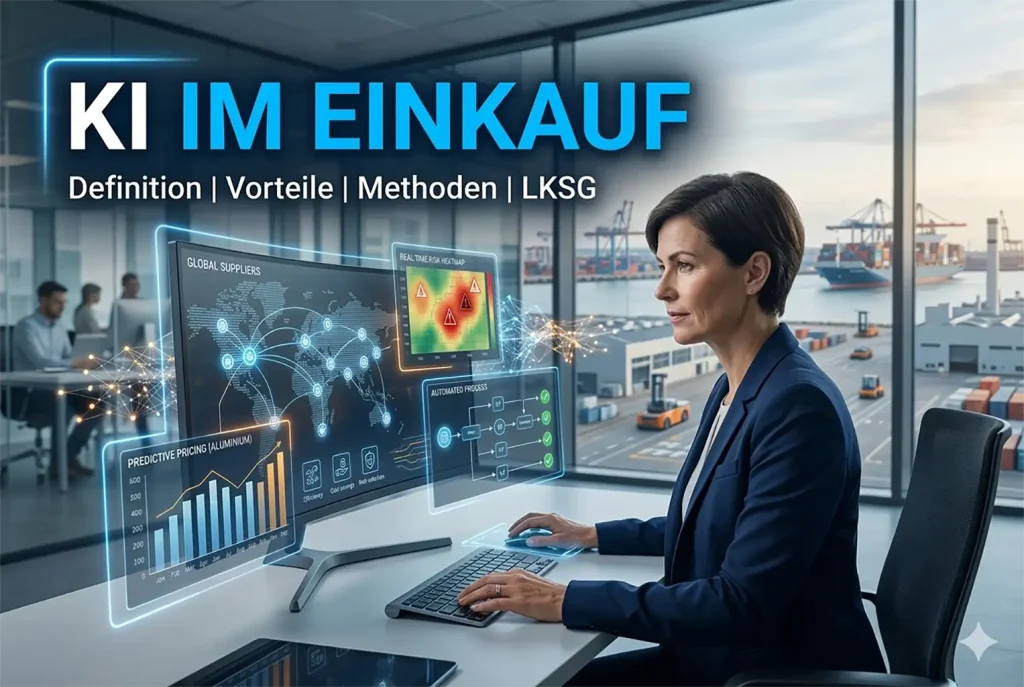
AI in Purchasing 2026 is the backbone for resilient and highly profitable companies. Through the symbiosis of human negotiation expertise and AI-supported data processing, process costs can be reduced by up to 40 %. The decisive advantage today no longer lies solely in efficiency, but in AI's ability to anticipate global risks and conduct negotiations completely autonomously.
Key Facts at a glance
- The use of machine learning algorithms for the automation and strategic control of procurement.
- Core Methods: Machine Learning (Patterns), NLP (Contracts), Predictive Analytics (Forecasts), and Agentic AI (Actions).
- Biggest leverage: Transformation from a pure data manager to a „Value Architect“ by offloading operational routine tasks.
- Status 2026: Companies switch from assisted AI to highly autonomous systems in compliance with the EU AI Act.
1. Definition: What is AI in procurement?

„The question is no longer whether technology replaces humans, but how humans, with the help of technology, surpass themselves.“
It recognises complex patterns in unstructured data (like free text in emails or global news feeds) and develops through continuous feedback. At its core, it's about scaling human cognitive abilities with machine computing power.
2. The most important methods of AI-powered procurement
- Machine Learning (ML): AI learns from historical expenditure data and automatically classifies invoices into product groups (Spend Analysis).
- Natural Language Processing (NLP): AI „reads“ contracts and identifies compliance risks or deviations in payment terms in seconds.
- Predictive Analytics: By analysing market trends, AI calculates the probability of delivery delays or price increases.
- Agentic AI: AI agents that independently perform tasks, such as obtaining quotes, without human intervention.
3. Deep Dive: The 5 Stages of Autonomous Shopping
The development towards full automation proceeds in five stages:
- Stage 1: Descriptive (Manual) – Focus on historical data. Analyses are performed manually.
- Stage 2: Assisted – The AI provides warning signals, the human decides everything.
- Level 3: Semi-autonomous (Augmented) – The AI independently takes over routine processes such as master data cleansing.
- Level 4: Highly Autonomous – The AI conducts simple negotiations (e.g. spot buys) independently within tight guardrails.
- Level 5: Fully Autonomous – The system manages the process from demand identification to contract conclusion.
4. Areas of Application and Tools at a Glance
The modern tool landscape is modular today:
- Operational (Procure-to-Pay): Automation of invoice matching. Leading suites include SAP Ariba or Coupa.
- Strategic Sourcing: AI-powered supplier search and market analysis using tools like Jaggaer or Ivalua.
- Negotiation: Specialist providers like Pactum use chatbots to conduct thousands of negotiations simultaneously.
5. Roadmap: In 4 steps to AI implementation
- Phase 1: Data Hygiene (Months 1-2): Cleanse master data. Without clean data, AI will hallucinate.
- Phase 2: Use Case Identification (Month 3): Start with a high-leverage area (e.g., risk monitoring).
- Phase 3: Pilot Project (Months 4-6): Introduction of a specialist tool for one product group.
- Phase 4: Scaling (from Month 7): Rollout of the solution across the entire organisation.
6. The Skill Shift: What Buyers Need to Be Able to Do in the AI Age
„In the digital age, knowledge is power, but the ability to apply that knowledge in real-time is the true competitive advantage.“
The role is changing to that of a strategist. In demand are:
- Data Literacy: Being able to critically interpret AI analyses.
- Prompt Engineering: Guiding AI Systems Precisely.
- Relationship Management: The nurturing of strategic partnerships remains human.
7. Practical Example: AI Success in Mechanical Engineering
A medium-sized mechanical engineering company was struggling with a high manual workload for master data maintenance. The introduction of an AI-based platform allowed for the saving of 12,000 working hours per year. Additionally, purchasing prices for small parts fell by 6 %, as a negotiation bot consistently renegotiated every smallest order – an effort that no human purchasing agent could have managed.
8. Risks, ethics and the EU AI Act
- EU AI Act: From 2026, AI systems in companies must be transparent. Every decision must remain explainable.
- Algorithmic Bias: Regular audits prevent AI from disadvantaging suppliers due to flawed historical data.
- Cyber-Resilience: Protecting supply chain data from third-party access is a top priority.
9. E-E-A-T Check: Trust and Data Quality
For your AI strategy to stand the test of time, expertise, authority, and trustworthiness count. Use tools with proven security certifications and be transparent about AI usage with employees and suppliers.
10. Conclusion: The Future of AI in Procurement
The introduction of AI in Purchasing is no longer just an option, but the condition for economic survival. While technology provides precision, humans provide vision. Those who get their data in order today will set the benchmark in their industry in 2026.
11. FAQ: Frequently Asked Questions about AI in Procurement
What is the potential for savings through AI?
Process costs often decrease by 30%to 50%. Savings of between 3% and 8% on material costs are realistic.
What's the most important first step?
Begin with data quality. Thorough data cleansing is the foundation of any project.
Do we need new employees?
Not necessarily, but existing teams must be trained in data literacy and the use of AI tools.
How does AI influence sustainability (ESG)?
Massive AI checks supply chains in real time for violations, which is essential for compliance with the LkSG.