




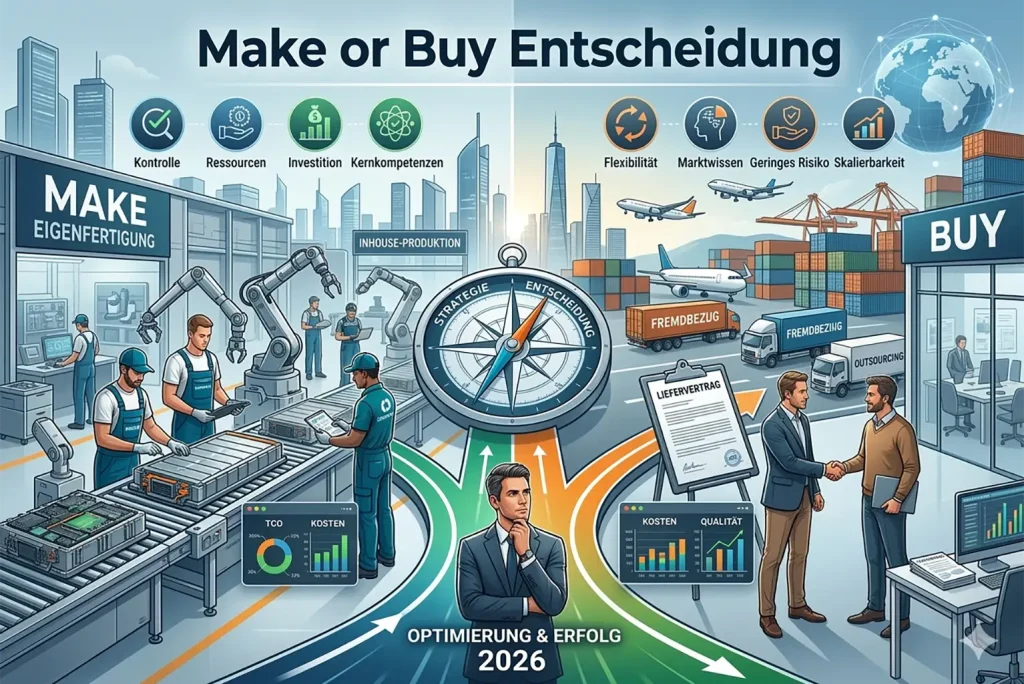
Key Facts on the Make-or-Buy Decision
- Definition: Choice between in-house production and external procurement of a service.
- Core question: Does in-house production protect our market position and core competence?
- Key factors: Total Cost of Ownership (TCO), quality, capacity, and strategic independence.
- Trend 2026: „Smart Insourcing“ of critical IT and AI infrastructure to minimise risk.
1. Definition: What is a make-or-buy decision?
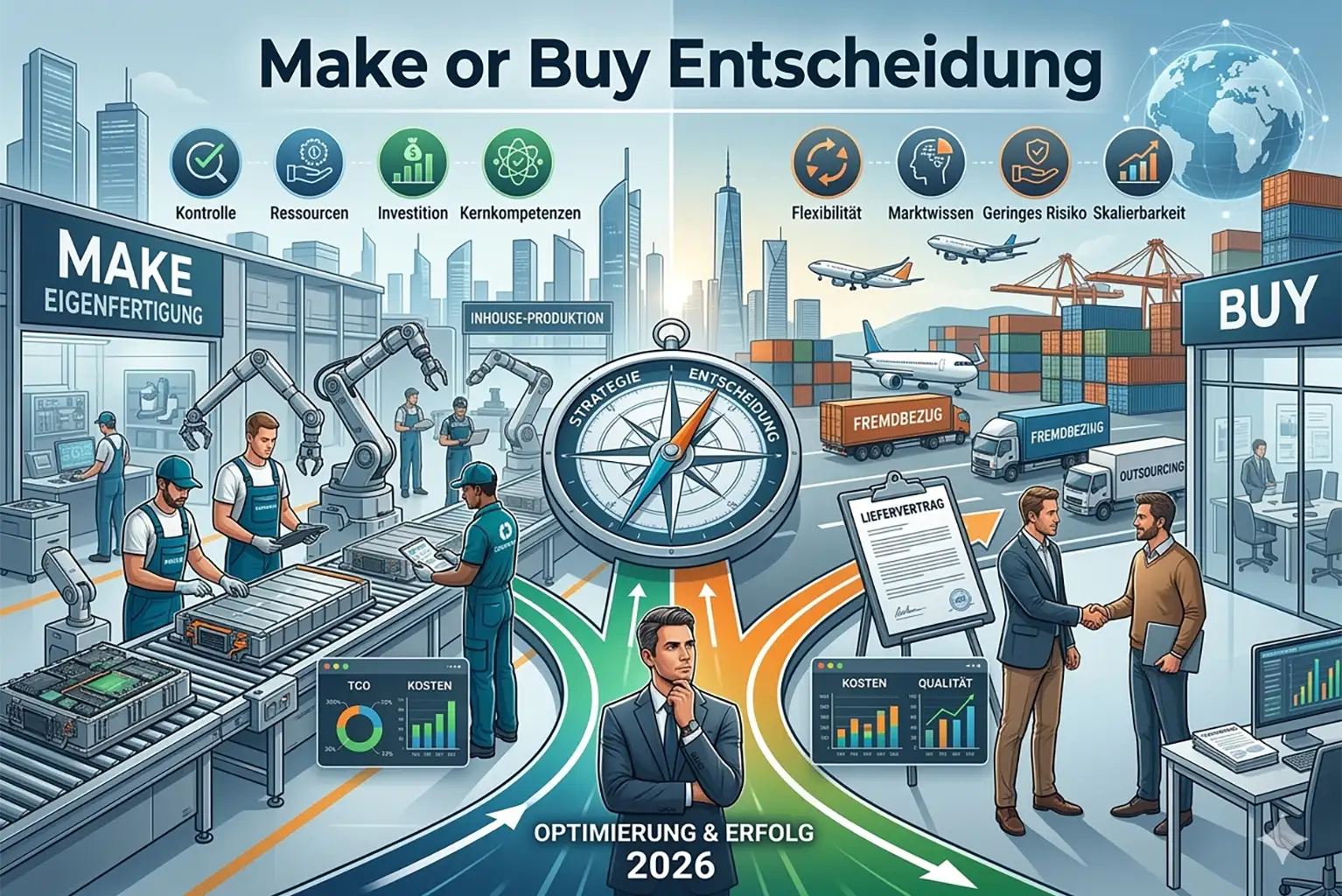
„Concentrate on what you do best, and delegate the rest.“
In today's business world (2026), this no longer just encompasses physical components, but also software, algorithms, and complex service chains.
2. Strategic relevance for modern businesses
Why is this decision so critical in 2026?
- Core competence focus: Resources are pooled where the company has a genuine competitive advantage.
- Agility: By „buying“ in, companies can react more quickly to market changes without the lengthy process of building their own departments.
- Cost structure: Conversion of fixed costs (make) to variable costs (buy), which increases financial stability in times of crisis.
3. The 4 Pillars of Decision Criteria
Instead of complex tables, these four points serve as a quick checklist for mobile use:
- I. Costs (Total Cost of Ownership - TCO consideration): Not only the purchase price counts, but also logistics, administration, and quality control.
- II. Competence & Protection: Are these business-critical innovations? In that case, „make“ is often the only option to keep knowledge in-house.
- III. Quality & Control: Do you have in-house experts for the highest standards, or are external specialists already technically superior?
- IV. Capacity & Scalability: In-house resources are often rigid. External partners enable rapid growth during peak demand.
4. The Make-or-Buy Matrix for Visualisation
A proven tool relates strategic importance to market availability.
- Highly strategic and rarely on the market: Here, make is essential to stand out from the competition.
- Strategic & Available Everywhere: Here, Buy is the standard. You should purchase standard services cheaply on the market.
5. Advantages and disadvantages in direct comparison
In-house production
- Advantages: Full process control, protection of trade secrets, independence from market price fluctuations.
- Disadvantages: High capital expenditure (CAPEX), risk of technological obsolescence, less flexibility during crises.
External procurement
- Advantages: Access to state-of-the-art technology, lower capital commitment, easy scalability.
- Disadvantages: Dependency on suppliers, communication overhead, potential loss of know-how.
6. In 5 steps to an informed decision
- Identification: Which component or service is under discussion?
- Cost Analysis: Calculation of Total Costs (In-house Production vs. Outsourcing).
- Strategy Check: Does the plan align with our long-term goals for 2026?
- Market research: Are there reliable partners with high ESG standards?
- Closure & Monitoring: Make a decision and critically review after 12 months.
7. Industry-Specific Nuances: Make or Buy in Practice
The decision parameters shift massively depending on the industry:
- IT & Software: The question here is dominated by „SaaS vs. Custom Build“. While standard CRM systems are almost always „Buy,“ companies are increasingly programming their core AI algorithms themselves (Make) in order to retain control over their data.
- Logistics: Many retail companies waver between operating their own fleet (control & branding) and outsourcing to 3PL providers (flexibility & cost).
- Manufacturing industry: The trend here is towards „modular sourcing“. Core components are manufactured in-house, while casings or standard electronics are procured worldwide.
8. Deep Dive: The Hidden Dimensions of TCO Analysis
Anyone who only looks at the offer price often ends up paying more. A true Total Cost of Ownership (TCO) analysis takes into account:
- Transaction costs: The effort involved in searching for suppliers and drawing up contracts.
- Quality costs: What is the cost of a production stoppage if an externally supplied part is faulty?
- Technological Debt: The Cost of Maintaining Internal Assets with „Make“.
- Exit costs: The financial expense incurred when an outsourcing decision has to be reversed.
9. Practical Example: Battery Manufacturing in E-mobility
A medium-sized e-bike manufacturer faces a choice: assemble battery cells themselves or buy ready-made battery packs?
- Strategy: As the Battery Management System (BMS) software is crucial for range, the company decides to make it in-house.
- Result: While they buy in the raw cells, they handle the assembly and software integration themselves. This differentiates them from the competition and protects their design innovations.
10. Conclusion: The optimal make-or-buy strategy for 2026
In 2026, the Make or buy decision not a one-off event, but a dynamic management process.
„Efficiency is doing things right; effectiveness is doing the right things.“
The most successful companies are using AI-powered dashboards to continuously optimise their value chain. The goal is a hybrid strategy: maximum control over what delights the customer, and maximum agility for everything that runs in the background as a standard process.
11. FAQ – Make-or-Buy: Frequently Asked Questions
Insourcing is a business practice where a company brings in external tasks or jobs back into its own company rather than to a third-party or subcontractor.
Insourcing is the repatriation of previously externally purchased services into one's own company. This is often done to ensure quality or regain digital sovereignty.
When should one prefer Buy?
If the performance is not part of the core business, the market is extremely efficient, and the internal costs for know-how and infrastructure would far outweigh the benefits.
What role do sustainability and ESG criteria play?
In 2026, supply chain responsibility will be enshrined in law. Companies will be required to verify if a supplier meets ESG requirements. If this cannot be done transparently, in-house production (make) will often become the safer choice.
Can make-or-buy decisions also affect personnel?
Absolutely. Companies are constantly deciding whether to hire experts permanently (make) or to use external consultants and freelancers for projects (buy).