


The bottom line upfront
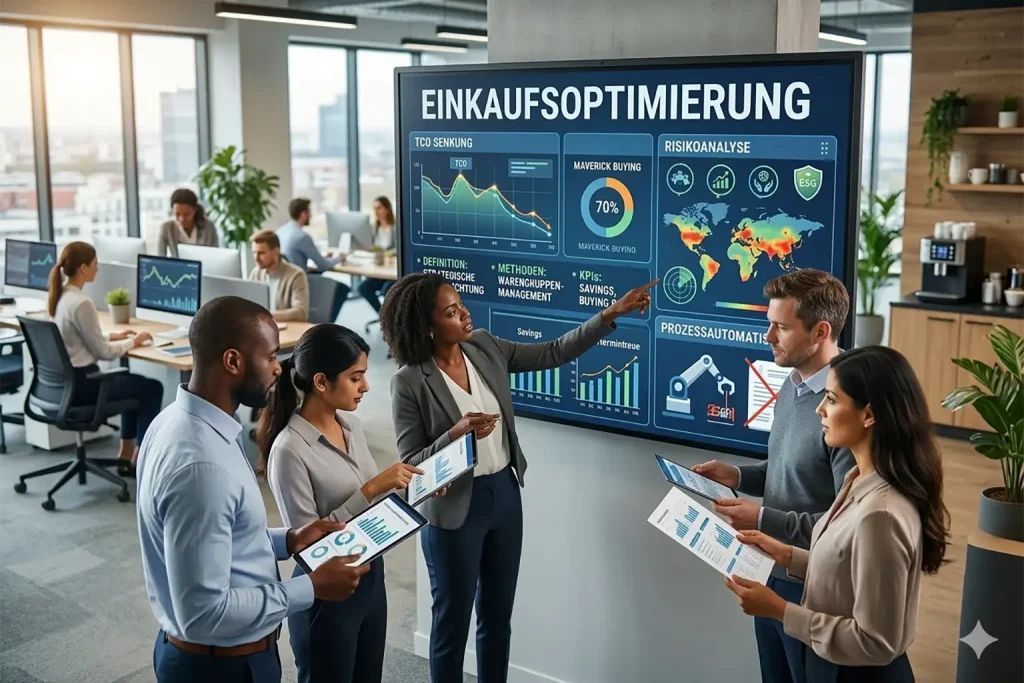
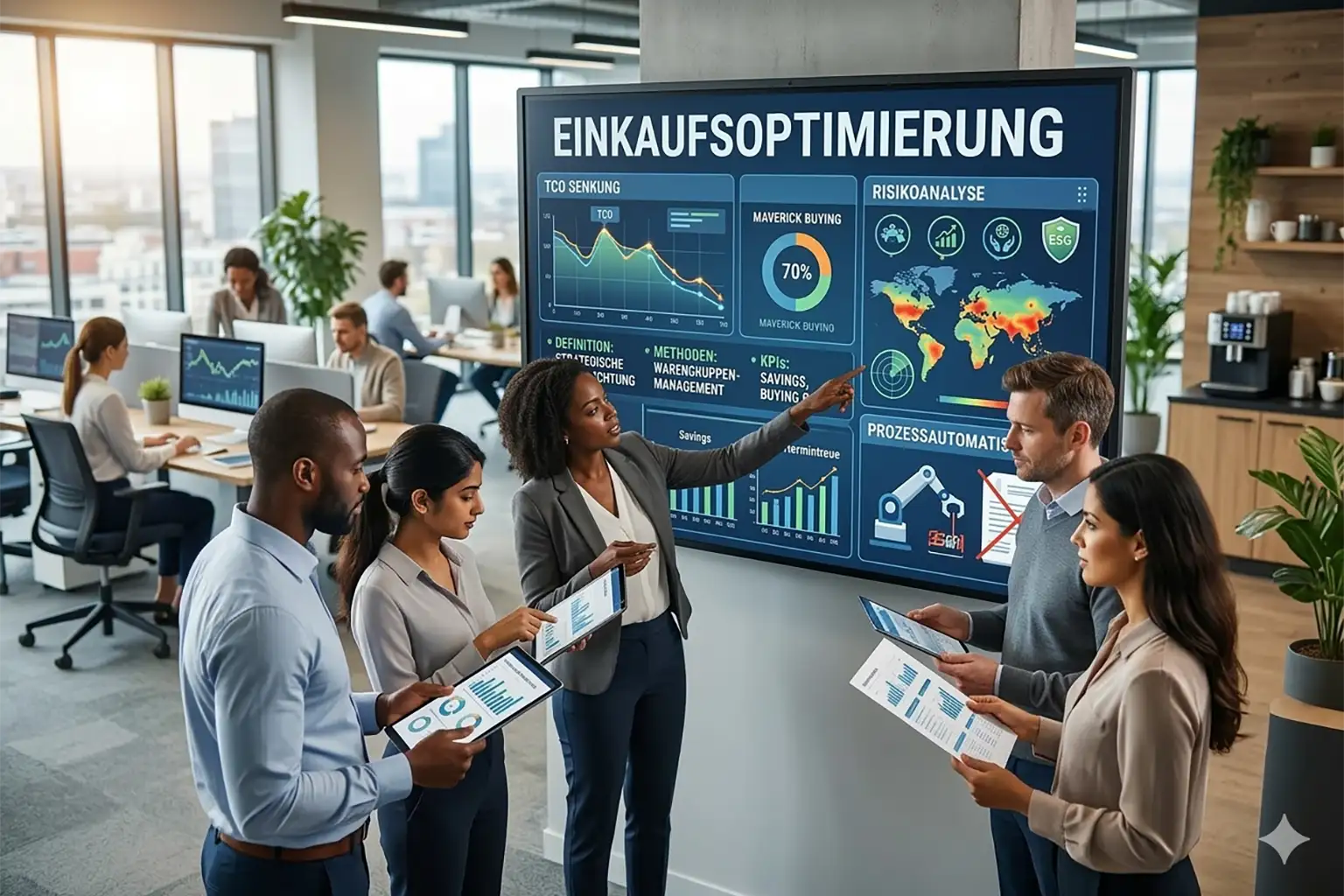
Sourcing optimisation is the strategic realignment of all Procurement processes with the aim of achieving the best value for money with maximum security of supply. The biggest lever today no longer lies solely in hard price negotiations, but in Digitisation (E-Procurement), the avoidance of maverick buying and a strategic classification of the product groups. Companies that their Purchasing processes professionalise, realise average cost savings of between 5% and 15% and at the same time massively reduce their process costs.
💡 Key Facts on Procurement Optimisation
- Core Objective: Reduction of Total Cost of Ownership (TCO) and increase in supply security.
- Top Methods: Kraljic Matrix, Category Management, Process Automation.
- Key KPIs: Savings (P&L), Maverick Buying Quote, On-Time Delivery, Resilience Score.
- Trend 2026: AI-powered risk analysis and focus on ESG compliance (LKSG).
1. Definition: What is meant by procurement optimisation?
„The profit is in the purchase.“
This old merchant's wisdom forms the foundation. It's not just about spending less, but about maximising value per euro invested.
2. Strategic Purchasing Optimisation Methods
To elevate procurement to a professional level, various tools are available:
The Kraljic Matrix: Strategic Classification
With the Kraljic Matrix, you divide your requirements according to supply risk and profit impact:
- Strategic Articles: Core Components. Goal: Partnership.
- Key article: High market power. Objective: Best prices through bundling.
- Bottleneck items: Difficult availability. Objective: Security of supply.
- Uncritical articles: C-parts. Goal: Maximum automation.
B. Risk Management & Resilience
Optimisation today means more than just „cheap“. You create resilience through dual sourcing (avoiding dependencies) and regional sourcing (shortened delivery routes).
3. KPIs: Making Success Measurable
What cannot be measured cannot be managed. On mobile devices, the following list has proven itself for monitoring success:
- Savings (P&L): Actual savings compared to the previous year.
- Maverick Buying Quote: Share of purchases bypassing the official process.
- Delivery reliability: Percentage of on-time deliveries.
- Cost per order: total purchase costs divided by the number of orders.
4. The Process: The 5 Phases of Professional Implementation
A structured process is the backbone of any procurement optimisation. Here is the detailed roadmap:
Phase 1: Spend Analysis & Transparency (Current State)
Before optimisation can occur, clarity is needed.
- Data consolidation: capturing all expenditure across all locations. Who buys what from whom at what price?
- ABC analysis: Identification of „A suppliers“ (80% of volume) and „C parts“ (high administrative effort, low value).
- XYZ Analysis: Determining demand predictability (continuous vs. intermittent).
- Quick Wins: Identification of obvious price differences for identical items.
Phase 2: Demand Aggregation & Standardisation
This is where the greatest potential for cost savings lies.
- Supplier consolidation: Reducing the number of suppliers to strengthen negotiating power and reduce complexity.
- Variety Reduction: Do we really need 20 different types of pens? Standardisation leads to higher order quantities per item and thus to better prices.
- Centralisation: Pooling the requirements of different departments or locations into a total volume.
Phase 3: Process Automation (P2P Workflow)
Here, indirect costs (process costs) are massively reduced.
- E-Procurement Systems: Introduction of catalogue systems where employees can order independently (but under supervision).
- Digital approvals: Automated workflows replace manual signature rounds.
- Connecting Accounts Payable: Electronic Data Interchange (EDI) for invoices reduces errors and speeds up the process.
Phase 4: Strategic Negotiation & SourcingThe transition from price-avoider to strategist.
- TCO Consideration: Negotiations are not based on the individual price but on the total cost (incl. logistics, quality, disposal).
- Tenders & E-Auctions: Using digital tools for transparent and efficient bidding processes.
- Supplier development: Close collaboration with top partners to jointly reduce production or logistics costs.
Phase 5: Monitoring & Performance Management Optimisation isn't a goal, but an ongoing cycle.
- Dashboarding: Real-time monitoring of KPIs (Savings, Delivery reliability, Maverick Buying).
- Supplier Audits: Regular assessment of partners regarding quality and ESG criteria.
- Feedback loops: Regular exchange with specialist departments to ensure acceptance of the optimised processes.
5. Practical Example: Procurement Optimisation at TechBau GmbH
Let's consider „TechBau GmbH“, a Mechanical engineer with 250 employees.
Initial situation: The company purchased indirect materials from over 50 suppliers. The Maverick buying rate was 45% %, as everyone ordered wherever they wanted.
Measures & Results: By introducing the Kraljic matrix and a digital catalogue, the company reduced the number of suppliers to three main partners for C-parts. After 12 months, the maverick buying rate fell to below 5 %and material costs decreased by 12 %.
„Quality remains when the price is long forgotten.“
6. Conclusion: Long-term company success through procurement optimisation
Purchasing optimisation is not a one-off cost-cutting exercise, but an ongoing task for the company’s resilience. Those who professionalise procurement through strategic methods such as the Kraljic Matrix and digital tools not only improve their profit margins but also secure competitive advantages in an unstable market environment.
7. Shopping Optimisation FAQ: Answers to the most important questions
Was ist der größte Fehler bei der Einkaufsoptimierung?
The focus on price alone. Those who buy too cheaply often pay dearly through poor quality, delivery delays or high administrative process costs (TCO).
How do I sustainably reduce Maverick Buying?
Through usability. The e-procurement system must be as intuitive as private online marketplaces. If the official route is the easiest, „rogue“ purchasing will disappear.
What role does sustainability (ESG) play in procurement optimisation?
From 2026, supply chain transparency will be a legal requirement. Optimisation must include ESG compliance today to avoid legal risks.
The Kraljic Matrix is important for several reasons: * **Strategic Sourcing:** It helps companies categorise their purchased items based on their impact on profit and supply risk. This allows them to develop tailored sourcing strategies for different categories. * **Risk Management:** By identifying high-risk items, companies can proactively develop mitigation plans, ensuring supply continuity and avoiding disruptions. * **Cost Savings:** The matrix highlights opportunities for cost reduction and value creation by optimising purchasing processes and negotiation strategies for different item types. * **Supplier Relationships:** It guides companies on how to manage their supplier relationships effectively, fostering stronger partnerships with key suppliers and adopting a more transactional approach with non-critical ones. * **Improved Decision-Making:** It provides a clear framework for procurement professionals to make informed decisions about where to focus their efforts and resources, leading to more efficient and effective procurement operations. * **Competitive Advantage:** By optimising their procurement strategies, companies can gain a competitive edge through lower costs, improved quality, and enhanced supply chain resilience.
Because it helps to set priorities. It shows where aggressive price negotiations are worthwhile (leverage items) and where it's better to invest in partnerships.