




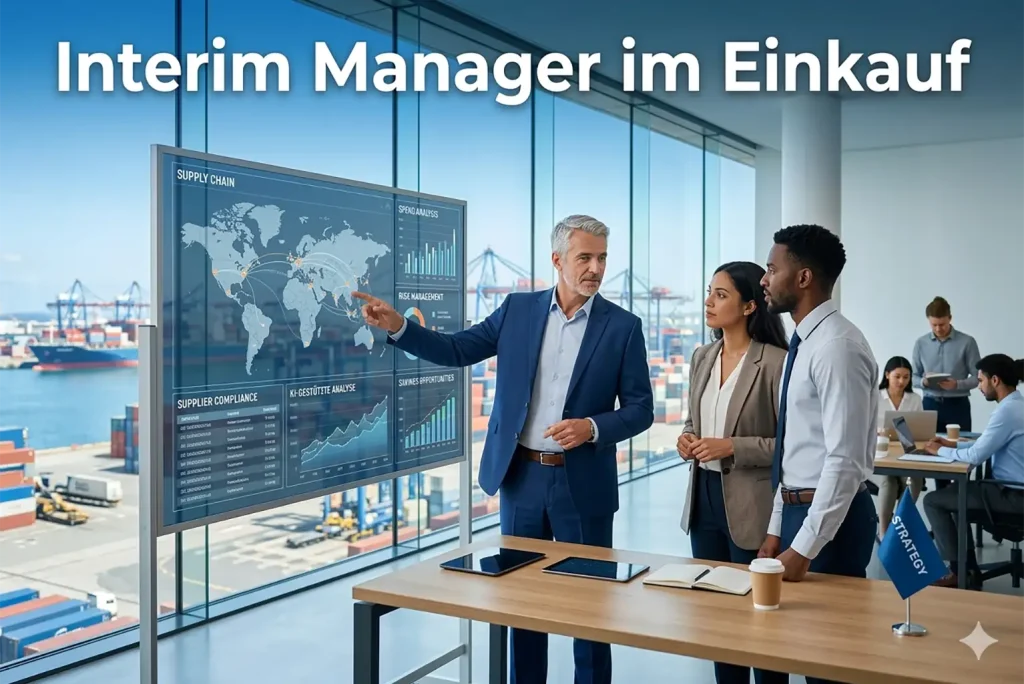
Key Facts on Interim Procurement Management
- Availability: Immediate deployment (usually under 5 days) with no fixed cost risk.
- Main areas of application: Cost reduction, supply chain resilience, ESG compliance (LKSG).
- Advantage: High seniority, no internal operational blindness, immediate ROI.
- Duration: Project-dependent, typically 6 to 12 months.
- Focus 2026: Implementation of AI Agents in Procurement and Decarbonisation of the Supply Chain.
1. Definition: What is an interim procurement manager?
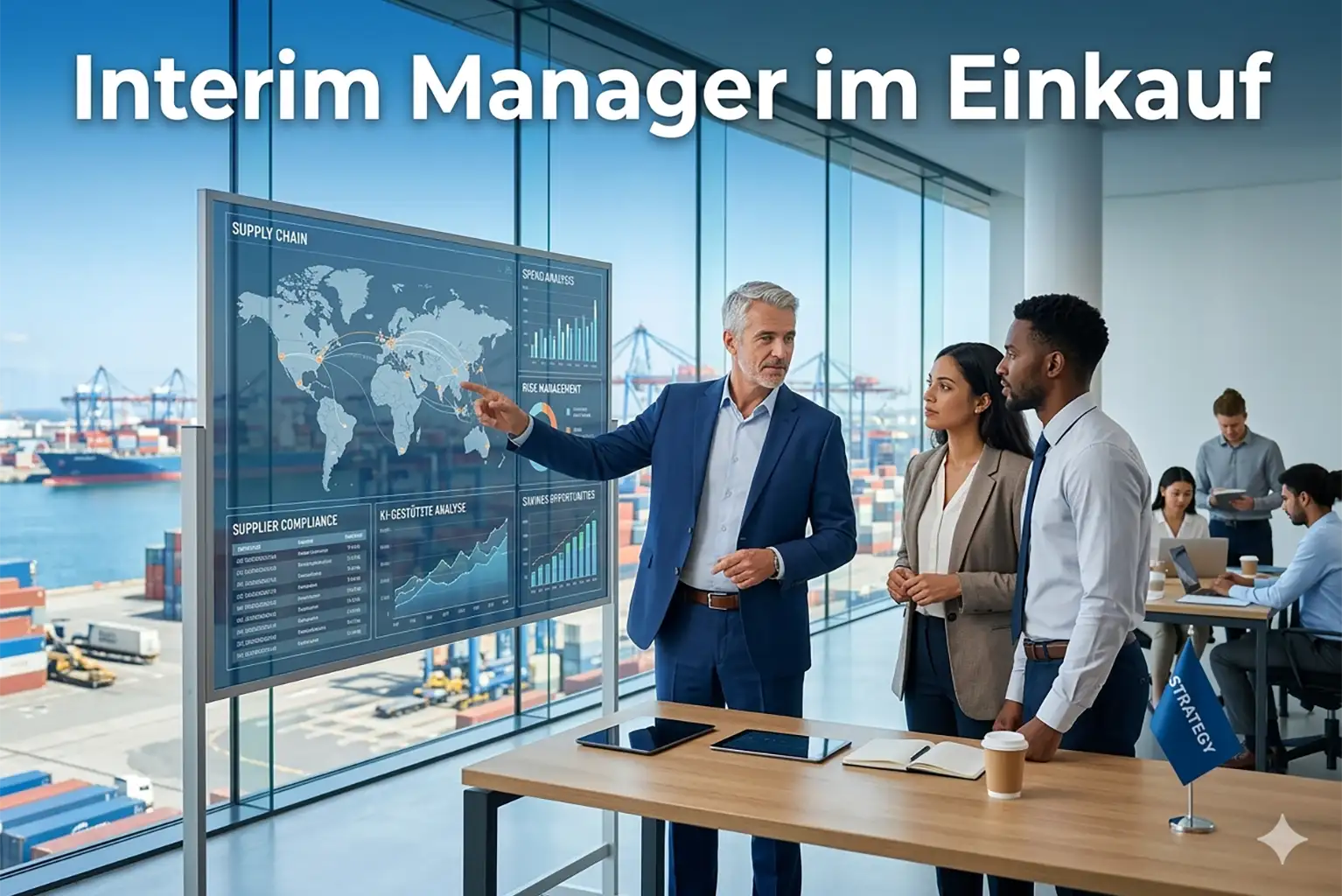
In practice, these experts act as a „fire brigade“ during crises or as strategic architects when reorganising the procurement organisation.
2. Strategic deployment scenarios for businesses
In the volatile economic climate of 2026, the reasons for external staffing are diverse:
- Vacancy Management: Bridging the period until a key procurement position is permanently refilled.
- Supply Chain Resilience: Building resilient supplier networks to minimise geopolitical risks.
- Sustainability & ESGRapid implementation of legal requirements such as the Supply Chain Due Diligence Act (LKSG).
- Cost reduction: Radical realisation of savings potential in special situations.
„In times of upheaval, the speed of implementation is often more valuable than the perfection of the original plan.“
3. The key difference from management consultancies
While consultants often come in as a team and present concepts, the interim manager integrates deeply into the organisation. Here are the key differences summarised:
- Focus: The interim manager concentrates on operational implementation and results, while consultants are often focused on analysis and strategy concepts.
- Role: An interim manager is part of the line organisation (authorized to give instructions), consultants mostly remain external observers and coaches.
- Responsibility: The interim professional bears full accountability for the results of their decisions.
- Cost-effectiveness: Only a single, highly qualified expert is paid instead of a whole team of consultants.
Would you like a brief consultation on this?
4. E-E-A-T Checklist: How to Recognise Top Experts
Quality in interim management is measured by Experience, Expertise, Authoritativeness, and Trustworthiness.
- Experience: Many years of leadership experience (C-level or Head of) in comparable industries.
- Expertise: Mastery of modern e-procurement tools (e.g. SAP Ariba, Coupa, Celonis) and AI-powered software.
- Authoritativeness: Demonstrable successes (references) and a strong industry network.
- Trustworthiness: Transparent communication and a clear focus on knowledge transfer to the team.
5. Fees and ROI considerations
In 2026, the daily rates will range between €1,300 and €2,500. The profitability can be easily calculated:
ROI Formula: (Realised Savings – Manager’s Costs) / Manager’s Costs * 100 = ROI in percent.
Experienced professionals often achieve a payback factor in the first quarter where savings made exceed fee costs by three to five times.
6. The Phase Model: The First 100 Days in Office
A successful mandate follows a clear structure to achieve maximum impact:
- Phase 1: Diagnose (Weeks 1-2): Analysis of goods groups, spend data, and supplier structure. Identification of „low-hanging fruit“.
- Phase 2: Quick Wins (Weeks 3-6): Immediate renegotiation of indirect costs or bundling of volumes. Stabilisation of liquidity.
- Phase 3: Transformation (Months 2-6): Implementation of new processes (e.g. AI Tools, and ESG reporting) and staff coaching.
- Phase 4: Sustainability & Handover (Month 7+): Documentation of processes and onboarding of the permanent successor.
7. Legal certainty and compliance: What businesses need to consider
To avoid the risk of false self-employment, clean contractual design is essential. A professional interim manager in purchasing is characterised by:
- Works on the basis of a clear service or works contract with defined project objectives.
- No fixed integration into the company's internal working time recording.
- Uses own resources (laptop, software licenses) or has clear project responsibilities for the use of internal systems.
- Works for multiple clients or demonstrably acts in a self-employed capacity.
„An interim expert often brings precisely the clarity that has been lost in the day-to-day operations of internal structures.“
8. Deep Dive: AI Transformation in Interim Procurement 2026
In 2026, the interim manager is primarily a data strategist. The focus is on:
- Automated Spend Analysis: Using AI Agents for Real-Time Correction of Price Deviations.
- Predictive Risk Management: Early Warning Systems for Global Supply Chain Disruptions.
- Smart Contracts: Introducing Blockchain-Based Contracts for Automating Compliance.
9. Practical example: Successful turnaround in industry
Scenario: A medium-sized machine manufacturer is struggling with falling margins. The Head of Purchasing unexpectedly resigns.
The assignment: An interim manager takes on the role of CPO for 9 months.
- Result: Realised savings of €4.2 million with total costs for the mandate of approx. €250,000. ROI: Over 1500 %.
10. Conclusion on the Use of Interim Managers in Procurement
A Interim Procurement Manager is far more than a temporary solution for staff shortages. It is a strategic lever for bringing agility and expertise into the company in volatile times. If savings targets are missed or supply chains are endangered, the opportunity costs of waiting far outweigh the fees of an expert. The combination of decades of experience, legal certainty, and cutting-edge technology makes them an indispensable partner for management.
11. FAQ – Frequently Asked Questions about Interim Purchasing Managers
How quickly can an interim purchasing manager get started?
As a rule, within 48 to 72 hours of initial contact.
Does an interim manager have the authority to give instructions to internal employees?
Yes, as a rule, he takes on a full line management role with disciplinary or at least functional authority.
How is legal certainty guaranteed?
Through project contracts with clearly defined milestones and independent working by the expert.
What happens if the project finishes early?
Most contracts stipulate flexible notice periods (e.g., 14 to 30 days), which maximises cost control for the company.