




First and foremost:
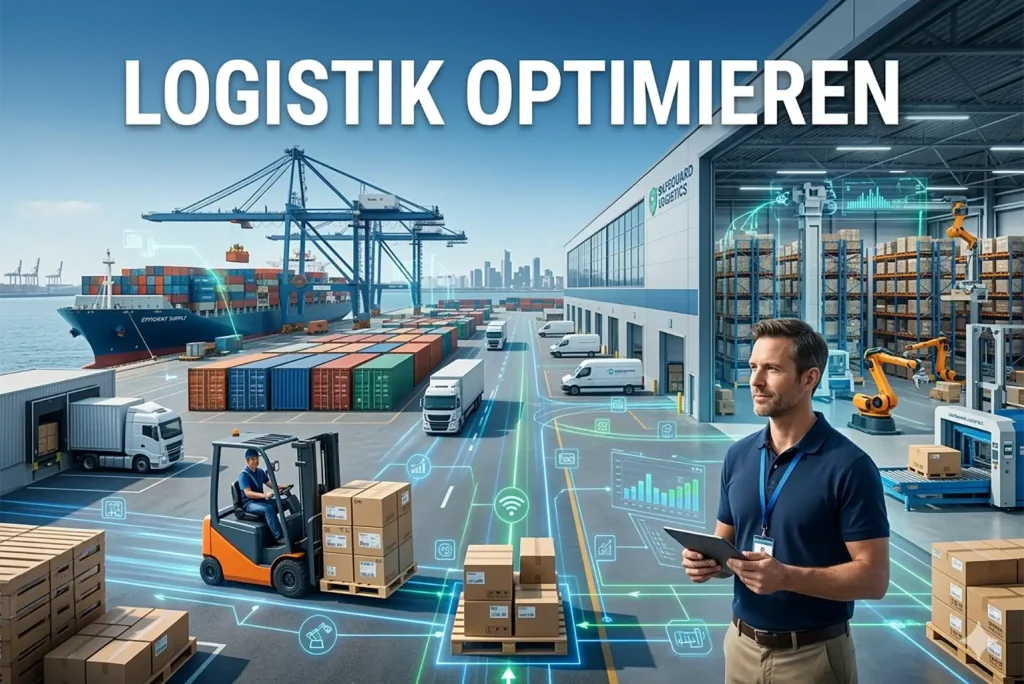
To Optimise logistics To be able to do so, companies must switch from a reactive way of working to a proactive, data-driven strategy. The greatest levers for cost reduction lie in the avoidance of waste (Muda), the real-time digitalisation of processes, and systematic control via KPIs. Those who create transparency today transform their logistics from a pure cost centre into a strategic value driver.
Key Facts on Logistics Optimisation
- Digital Leverage: Cloud WMS and ERP integration reduce process costs by approx. 15–20 %.
- Lean principle: Reducing inventory frees up liquidity and lowers warehousing costs.
- KPI Management: Inventory turnover is the most important indicator of efficiency.
- Future bonus: Sustainable route planning saves CO2 taxes and direct fuel costs.
1. Definition: What does it mean to optimise logistics?
2. Status Quo: The true cost drivers of the modern supply chain
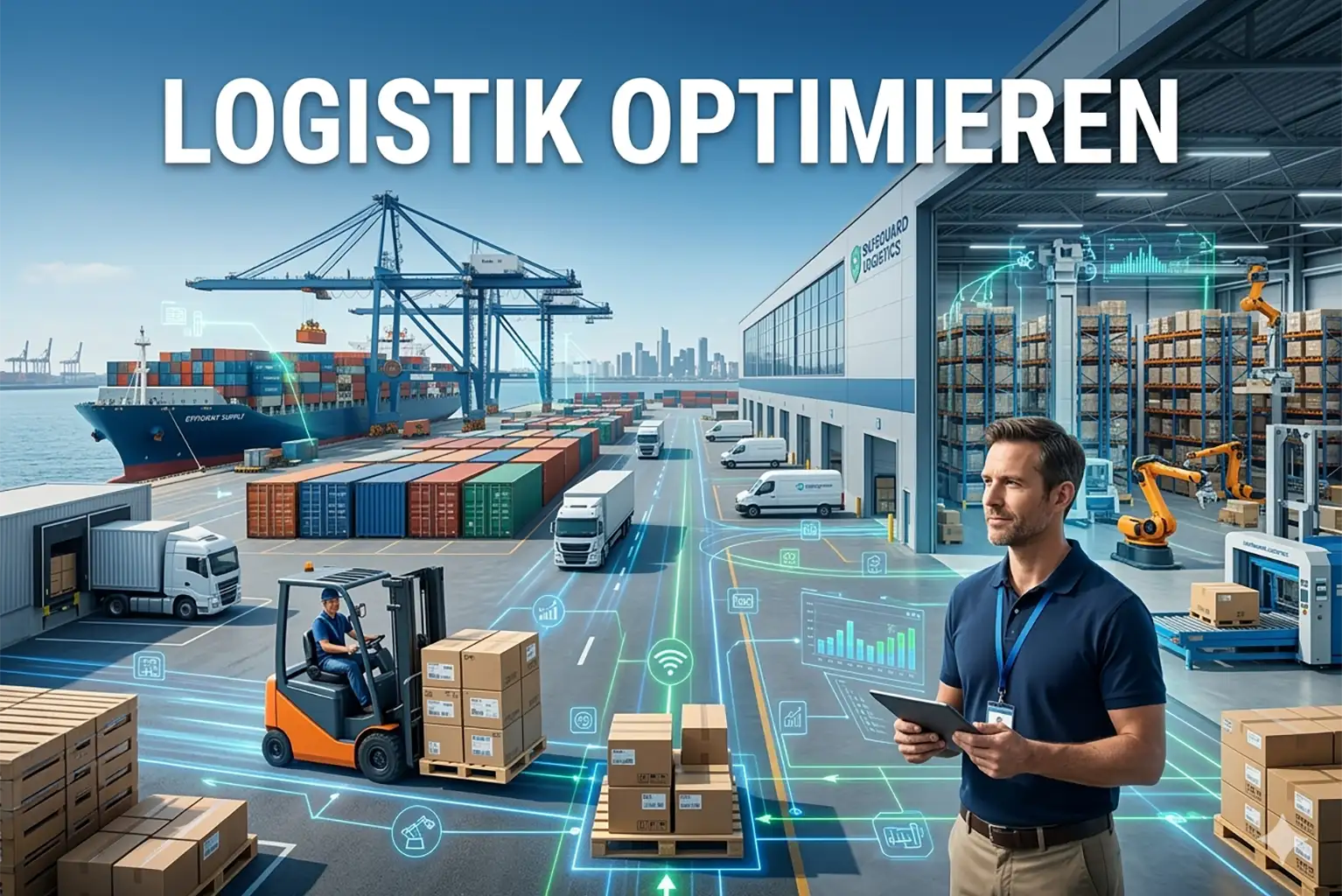
Rising toll fees, CO2 prices, and the blatant shortage of skilled workers have permanently altered the cost structure. Those who only look at the cheapest purchase price today often lose out on hidden process costs. The modern cost drivers are inefficiencies in communication, high return rates, and unnecessarily high safety stocks, which arise from a lack of data transparency.
3. The Tech Stack: Digitalisation as the Nervous System
Real optimisation requires a valid data basis. A modern tech stack forms the backbone:
- ERP Integration: The brain where sales forecasts and inventory converge.
- Warehouse Management (WMS): Orchestrates travel paths and picking strategies in real time.
- Transport Management (TMS): Bundles shipments automatically into efficient tours.
- IoT & RFID: Enables seamless tracking without manual scanning.
Would you like a brief consultation on this?


4. Deep Dive: Lean Logistics and Predictive Analytics
To optimise logistics, professionals use the Lean principle. This involves identifying the „7 types of waste“, such as unnecessary transport, waiting times, or overproduction.
This is supplemented by predictive analytics: algorithms analyse historical order data and external factors (e.g. market trends or seasonality) to precisely predict demand for the coming weeks. This allows you to plan personnel and loading space proactively rather than reactively, preventing costly express freight space purchases.
5. KPI Management: Making Success Measurable
Without measurement, there is no targeted improvement. Those who want to optimise their logistics must master these key figures:
- Stock turnover frequency: How often is your stock completely replaced per year?
Formula: Cost of Goods Sold / Average Inventory - Perfect Order Rate: The percentage of orders that arrive completely error-free and on time.
- Logistics cost quote: Proportion of logistics costs relative to total revenue. A declining figure with an increasing service level indicates success.
„Efficiency means doing things right; effectiveness means doing the right things.“
6. Storage Strategy: Efficiency through Process Design
The warehouse should be a dynamic transit point. Methods such as ABC/XYZ analysis help to place fast-moving items (A-goods) in the most ergonomic locations directly at the dispatch area. Cross-docking, in turn, allows goods to be directed from goods inwards straight to despatch, without the costly and time-consuming detour via the high-bay warehouse.
7. Transport Management: The Art of Utilisation
Every kilometre driven without charging is lost capital. Optimisation here means:
- Freight bundling: Use collaborations to consolidate Less Than Truckload (LTL) shipments into Full Truckload (FTL) shipments.
- Dynamic Routing: Software calculates routes based on real-time traffic data and the specific time windows of the recipients.
8. Practical example: 20 % cost savings in SMEs
An industrial goods manufacturer suffered from uncoordinated collections and overcrowded warehouses.
The solution: Introduction of digital time slot management and reorganisation of storage spaces according to access frequency.
The result: Waiting times for lorries fell by 40 %, picking performance increased by 15 %. Due to the transparency gained, total logistics costs fell by 20 %within 12 months, while delivery reliability rose to 99 %.
9. Sustainability: Green Logistics as a Yield Accelerator
Sustainability is a hard economic factor today. Less packaging material reduces weight and volume, which lowers the transport costs per item. Additionally, CO2-optimised route planning prepares your company for future taxes and toll increases.
„He who stops wanting to improve has stopped being good.“
10. Conclusion: Why You Should Optimise Your Logistics Now
In summary: anyone who today Optimise logistics can builds a foundation for long-term growth and stability. It is not about blindly cutting costs, but about replacing waste with intelligent processes and robust data.
A modern supply chain is not a necessary evil, but a central competitive advantage. Only through continuous analysis, the deployment of modern technologies, and consistent monitoring of your key figures can you optimise your logistics and remain profitable in a volatile market environment. The path to excellence begins with the transparency of your own data streams.
11. FAQ: Key Questions About Optimising Logistics
When does specific optimisation software become worthwhile?
As soon as manual processes such as Excel lists lead to frequent errors or information retrieval consumes more than 20 % of working time, a WMS or TMS usually pays for itself within a year.
What are the quickest quick wins?
Realigning stock locations according to turnover frequency and the consistent bundling of freight orders often offer immediate savings of up to 10 %.
How do I deal with the shortage of skilled workers?
Through digital support (e.g. pick-by-voice) and ergonomic workstations. The simpler and more error-proof a process is, the faster new employees can be productively trained.
Can logistics be optimised without compromising delivery quality?
Yes, as a rule, optimisation improves quality. By eliminating search times and manual errors, the supply chain not only becomes cheaper but also faster and more reliable.