




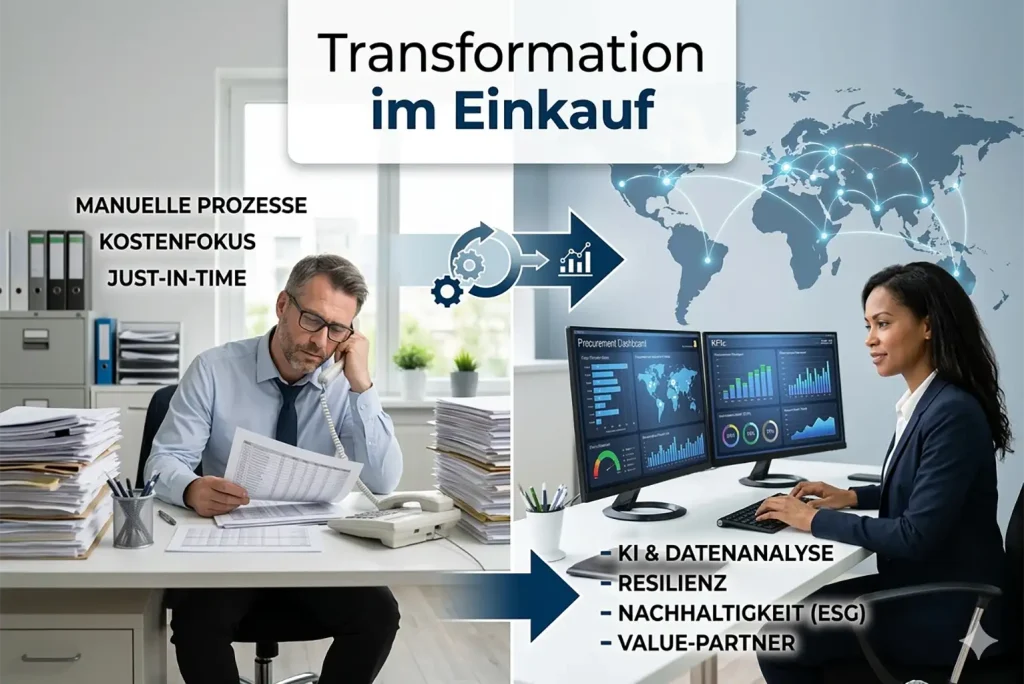
The most important points in brief:
The modern Transformation in Purchasing radically shifts the focus away from short-term savings towards long-term value creation and resilience. Those who want to win today must digitalise procurement (AI & data analysis), Sustainability (ESG) embed as a core strategy and make supply chains crisis-proof through diversification. Tomorrow's buyer is no longer a negotiator but a relationship manager and data strategist.
Key Facts regarding Transformation
- Status Quo: Transition from a Pure Customer to a Strategic Value Partner.
- Technology: Focus on AI-powered predictive sourcing and process automation.
- Resilience: Moving away from single-sourcing towards robust multi-sourcing networks.
- ESG Compliance: Sustainability as a Legal and Economic Duty (LkSG).
- Human: New skillset required – from price slasher to data analyst.
1. Definition: Transformation in Procurement
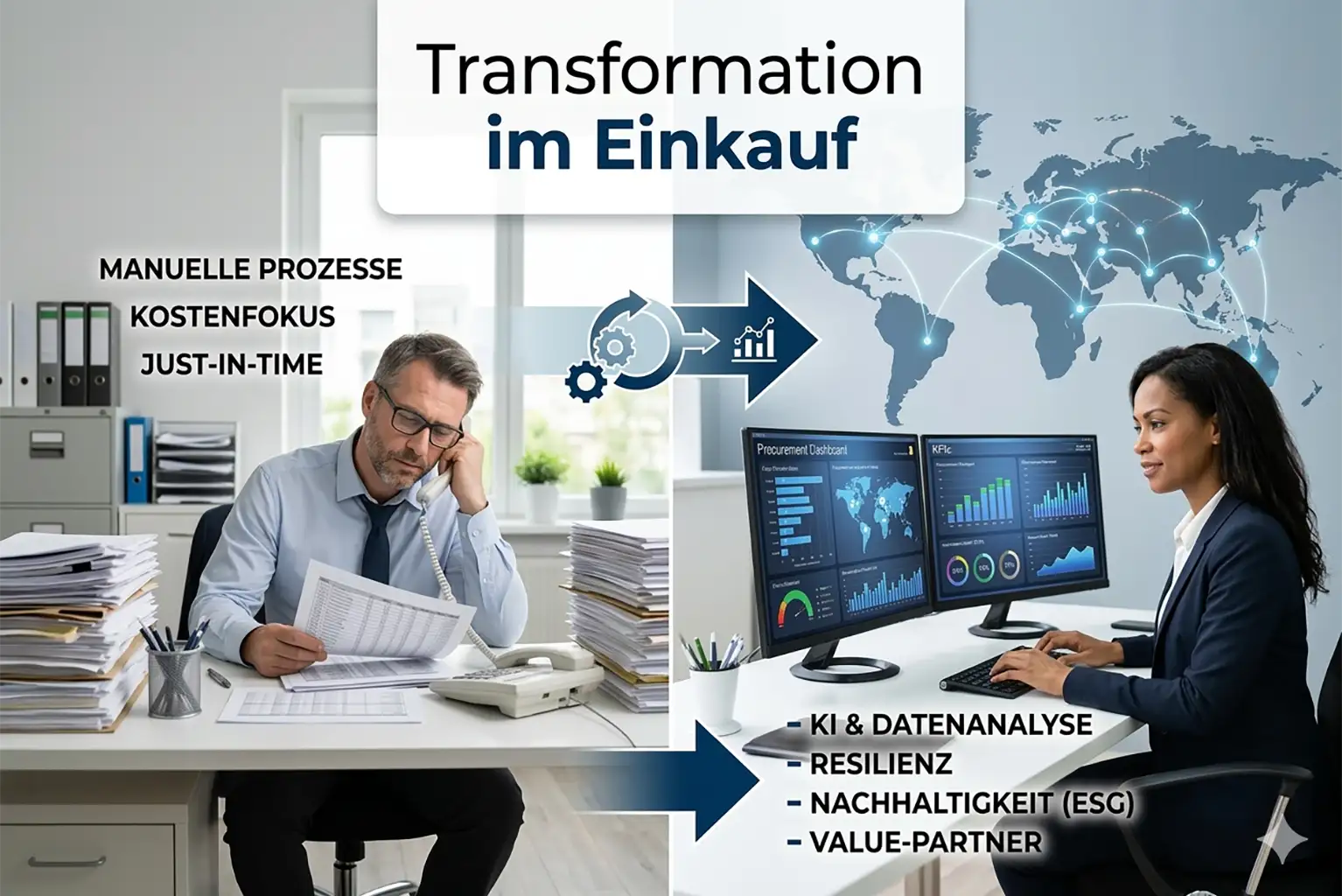
„Procurement is no longer an administrative process, but an active Risk management of the company's future.“
This process is not a one-off software implementation, but a holistic realignment on three levels:
- Structural: Dissolution of silos in favour of close integration with R&D, production and logistics.
- Technologically: Use of cloud solutions and AI for data-driven control.
- Cultural: A shift in employees„ self-perception – from “administrator„ to “creator.".
2. From Cost Centre to Value Partner: The Strategic Shift
For a long time, the success of procurement was measured solely by the „savings“ achieved. In modern transformation, this focus is shifting significantly. Procurement is becoming a „business enabler“ that actively contributes to the company's success.
- Innovation management: Purchasing acts as the interface to the supplier market. It identifies partners who bring in technological innovations before they are generally available on the market.
- Total Cost of Ownership (TCO): Modern buyers analyse the entire cost structure over the lifecycle – including Logistics, Storage, Quality Defects, and Disposal.
- Stakeholder Management: Procurement advises specialist departments on specifying requirements, in order to minimise cost and risk factors during the planning phase.
3. Digitalisation & AI: Efficiency through modern technology
Digitalisation is the backbone of transformation. It’s about eliminating manual sources of error and using data strategically.
- Artificial intelligence & Predictive Sourcing: AI algorithms often recognise price trends or impending raw material shortages weeks in advance. This enables proactive action instead of mere reaction.
- End-to-End Process Automation (P2P): The „Purchase-to-Pay“ process is fully digitised. From the request for goods to AI-supported invoice verification, operational tasks are handled without human intervention.
- Single Source of Truth: Centralised SRM (Supplier Relationship Management) systems create a clear, valid data foundation for all strategic decisions.
Would you like a brief consultation on this?
4. Deep Dive: Autonomous Sourcing – The Final Stage of Digitalisation
In this deep dive, we'll examine the end goal of digital transformation: autonomous sourcing. While automation merely speeds up existing workflows, autonomous sourcing makes independent decisions:
- Bot negotiations: AI-based agents conduct negotiations for standard components (C-parts) within set guardrails.
- Self-Healing Supply Chains: The system proactively identifies supply risks (e.g., through weather data) and autonomously rebooks capacities with alternative suppliers.
- Predictive Category Management: Algorithms predict price peaks and optimise purchasing timing for framework agreements.
5. Resilience Strategies: Designing Supply Chains to be Crisis-Proof
The „just-in-time“ mentality reached its limits. Today, supply security is the top priority.
„He who only stares at the price overlooks the cost of failure – resilience is the new hard currency of procurement.“
- Regionalisation (Nearshoring): Critical components are sourced closer to the home market again.
- Multi-Sourcing: The targeted distribution of volumes among several suppliers prevents total dependence on a single partner.
6. Sustainability (ESG): Responsibility as a Strategic Competitive Advantage
Sustainability has transformed from an ethical option into a business-critical necessity. In the context of procurement transformation, ESG (Environmental, Social, Governance) means far more than just completing questionnaires.
- Decarbonising supply chains (Scope 3): As often over 80% of a company's CO2 emissions arise in the supply chain, procurement is the primary lever for achieving net-zero goals. Transformation here means integrating CO2 prices into award decisions.
- Legal certainty through the LkSG: Compliance with the Supply Chain Due Diligence Act requires seamless transparency. Modern sourcing tools automate risk screening for human rights and environmental standards across thousands of suppliers simultaneously.
- Circular Economy: The purchasing of the future not only procures materials but also plans for their return. The management of secondary raw materials and recycled materials will become a new core competency in category management.
- Reputation and financing: ESG-compliant supply chains improve ratings with banks and investors and strengthen brand trust with end customers, who are increasingly demanding transparency.
7. Practical Example: Transformation at a Medium-Sized Industrial Company
The „Müller Maschinenbau GmbH“ serves as an example of a successful transformation:
- Challenge: High failure rates with single-sourcing partners and 80% manual process load.
- Measure: Introduction of a digital collaboration platform and transition to a hybrid sourcing model.
- Result: Reduction of operational process costs by 28% and 100% security of supply during the 2025 raw material crisis.
8. The Human Factor: Competencies for Purchasing 4.0
Technology is only as good as the people. The modern buyer needs:
- Data Literacy: The ability to understand and implement complex analyses.
- Relationship Management: Empathy for Long-Term Alliances with Key Suppliers.
- Change Management: The readiness to view new digital tools as an opportunity.
9. Conclusion: Actively shape the transformation in procurement
The Transformation in Purchasing In 2026, it will no longer be a purely operational decision, but an existential necessity for the future viability of a company. It is a dynamic process that goes far beyond the introduction of new software.
The three pillars of success:
- Technological excellence: leverage AI and automation not only to increase efficiency, but as a strategic eye on the market.
- Holistic Values: Integrate sustainability and resilience as equal factors alongside price into your DNA.
- Employee enabling: Invest in people who can interpret data and manage complex networks.
He who bravely transforms procurement today builds the bridge from a reactively acting cost centre to an agile, value-adding powerhouse that safely guides the company through the volatility of global markets.
10. FAQ: Frequently Asked Questions about Procurement Transformation
Why is transformation in procurement so important right now?
Due to the high volatility of the markets, stricter legislation (ESG) and the availability of AI technologies, the old, manual procurement methods are no longer competitive.
What budget should be allocated for the transformation?
That depends on the company size, but the investments usually pay for themselves within 12 to 24 months through drastically reduced process costs and better purchasing conditions.
How do suppliers react to this transformation?
Professional suppliers welcome the increased transparency and digitalised interfaces as they make collaboration more efficient and foster long-term partnerships.
Do I have to change my entire purchase immediately?
No. An agile approach is recommended: start with a pilot project in a specific product group (e.g. C-parts automation) to make initial successes visible.