




Key Facts about Procurement Consulting
- Central focus: Identification of savings potential and increase in process efficiency through specialised expert knowledge.
- Methodology: Data-driven spend analysis, supplier consolidation, and implementation of strategic category management.
- Digitalisation: Implementation of e-procurement solutions, AI-powered analysis tools and automation of the purchase-to-pay cycle.
- Sustainability: Ensuring compliance (e.g. German Supply Chain Due Diligence Act) and active decarbonisation of the supply chain as a competitive advantage.
1. Definition: What is Procurement Consulting?
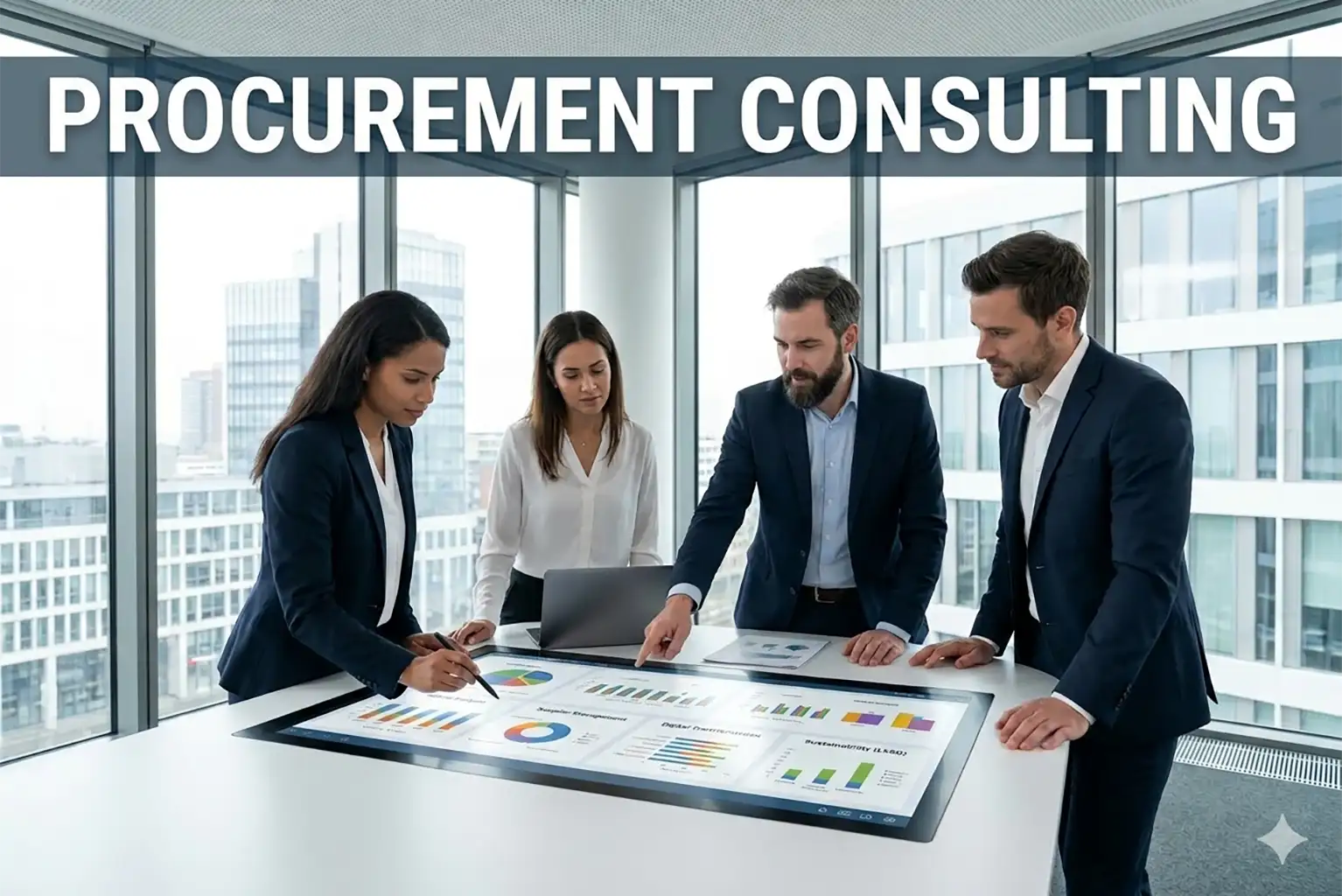
The focus is on a holistic analysis of the supply chain: from the organisational structure and technological infrastructure to strategic supplier development. The aim is to create a „best-in-class“ purchasing organisation that not only reduces costs but also makes a measurable contribution to corporate success through innovation management and risk minimisation.
2. Why Procurement Consulting is crucial today
In a market environment characterised by volatile commodity prices, geopolitical tensions and a shortage of skilled workers, traditional purchasing often reaches its limits. Procurement consulting closes the gap between day-to-day operations and necessary strategic transformation.
„The true value of a company is not only shown in sales success, but above all in the intelligence of its procurement.“
A consultant acts as a catalyst for internal change. When sales have little room for growth due to market saturation, purchasing becomes the most important lever for margin: a saving of 5 %in purchasing often has a stronger impact on profit than a sales increase of 20 %.
3. The three pillars for sustainable cost reductions
An effective project rests on three pillars that must interlock:
- Commercial Excellence: Optimising conditions through modern tender formats. The Total Cost of Ownership (TCO) is always considered to factor in hidden costs such as logistics and warehousing.
- Operational Excellence: Outdated, manual processes are replaced by automated workflows. A critical factor is the elimination of maverick buying – the unauthorised purchasing by departments bypassing central procurement.
- Demand Management: This pillar questions the necessity of the demand itself. Through standardisation, action is taken before the order is even placed.
Look beyond the pure purchase price. Often, the greatest leverage lies in reducing complexity and optimising logistics routes or payment terms, which are not immediately apparent in the pure unit price.
Would you like a brief consultation on this?
4. The structured optimisation process (step by step)
A reputable procurement consultancy follows a proven methodology:
- Step 1: Diagnosis & Transparency (Spend Cube)
Data from ERP systems is cleaned and categorised. Only on the basis of this transparency can savings potential be identified. - Step 2: Category Management Strategy
It is set which levers to pull (e.g. Global Sourcing vs. Local Sourcing. - Step 3: Sourcing & Implementation
Implementation through structured RFQs. Consultants often conduct negotiations here or coach the internal team. - Step 4: Implementation & Tracking
New contracts are entered, and savings are monitored via a dedicated tracking system.
5. Digitalisation and Artificial Intelligence in Procurement
Modern procurement consulting is inextricably linked with „Procurement 4.0“.
- AI-powered spend analysis: Algorithms automatically classify expenditure.
- Predictive Risk Analysis: AI tools scan global data to predict supply chain disruptions.
- Automation through RPA: Robotic Process Automation takes over order creation and invoice reconciliation.
Before you introduce complex AI tools, clean up your supplier and article master data. Without data hygiene, even the best software will only deliver flawed results („Garbage in, garbage out“).
6. Sustainability (ESG) as a Strategic Competitive Advantage
Sustainability is already a legal requirement in procurement (e.g. via the LkSG).
„In a connected world, the supply chain is no longer just a cost factor, but the nervous system of operational resilience.“
Procurement consulting supports the process of, Sustainability Scores to integrate into the supplier evaluation. The reduction of CO2 emissions often goes hand in hand with lower material consumption and optimised logistics – this is where ecological goals meet economic advantages.
7. Deep Dive: Tail Spend Management – Efficiency in Small Item Procurement
An often underestimated area in procurement consulting is so-called tail spend management. Statistically, these non-critical small expenses account for around 80 %of transactions but only represent 20 %of the purchasing volume. The administrative effort per order here is often higher than the value of the goods. Consulting approaches such as e-catalogues and vendor consolidation not only reduce material costs by approximately 10 % but, above all, reduce process costs by up to 50 % by eliminating manual effort for small orders.
8. Practical Example: Cost Reduction for a Medium-Sized Mechanical Engineering Company
A mechanical engineer with €150 million in revenue struggled with fragmented supplier structures.
- The analysis: 400 suppliers for C-parts caused approximately EUR 120 in process costs per order.
- The solution: Introduction of an e-procurement portal and reduction to 20 core suppliers by the consulting team.
- The result: Within 9 months, €1.2 million was directly saved. Process costs decreased by 40 % through automated invoice checking. The project's ROI was 1:7.
9. Conclusion: Why Procurement Consulting Makes the Crucial Difference
In summary, Procurement Consulting goes far beyond simply negotiating discounts. It is a strategic realignment that empowers procurement to act as a value creation engine. By combining expertise, digital excellence, and methodical strength, companies not only become more cost-efficient but also more resilient. Those who invest in professionalising their procurement today are laying the foundation for long-term market success.
10. FAQ: Important Questions about Procurement Consulting
When is the right time for a consulting project?
Whenever procurement costs rise faster than revenue, the number of suppliers becomes unmanageable, or regulatory requirements like the LkSG tie up internal resources.
How is the success of such advice measured?
Primarily through „savings“ (P&L effective), but also through the reduction of process costs, the increase in the compliance rate, and the improvement of supplier performance.
Ist Beschaffungsberatung nur eine einmalige Aktion?
A good project leaves structures behind. The aim is knowledge transfer so that the internal team can independently continue with the new processes and tools after the project has ended.
Does the approach also work for indirect costs?
Absolutely. Particularly in areas such as IT, Marketing, or Facility Management, the greatest potential often lies dormant, as these categories are frequently managed less professionally internally than direct production materials.