




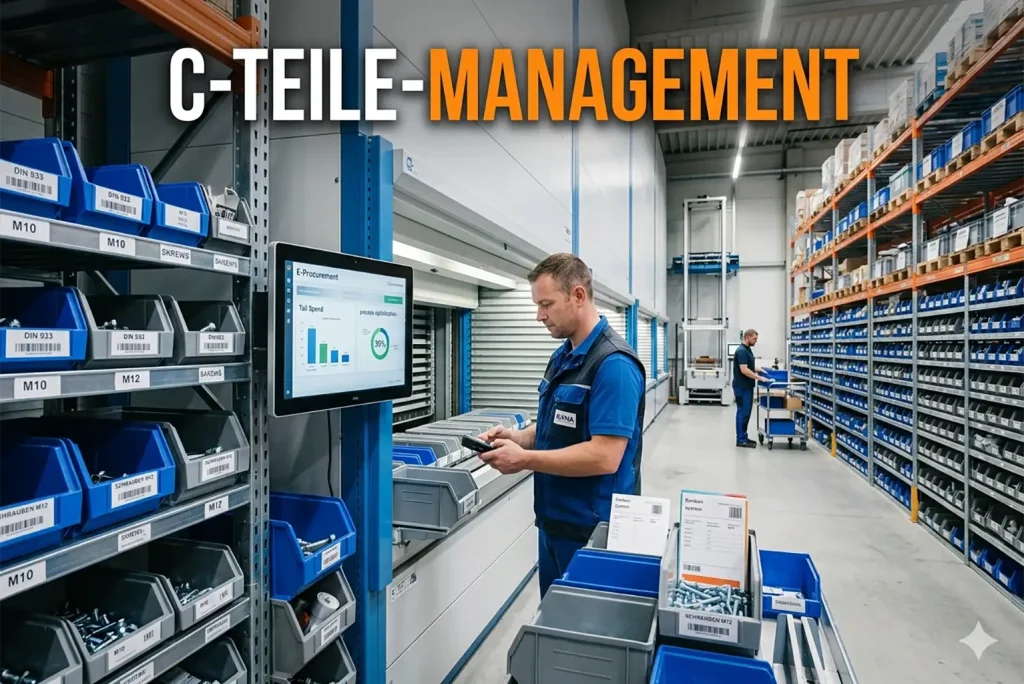
The most important points in brief:
Efficient C-parts management is the most important lever for reducing procurement process costs. While C-parts only account for approx. 20 % of the purchasing volume in terms of value, they often cause over 80 % of the administrative effort and SKU complexity. Through Digitisation (E-Procurement), radical Supplier bundling by outsourcing to system partners, tail spend (uncontrolled small-ticket purchases) can be drastically reduced. The result: process costs drop by up to 30%, while supply reliability increases significantly thanks to automated systems such as Kanban or VMI.
Key Facts about C-Parts Management
- Core Definition: Strategic Optimisation of procurement from low-value goods to reduce the Total Cost of Ownership (TCO).
- The 80/20 paradox: C-parts make up 80% of the items, but only 20% of the value – yet tie up the majority of resources.
- Main source of savings: Not the purchase price, but the process costs (Search, Order, Invoice).
- Technology Enablers: OCI/Punch-out Catalogs, EDI Interfaces, and Automated Credit Memos.
- Strategy: Transition from „Many-to-Many“ (many purchasers, many suppliers) to „Many-to-One“ (many purchasers, one system partner).
1. Definition of C-parts management
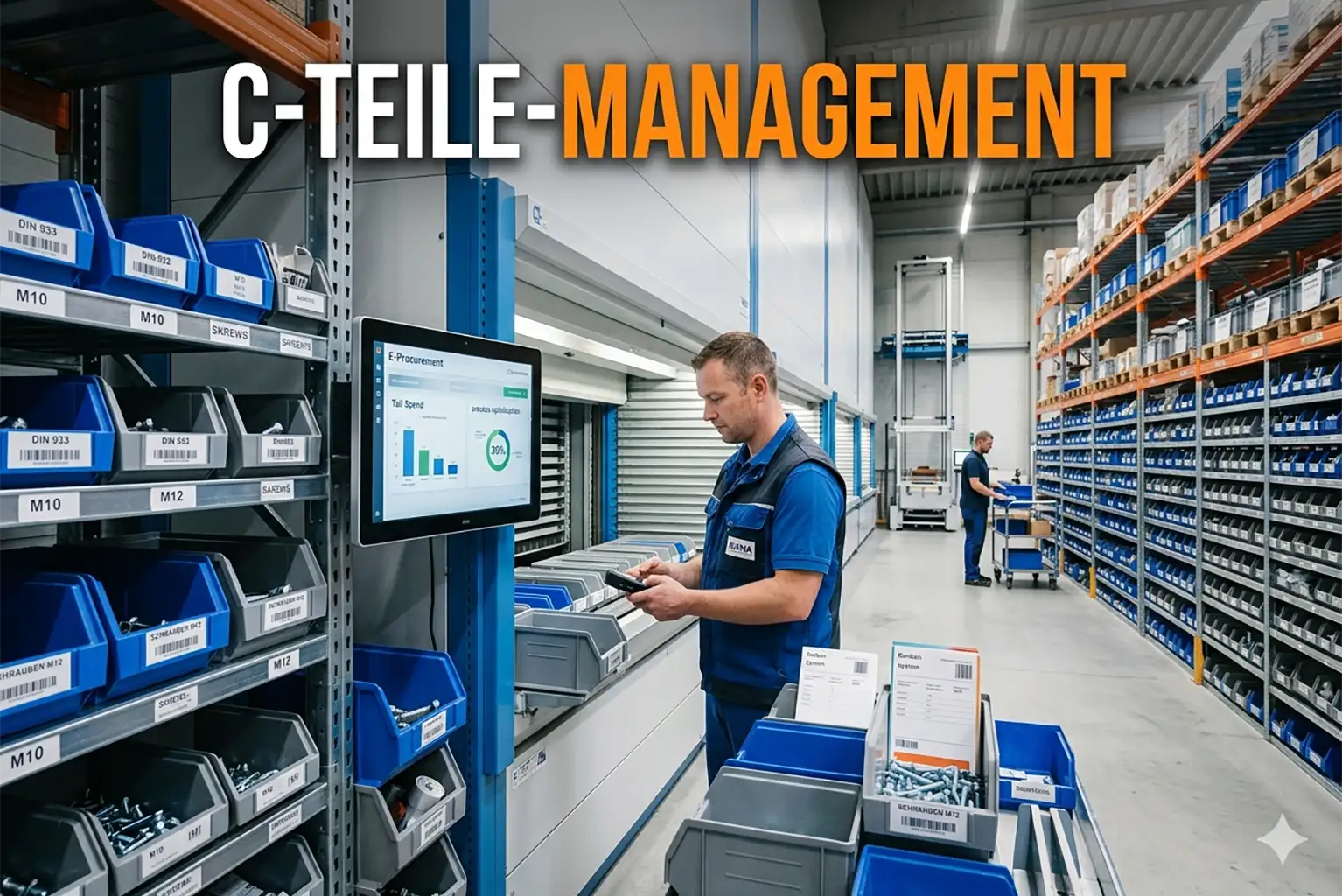
2. What are C-parts and why are they problematic?
In classical ABC analysis, C-items are the „mass items“. They are characterised by a low individual value, but typically make up 60 % to 80 % of all stock keeping units (SKUs).
Typical product groups:
- Production material: screws, seals, small parts.
- MRO Supplies: Tools, Maintenance Materials, Cleaning Supplies.
- PSA: Safety equipment from gloves to safety helmets.
The problem: As these items often appear „unimportant,“ a central strategy is lacking. This leads to hundreds of employees wasting time on manual searches, causing hidden costs to skyrocket.
3. Tail Spend: The Hidden Cost Eaters in Procurement
Tail Spend is the „long tail“ of expenditure: many small orders with an unmanageable number of suppliers.
- Maverick BuyingEmployees are independently ordering from third-party providers because the internal process is too complicated.
- Creditor sprawl: Each new supplier setup costs between €150 and €500 in master data management. For C-parts, these costs often exceed the total annual turnover with that supplier.
Would you like a brief consultation on this?


4. Deep Dive: The Anatomy of Process Costs – The €100 Screw
Why does a 5-euro screw end up costing 105 euros? A look at the process chain reveals the cost drivers:
- Identification (£20): Searching the catalogue or internet.
- Order (30 €): Obtain approval, record order in ERP.
- Logistics (€25): Parcel acceptance, inspection, delivery to site.
- Administration (30 €): Invoice entry, price reconciliation, payment run.
A professional system massively reduces these steps, so that the cost per order often drops to under 15 Euros.
5. Optimisation Strategies: The 3-Pillar Plan for Tail Spend Reduction
Simply lowering prices leads to hardly any successes in the C-parts sector. Instead, companies must focus on three strategic levers.
„Success in procurement is no longer measured solely by price discounts, but by the time gained for strategic decision-making.“
Column 1: Assortment Rationalisation and Standardisation
The aim of standardisation is to drastically reduce the variety of options. Instead of ten different protective gloves from five manufacturers, a standard model is defined for 90% % of all use cases. Higher purchasing volumes per item lead to better conditions, and stock-keeping is massively simplified.
Column 2: Radical Supplier Consolidation
By selecting one or a few powerful system suppliers who cover the entire spectrum (from screws to office supplies), the administrative effort for hundreds of creditor master data is eliminated. A single contract replaces hundreds of individual relationships.
Pillar 3: Logistics Process Automation
To minimise operational expenditure, intelligent logistics systems are being implemented:
- RFID-Kanban: An empty bin automatically triggers reordering.
- Vending machines: dispensing machines for PPE directly at the workplace ensure 24/7 availability without staff.
6. Practical Example: Transformation at „AlphaMaschinen GmbH“
Let's consider the transformation of a medium-sized mechanical engineering company (fictional, practical scenario):
Starting situation: AlphaMaschinen sourced indirect requirements from over 180 suppliers. The accounting department processed approximately 6,000 individual invoices annually with an average value of only 45 Euros. The process cost per invoice was estimated at 85 Euros.
The implementation:
- An analysis revealed that 70 % of suppliers were only responsible for C-parts.
- Partner Selection: A technical distributor has been chosen as a single-source system partner.
- Digitalisation: Introduction of a punch-out catalogue in the SAP system.
- Logistics: Installation of machine tools in the assembly hall.
Expert Tip 1: Always start inventory rationalisation with PPE items. Employee acceptance of standardisation is highest here, provided the quality is right, and savings through consolidation are immediately measurable due to high consumption.
Results after one year:
- Creditor reduction: From 180 to 3 active C-part suppliers.
- Time savings: Strategic buyers got 30 % of their working time back.
- Cost reduction: TCO demonstrably reduced by €145,000 per year.
7. E-Procurement as a Digital Enabler: Interfaces and P2P Automation
Without a clean IT infrastructure, C-part management remains piecemeal. Only digital networking between purchasers and suppliers closes the efficiency gap.
„Digitalisation in C-part management is not a technological project, but a cultural shift towards efficiency.“
OCI and Punch-out: The Purchasing Experience
Instead of manually maintaining article data, OCI (Open Catalog Interface) or Punch-out is used. The employee „jumps“ directly from the ERP system to the supplier's webshop. Individually negotiated prices are stored there. The filled shopping basket is transferred back to the ERP system with a click, where the purchase requisition is automatically generated.
EDI (Electronic Data Interchange)
EDI is the standard for data exchange without human intervention. Orders and advance shipping notices flow as structured data sets in real time. Errors due to manual typing mistakes are reduced to zero.
ERS (Evaluated Receipt Settlement) – Credit procedure
Instead of the supplier issuing an invoice, the buyer's system automatically generates a credit note based on the goods receipt. There are no longer any price or quantity discrepancies, as the basis for payment is the goods received that have actually been booked.
Expert Tip 2: Implement „No-Touch Invoices“ for amounts under €100. Define tolerance levels in the system for price deviations of up to 5 %. The manual clarification of a €2 difference usually costs you more than €50 in process time internally – automatically approve such amounts.
8. Advantages of holistic C-parts management
Implementing well-thought-out C-parts management is a strategic masterstroke. Harmonising processes leads to efficiency gains that directly impact the bottom line. It's about freeing up resources where they create real value, rather than tying them up in administrative minutiae.
The core benefits at a glance:
- Drastic TCO reduction: Lowering overall costs through contactless processes.
- Maximum transparency: full control over consumption through central data storage.
- Higher supply security: Automated replenishment systems minimise the risk of production downtime.
- Strategic relief: Purchasing gains time for supplier development for A-items.
9. Conclusion: Why professional C-parts management is indispensable
C-parts management is the premier discipline of operational efficiency. It's not about squeezing three pence off the price of a screw, but about eliminating the 100 Euros in process costs surrounding it. In a time of skills shortages, it is fatal to tie up qualified buyers with the administration of small parts. A modern, digitised C-parts concept transforms procurement from an administrator to a strategic value-adding partner. Those who consistently leverage this will provide their company with a measurable competitive advantage through agility and cost leadership. By consistently eliminating manual steps, companies not only create financial leeway but also secure the necessary agility in the supply chain.
10. FAQ: Frequently Asked Questions on C-Parts Management
What is the most important KPI in C-parts management?
The Cost per Order (CPO). It measures the process costs incurred by the company for a single order. The aim is to minimise this metric through automation.
How to deal with employee resistance (maverick buying)
By making the official process as simple as „Amazon“. If ordering through the e-procurement system is faster and more convenient than buying independently, acceptance will increase by itself.
Is C-parts management only relevant for large corporations?
No. SMEs often benefit even more from this, as they tend to have scarcer personnel resources in purchasing, and the relief from routine tasks can be immediately used for strategic projects.
What impact does digitalisation have on tail spend?
Digitalisation makes the „rat's tail“ (tail spend) visible in the first place. It is only through digital recording that patterns in maverick buying can be recognised and guided into controlled channels through targeted catalogue integrations.