




First and foremost:
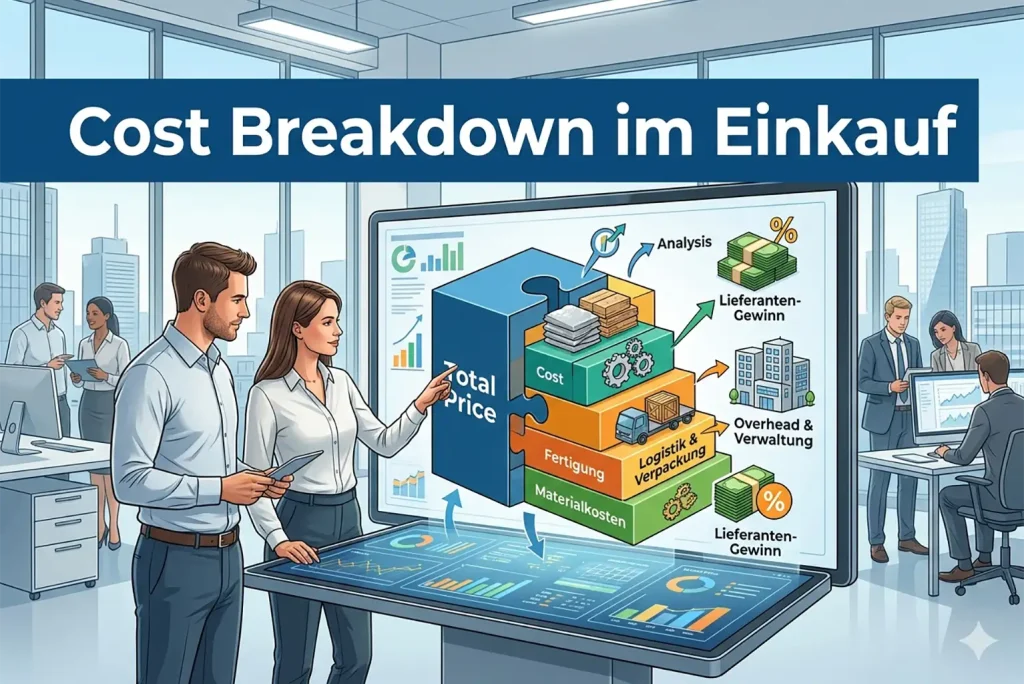
The Cost Breakdown (CBD) is the most precise instrument in the Strategic procurement, to open the „black box“ of supplier prices. Instead of accepting flat-rate final prices, all cost factors such as material, labour, overhead and profit are analysed individually. The aim is a fact-based Negotiation, the identification of inefficiencies and - essential in 2026 - the transparent reporting of sustainability and ESG costs.
Key facts about the cost breakdown
- Core concept: Transparent breakdown of the price into its smallest components.
- Leverage: Identification of hidden margins and unnecessary cost drivers.
- Methodology: Use of bottom-up calculations and should-cost benchmarks.
- Sustainability factor: Integration of CO2 prices and ESG compliance costs.
- Advantage: Change from emotional price negotiations to objective cost analyses.
1. definition: What is a cost breakdown?
„Whoever negotiates the price wins the moment; whoever understands the costs wins the future.“
A typical CBD regimen includes:
- Direct costs: Direct material costs and purchased parts.
- Production costs: machine running times, labour costs and set-up costs.
- Overheads: allocations for administration, development and sales.
- Logistics: packaging, freight and customs.
- Profit margin: The calculated profit of the provider.
2 Why Cost Breakdown? The strategic benefit
Those who know the cost structure of their suppliers no longer negotiate on the basis of „gut feeling“, but on the basis of hard market data.
- Maximum transparency: You can see exactly which part of the costs is influenced by commodity price fluctuations.
- Targeted cost reduction: If you know that the set-up costs are too high, you can discuss batch size optimisation with the supplier.
- Risk management: A CBD reveals whether a supplier's existence is threatened by rising energy prices.
- Fairness: It also protects the supplier from ruinous price competition, as an adequate margin remains visible.
3. methods of cost analysis
In order to obtain a valid database, various analysis models are used in practice:
- Bottom-up calculation: Here, the product is theoretically „modelled“. Every movement and every gram of material is calculated. Ideal for complex components.
- Should-cost analysis: Based on benchmarks and market data, an estimate is made of what a product should cost under ideal conditions.
- Linear Performance Pricing (LPP): Here, prices of technical parameters (e.g. weight or performance) are compared.
- Parametric estimation: Utilises statistical models to predict costs in early phases.
Would you like a brief consultation on this?


4. deep dive: overheads and hidden cost drivers
While material and production costs are often tangible, the „trick“ lies in the detail of overheads:
- SGA costs (Sales, General & Administrative): These are often added on as a flat-rate percentage. A deep dive checks whether the administrative costs are really justified for your specific volume.
- Hourly machine rates: Scrutinise the depreciation periods. A machine that has already been depreciated must not be calculated at the full rate.
- Efficiency levels: Suppliers often calculate with conservative reject rates (e.g. 5 %). A technical deep dive can show that 2 % would be realistic.
- Energy cost allocation: Is the energy distributed across the plant as a lump sum or billed per machine according to consumption?
5 Step-by-step analysis: how to proceed
Implementing a cost breakdown requires more than just sending out a form. It is a strategic process that requires clean data, analytical skills and diplomatic tact in supplier communication. Only those who take a structured approach can transform mere columns of figures into a powerful chain of arguments for the next price negotiation.
Step 1: Standardisation
Send the supplier a clear template (CBD sheet). You can only compare offers effectively if all suppliers use the same structure.
Step 2: The plausibility check
Check the data against external indices (e.g. commodity exchanges). Are the stated hourly machine rates realistic for the location?
Step 3: Identification of the gaps
Where are the biggest differences between the offer and your target costs? These points form the agenda for the next meeting.
Step 4: Collaborative Cost Reduction
Enter into dialogue. The aim is „design-to-cost“ or process optimisation in order to reduce the cost base sustainably.
6. practical example: cost breakdown of a technical component
Let's imagine a housing made of die-cast aluminium. A classic CBD often shows the following picture:
- Raw material: € 3.50 (based on 1.2 kg of aluminium alloy at the LME rate).
- Production (moulding & deburring): 2.10 € (cycle time 120s at 63 €/h).
- Post-processing (CNC milling): € 1.80 (processing time 90s).
- Overheads (15 %): € 1.11 (allocation for administration/logistics).
- Profit (8 %): € 0.68.
- Total price: 9,19 €.
The lever: The analysis reveals that the cycle time for CNC milling 30 % is above the market average. The solution: An investment in new equipment permanently reduces the unit price by €0.50.
7. checklist: Sustainability & ESG in the cost breakdown
In a modern shopping environment (2026), price is inextricably linked to environmental footprint. Use these factors to analyse:
- CO2 levies: Are certificate costs (ETS) shown correctly per component?
- Green Energy Premium: Is there a surcharge for green electricity? Verify the guarantees of origin.
- Recycling percentage: How high are the costs for secondary materials compared to primary raw materials?
- Compliance audit costs: Are costs for Supply Chain Act (SCA) audits included transparently?
- Circular economy: Are the costs of taking back the product at the end of its life cycle already priced in?
8. Challenges and Best Practices
Expert tip: A cost breakdown is not an interrogation. If suppliers stonewall, this is usually due to concerns about margin pressure. Explain that Transparency also protects the supplier - for example in the event of rising raw material prices, which you can then compensate fairly.
- Data quality: Insist on detailed information instead of flat-rate „Other costs“.
- Set your focus: Apply the Pareto principle. Analyse intensively only the 20 % of the parts that make up 80 % of your volume.
- Timeliness: Use dynamic price clauses for volatile factors such as energy.
„Knowledge of the cost structure is the only bridge from price squeezing to strategic value management.“
9 Conclusion on cost breakdown: from price to value management
The Cost Breakdown is far more than just a savings tool. It is the basic prerequisite for professional supply chain management. If you know your costs, you can optimise them in partnership, identify risks earlier and manage innovations in a more targeted manner. In a volatile business world, transparency is the only currency that creates lasting trust and competitive advantages.
In addition, methodical cost transparency enables an objective assessment of automation potential and future investment decisions. Ultimately, this transforms purchasing from a pure cost reducer to a proactive shaper of corporate profitability, perfectly combining technical expertise and commercial negotiating skills.
10th Cost Breakdown FAQ - Frequently asked questions
Does a supplier have to disclose its costs?
There is no legal obligation. In strategic purchasing, however, the willingness to „open book“ is often a key criterion for the award of major projects and strategic partnerships.
What do I do if the supplier refuses to disclose?
Make greater use of external should-cost models. Show the supplier that transparency is the basis for a fair distribution of market risks (e.g. raw material prices).
From what batch size is a detailed cost analysis worthwhile?
A CBD is particularly useful for high volumes (A parts). For low-value C-parts, the administrative effort is usually disproportionate to the savings potential.
What role will AI play in cost analysis in 2026?
Today, AI uses CAD data to create target calculations in real time based on global wage and energy databases, which massively speeds up analysis and minimises errors.