




First and foremost:
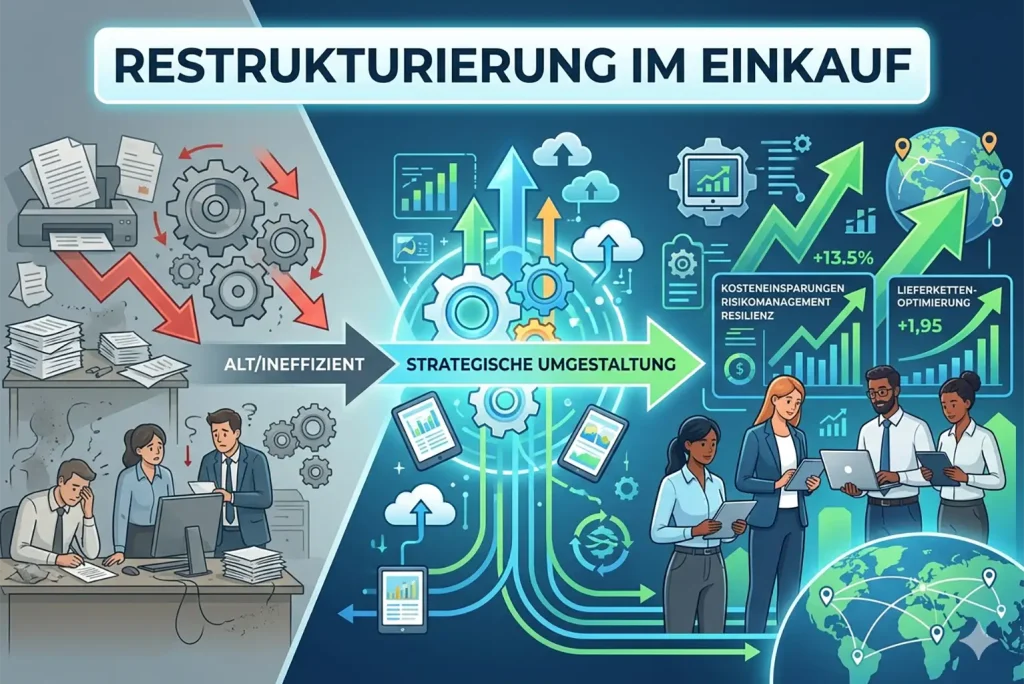
The Restructuring in Purchasing The department transforms from an administrative ordering instance into a strategic value-adding partner. By realigning to a hybrid organisational model and data-driven processes, companies sustainably reduce their process costs by up to 25 %. The focus today is on the triad of digital automation, proactive risk management, and the consistent use of spend analytics to secure global competitiveness.
Key Facts on Purchasing Restructuring
- Core objective: Increase agility and resilience while reducing costs.
- Methodology: Separation of strategic sourcing and operational execution (transactional procurement).
- Technology: Use of cloud-based e-procurement systems and AI-powered spend analysis.
- Success Factor: Active Change Management and Upskilling of Employees to Category Manager.
- Impact: Drastic reduction in maverick buying and optimisation of working capital.
1. Definition: What does restructuring mean in procurement exactly?
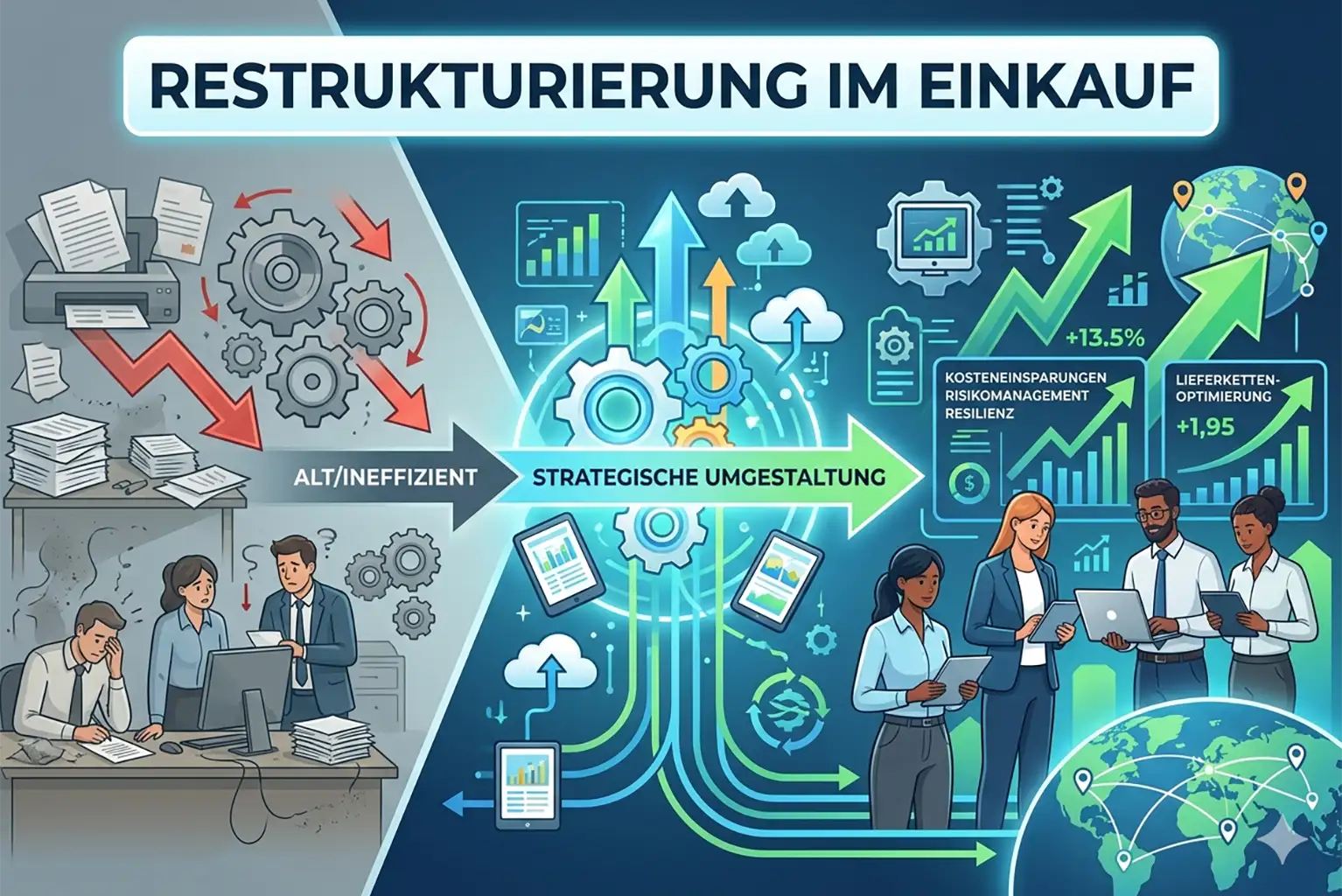
The objective is to separate strategic, tactical, and operational tasks from each other to ensure efficient use of resources. This will involve refining role profiles, modernising IT systems, and optimising interfaces with suppliers and internal specialist departments for maximum value creation.
2. Why the status quo in purchasing is often no longer sufficient
Obsolete Purchasing structures often suffer from the „firefighter syndrome“: reacting only when prices rise or supply chains break. Typical deficits include:
- Maverick Buying: Uncontrolled procurement by specialist departments undermines framework agreements.
- Administrative Paralysis: Strategic buyers spend most of their time on operational processing instead of market analysis.
- Lack of transparency: Without a clean data foundation, there is no overview of global risks.
„True transformation in procurement doesn't start with price, but with the process.“
3. The three pillars of a modern procurement strategy
A sustainable restructuring is based on three technologically and organisationally interwoven foundations:
- The hybrid organisation (Centre of Excellence): Centralisation where economies of scale and expertise need to be pooled (e.g. negotiation), and decentralisation where speed and closeness to local needs are crucial.
- Digital Process Excellence: The use of e-procurement systems automates standard orders (touchless procurement). This reduces the error rate and frees the team from repetitive tasks.
- Value-Based Supplier Management: Suppliers are no longer managed solely on price but are integrated as innovation partners. Furthermore, in-depth risk management secures supply in volatile markets.
Would you like a brief consultation on this?


4. Deep Dive: Data-Driven Spend Analytics & Risk Resilience
The success of the restructuring hinges on this core technical area. It's about transforming raw data into strategic directives.
- Der Spend Cube: Ausgaben werden nach Warengruppen, Lieferanten und Bedarfsträgern visualisiert. Dies deckt sofort „Tail-Spend“-Potenziale auf – also jene 20 % der Ausgaben, die oft 80 % der Lieferanten verursachen und extrem hohe Verwaltungskosten binden.
- Total Cost of Ownership (TCO): The restructuring is establishing models that evaluate not only the purchase price, but the overall costs throughout the lifecycle (logistics, quality, disposal).
- Predictive risk management: By linking internal data with external risk indicators, procurement becomes the company's early warning system and can proactively switch to alternative sources.
5. The 4-Phase Plan for Successful Realignment
A restructuring in purchasing is not an ad-hoc project, but a profound change process that requires a clear roadmap. In order to steer the transformation safely and minimise operational risks – such as supply bottlenecks during the transition – a modular 4-phase plan has proven effective in practice. This guides the organisation step by step from the initial analysis to sustainable success assurance.
- Diagnosis & Transparency: Analyse of the CURRENT state using Process Mining to identify weak points and budget leakages.
- Target Operating Model (TOM): Design of the new target model including role definitions and IT roadmap.
- Realisation: Implementation of the new structures, software roll-outs and team training.
- Optimisation: Establishment of a performance dashboard for continuous monitoring of KPIs such as savings and process speed.
6. The Human Factor: Change Management as a Guarantee of Success
Restructuring rarely fails due to technology, but rather due to staff resistance. The shift from „order-taker“ to „strategic manager“ requires targeted upskilling.
„Technology is the engine of change, but people's acceptance is the fuel.“
Transparent communication is crucial here to highlight the benefits – such as relieving the burden of routine tasks – and to allay fears about digitalisation.
7. Practical example: Leap in efficiency through organisational change
A medium-sized plant constructor suffered from a fragmented supplier base of over 3,000 creditors and a Maverick buying rate of 40 %.
The solution: As part of the restructuring, C-parts were transferred into a digital catalogue system. A central team took over negotiations for global framework agreements, while the plants remained operationally autonomous.
The result:
- Reduction of supplier numbers by 60 %.
- Savings in procurement volume of 12 % through bundling effects.
- The process lead time for an order decreased from 7 days to a few hours.
8. Critical Success Factors & Measurability (KPIs)
For the restructuring in procurement to bear fruit in the long term, measurable milestones must be defined:
- Maverick Buying Quote: Percentage of purchases bypassing the official process. Target after restructuring: < 5 %.
- Cost per PO (Process Cost): Total costs of the purchasing department divided by the number of purchase orders. Reductions of up to 30 % are realistic.
- Managed Spend: The proportion of purchasing volume actively managed by category management. Target value: > 85 %.
- Degree of automation: Percentage of „touchless“ orders that run from requirement to invoice without manual intervention.
9. Conclusion: Long-term success through restructuring in procurement
The Restructuring in Purchasing is the decisive lever for making a company crisis-proof and future-proof. Those who consistently use data as a strategic asset and align their organisation to be agile and value-oriented not only save significant costs but also generate real competitive advantages through innovation and speed.
In an era of permanent global disruption, purchasing is transforming from a mere cost manager to the central protector and proactive innovation driver for the entire group through professional realignment. Ultimately, this transformation forms the foundation for sustainable corporate governance, successfully uniting economic efficiency with environmental responsibility and maximum supply chain security.
10. FAQ: Important questions about restructuring in purchasing
How do I know if my portfolio needs restructuring?
Typical warning signs include a high rate of uncontrolled purchases (maverick buying), a lack of transparency regarding total expenditure per product group, and an overburdened team due to purely operational activities.
How long does such a transformation take on average?
While „quick wins“ through process automation often take effect after just 3 to 4 months, a complete organisational and cultural realignment usually requires 12 to 18 months.
Isn't it enough to introduce new purchasing software?
No. A tool is merely an enabler. Without clearly defined processes and roles beforehand, you are merely digitising existing inefficiencies, which prevents the desired success.
What role does sustainability play in realignment?
A central role. Modern restructurings directly integrate ESG criteria into supplier selection and risk management in order to legally and efficiently fulfil statutory requirements such as the LkSG.