




First and foremost:
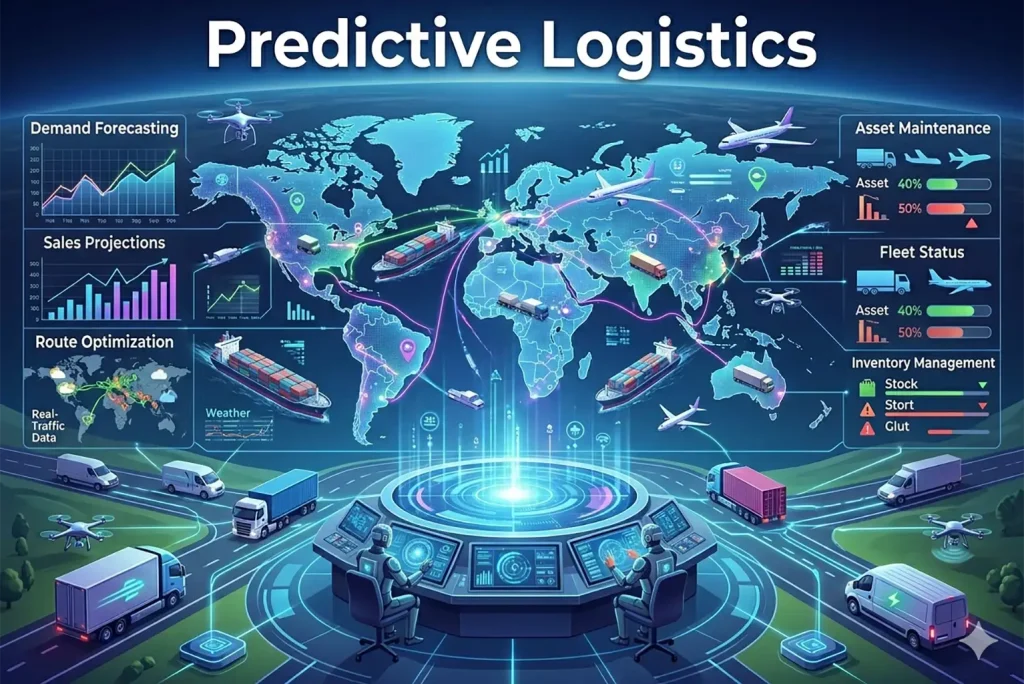
Predictive Logistics transforms the Supply Chain from a reactive cost factor to a proactive strategic asset. By merging big data, machine learning, and real-time IoT data, bottlenecks are no longer just managed, but anticipated. This allows companies to reduce inventory costs by up to 25% %while simultaneously increasing on-time delivery rates to over 98% %.
Key facts about predictive logistics
- Core Concept: Mathematical modelling of future logistics scenarios for proactive risk minimisation.
- Technology Stack: Artificial Neural Networks (ANNs), Random Forest Algorithms, Edge Computing and Cloud Data Warehouses.
- Business Impact: Optimised working capital through „dynamic stocking“ and significant reduction of the CO2 footprint.
- Market Trend 2026: Integration of Generative AI for intuitive querying of complex logistics scenarios („Natural Language Supply Chain“).
1. Definition: What is Predictive Logistics?
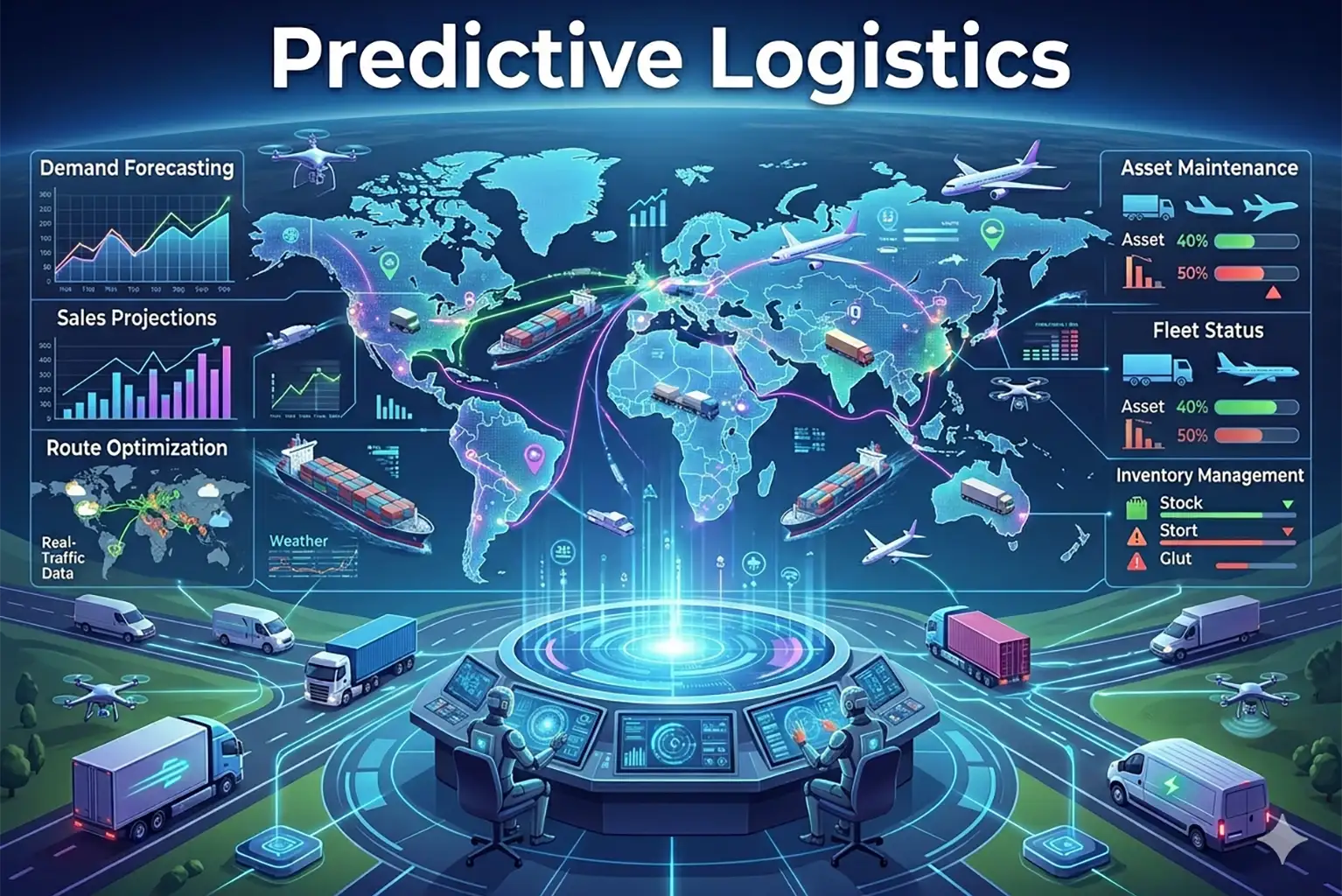
This involves a paradigm shift: away from static planning and towards dynamic, real-time anticipation. Hundreds of variables are correlated simultaneously – from historical sales data and machine statuses (predictive maintenance) to macroeconomic indicators or port congestion data.
„In a connected world, knowledge of tomorrow is worth more than the mere analysis of yesterday.“
2. Methodology: The Technological Architecture
The depth of predictive logistics arises from the combination of various technological disciplines:
- Machine Learning (ML): Use of regression models and time series analyses to identify seasonal patterns and non-linear trends in demand.
- IoT & Sensors: Smart assets continuously provide data on GPS, telematics, and environmental conditions. This data is fed into the models in real time to dynamically adjust estimated times of arrival (ETA).
- Data Mining: The integration of unstructured data is crucial. A strike at the port or low water levels on the Rhine will be immediately identified as a risk factor, even before one's own goods are physically affected.
3. Strategic Advantages: Why Predictive Logistics is Non-Negotiable
In a volatile world, predictive logistics offers three crucial levers:
- Financial optimisation: More precise demand forecasting (demand sensing) minimises capital tied up in inventory. Safety stocks can be reduced without risk.
- Operational Resilience: Early warning systems allow for timely switching of transport modes before a production stoppage occurs.
- Sustainability (Green Logistics): Optimising lorry utilisation and avoiding empty journeys significantly reduce CO2 emissions.
Would you like a brief consultation on this?


4. Deep Dive: The Path from Predictive to Prescriptive Analytics
The true maturity of an organisation is demonstrated in the transition to prescriptive analytics. Here, the system doesn't just say, „Your delivery will be late,“ but actively proposes solutions: „Book 500 units from supplier B now to offset the stockout at factory A.“.
This requires networking beyond company boundaries. The system acts as a Digital Control Tower, simulating hundreds of scenarios in seconds and recommending the most economically viable decision.
5. Practical example: Resilience in the FMCG sector
A global food manufacturer faced the problem that promotions often led to „out-of-stock“ situations.
The solution: Integration of social media trends and weather data into the predictive model. It recognises the AI A trend combined with a sunny weekend will see production for specific regions ramped up 72 hours in advance.
The result: 20% fewer empty shelves and a 12% reduction in food waste.
6. Implementation Challenges
The biggest hurdles are of a technical and cultural nature:
- Data silos: information is often held in isolated departments (purchasing vs. logistics).
- Data Quality: Without clean master data, even the best algorithms will deliver incorrect results.
- Cultural change: Experienced dispatchers must learn to trust the recommendations of a „black box“ (AI). Explainable AI (XAI) is important here to make decisions understandable.
7. Roadmap: In 5 Steps to Forward-Looking Logistics
The Transformation To data-driven logistics is not a sprint, but a strategic evolution. To transition from reactive processes to an intelligent, proactive Supply Chain To make it successful, a clear structure is required. The following roadmap shows you how to lay the technological foundation and generate real added value step by step:
- Data Audit: Identification of all relevant data sources (ERP, CRM, WMS).
- Define pilot scope: Focus on a critical area (e.g. inventory optimisation for A-items).
- Model Building: Selecting appropriate ML algorithms and training with historical data.
- Real-time integration: Connection of live data streams (IoT, weather, traffic).
- Scaling: Roll-out across the entire supply chain and transition to prescriptive models.
8. Outlook: Autonomous Networks and the Digital Twin
After 2026, the focus will shift to the Digital Twin of the supply chain. Every package, every lorry, and every warehouse will exist as a digital replica. Predictive Logistics will then become the standard operating system, making fully autonomous decisions – from independently reordering from the most sustainable supplier to automatically changing the routes of self-driving fleets.
9. Conclusion on Predictive Logistics: Competitive advantage through data sovereignty
Predictive Logistics is far more than an IT project; it is a strategic realignment. Companies that invest today secure the necessary agility to survive in unstable global markets. He who knows today what will happen tomorrow controls tomorrow's value chain.
„Logistics today are no longer decided solely on the road, but primarily in data streams.“
This transforms the logistics department from a mere executor and cost centre administrator into the central driving force of company success. In an era where data is the new gold, the ability to predict accurately is the ultimate lever for sustainable growth and operational excellence. Those who ignore this development risk losing their place at the forefront of the market in an increasingly automated world.
10. FAQ on Predictive Logistics – Frequently Asked Questions
How does predictive logistics differ from traditional statistics?
Classical statistics uses linear models. Predictive logistics uses machine learning, which also understands complex, non-linear relationships in unstructured data.
What role does the cloud play?
The cloud is the backbone. The computing power required for real-time simulations of thousands of routes is hardly economically viable locally.
Is the system useless for „Black Swan“ events?
No. While AI can predict the event itself with difficulty, it recognises the consequences (port closures, drops in demand) much faster than human planners and immediately calculates alternatives.
What's the entry fee?
Thanks to SaaS models, entry for medium-sized businesses is now possible in the five-figure range. The ROI is usually achieved within 6 to 12 months, primarily due to lower capital tie-up and fewer special journeys.