




First and foremost:
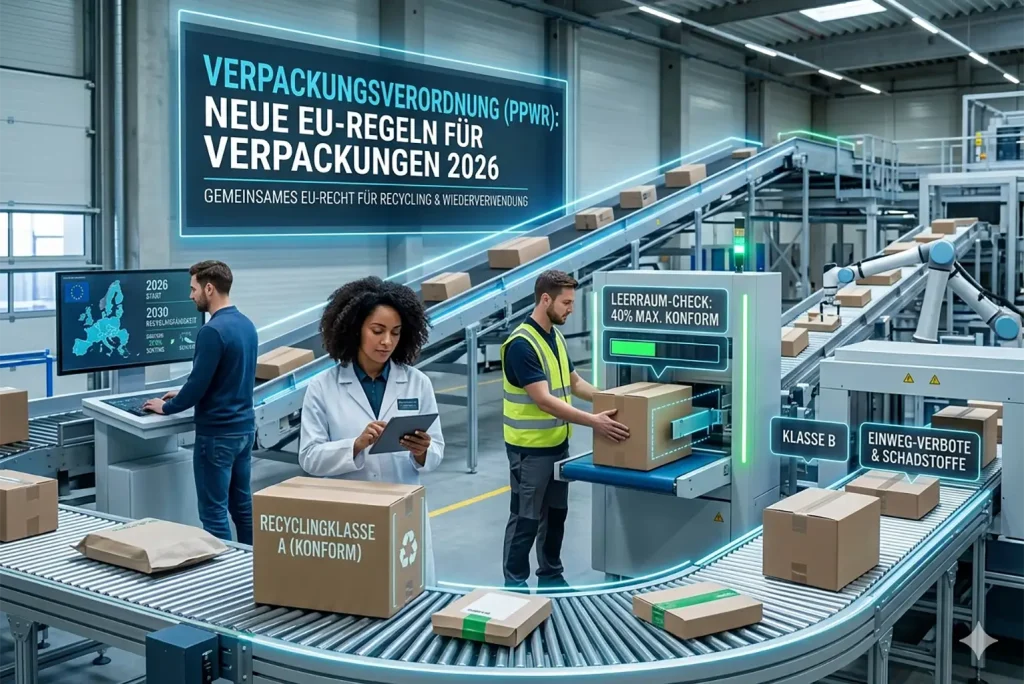
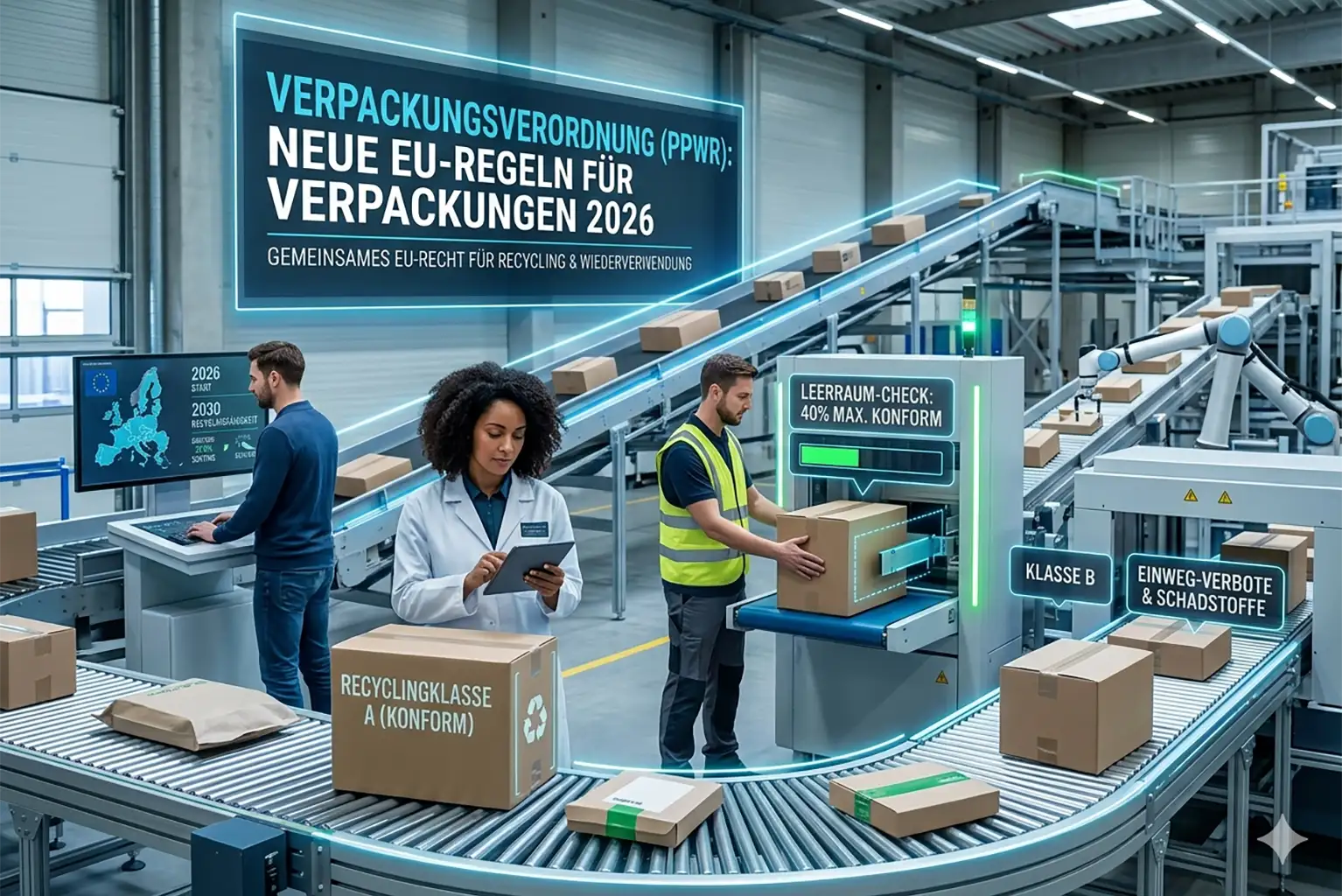
The new EU Packaging and Packaging Waste Regulation (PPWR) it standardises waste law across Europe, replacing national one-off solutions. From 2026, the first massive restrictions will come into effect: These include a ban on certain single-use packaging, strict void space requirements of a maximum of 40 % for mail-order companies and the obligation for EU-wide uniform disposal instructions. Companies must now adapt their packaging design to remain compliant.
Key Facts on the PPWR 2026
- Legal form: Directly applicable regulation (no scope for national deviations).
- Empty space limit: Shipping boxes may not contain more than 40 % air from 2026.
- Pollutant Stop: Ban on PFAS in food packaging to protect health.
- Disposable bans: Goodbye to mini-shampoos in hotels and plastic packaging for small quantities of fruit/vegetables.
- Recycling obligation: Introduction of performance classes (A–E); from 2030, almost all packaging must be at least 70 % recyclable.
1. Definition: What is the PPWR and why is it coming now?
Why now? In the EU, nearly 190 kg of packaging waste is produced per person annually. To achieve the climate goals of the Green Deal, resource consumption must be decoupled from economic growth. The regulation also ensures a genuine internal market, as traders no longer have to comply with 27 different national rules.
„The transition to a circular economy is not a sprint, but a necessary marathon for the entire European industry.“
2. The most important changes from 2026 at a glance
The year 2026 marks the turning point for many logistics and design processes:
- End of „hot air“: In e-commerce, the proportion of empty space is limited to 40 %. Those who ship small products in huge boxes risk sanctions.
- PFAS ban: Packaging that comes into contact with food must no longer contain harmful „perpetuating chemicals“ (PFAS).
- Harmonisation: Registration with national authorities is simplified by EU-wide standards.
3. Design for Recycling: The new performance classes A to E
One of the most technically demanding innovations of the Packaging and Packaging Waste Regulation (PPWR) is the assessment of recyclability according to performance classes. From 2030, Packaging achieve specific thresholds, yet the foundations are already being laid in 2026.
Here is the overview of the efficiency grades (Recyclability Performance):
- Class A (95 % or more): Packaging can be almost losslessly recycled (e.g. pure monomaterials).
- Class B (90 %to 95 %): High recyclability with low technical losses.
- Class C (80 %to 90 %): Acceptable, but already requires optimisation.
- Class D (70 %to 80 %): The lower limit of compliance.
- Class E (less than ): Packaging in this class will be considered non-recyclable from 2030 and will no longer be able to be placed on the market.
This rating forces companies to critically question composite materials (e.g. a mix of plastic and paper), as these often move directly into Class D or E.
Would you like a brief consultation on this?


4. Prohibitions and Restrictions: What is disappearing from the market?
From 2026 or early 2027, specific single-use solutions will be banned:
- Hotel miniature toiletries: Small plastic bottles for toiletries are being replaced by refill systems.
- Fresh Plastic: Plastic packaging for fruit and vegetables weighing less than 1.5 kg is prohibited unless there is a technical protection requirement.
- Dine-in disposable: Restaurants are no longer allowed to serve food in disposable packaging on-site.
5. Labelling requirements and digital transparency
A key aspect is informing consumers through standardised pictograms:
- Disposal symbols: Uniform logos will indicate across the EU which bin packaging belongs in.
- Digital transparency: QR codes are becoming mandatory to make information about the ecological footprint and material composition digitally accessible.
6. Deep Dive: The Technical Implementation of the 40 % White Space Rule
A critical point of the PPWR is the limitation of the empty space. 40 % sounds a lot, but is quickly reached with small articles.
Companies must shift their logistics from static to dynamic solutions. Important for experts: those who use cushioning material like polystyrene chips to fill cartons will be disappointed. Only the minimum amount of filling material absolutely necessary for protection counts as „used“. Decorative outer packaging thus becomes a compliance risk.
7. Practical Example: How an Online Retailer Masters the PPWR
Let's consider a medium-sized retailer of sports electronics.
Before the change: A smartwatch was shipped in a standard size M box. The result was a void fill percentage of approximately 70 %.
The solution according to the PPWR: The retailer invested in an automated cardboard cutting system. This scans the dimensions of the smartwatch and folds a perfectly fitting box from endless corrugated cardboard.
- Result: The gap fell to below 10 %.
- Additional benefit: Due to the smaller volume, more packages can fit on a pallet, which reduces the logistics costs per item by 15 %.
8. Business Checklist: How to Prepare
The path to conformity requires a structured approach. As the PPWR demands profound changes in design, logistics, and reporting, companies should not wait until the deadline. The following checklist will help to identify critical areas of action and initiate the necessary processes early on:
- Audit: Systematically analyse your entire portfolio for empty space and material variety.
- Classification check: In which performance class (A–E) do your current packaging materials fall?
- Supply chains: Ensure your suppliers already offer and can certify PFAS-free alternatives.
- Size optimisation: Examine the use of pack-on-demand systems or the introduction of finely graduated carton sizes.
- Labelling: Prepare graphic templates for the new harmonised EU pictograms to meet transition deadlines.
- Data Management: Establish processes for capturing recycled content percentages for upcoming reporting.
9. Conclusion on the Packaging and Packaging Waste Regulation (PPWR): Circular Economy as a Competitive Advantage
The Packaging and Packaging Waste Regulation (PPWR) is far more than just a new compliance hurdle. It compels the industry to innovate, which saves costs in the long run – for instance, through reduced material usage and more efficient logistics. Companies that proactively manage the transition by 2026 will secure a trust advantage with customers and avoid significant fines.
„In the future, packaging will no longer be just a means to an end, but a digital ambassador for a sustainable value chain.“
Furthermore, the consistent reduction of packaging material will become a crucial criterion in gaining favour with end consumers. Those who view the transformation as an opportunity and optimise their packaging towards performance class A will not only position themselves legally, but also as pioneers of sustainable industrial modernity. Ultimately, the PPWR will reward market participants who understand ecological transparency and technical efficiency as an integral part of their business model.
10. FAQ – 4 important questions on the PPWR
Does the PPWR also apply to online retailers from outside the EU?
Yes. Anyone introducing goods into the EU internal market (importing) must comply with the requirements of the PPWR. Market surveillance authorities can stop sales in case of non-compliance.
How is the void space measured for irregularly shaped products?
The calculation is based on the smallest possible cuboid that encloses the product. Differences between this cuboid and the shipping packaging may not exceed 40 %.
What happens if my packaging is classified as Class E?
You have until 2030 to make optimisations. After that, there will be a de facto ban on placing products on the market. However, as early as 2026, higher licence fees may apply to packaging that is less easily recyclable.
What happens in the event of violations of the new Packaging and Packaging Waste Regulation (PPWR)?
The sanctions are set at a national level, but can include fines of up to 4 % of annual turnover, as well as sales bans for the affected packaging.