




First and foremost:
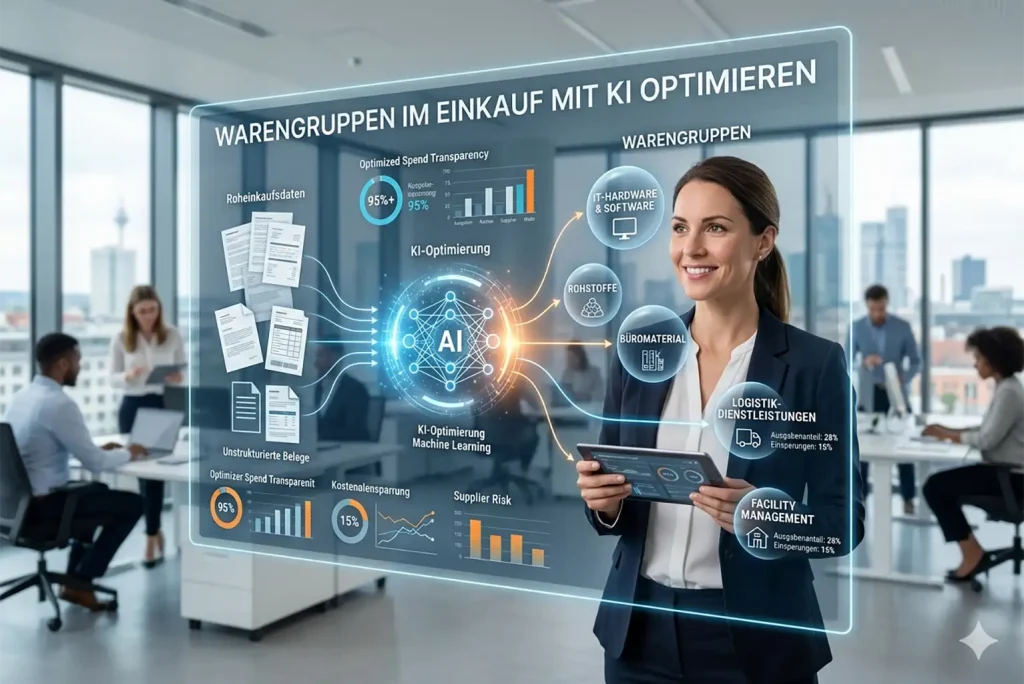
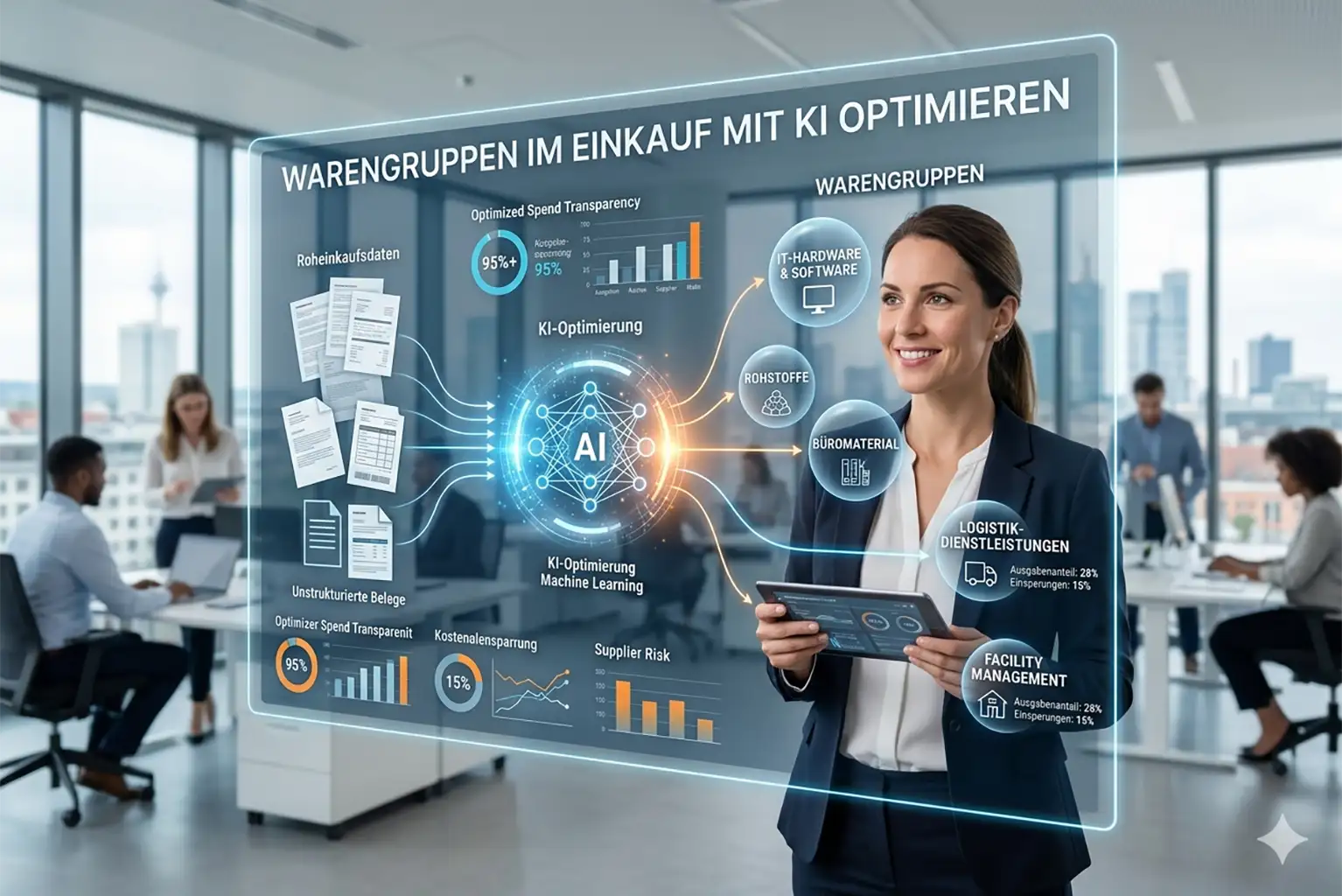
The AI-powered optimisation of product groups marks a turning point in 2026 from purely administrative management to proactive value creation. Through the use of machine learning and automated classification, companies achieve over 95% spend transparency %, identify Savings potential in real time and almost completely eliminate maverick buying. This transforms strategic purchasing from a data manager to a business architect.
Key Facts on AI Trade Group Optimisation
- Definition: Strategic bundling of procurement goods to maximise negotiation power.
- AI Deployment: Lightning-fast classification of unstructured data into standards like eCl@ss or UNSPSC.
- Prediction: Forecast of price and delivery risks directly at the product group level.
- Efficiency: Reduction of manual analysis effort by up to 80 %.
1. Definition: What is understood by category management?
„Data is the raw material of the 21st century, but it is only intelligent structuring that transforms it into real strategic capital.“
In 2026, precise product group management is the digital backbone of any automation strategy. Without a clean structure for purchasing data, even the best AI algorithms will come to nothing, as they cannot create logical links between requirements and markets.
2. The transformation of category management through AI
In the past, maintaining product groups was a Sisyphean task: manual allocations in Excel, incorrect postings and inconsistent master data made a real overview almost impossible. Buyers often spent 70 % of their time on data cleansing and only 30 % on the actual strategy.
Today, hybrid AI models are reversing this relationship. The AI acts as an intelligent filter that recognises patterns even in incomplete datasets. Product groups are now rated dynamically. Categories are no longer judged solely on their annual purchasing volume; factors such as geopolitical risks, ESG (sustainability) criteria, and market volatility are now incorporated into segmentation in real-time.
3. strategic fields of application for artificial intelligence
Artificial intelligence optimises category management primarily where enormous volumes of data arise:
- Intelligent Classification: AI models „understand“ free-text fields in invoices and automatically assign them to the correct product group. The problem of „other services“ (tail spend), in which enormous potential often disappears, is a thing of the past.
- Anomaly Detection: The system immediately detects when prices within a product group suddenly deviate or when purchases are made bypassing existing framework agreements (Maverick Buying).
- Predictive sourcing: By linking internal data with external market signals (e.g. commodity indices), the AI predicts the optimum time for new contracts to be concluded in the respective clusters.
Would you like a brief consultation on this?


4. Deep Dive: How Hybrid AI Models Tame Unstructured Data
To truly master product groups in purchasing, modern systems rely on a hybrid approach combining classic Machine Learning (ML) and Large Language Models (LLMs).
- The classic ML part: it's unbeatable with numerical patterns. It recognises when prices for „stainless steel screws M8“ diverge across different suppliers, based on historical transaction data.
- The LLM component (Semantics): This is where the real breakthrough lies. Whereas old systems failed with free texts like „fastening material Project XY,“ an LLM understands the context. It knows that „fastening material“ in the context of a mechanical engineering company most likely belongs to the product group „C-parts/standard parts.“.
- Synthesis through knowledge graphs: The AI builds up an internal knowledge network. When a new article is created, the AI not only compares it with names, but also with attributes such as material, intended use and supplier portfolio.
This deep dive shows: The AI does not guess, it „understands“ the semantics of the purchase, which lowers the classification error rate to less than 2 %.
5. Practical Example: From 20,000 free-text entries to full transparency
A medium-sized mechanical engineering company faced the challenge that approximately 40% of the orders in the ERP system were either not assigned to a product group or assigned to the wrong one. The “Indirect Materials” category, in particular, was a complete mystery.
The solution: The company implemented an AI-based spend analysis tool. Within just 48 hours, the AI analysed 20,000 historical invoice items. Through semantic analysis, the tool recognised that IT peripherals and special cleaning agents were also hidden under the collective term „office supplies“.
The result:
- Transparency: „Unclassified spend“ fell from 40 %to under 3 %.
- Savings: Thanks to the newly gained clarity, three suppliers could be consolidated in the „occupational safety“ product group, resulting in a price saving of 12 %.
- Process speed: Manual reprocessing by purchasing departments was almost entirely eliminated.
6. E-E-A-T: Why expertise and data quality make the difference
In the context of E-E-A-T (Expertise, Experience, Authority, Trustworthiness), the robustness of the decision basis is paramount in procurement.
- Expertise and Experience: An AI is not a replacement for a buyer, but a tool. The best results are achieved by models trained with the expertise of your experienced category managers.
- Trust through transparency: results must remain understandable (Explainable AI). Blind trust in „black-box“ algorithms without human validation loops harbours risks in the supply chain.
Compared to the traditional method (manual, past-oriented), the AI-powered approach offers real-time validation and precision that elevates purchasing from „order-taker“ to a strategic value driver.
7. 5-Step Implementation Guide
The transition to AI-supported management is not a one-off event, but a structured process that combines technical setup with strategic change management. In order to achieve sustainable results, companies should follow a clear roadmap that ranges from the creation of a clean database to continuous algorithmic optimisation.
- Data Harmonisation: Centrally consolidate all data sources (ERP, CRM, external portals).
- AI-powered cleansing: Use algorithms for duplicate checking and supplier name normalisation.
- Automated Mapping: Let the AI map the cleaned data to a uniform structure (e.g. eCl@ss).
- Strategy derivation: Use the AI insights for targeted bundling and price negotiations.
- Feedback Loop: Establish a control loop in which experts validate the AI suggestions to continuously increase accuracy.
8 Conclusion: Strategic advantages for product groups in purchasing through AI
The AI-powered optimisation of product groups is not just a trend, but the necessary response to the complexity of modern markets. It frees up purchasing from administrative routine tasks and provides the factual basis for well-founded decisions. Those who consistently use this technology secure a sustainable competitive advantage through agility, cost transparency, and a resilient supply chain structure.
„The greatest danger in times of upheaval is not the upheaval itself, but acting with the logic of yesterday.“
This is no longer just about short-term savings, but about fundamentally transforming procurement into a proactive value creator within the company. Ultimately, AI enables a precision in category management that would never be achievable manually, thus laying the crucial foundation for autonomous procurement of the future.
9th FAQ - Frequently asked questions about product groups in purchasing
What is the biggest advantage of AI for product categories in procurement?
The massive increase in data transparency. When you know exactly what you are buying, where, and under what conditions, you can unlock potentials that were previously invisible in the „data noise“.
Do we need perfect data quality to launch?
No. Modern AI solutions are specialised in learning from unstructured or incomplete data and self-sufficiently cleaning and normalising it during the analysis process.
Will artificial intelligence replace the strategic buyer in managing product categories?
Definitely not. The AI takes over data analysis and pattern recognition. The final decision on partnerships, risk management or negotiation remains a human discipline that requires empathy and strategic acumen.
Is AI optimisation worthwhile for small and medium-sized enterprises (SMEs)?
Yes, absolutely. SMEs in particular benefit from the massive time savings, as they often have less personnel available in purchasing. Modern SaaS solutions today offer scalable entry-level models that do not require huge IT budgets, but immediately bring order to the product categories.