



Game theory in purchasing
Game theory in purchasing This is the most effective tool for mathematically optimising negotiation outcomes and achieving significant cost savings. By analysing supplier interactions and strategically controlling auction designs, companies achieve superior deals that go far beyond the potential of traditional negotiations – especially in complex markets with few suppliers.

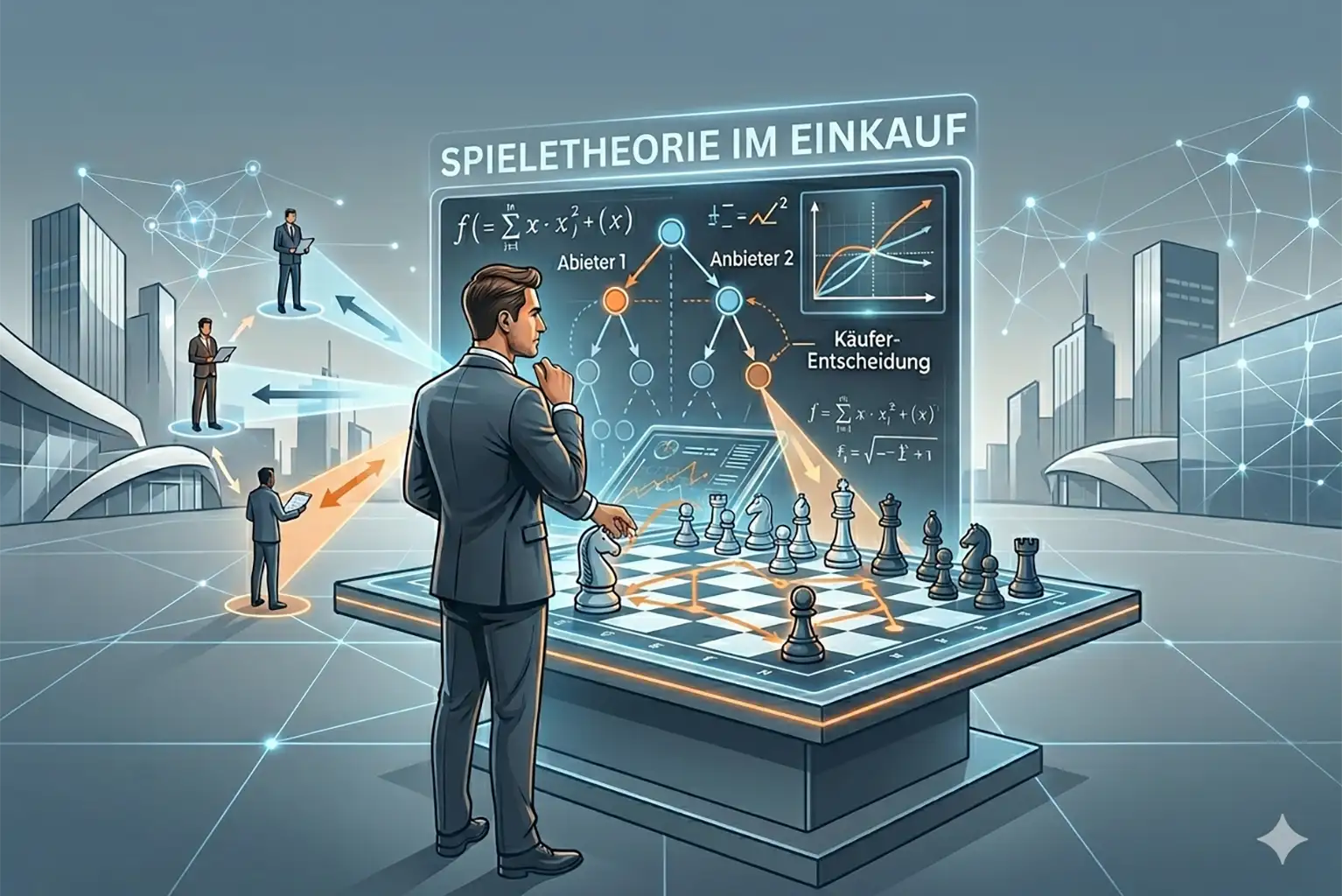
Why Game Theory in Purchasing Offers a Decisive Competitive Advantage
In today's modern procurement markets, intuition is no longer sufficient. Game theory transforms the purchasing process from an emotional negotiation into a systematic science. By designing specific game rules, supplier interactions are anticipated and controlled in a way that creates fair competition and generates maximum value. Kloepfel Consulting supports you in safely integrating these complex mechanisms into your daily sourcing operations.
Key Facts on Game Theory in Purchasing:
- Objectivity: Replacing gut feeling with mathematically grounded models.
- Competitive pressure: Targeted market activation, even in oligopolies.
- Efficiency: Shorter negotiation cycles through clear auction rules.
- Quality of results: Realisation of potential that is 5 % to 15 % above the standard.
- Transparency: Audit-proof documentation of every procurement decision.
Excellent as BEST ADVISORS – 11th time in a row
KLOEPFEL Negotiations – Game Theory Expertise for Your Procurement
When it comes to taking procurement negotiation outcomes to a new level, it requires more than experience and intuition – it needs mathematically sound approaches. Game theory is the scientific foundation upon which these approaches are based: it analyses strategic interactions between rational actors and provides models to predict the behaviour of counterparties.
KLOEPFEL Negotiations uses insights from game theory to predict supplier behaviour and react strategically. As part of the EPSA GROUP, with over 5,000 procurement experts in 40 countries, we are one of the few consultancies in Europe to offer game theory-based procurement optimisation as a core service in purchasing. Our promise: We work exclusively on a success basis and measure ourselves by the savings we achieve for you. Game theory is not a theoretical construct, but a proven, operational tool – used in real negotiations and procurement processes with measurable results.
Game Theory in Purchasing – Science Meets Practice.
What is game theory?
Game theory is a branch of mathematics and economics that analyses strategic decision-making situations – situations where the outcome depends not only on one's own decision but also on the behaviour of other actors. It was founded in the 1940s by John von Neumann and Oskar Morgenstern. John Nash expanded it in the 1950s with the concept of Nash equilibrium, for which he received the Nobel Prize in Economics in 1994. At its core, game theory asks: how do rational actors behave when their decisions depend on each other? The answer is provided by formal models – so-called games – which precisely describe actors, strategies, information, and payouts.
Game theory is particularly relevant to procurement: every negotiation and every tender is a strategic interaction between buyer and supplier – with incomplete information, competing interests, and mutual dependence. Game theory-based negotiation uses these insights to design procurement processes in a way that achieves optimal results. This is exactly where KLOEPFEL Negotiations comes in.
The Nash Equilibrium: Why Rational Actors Achieve Suboptimal Outcomes
The Nash equilibrium is the central solution concept in non-cooperative game theory. It describes a situation in which no player can achieve a better payoff by unilaterally deviating from their strategy – even if the overall outcome is suboptimal for all participants.
In a purchasing context, this means: If suppliers act strategically and assume the buyer does not have a complete overview of the market, they will not offer their prices at the most competitive level. The equilibrium that arises is stable – but not optimal for the buyer. Game-theory-based procurement designs disrupt this equilibrium deliberately: through rules that incentivise suppliers to disclose their true costs.
The Prisoner's Dilemma: The most famous model in game theory
The prisoner's dilemma is arguably the best-known example of game theory. Two actors face a decision: cooperate or defect. Both would fare better together if they cooperate – but because neither can trust the other and each seeks to maximise their own advantage, both choose the dominant strategy: to defect. The outcome is worse for both than the potential cooperative solution.
In supplier management, this pattern is ubiquitous: suppliers competing with each other tend to behave strategically under uncertainty, even when transparency would be more beneficial for all. The procurement design of KLOEPFEL Negotiations addresses this point: through clearly defined rules that exclude renegotiations and establish the competitive price as a binding decision criterion, the rules of the game are set in such a way that suppliers reveal their true costs.
Classic negotiation vs. Game-theoretic negotiation
Why structured procurement designs are systematically superior to the classic approach.
| Criterion | Classic negotiation | Game-theoretic negotiation |
|---|---|---|
| Basis | Experience & gut feeling | Mathematically founded models |
| Award decision | Often subjective and negotiable | Binding based on the reference price |
| Information asymmetry | Supplier exploits knowledge advantage | Is systematically reduced by procurement design |
| Supplier behaviour | Hard to predict | Is anticipated by game models |
| Renegotiations | Frequently, the result will be diluted | Excluded on both sides |
| Total Cost of Ownership | Rarely fully considered | All criteria monetised and included |
| Result | Dependent on negotiation skills | Systematically optimised, measurable |
| Risk for buyers | Highly from informed suppliers | Minimised through structured procurement design |
KLOEPFEL by EPSA Game-theory-based procurement designs for measurably better purchasing results.
Why classic negotiations reach their limits
Many purchasing departments are so tied up in day-to-day operations that there is hardly any capacity left for a well-thought-out negotiation strategy. Negotiations are conducted based on experience and gut feeling – with the result that savings potentials remain systematically undiscovered and suppliers can exploit their information advantages.
Game-theoretic negotiation fundamentally changes this and supplements a professional sStrategic procurement optimal: Statt intuitiv zu verhandeln, werden Vergabeprozesse und Verhandlungen auf Basis mathematisch fundierter Modelle gestaltet. KLOEPFEL Negotiations analysiert Ihr gesamtes Verhandlungsportfolio, entwickelt für jede Situation das optimale Vergabedesign und setzt die Strategie gemeinsam mit Ihrem Team um. Das Ergebnis: objektivere Entscheidungen, stärkere Verhandlungspositionen und messbar bessere Konditionen – zu 100 % auf Erfolgsbasis.
Cooperative vs. non-cooperative game theory in purchasing
In non-cooperative game theory, each player acts independently and pursues their own interests – typical of competitive tenders and auctions where multiple suppliers compete against each other. The aim here is to design procurement rules in such a way that suppliers reveal their true costs and an optimal outcome for the buyer is achieved.
Cooperative game theory, on the other hand, analyses situations where players can make agreements – relevant for long-term supplier partnerships and bilateral negotiations where both sides aim to create added value together. KLOEPFEL Negotiations masters both approaches and selects the optimal path for each procurement situation: competitive tenders for situations with competition and bilateral negotiations for strategic partnerships.
Alongside this, two further areas play a central role: Auction theory – a sub-field of game theory – provides models for the optimal design of bidding processes where suppliers submit their prices under competitive pressure. Behavioural economics complements this approach with psychological factors: How do suppliers react to framing, anchor prices, or time pressure? KLOEPFEL Negotiations integrates both perspectives to optimise procurement processes not only mathematically but also to secure them psychologically.
Auction theory: The game-theoretic framework for competitive procurement
Auction theory is a sub-field of game theory that deals with the optimal design of auction mechanisms. It examines which auction format – whether a first-price auction, a second-price auction (Vickrey auction), or a reverse auction – achieves the best outcome for the seller under specific conditions.
In purchasing, this means that not every tender works the same way. The choice of procurement format directly influences whether suppliers reveal their true costs or submit strategically inflated bids. Based on auction theory, KLOEPFEL Negotiations develops the optimal procurement design – individually tailored to the product group, supplier structure, and competitive situation.
The Game theory principle Shopping
From the Prisoner's Dilemma to Optimal Auction Design
through clear rules of the game
Kloepfel Negotiations
Our negotiation team combines game theory with over 17 years of practical procurement experience.
Game theory is not a theoretical concept for KLOEPFEL Negotiations – it is the operational tool that our negotiation experts work with daily in three areas of application. You can find all details on methodology, processes, and conditions on our Negotiation page.
Competitive tenders
When multiple suppliers are competing, we design the procurement process based on auction theory and mechanism design to encourage suppliers to reveal their true costs. All decision-relevant factors are monetised – from payment terms and Incoterms to quality and sustainability. The binding decision is based on the comparative price. Renegotiations are excluded on both sides.
Bilateral negotiations
In situations without direct competition, we combine game theory with behavioural economics and classic negotiation theory. We develop the optimal negotiation strategy – from lever development and concession strategies to round-by-round preparation. Whether as lead negotiator or shadow negotiator: we negotiate the best outcomes.
Accelerated negotiations
Game theory methodology also works under time pressure. Our experts have 100 % focusing on negotiation methodology and can accelerate processes without skipping crucial steps – including live reporting of all ongoing negotiations.
Mechanism Design: Intentionally Shaping the Rules of the Game
Mechanism Design – also referred to as reverse game theory – does not ask how actors will act in a given game, but rather: How must the game be designed in order to achieve the desired outcome? It is the tool of game theory that can be most directly applied to procurement.
In the procurement process, mechanism design means that the rules of the tendering procedure are constructed in such a way that it is rational for every supplier to submit their most favourable bid. The procurement design itself ensures transparency and fairness – information asymmetries are neutralised by the structure of the process, not bridged by negotiation skills.
Cross-industry negotiation expertise
Our negotiation experts bring in-depth industry knowledge from numerous sectors. Whether it's automotive, mechanical and plant engineering, pharma & healthcare, or the consumer goods industry, we understand the specific negotiation situations of every sector and adapt our game-theory-based awarding designs accordingly. This industry expertise enables us to set robust benchmarks, transfer best practices across industries, and identify negotiation potentials that often remain undiscovered without specialised industry knowledge.
Game Theory Meets Behavioural Economics: Why Rational Action Isn't Enough
Classical game theory assumes completely rational actors – suppliers who solely maximise their economic benefit. Reality is different: negotiation partners react to anchor prices, social norms, time pressure, and fear of loss. Behavioural economics complements formal game models with these psychological dimensions.
In procurement, this means: A supplier who is presented with a reference price significantly below their expectations is in a different psychological starting position than one who receives no price signal. A procurement design that considers both – game-theoretic optimality and behavioural economic effects – achieves measurably better results than one that relies solely on numbers.
KLOEPFEL Negotiations therefore combines game theory, auction theory, and behavioural economics into an integrated negotiation approach – and implements it directly within your company.
Our approach: Game theory meets practice
At KLOEPFEL Negotiations, we begin with a comprehensive analysis of your current negotiation situation, transparently showing you where the greatest leverage lies. We then develop the optimal procurement design per product group together with your purchasing team and implement it consistently. Our negotiation experts work directly within your company – side by side with your employees and suppliers. This way, we ensure that expertise remains embedded within your organisation. Our motto: We don't talk. We implement.

„We are happy to offer you a no-obligation consultation on game theory in procurement."

Frequently asked questions about game theory in procurement:
What is game theory in procurement?
Game theory is a branch of mathematics that analyses strategic decision-making situations. In procurement, it is used to design negotiations and awarding processes to achieve optimal results – based on models such as Nash equilibrium, auction theory, and mechanism design.
What is procurement mechanism design?
Mechanism Design investigates how rules and processes can be designed to achieve a desired outcome. In procurement, this means: tender rules are designed so that suppliers reveal their true costs and the buyer achieves the best possible outcome – through individually designed tender processes.
What is the difference between cooperative and non-cooperative game theory?
In non-cooperative game theory, each player acts independently – typical for competitive tenders and auctions. Cooperative game theory analyses situations where players can make agreements – relevant for long-term supplier partnerships and bilateral negotiations.
Why is game-theoretic negotiation worthwhile in procurement?
Game theory negotiation replaces gut feeling with mathematically founded models. Procurement processes are designed so that suppliers disclose their true costs and the buyer achieves the optimal outcome. KLOEPFEL Negotiations works 100% % on a success basis – you only pay for savings actually achieved.
What are the typical savings from game-theoretic award optimisation?
Depending on the industry and initial situation, our clients achieve significant savings on the analysed procurement volume through game-theoretic tender optimisation. In individual product groups, the savings can be particularly high – especially where negotiations previously took place without a structured tender design.
What is the Nash equilibrium?
The Nash equilibrium describes a situation in game theory where no player can achieve a better payout by unilaterally deviating from their strategy – even if the outcome is suboptimal for all participants. It is named after the mathematician John Nash, who formulated it in the 1950s and received the Nobel Prize for it in 1994. In procurement, the Nash equilibrium is relevant because it explains why suppliers do not submit optimal offers without appropriate procurement design: their strategic behaviour leads to a stable, but inefficient, equilibrium.
What is the prisoner's dilemma?
The Prisoner's Dilemma is the most well-known model in game theory. It demonstrates that two rational actors will still both choose the non-cooperative strategy in a situation where cooperation would be better for both – because neither can trust the other. In procurement, this pattern is reflected in situations where suppliers withhold price information, even though transparency would lead to better outcomes for everyone. Game-theoretic procurement designs build on this pattern and create frameworks in which disclosure becomes rational for all parties.
What is auction theory?
Auction theory is a subfield of game theory that examines optimal auction mechanisms. It analyses which auction format – first-price auction, second-price auction, reverse auction, or other variants – achieves the best outcome for the auctioneer under specific conditions. In purchasing, auction theory is used to design tender procedures in such a way that suppliers reveal their true costs, and the buyer receives the best price with optimal quality.
What is behavioral economics?
Behavioural economics – or Verhaltensökonomie in German – examines how psychological, social, and emotional factors influence the economic decisions of individuals. Unlike classical game theory, which assumes fully rational actors, behavioural economics considers phenomena such as anchoring effects, loss aversion, herd behaviour, and social norms. In procurement, this means: well-designed tender formats utilise not only mathematical optimality but also psychological mechanisms to guide supplier behaviour in the desired direction.
How does game-theoretic allocation optimization differ from traditional competitive bidding?
In traditional tenders, bids are solicited and evaluated based on price or other criteria – often with subsequent renegotiations that can distort the outcome. Game-theoretic award optimisation designs the entire process from the outset so that suppliers directly disclose their best terms: through a binding award design, a comparison price as the sole decision criterion, and the mutual exclusion of renegotiations. The result is objective, transparent, and systematically better – because the process itself applies the game theory principle of mechanism design.
Further services relating to
Cost optimisation
Optimise logistics

Negotiations