

First and foremost:
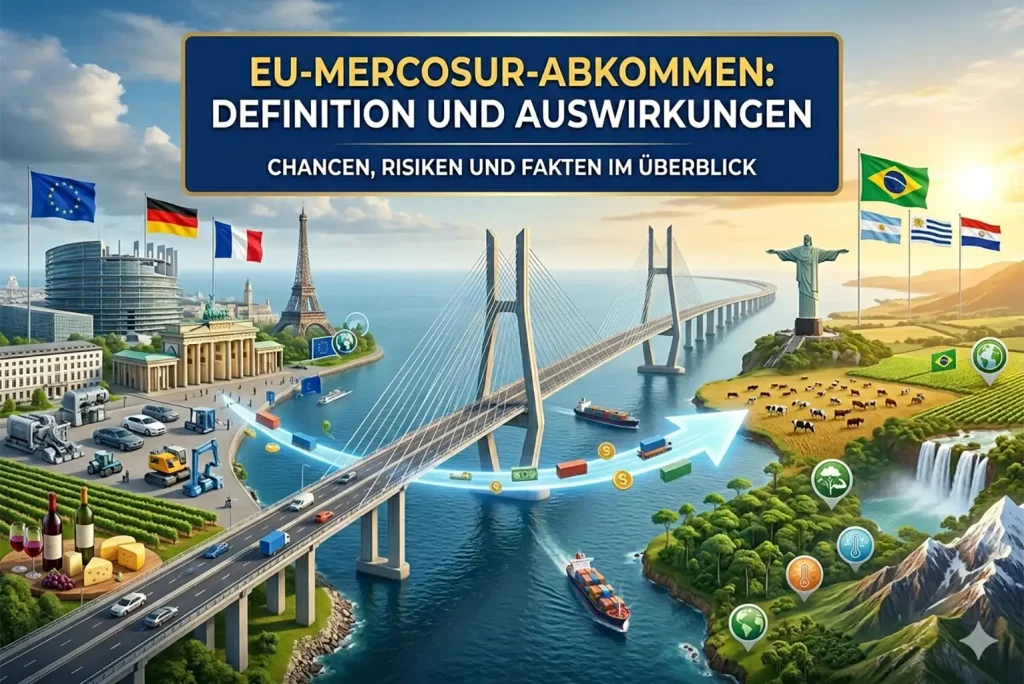
The EU-Mercosur Agreement It is the largest planned free trade agreement in the world. It aims to dismantle trade barriers between the European Union and the Mercosur states (Argentina, Brazil, Paraguay and Uruguay). While European industry hopes for massive savings on customs duties, ecological risks for the Amazon and existential pressure on domestic agriculture are at the centre of a critical debate.
Key Facts on the Mercosur Agreement
- Partner: EU-27 and the founding members of Mercosur (Brazil, Argentina, Uruguay, Paraguay).
- Market volume: Over 780 million consumers; saving approx. €4 billion in customs duties per year.
- EU export focus: Automobiles, mechanical engineering, chemical products, high-quality foodstuffs (wine, cheese).
- Mercosur export focus: Beef, poultry, soy, ethanol, and strategic raw materials.
- Core conflict: Economic benefits versus rainforest protection and adherence to European agricultural standards.
1. What is the EU-Mercosur agreement? (Definition)
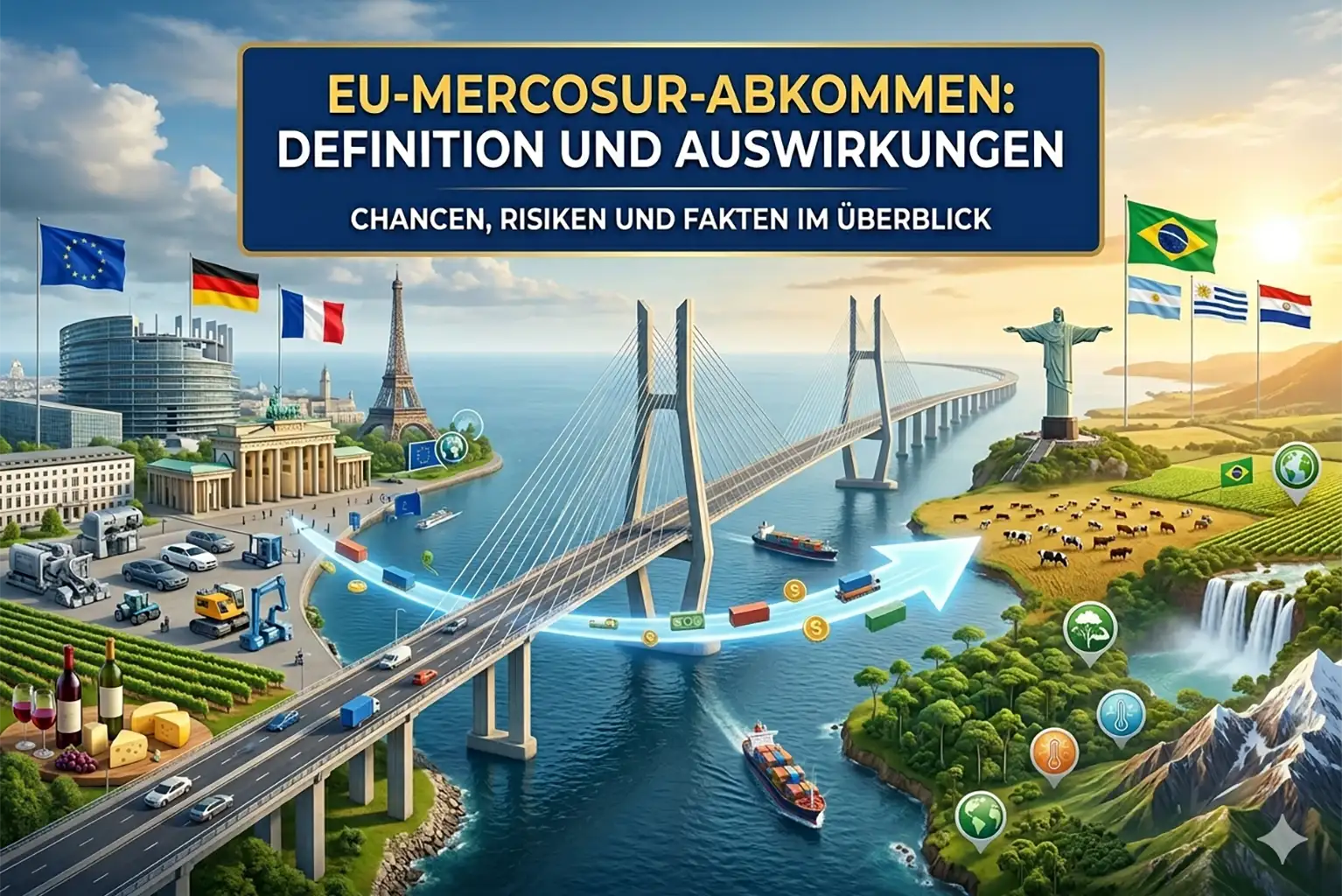
Essentially, it is about gradually abolishing or massively reducing tariffs on over 90 % of traded goods. For the EU, this means access to a market previously protected by high protectionist walls. For Mercosur states, it offers a historic opportunity to modernise their industrial base with European know-how and, at the same time, to emerge as a leading global supplier of agricultural raw materials and green energy (e.g. hydrogen). The negotiations are characterised by the search for a balance between market opening and the protection of sensitive national sectors on both sides of the Atlantic.
2. The economic repercussions for EU industry
For the European export economy, the agreement is considered a „game changer,“ as it often makes European products competitive in South America for the first time. Previously, many companies suffered from so-called „tariff barriers,“ which artificially inflated the price of imported goods.
- Automotive industryThe Mercosur region is one of the few major car markets that is not yet completely saturated. Tariffs of up to 35 % on vehicles and 18 % on spare parts are being abolished, paving the way for broad market penetration.
- Mechanical and plant engineeringEuropean high-tech products are in demand in South America to make local production more efficient. The removal of tariffs between 14 % and 20 % represents direct cost advantages in the billions for the European middle class.
- Pharma and ChemicalsIn addition to customs exemption, these sectors benefit from the harmonisation of technical standards. This means that medicines and chemical products no longer need to be certified twice, which massively shortens time to market.
- Geographical Indications: A major victory for EU diplomacy is the protection of over 350 product names (such as Champagne, Feta, or Parmigiano Reggiano). This prevents local imitations from being sold under these names.
3. Ecological Critique: The Amazon and Climate Protection
The ecological dimension is the Achilles' heel of the agreement. Critics argue that free trade creates a direct economic incentive to convert even more forest areas into pastureland or soy plantations.
„A trade agreement must never act as an accelerant for ecological crises; the protection of global commons such as the rainforest must be a prerequisite for economic cooperation, not its price.“
The EU has responded to this with the EU Deforestation Regulation (EUDR), which, from 2025/2026 onwards, strictly stipulates that products such as beef, soy and timber may only enter the EU if they demonstrably do not originate from land deforested after 2020. Nevertheless, scepticism remains high: experts doubt whether local authorities in South America have the means and the political will to monitor these supply chains without gaps. The danger of „greenwashing“, where goods from illegal logging are legalised through intermediaries, is a central criticism from environmental organisations.
Would you like a brief consultation on this?


4. The Perspective of Agriculture: Competition and Standards
For European farmers, particularly those in meat production, the agreement presents an existential threat. They operate in a high-price environment with extremely strict regulations on animal welfare, the environment, and worker protection.
- The cost clash: In Brazil and Argentina, agricultural businesses can produce at prices that are unattainable for European family farms, thanks to sheer economies of scale and lower wage and land costs.
- Pesticide Dualism: A sensitive issue is the use of active ingredients. Many pesticides used in the Mercosur region are banned in the EU due to their toxicity. The concern is that residues of these substances could reach European plates through imports, while domestic farmers are not permitted to use these agents.
- Market pressure: Even small import volumes can destabilise the sensitive European beef market and depress producer prices to such an extent that many farms are forced to cease production.
5. DEEP DIVE: The „Splitting“ Strategy – The Legal Path to Implementation
The legal construction of the agreement is highly complex and politically highly explosive. As the agreement has been blocked for years by national vetoes (e.g. from the Austrian National Council or the Walloon Parliament), the EU Commission has reassessed the procedure legally.
Legal splitting explained:
Rather than adopting a single, „mixed“ agreement, the treaty will be split into a pure trade part and a political cooperation part.
- The trade section falls within the exclusive competence of the EU. This means that a qualified majority in the EU Council and the approval of the European Parliament are sufficient for this. The national parliaments of the 27 Member States no longer have a direct veto right here.
- The cooperation section (e.g. human rights, cultural exchange) remains mixed and must continue to be ratified by all parliaments.
This strategy causes massive tension, as critics see it as an erosion of national sovereignty. Supporters, on the other hand, warn that the EU is becoming an unreliable trading partner worldwide if individual regional parliaments can block global treaties for decades.
6. Practical example: The export of a European mid-range car
To make the theoretical customs advantages tangible, the automotive industry serves as an ideal example. Let's take a typical electric vehicle produced in Europe:
No-deal scenario:
A car with a net price of €40,000 is charged a 35% % import duty when brought into Brazil (+€14,000). On top of this, there are complex local luxury taxes and logistics fees. In the end, the vehicle costs the end customer in Brazil almost twice as much as it does in Europe. This degrades European technology into a niche product for the super-rich.
With the agreement (stage plan):
Tariffs will not be dismantled overnight, but over a period of up to 15 years. In practice, this means: after just a few years, the tariff burden will fall to such an extent that the vehicle can become price-competitive with Asian imports. Furthermore, complex dual testing of airbags or exhaust systems will be eliminated, as Brazil largely recognises EU standards. This saves additional administrative costs in the six-figure range per exported model.
7. Current Status and Geopolitical Relevance (as of 2026)
In 2026, the geopolitical situation is more tense than ever. The EU-Mercosur agreement is now primarily viewed through the lens of security policy.
„In a world of shifting power blocs, the strategic partnership between Europe and South America is not a luxury, but a necessity, to secure global supply chains and defend common values.“
China has invested massively in South America's infrastructure over the past decade and is now the most important trading partner for Brazil and Argentina. The EU risks losing access to the „Lithium Triangle“ (Bolivia, Argentina, Chile), which is vital for European battery production. The agreement is therefore an attempt to strengthen South America's ties to the West and diversify dependencies on authoritarian regimes. After years of stalemate, additional protocols defining stricter environmental requirements have recently been adopted. However, ratification remains a political balancing act.
8. Conclusion on the EU-Mercosur Agreement: Opportunity or Risk?
The EU-Mercosur Agreement remains a hybrid of enormous economic opportunity and ecological risk. While it strengthens European industry and reduces dependence on China, it demands a high price in the form of potential environmental damage and a weakening of domestic agriculture. The success of the agreement in 2026 will depend significantly on whether the agreed protection mechanisms for climate and nature are actually effective or merely exist on paper.
The debate must not get stuck in rigid black-and-white thinking; rather, it requires a transparent, data-driven monitoring process that guarantees both economic fairness and ecological integrity. Ultimately, the agreement could set a global precedent for whether modern global trade is capable of ambitious Sustainability goals directly into their supply chains, rather than just treating them as an afterthought. The coming years will show whether the political courage is sufficient to master this balancing act between prosperity and environmental protection in the long term.
9. FAQ: Frequently asked questions about the EU-Mercosur agreement
Will the meat become cheaper as a result of the agreement?
Theoretically yes, due to the abolition of tariffs and higher import quotas for high-quality beef. In practice, however, new sustainability levies and the rising logistics costs for CO2-neutral transport could offset this effect.
What role does environmental protection specifically play?
The agreement includes a binding Trade and Sustainable Development (TSD) chapter. New mechanisms for specific sanctions will be introduced in 2026, which will apply if a partner country systematically violates the Paris Agreement on climate change – a first in EU trade policy.
Can individual countries still stop the agreement?
Only to a limited extent. Due to the splitting strategy, the trading part is largely protected from the vetoes of national parliaments. A country would now have to organise a blocking minority in the EU Council, which is difficult due to strong support from heavyweights such as Germany and Spain.
Which countries are members of Mercosur?
The founding members are Brazil, Argentina, Paraguay and Uruguay. Venezuela is currently permanently suspended due to violations of the block's democratic principles. Bolivia is in the advanced process of full membership.