




Procurement: Optimising Purchasing through 6 Pillars
Increasing demands, decreasing trust. Today's purchasers often face expectations they can no longer meet. Materials are expected to be sourced quickly, cheaply, and to a high standard, without causing problems – but training and an adequate number of staff are often prerequisites for success.
Dadr no budget is planned as procurement does not generate profit. After all, it „only" has to“something can be ordered - that can't be that difficult. Anyone who nods in agreement here is on the wrong track. Companies that optimise their procurement processes achieve measurable cost reductions and strengthen their competitiveness. Because the reality looks different.


The right foundation for successful – and profitable – procurement rests on 6 pillars:
These pillars do not stand alone, but are interdependent. Because of this interdependence, improvements to only one aspect are many times weaker than if all aspects are enhanced. Hence this holistic approach.
Strategy
When it comes to purchasing too, strategies serve to achieve objectives. Therefore, it is necessary to expand purchasing with strategic planning. Essentially, the focus here is on materials and suppliers. The well-considered bundling of orders saves costs and reduces the workload, which in contrast arises from impulse purchases. In parallel, suppliers are reorganised to optimally distribute the changed ordering processes.
Processes
Anyone who wants to optimise procurement processes must start with order processing. The Slimming down shortens the path between demand and delivery and provides a manageable overview. This introduces a system through which employees can send their orders directly to purchasing, rather than haphazardly sending orders to suppliers., the the purchase has to be painstakingly retraced.
Organisation
Similar to processes, organisation is about streamlining. Of particular note here is a clear division of tasks within the purchasing department. Who can departments turn to, who orders which product groups, who has to approve orders? Clear purchasing chains can be installed through e-procurement systems, which allow for a clear overview of all orders.
Employees
Every organisational step forward can only be achieved with employees who perform at a suitably high level. Many purchasing professionals are permanently assigned new tasks, yet training and appropriate further education are often neglected. In doing so, the complexity of purchasing is frequently overlooked, and employees are not adequately supported. Furthermore, trust, responsibility, and adequate remuneration form the foundation upon which management should build. This is because motivation does not arise on its own: with personal incentives and due recognition, a purchasing professional will significantly increase their performance, which in turn benefits the company.
Methods/Tools
However, engagement is not everything; it must also be implemented through the right working methods. This includes both supplier and material group management. These tools can achieve more cost-effective ordering processes, for example, by leading to more advantageous conditions through volume discounts.
Internal processes can be improved through ABC analyses, which represent the priority of goods or items and enhance a thorough cost structure analysis. This is because financial resources can often be saved in seemingly rigid processes, which can then be used far more effectively.
Controlling
Purchasing controlling stands above all individual processes. Through close monitoring of operations, it ensures that purchasing remains profitable and capitalises on emerging opportunities. This includes a structured key performance indicator system, which weighs all company items against each other, thereby ensuring clarity. Furthermore, controlling addresses aspects such as material price development and parts of risk management. Due to this overarching position, purchasing can react to market fluctuations in advance and make more flexible decisions.
SIX PILLARS, STABLE SHOPPING
Our 6-pillar approach anchors strategy, processes & Co. for a future-proof and high-performing procurement function.
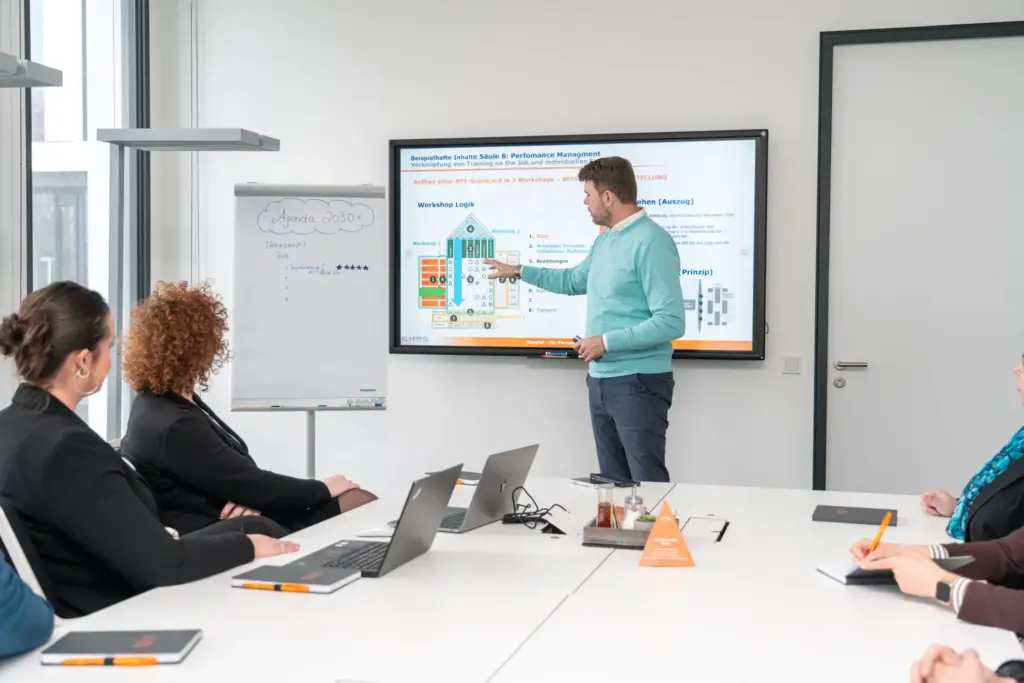
The technical departments: are they sacred cows or blind ones?
Purchasing can become a driver of returns within weeks once purchasing and technology truly work hand-in-hand. However, these opportunities are not being consistently seized. Design, production, and development do not take purchasing seriously as a competent partner. They speak different languages: some think in commercial terms, others in technical ones. For the entrepreneur, on the other hand, the technical departments are „sacred cows“. If revenue is to be generated, management first calls the technical and sales departments.
Technology and Purchasing – how can the potential for conflict be resolved?
For engineers, purchasing departments are often a red rag to a bull. There are fears of cost savings at the expense of their own department, product quality, and security of supply. Furthermore, technical departments are often so busy with projects that any additional change requests are perceived as an disruption.
Purchasing wants to cut costs. Technology wants the largest possible budget for the best product quality. Both departments need a common goal and a common language. The common goal must be to always stay one step ahead of the competition through innovation and the best price-performance ratio. Purchasing and technology must not compete with each other; they must collaborate constructively.
But how does good cooperation work?
On the one hand, the mutual need for support and decision-making powers must be established. On the other hand, the division of roles between purchasing and engineering, as well as the rights and obligations of the team members. It must be clarified who supports whom, how, and where, and who has which rights and obligations.
However, the prerequisite for this is that buyers and technicians speak each other's language. Technicians require a basic understanding of commercial matters and must be integrated into product group management. The buyer, in turn, must be able to read data sheets and technical drawings. Buyers must be able to assess functionalities, technical problems, compatibility, and quality.
If the buyer then sees themselves as more than just a pure procurer, as an interface, or rather as a connecting link between departments, a great deal has already been achieved. If these prerequisites are met, a simple measure, such as a joint barbecue, can help to break down old ways of thinking and behaving, allowing purchasing and engineering to get to know each other better and to openly address any misunderstandings and conflicts. Building on this, a workshop on specific projects or components is recommended. Here, the following core questions need to be clarified: What would each department have wished for? Why did who decide what? Who had what basis for their decision? This helps to dismantle silo thinking and allows everyone to understand each other's perspectives much better.
Corporate culture and open communication are, in turn, important for addressing and resolving conflicts or misunderstandings early on. Furthermore, island knowledge must be disseminated across departments through active exchange.
However, the buyer can do considerably more to earn respect.
How can purchasing gain respect?
By doing what, for example, the Hidden Champions demonstrate: using suppliers as a source of innovation and ideas. It is well known that it makes sense to continuously involve suppliers in product development. Yet, it is still done too rarely – partly out of habit, partly out of fear of opening up, and partly because the appropriate suppliers are missing. Procurement acts as the interface to the supplier here, who, as a development partner, provides ideas and helps to accelerate processes.
A practical example
An automotive manufacturer decided to commission an automotive supplier to develop a cast housing, rather than designing it themselves. To this end, installation space dimensions, functionalities and 3D contour data were to be provided to the supplier. Through the close collaboration between engineering and purchasing, a suitable supplier was then selected to accomplish this task. The prerequisites were the specialist knowledge of the supplier and ongoing, open communication between development and purchasing. The result was a product that was thinner-walled, lighter, and cheaper, and everything was completed within the specified timeframe.
Savings potential through suppliers
Teamwork between Purchasing and Engineering as a driver of profit and innovation
What may sound provocative to engineers at first glance, reveals itself as a veritable treasure trove for the company on second glance. A look at the following figures is undoubtedly worthwhile: In mechanical engineering, for example, about 60 percent of costs consist of purchased materials. Technically proficient purchasers, as well as suppliers, must be involved early in product development here. Through this involvement of purchasing and suppliers, it is possible to inform technical departments about cost developments in a timely manner and correct any misjudgments. To this end, purchasing must be able to moderate and systematically manage the interface between supplier and technical departments.
In cost reduction projects, procurement must be an active driver. This must then always be in close cooperation with engineering. This requires support from top management, as well as regular reporting, transparency, an escalation management process and regular training.

Would you like to learn more about procurement processes or do you have other questions about KLOEPFEL Consulting?

Duet of Shopping and Business Management:
Optimising Procurement Processes – Seven Ideas for Management
Often underestimated and yet so profitable: hidden gains can be found within procurement processes. You just need to know how to bring them to light.
Awareness of the value of procurement is also increasing in the medium-sized business sector. However, many buyers still lack the necessary support from management to fully utilise their capabilities.
Those who expect performance should reward performance
Procurement is not merely an ordering department, but can take the reins and act independently. However, there is a considerable deficit in this regard: while sales and marketing are still promoted as profit-generating departments, procurement is usually treated as a poor relation. Purchasers lack fundamental support from senior management: innovative ideas are not realised, and suggestions for savings are dismissed as unimportant. Employee motivation? Non-existent in procurement. Thus, payment is often not based on performance, but on a fixed basic salary. Buyers with personal incentives would seize far more opportunities, negotiate harder, and strive for further optimisation. Therefore, it is advisable to give them exactly this motivation and aim for performance-based remuneration.
Optimising procurement processes – Strengthening strategic purchasing
The day-to-day life of a buyer is often overloaded with operational tasks. There is little time for thoughtful planning, leading to a reactive rather than proactive approach. Relying on tried-and-tested patterns is not inherently bad, but it can become a disadvantage when the market environment changes and one's own methods are no longer up-to-date. The risk of being edged out by competitors, who have recognised their potential, constantly grows. Instead of simple data processing, a strategic approach to purchasing would be considerably more profitable. If you wish to optimise your procurement processes, outsourcing purchasing and logistics, or establishing novel analytical tools such as the purchasing tracker, can help.
Observe, plan, implement – adapting one's own procurement to new developments happens both inside and outside the company and requires constant attention.
Without a plan and structure – coordination in the company
„We'll just order it ourselves, it works out better.“ This sentence is often used by specialist departments to order goods independently. Many employees tend to forget that there is actually a responsible purchasing department for this. As many companies struggle with „Maverick Buying“, also known as rogue purchasing. Departments order at their own discretion, often causing unnecessary deliveries. The reason for this is the lack of acceptance of the purchasing department. Employees don't trust buyers to be able to order the necessary products correctly. The consequences: excess inventory, high costs due to individual orders, and too many overpriced suppliers.
This problem can be solved using the principle of material group management. Goods are classified into different categories in order to cover similar materials with as few suppliers as possible. The groups are selected by subject matter experts from purchasing and other departments. Furthermore, it is extremely helpful to standardise products rather than designing each item from scratch, as large order volumes of identical components allow for discounts to be negotiated.
Just-in-Time rhythm
When production comes to a standstill, it costs money. It disrupts internal processes and should be avoided at all costs. However, if essential materials are missing, downtime is unavoidable. There's the option to order and stock products in large quantities. But this is counteracted by storage costs and the risk of the goods' value decreasing due to damage or price fluctuations. The company's financial liquidity is also strained when payment for large delivery volumes is due.
Goods deliveries using the just-in-time principle provide a solution. It dictates that goods deliveries occur at regular intervals, always supplying precisely the required quantities. This prevents the company from grinding to a halt and simultaneously rids it of storage risks. However, the supplier must also coordinate their stock levels and necessarily requires a fixed ordering rhythm for constant delivery dates. Consequently, clear deadlines must be set in purchasing for when departmental orders can still be accepted and processed to arrive with the next scheduled delivery. Orders for special items that may be needed at short notice are excluded from this.
Optimise existing contracts
Especially with established companies, there are supplier contracts that have often been in place for a long time. They were drawn up under the best conditions at the time and were fair to all parties. However, external and internal factors change over time. The conditions that were previously favourable are now no longer sustainable for the company. Therefore, if the supplier strictly adheres to the agreed-upon purchase quantities and prices, there will be no happy ending to this business relationship.
A renegotiation of contracts is due: commodity prices must be adjusted to market levels, and superfluous costs with the supplier shall be saved where necessary. Purchase quantities will be made more flexible and aligned with the buyer's requirements in order to compensate for order fluctuations. If a buyer approaches suppliers with these requests, approximately half will, based on experience, concede to the demands. The rest will either negotiate compromises or reject any negotiations entirely. Thus, new contracts can be concluded with three-quarters of the suppliers.
Single or multi-sourcing?
It is, of course, extremely convenient when all the necessary goods can be ordered from a single provider. However, this also creates a dependency. If a business relies on one supplier and even structures its production around them, it puts itself in an unfavourable position. A supply bottleneck leads to downtime, and the company has little leverage against a price increase. If the provider changes the design or quality of their products, the buyer also has to adapt.
The situation is different when product standardisation leads to several suppliers being available. If one then fails, this can be compensated for quickly and easily. Multi-sourcing is more complicated to coordinate, but it is worthwhile. The existing competition will make suppliers more willing to offer better terms and make them more flexible. The bundled allocation of orders is also helpful, whereby all similar goods are covered by one to two suppliers. This way, maximum volume discounts are achieved for the same purchasing volume.
Nicht in Deutschland hergestellt
Have you ever considered whether foreign suppliers might be worthwhile for you? Many entrepreneurs will already be shaking their heads. Lack of quality, long delivery times and high shipping costs. Added to this are the problems with language barriers and foreign customs. The effort seems to outweigh the benefit.
However, in reality, global sourcing certainly has potential. Suppliers from Eastern Europe or Asia may be far away, but their quality is increasingly approaching Western European standards while their prices remain low. Supply chains are becoming more stable and faster, and communication is better than before thanks to the global language of English. Although small order quantities are not yet profitable, larger orders are definitely worthwhile. To achieve this, a company needs two essential prerequisites: Firstly, a strategically planned inventory management system, allowing orders to be placed well in advance. This helps to offset fluctuations in delivery times. Secondly, the ability to store larger quantities of goods, thereby securing volume discounts and consolidated shipping costs.
Outlook
So, there are numerous ways to achieve savings in purchasing. The prerequisite for this is the willingness to make even significant changes. Transitional solutions and half-hearted attempts will bring about equally minor improvements. Therefore, to achieve clear gains, competent personnel and specialist knowledge are required. Many buyers can offer that, but are limited by management in their scope of action and cannot apply their knowledge. In other situations, the relevant employees simply lack the necessary knowledge to identify the necessary weaknesses within their company. Here, external support is often the only option, whether through specialised consulting firms or advice from within the business community. Even looking at competitors can reveal new opportunities in some cases. Whichever way it is approached, looking into procurement is worthwhile.
Further services relating to
The topic of structural and process optimisation

Digitalisation in purchasing

Transformation