




First and foremost:
The choice between Single and Multiple Sourcing has evolved in 2026 from a purely operational pricing issue to an existential decision regarding company resilience. While single sourcing convinces with maximum economies of scale and deep innovation partnerships for complex A-parts, multiple sourcing serves as indispensable insurance against geopolitical and logistical shocks. The strategic „gold standard“ for critical components today is dual sourcing, which combines the efficiency of a close relationship with the security of a redundant supply chain.
Key Facts on Single vs. Multiple Sourcing
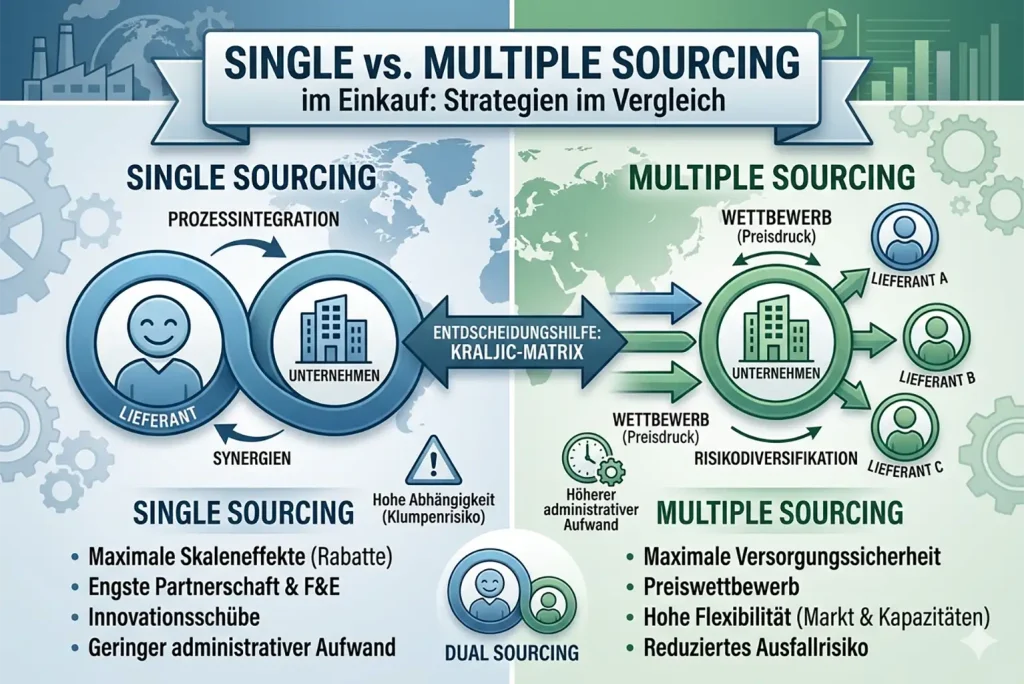
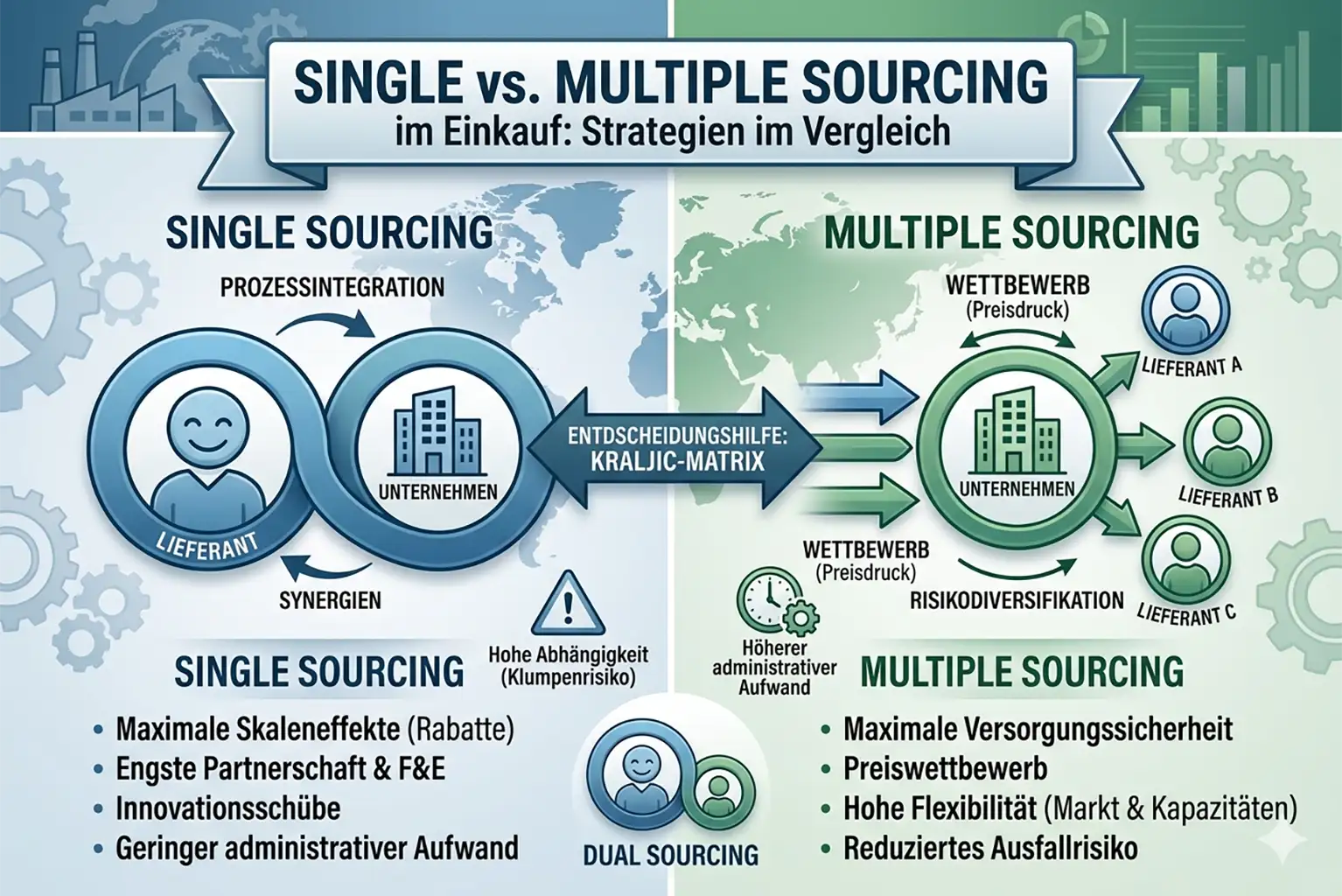
- Single Sourcing: Concentration on one partner. Advantage: Deep IT integration and innovative strength. Risk: Total dependency (single point of failure).
- Multiple Sourcing: Splitting volume across multiple suppliers. Advantage: Maximum security of supply and price competition. Disadvantage: High management overhead.
- TCO Focus: In 2026, the decision will no longer be made on the unit price, but on the Total Cost of Ownership (TCO) including a calculated risk premium.
- Strategy Trend: „De-risking“ through regionalisation (nearshoring) while simultaneously leveraging global price advantages via hybrid sourcing models.
1. Definition: The strategic importance of supplier selection
This decision is not a static process but a dynamic element of corporate management. Those who opt for a strategy determine how closely the fate of their own company is linked to the success or failure of external partners. In a globalised, yet increasingly unstable, economic world, supplier selection becomes a strategic lever that decides profit margins and market presence.
2. Single Sourcing: Maximum efficiency through exclusive synergies
Single sourcing describes the conscious decision to forgo alternative suppliers in favour of an exclusive relationship for a particular product group or specific component. In an era where efficiency is often considered the highest good, this approach offers benefits that go far beyond mere discounts.
The strategic depth of single sourcing: Through the Bundling Significant economies of scale arise from the entire volume being with a single partner. The supplier can plan their production long-term, invest in specific tooling, and pass these cost advantages on to the buyer. Even more important, however, is process integration: In 2026, ERP systems will communicate via API in real-time, enabling automated inventory management (Vendor Managed Inventory). Furthermore, joint innovation is a crucial factor. A supplier who is confident in their exclusivity is more likely to share their expertise for co-creation projects, securing your company a technological advantage.
The flip side of the coin: However, this closeness is a double-edged sword. Total dependence means that every problem the supplier has – whether financial, political, or due to force majeure – immediately becomes your problem. Furthermore, there is a risk of technological stagnation if the partner slows down the pace of innovation, as switching is often economically unappealing due to high conversion costs (lock-in effect).
3. Multiple Sourcing: Supply security in volatile markets
When companies divide the demand for a good among three or more suppliers, we refer to it as multiple sourcing. This strategy is the classic response to uncertainty and is primarily found with standardised products.
Resilience through diversification: The core advantage lies in Risk management. If a supplier fails due to geopolitical tensions, strikes, or logistical problems, the remaining partners can usually fill the gap at short notice. At the same time, multiple sourcing ensures permanent price competition. Suppliers are aware of their interchangeability and are more willing to go to their limits with terms and service levels.
„Whoever bets their future on a single card relinquishes control of the game.“
Administrative challenges: The price for this security is a drastically increased administrative complexity. Purchasing must negotiate multiple contracts, harmonise different quality standards, and coordinate diverse logistics flows. Furthermore, the individual importance of the buyer to the individual supplier diminishes. In times of raw material scarcity, the supplier will first serve those customers who represent a strategic priority for them – a status that is often lost when splitting volumes.
Would you like a brief consultation on this?


4. The direct comparison: A narrative alignment of strategy values
To understand the differences without rigid tables, one must consider the company's goals. Single sourcing is the strategy of optimisation. This is about achieving the maximum in cost efficiency and technological depth from a stable situation. It is the tool for specialised A-parts, where trust in the partner forms the basis of production.
Multiple sourcing, on the other hand, is a strategy of hedging. The focus here is not on the last percentage point of the unit price, but on the guarantee that the assembly line will never stand still. It is the method of choice for commodities and standardised components where the market is broad enough to activate alternatives at any time. While the single sourcer relies on the power of commitment, the multiple sourcer trusts in the dynamics of the free market.
5. Dual Sourcing: The Strategic Centre in Modern Procurement
Dual sourcing has established itself by 2026 as the intelligent compromise. A volume split of around 70/30 or 80/20 is usually practised. The main supplier ensures economic viability and process proximity through the high volumes, while the secondary supplier acts as an active safety net.
The decisive advantage: the delivery route to the second partner is already qualified and „warm“. Master data has been created, quality has been checked, and the logistics routes are established. If a disruption occurs with the main supplier, the company can ramp up volumes with the secondary supplier within a few days, instead of having to search for a new source for months. It's the insurance that has already been taken out before the fire starts.
6. Deep Dive: Total Cost of Ownership (TCO) as the True Decision-Making Basis
A common mistake in strategic purchasing is focusing solely on the purchase price. To make an E-E-A-T-compliant decision between single and multiple sourcing, an analysis of the Total Cost of Ownership Indispensable.
In a world of volatile energy prices and CO2 taxes (CBAM), looking at supply alone is no longer enough. A TCO model in 2026 will take into account:
- Transaction costs: The internal effort for communication, invoice verification, and master data maintenance.
- Quality Costs: Costs for audits, scrap, and rework from various sources.
- Logistics costs: Freight, customs duties, insurance and the costs of capital tie-up during long sea voyages.
- Risk Premium: A mathematical assessment of default probability.
„The cheapest price is often the most expensive way to buy, if you forget the cost of risk.“
Only when these factors are aggregated does it often become apparent that a supposedly more expensive local second supplier (dual sourcing) reduces overall costs over the product life cycle by minimising the risk of costly line stoppings.
7. Practical Example: From Dependency to a Resilient Supply Chain
A medium-sized manufacturer of control units sourced its circuit boards exclusively from a highly specialised partner in Asia for years (single sourcing). Profitability was excellent until, in 2025, a regional logistics lockdown interrupted deliveries for eight weeks. The production stoppage cost the company €1.8 million in lost contribution margins and contractual penalties.
The Realignment: Following the crisis, a shift was made to dual sourcing. 75 % of the volume remained with the Asian partner to maintain cost advantages. 25 % were placed with a local manufacturer in Eastern Europe. Although the local circuit boards were 15 % more expensive per unit, the company was able to switch immediately during the next minor disruption in Asia and maintain production at 80 % capacity. The additional costs of local sourcing were amortised in advance by the avoided costs of downtime over the next three years.
8. The Kraljic Matrix: A Tool for Portfolio Optimisation
To determine the sourcing strategy based on facts rather than gut feeling, the Kraljic matrix serves as a compass. It assesses items based on supply risk and their impact on the bottom line.
- Strategic articles (high value, high risk): Single or dual sourcing with a focus on long-term contracts and partnerships is essential here.
- Leveraged products (High value, low risk): Multiple sourcing is the order of the day here. The market is transparent, and procurement uses its power to control prices.
- Critical low-value, high-risk items: Safety over price. Multiple sourcing or high safety stocks are vital.
- Uncritical articles (C-parts): Single sourcing via system suppliers is advisable here to keep the process costs for small parts (screws, office supplies) to a minimum.
9. Conclusion: Strategic Decision-Making: Single vs. Multiple Sourcing
In summary, there will be no one-size-fits-all ideal solution for procurement in 2026. While single sourcing is the scalpel for precise Cost optimisation and innovation, multiple sourcing provides the shield against the uncertainties of the global market. The art of a modern purchasing manager lies in diversifying the portfolio so that efficiency reigns where stability is present, and redundancy is built up where risks lurk. The strategic balance in deciding for Single vs. Multiple Sourcing in Purchasing ist heute kein reiner Kostenfaktor mehr, sondern der Garant für die Zukunftsfähigkeit Ihres Unternehmens.
10. FAQ: Key Questions about Single vs. Multiple Sourcing
When is single sourcing absolutely necessary despite the risks?
Single sourcing is often unavoidable when technical requirements are so specific that only one supplier can deliver the required quality, or when extremely high tooling costs make it economically impossible to split the volume.
Can AI mitigate the disadvantages of multiple sourcing?
Yes, absolutely. Modern software will automate large parts of supplier management, master data maintenance, and quality monitoring by 2026. This will massively reduce transaction costs and make multiple sourcing profitable even for smaller companies.
Why do many companies fail at dual sourcing?
Backup suppliers are often given too little volume. A partner who only receives 2 % of the requirement will not prioritise you in an emergency. A minimum quantity of 20–30 % is necessary to be perceived as an important customer.
How does the German Supply Chain Due Diligence Act (LKSG) influence the choice between single vs. multiple sourcing in procurement?
The law increases the documentation effort. Single sourcing makes monitoring easier, as you only have to check one partner. With multiple sourcing, the auditing effort multiplies, which drives up the process costs of this model.