



First and foremost:
Demand Management is far more than a mere sales forecast; it is the strategic nerve centre of a resilient business. Through the precise synchronisation of market signals with the operational capacities of Supply Chain warehouse costs are reduced, delivery reliability is maximised, and capital commitment is minimised. In an era of global volatility, the quality of demand management determines a company's ability to act proactively in the market, rather than just reactively.
Key Facts on Demand Management
- Core objective: To create a dynamic balance between market demand and supply capacity to avoid stockouts and overcapacity.
- Methodology: Integration of statistical demand planning, real-time demand sensing, and active demand shaping through marketing and pricing.
- Competitive advantage: Reduction of safety stocks, often by 15–25 %, while simultaneously increasing service levels.
- Technology: Transitioning from simple spreadsheets to AI-powered Advanced Planning & Scheduling (APS) systems.
- Strategic Focus: Avoiding the bullwhip effect through transparent data flows along the entire value chain.
1. What is Demand Management? An in-depth definition
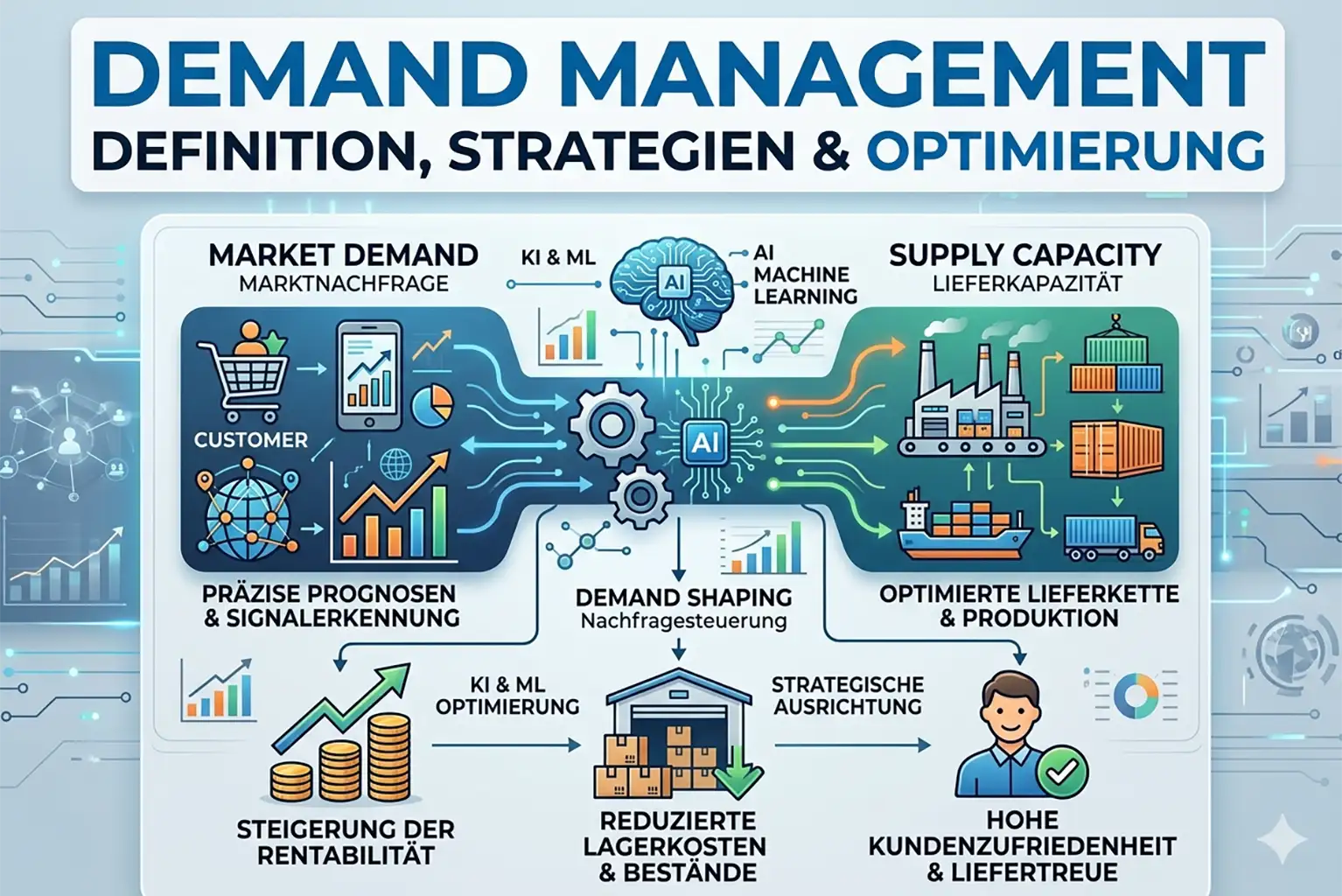
Unlike pure sales, this is not just about selling, but about coordination. The goal is to create a „single point of truth“ for planning, so that production, Procurement and Logistics work from the same information basis as sales. It is therefore the discipline that replaces uncertainties in planning with data-based probabilities and ensures that resources are deployed precisely where the highest value is generated.
„In a world full of volatility, the ability to not just anticipate demand, but strategically steer it, is the difference between mere survival and market leadership.“
2. The three pillars of modern demand management in detail
To build a robust system, businesses must master three distinct time horizons and methods:
- Demand Planning (The Strategic Foundation): This involves medium to long-term planning. Experts use statistical methods such as exponential smoothing or regression analysis to extract seasonal patterns and trends from historical data. This step forms the basis for investment decisions.
- Demand Sensing (Tactical Early Detection): In a volatile world, historical data is often insufficient. Demand Sensing uses short-term signals – such as current point-of-sale (POS) data, weather changes, or market trends – to correct the forecast for the next few days or weeks in real-time.
- Demand Shaping (Active Influence): This is the „royal discipline“. When a company recognises that demand exceeds (or falls below) capacity, it intervenes actively. Through dynamic pricing, targeted advertising campaigns, or adjusting delivery times, demand is shaped to optimally fit the supply chain.
3. Effective Management Strategies: Active vs. Passive
The choice of strategy depends significantly on market power and the flexibility of one's own production:
The passive/reactive strategy: Companies in very stable markets often act passively. They accept demand as given and merely optimise their internal buffers. The disadvantage: In times of crisis, these companies are often too slow, leading to high losses due to stockouts.
The active/proactive strategy: Here, the market is regarded as being capable of being shaped. This strategy requires close integration with marketing. A classic example is the aviation industry: through yield management (price adjustments depending on booking status), capacity utilisation is actively controlled in order to maximise profitability.
Would you like a brief consultation on this?


4. The Demand Management Process: Integration into S&OP
Modern demand management is almost always part of Sales & Operations Planning (S&OP) and follows a clear cycle:
- Data Management: Consolidation of data from ERP, CRM, and external sources, as well as the cleansing of statistical „outliers“.
- Basis Forecast: Algorithms create an initial draft based on mathematical models without human bias.
- Collaborative Overlay: Sales teams supplement their market knowledge regarding planned promotions or competitive changes.
- Consensus Meeting: Moderation between Sales (desiring high stock levels) and Finance (desiring low capital tied up) towards a joint plan.
- Monitoring: Continuous comparison of the forecast with actual data for ongoing process improvement.
5. Deep Dive: The Bullwhip Effect and the Role of Data Transparency
The bullwhip effect describes a phenomenon where small fluctuations in end-customer demand are massively amplified by safety buffers at each stage of the supply chain. At the end of the chain, this results in massive overstocks or sudden capacity bottlenecks, causing enormous costs.
Demand management breaks this vicious cycle through information sharing. When the producer has direct access to real market data, they see the true demand and do not have to guess based on distorted order signals. This is the foundation for modern concepts such as Vendor Managed Inventory (VMI).
6. Practical Example: Scaling and Crisis Management in Retail
A global sports apparel manufacturer during a Football World Cup illustrates the value of the process:
- Without Demand Management: The manufacturer produces based on previous year's figures. If a team surprisingly reaches the final, the shirts are immediately sold out. Subsequent production takes too long – revenue is lost.
- With Demand Management: The company uses Demand Sensing. It already identifies the trend after the first games through search queries and early shop data. Through Demand Shaping, prices for less popular teams are lowered, while logistics for top jerseys are immediately switched to air freight to guarantee availability.
7. Optimisation through Technology: From Heuristics to Machine Learning
The future of demand management lies in artificial intelligence. AI systems offer three crucial advantages today:
- Pattern recognition: AI finds correlations between seemingly unrelated data (e.g. the impact of petrol prices on outdoor equipment).
- Automation: routine decisions are automated, allowing planners to focus on critical exceptions.
- Precision: Modern ML models often reduce forecast error by 10 to 30 %, which directly lowers inventory costs and increases liquidity.
8. Conclusion: The Strategic Relevance of Demand Management
In an era of volatile markets and fragile supply chains, demand management is the anchor for economic stability. It transforms vague estimates into actionable data, and is the only discipline capable of bridging the natural gap between market volatility and industrial inertia.
„Efficiency in the supply chain doesn't start in the factory, but in a deep understanding of what the customer will truly desire tomorrow.“
Companies that master this process are not only more profitable but also more resilient to crises. This is not just about implementing new software, but about a fundamental cultural shift away from siloed thinking towards integrated, data-driven collaboration. Ultimately, excellence enables Demand Management the transformation from a purely product-driven to a truly customer-centric organisation that can react flexibly and proactively to global changes. The combination of human expertise and technological support forms the indispensable foundation for long-term market success.
9. Gestions of Demand FAQ: Frequently Asked Questions
Why isn't forecast accuracy alone sufficient?
Because it only evaluates the past. A good process also considers „bias“ (systematic deviations) and the financial impact of forecasting errors. It is more important to be accurate with expensive key products than with C-items.
Which software solutions are leading the market?
In the enterprise segment, SAP IBP and Oracle dominate. For SMEs, cloud-based add-ons for common ERP systems are increasingly making AI functionalities affordable.
What role does sustainability play?
A huge role. Precise demand management avoids overproduction. This saves resources, reduces waste, and actively protects the environment through optimised transport routes.
What is the difference to sales forecasting?
Sales forecasting is often a target value for sales („What do we want to sell?“). Demand management is a reality check that balances these wishes with delivery capability and market conditions.