




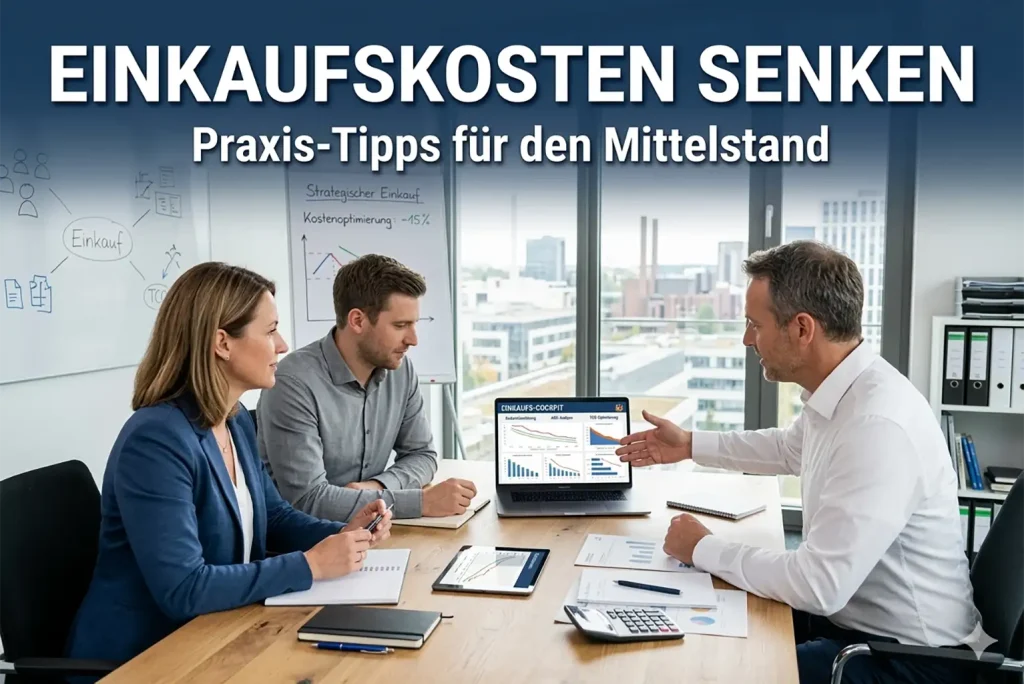
Small and medium-sized enterprises can their Reduce purchasing costs, by transforming it from a pure order management system into a strategic Supply Management change. The most effective levers are the bundling of requirements, a consistent ABC analysis and the use of value engineering. Those who also digitalise their C-Parts processes reduce process costs by up to 30 % and directly increase net returns.
Key Facts for Decision Makers
- Definition: Procurement costs include the purchase price plus all internal process costs (TCO).
- Lever 1: ABC Analysis – Separation of valuable A-items and process-intensive C-parts.
- Lever 2: Value Engineering – Cost reduction during the construction phase.
- Lever 3: Digitisation E-Procurement frees up purchasing from „paper-shuffling“.
- Lever 4: Demand Aggregation – Savings of 10–20 % through strategic volume concentration.
1. Definition: What does it mean to reduce purchasing costs?
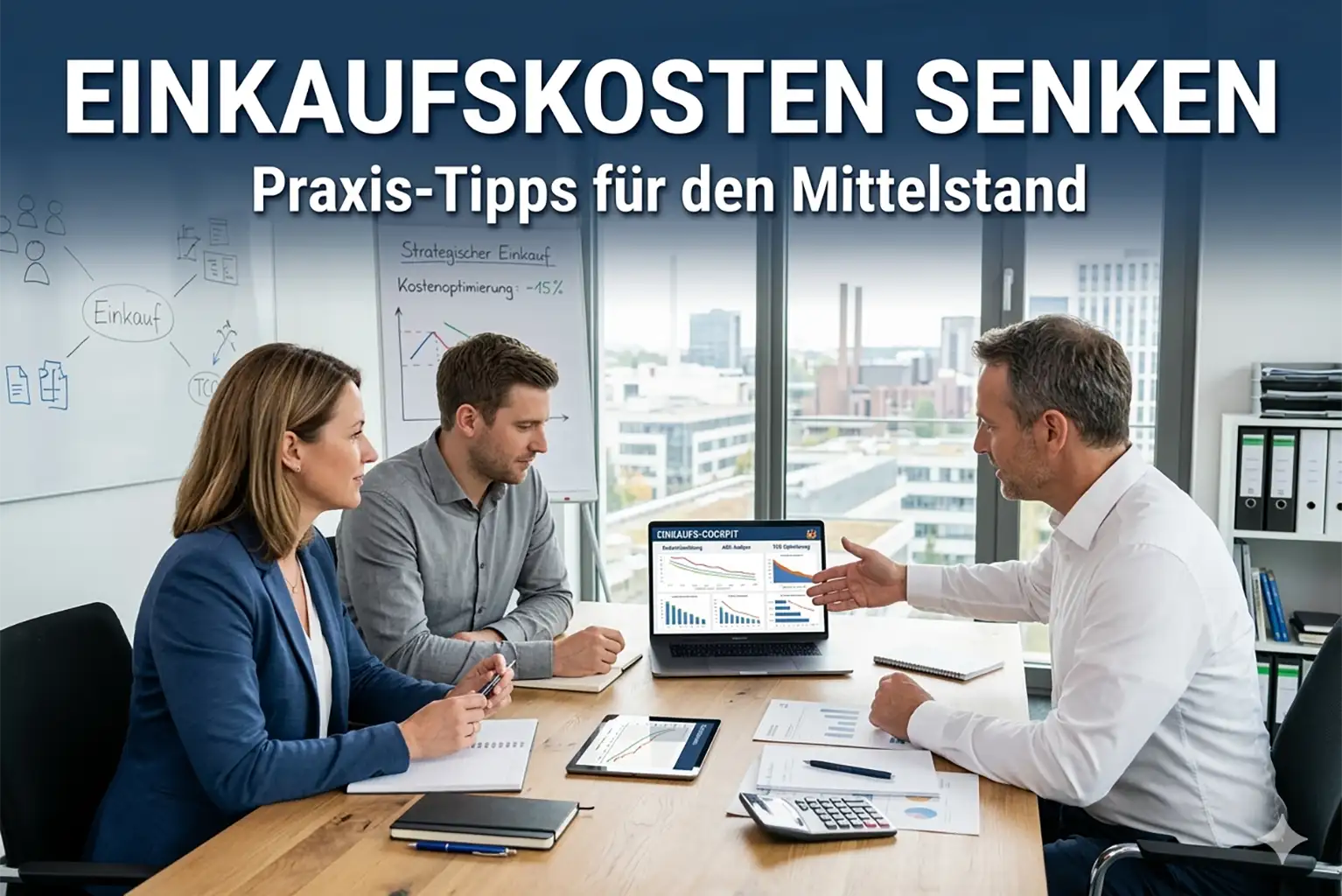
One distinguishes between:
- Direct procurement costs: Net prices for production materials.
- Indirect procurement costsCosts for logistics, quality assurance and internal administration (procurement).
„The profit is in the purchase.“
2. The starting position: Why procurement saves returns
In Germany's Mittelstand, purchasing is often misunderstood as a purely administrative support function. Yet, material and service costs frequently account for over 50 % to even 70 % of a company's total expenditure. This is where the so-called „profit lever effect“ is hidden: a reduction in material costs of just 5 % often has as strong an impact on earnings before tax as a revenue increase of 20 % or more. While a revenue increase requires massive marketing and additional sales capacities, every euro saved in purchasing goes directly to profit.
Medium-sized companies often tend towards historically grown, decentralised structures. Department heads place orders independently of one another, which leads to a fragmentation of the supplier base. Breaking down these silos not only creates financial flexibility but also improves liquidity and resilience to market fluctuations. In times of volatile commodity markets, a strategically positioned purchasing department is not a „nice-to-have“ but the fundamental safeguard of competitiveness.
3. Transparency through ABC analysis: Where to start
Efficiency means investing time where it is worthwhile.
- A Goods: High value (80 %). These are hard-negotiated and closely monitored.
- B-goods: Medium value. Standardisation is the goal.
- C-goods: Low value, but 80 % of the workload. The aim here is process automation, as in-house processing is often more expensive than the part itself.
Would you like a brief consultation on this?


4. Strategic Negotiation: Consolidating volumes and leveraging benchmarking
The bundling of requirements is the most powerful tool for achieving economies of scale. When different departments or locations procure their requirements independently, they forfeit negotiating power. By consolidating these volumes, a small buyer becomes a key account for the supplier. This not only enables better prices but also more advantageous payment terms and delivery conditions (e.g., Vendor Managed Inventory).
In addition, supplier benchmarking is essential. It is not enough to rely solely on long-standing, trusting partnerships. A structured market comparison using RFI (Request for Information) and RFQ (Request for Quotation) ensures that you are not paying above market level. This is not about short-term „squeezing,“ but about transparency. Professional benchmarking uses shadow calculations to understand how the supplier's price is arrived at. Only those who know the cost structure of their counterpart can Negotiations Act on an equal footing and jointly look for savings potentials that benefit both sides.
5. Deep Dive: Value Engineering – Reducing costs before purchase
However, strategic purchasing doesn't start with the supplier, but at the drawing board. Value engineering (value analysis) questions the function of a component:
- Material substitution: Does it have to be stainless steel or is a composite material sufficient?
- Complexity Reduction: Can three different types of screws be replaced by a single standard norm?
- Avoiding over-engineering: do we need a tolerance of 0.001 mm when 0.05 mm is sufficient?
6. Digital Efficiency: Drastically reducing procurement process costs
Process costs are massively underestimated in SMEs. Every manual order - from obtaining quotations and creating orders in the ERP system to manual invoice reconciliation - costs between €80 and €150 on average. With C-Parts such as industrial safety equipment or standard spare parts, this administrative effort often exceeds the actual value of the goods many times over.
The solution lies in the radical digitisation of these processes. E-procurement solutions enable the introduction of catalogue-based ordering systems, where the specialist department orders directly, while procurement merely controls framework agreements and budgets in the background. Automated workflows and Electronic Data Interchange (EDI) eliminate manual sources of error, and invoice verification can be carried out almost completely without human intervention through automated „three-way matching“ (matching of order, goods receipt, and invoice). This frees up valuable capacity in procurement, which is urgently needed for strategic tasks such as Supplier risk management or market analysis is required.
7. TCO Model: Why the Cheapest Price Is Often the Most Expensive
The „Total Cost of Ownership“ is the only honest metric. The formula is:
TCO = Purchase Price + Setup + Operating Costs + Maintenance + Disposal
„If you only look at the price, you often lose sight of the costs.“
A cheaper overseas supplier, with a 12-week delivery time and a higher defect rate, is often more expensive than the local partner who delivers „just in time“.
8. Practical example: How a mechanical engineering company reduced its costs by 15 %
„Mittelstand GmbH“ (name changed) was facing declining margins. Their approach:
- Current Situation: 15 tool suppliers, over 1,200 invoices per year.
- Measure: Bundling to a system supplier for C-parts and digital processing.
- Result: 8 % Price savings through volume bundling and reduction of invoices from 1,200 to 12 per year. The purchasing manager regained time for strategic negotiations.
9. Conclusion: Sustainable reduction of purchasing costs
To successfully the To reduce purchasing costs, The Mittelstand must move Purchasing out of its administrative silo. The combination of technical understanding (Value Engineering), data analysis, and modern software is key. A strategically positioned Purchasing department is no longer a cost factor today, but a profit centre that directly contributes to the company's success.
10. FAQ: Frequently Asked Questions about Reducing Procurement Costs
What is the first step in reducing purchasing costs?
Create a spend analysis: Who bought what from whom at what price last year? Without this transparency, the basis for negotiation is missing.
Is it always sensible to buy cheaply abroad?
No. Always consider the TCO. Transport costs, customs duties, and quality risks can quickly erode the price advantage.
How do suppliers react to bundling?
Mostly positive, as they also save on process costs if they can manage one large framework agreement more efficiently instead of many small orders.