




The most important points in brief:
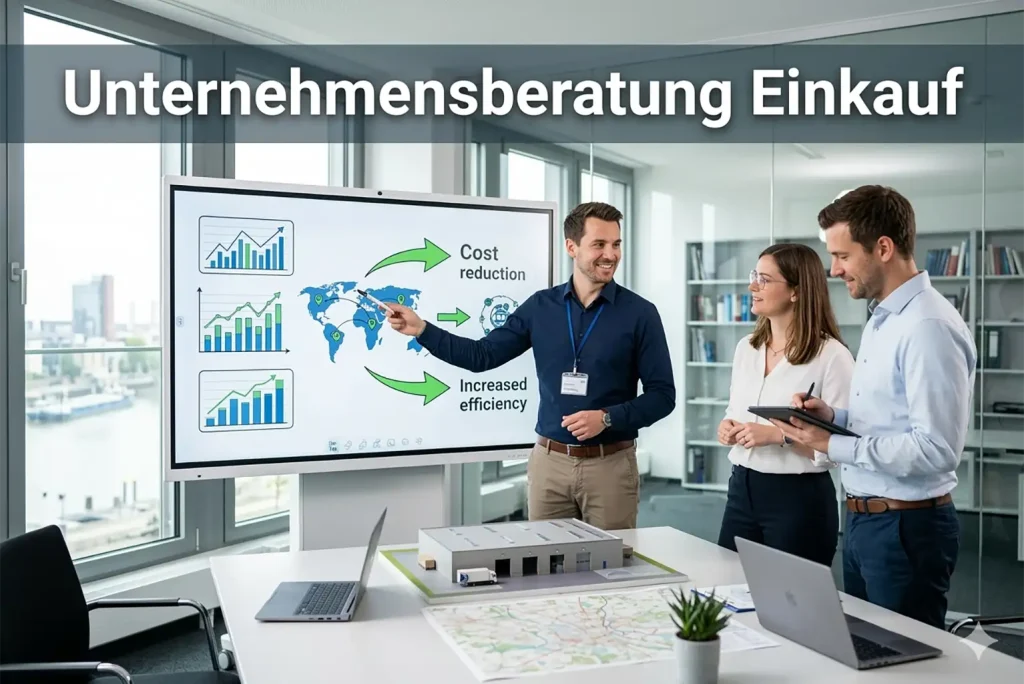
A specialised Procurement consulting enables medium-sized companies to sustainably reduce their total cost of ownership (TCO) by 5 % to 15 %. In a volatile market environment, it transforms procurement from a purely administrative function into a strategic value driver that secures supply chains and directly increases profit margins. Through professional leverage, procurement thus becomes the decisive factor for competitiveness.
Key Facts: Management Consulting Procurement
- Strategic support for optimisation Procurement processes, Cost structures and supplier relationships.
- Leverage: 1 % saving on purchases can often boost profit margins more than 5 % more sales.
- Core competencies: Global Sourcing, Risk management and the digital S2P (Source-to-Pay) transformation.
- ROI: Consulting projects usually pay for themselves within 6 to 12 months through realised P&L effects.
- Focus on SMEs: Practical „hands-on“ implementation and knowledge transfer rather than pure theory.
1. Definition: What is a procurement consultancy?
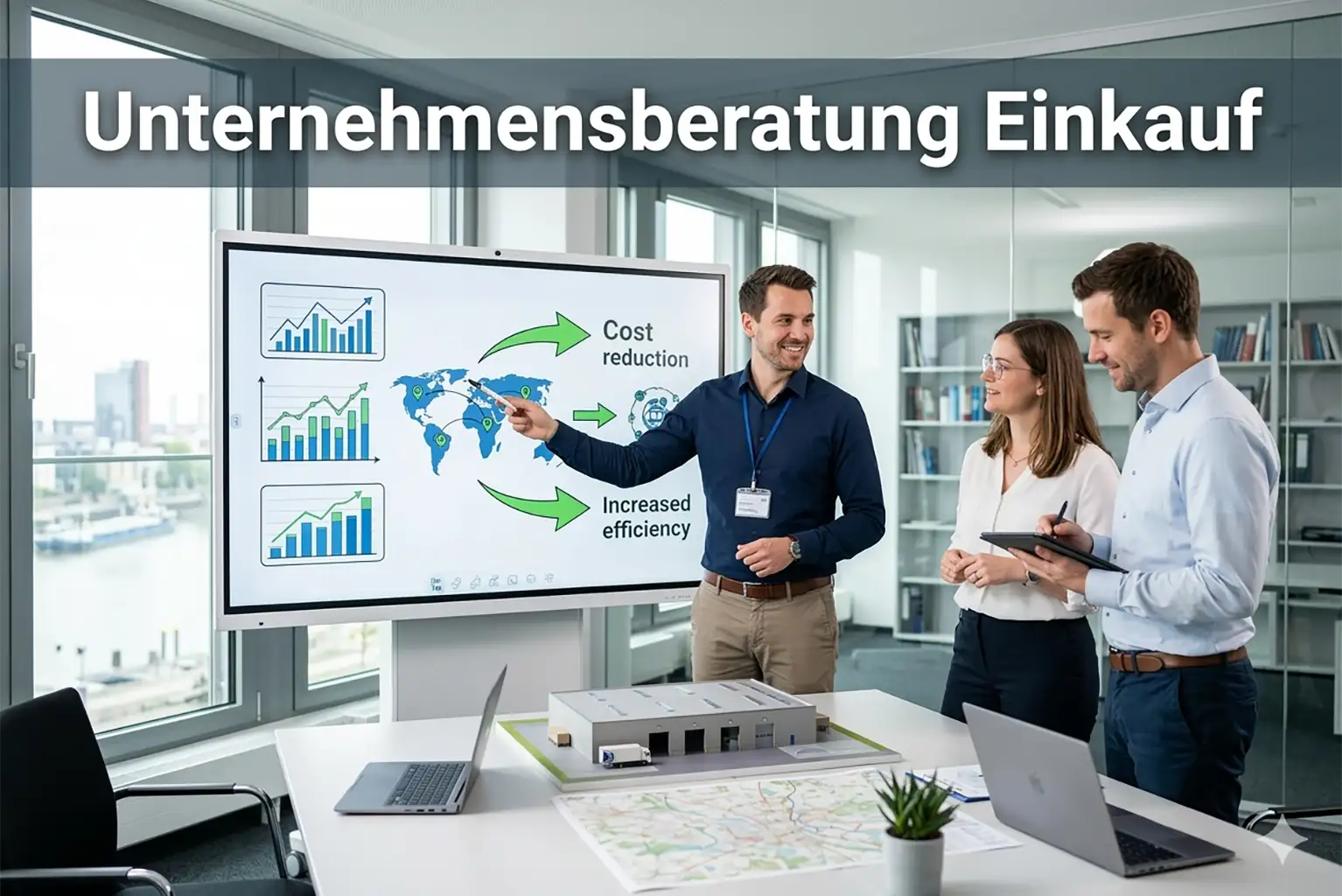
The consultancy considers both operational processes (order processing, master data maintenance) and strategic aspects (commodity group management, supplier development, global sourcing). The aim is to establish procurement as a value-adding partner within corporate management.
2. Why shopping at small and medium-sized enterprises is often underestimated
In many medium-sized businesses, purchasing is still viewed as mere „order processing“ or an adjunct to production. However, this perspective overlooks the enormous leverage purchasing has on the overall result. With a material cost ratio of, for example, 50 %, a cost reduction in purchasing of just 5 % leads to a direct improvement in results, for which sales often would have to increase turnover by 20 % or more.
„The profit is in the purchasing – every euro saved flows one-to-one into the operating profit.“
Furthermore, there is often the prevailing opinion in the medium-sized business sector that „the best prices“ have already been achieved through long-standing, trusting supplier relationships. However, external purchasing consultancy often reveals that potential is being missed due to a lack of benchmarks and insufficient market transparency. This is particularly the case in so-called indirect product groups – such as energy, Logistics, insurance or IT services – capacities for in-depth analysis are often lacking. In times of volatile markets, procurement is also shifting from a pure cost manager to a risk manager, securing the company's existence through resilient supply chains.
3. The core services of professional purchasing consulting
Specialised consultants pick up where the day-to-day business of the internal department ends:
- Spend Analysis: Creating 100 % transparency across all expenditure streams.
- Strategic Sourcing: Developing new, global supplier sources to minimise risk.
- Supplier Management: Professional auditing and development of key suppliers.
- Negotiation: Active support or coaching during complex price negotiations.
Would you like a brief consultation on this?
4. E-E-A-T Criteria: How to Find the Right Consultancy
For collaboration to bear fruit, the selection should be made according to the E-E-A-T principles:
- Experience: Have the consultants actually worked in the industry themselves, or do they only know the practice from the lecture hall?
- Expertise: Does the team possess in-depth expertise in your specific product groups?
- Authority: Can the consultancy provide robust case studies and reference clients?
- Trust: Does the partner offer transparent fee structures (e.g. gain-share)?
5. Digitalisation as a Gamechanger for SMEs
The Digitalisation in purchasing is no longer a „nice-to-have“ for SMEs. Many SMEs are still working with Excel lists and manual processes, which are time-consuming and prone to errors. Modern business consulting helps to introduce tools that are precisely suited to the size of the company.
The focus here is on e-sourcing (digital tenders) and e-procurement (automated ordering processes). This prevents the dreaded „Maverick Buying„Therefore, uncontrolled purchasing outside of the procurement department. By using modern systems, consultants can also analyse huge quantities of data to identify price outliers or supplier risks in real-time. Digitisation here means: more time for strategic negotiations instead of manual data collection.
6. The typical project workflow in three phases
A successful consultancy project in the mid-sized business sector is characterised by speed and proximity to decision-making. The structured phase model serves as a safety net in this regard: it ensures that no product group is overlooked, supplier relationships are not put at risk lightly, and internal employees are involved from the outset. Only through this systematic approach does a one-off cost reduction become a sustainable process.
The process traditionally breaks down into these three core phases:
- Diagnosis Phase: In-depth analysis of AS-IS data (spend cube), identification of commodity group clusters, and definition of realistic savings targets and „quick wins“.
- Sourcing Phase: Strategic market approach, conducting tenders and leading structured negotiation rounds based on benchmark data.
- Implementation Phase: Contractual finalisation of results, integration of suppliers with the systems, and intensive employee training.
7. Deep Dive: Total Cost of Ownership (TCO) – More Than Just the Price
A crucial mistake is the one-sided focus on the unit price. Professional purchasing consulting, on the other hand, introduces the concept of „Total Cost of Ownership“ (TCO). TCO considers all costs incurred over the entire lifecycle of a product.
„He who buys only the lowest price often ends up paying the highest amount for hidden follow-on costs.“
Imagine an iceberg: the purchase price is just the tip. Lurking below the surface are:
- Logistics costs: Long delivery routes tie up capital through higher inventory levels.
- Quality Costs: Inexpensive components that cause scrap significantly drive up the TCO.
- Administrative Overhead: Managing hundreds of micro-suppliers incurs enormous expense.
- Risk costs: The costs of production downtime due to unstable supply chains must be factored in.
8. Practical example: Success through structured purchasing consultancy
Let's consider an example from mechanical engineering (medium-sized company, approx. 200 employees):
- Initial situation: The company purchased C-parts with over 150 suppliers. There were no framework agreements.
- Measures: Spend Analysis, supplier consolidation to 15 core partners and implementation of an e-procurement system.
- The result: purchasing prices fell by 12 %. At the same time, administrative expenditure in accounting fell by 30 %.
9. Conclusion on Purchasing Consulting for SMEs
A professional Procurement consulting is not a cost factor for the mid-market, but a strategic investment with an excellent ROI. In a time of rising material costs, purchasing is the most important lever for safeguarding competitiveness. The key lies in selecting a partner who speaks „the language of the mid-market“ and focuses on sustainable implementation.
10. FAQ: Frequently Asked Questions about Purchasing Consulting
From what size of company is a consultant worthwhile?
From a purchase volume of approx. €10 million, effects can be achieved that far outweigh the consultancy costs.
How is a shopping consultation usually remunerated?
In addition to daily rates, success-based models („gain-share“) are common, whereby the consultancy receives a portion of the savings achieved.
How long does a typical project take?
Initial successes are often visible after 3 months. Profound optimisation usually takes between 6 and 12 months.
Will the knowledge be retained within the company?
Yes. A core objective of serious consulting is „enablement“. Employees are trained to continue strategies independently after the project ends.