




First and foremost:
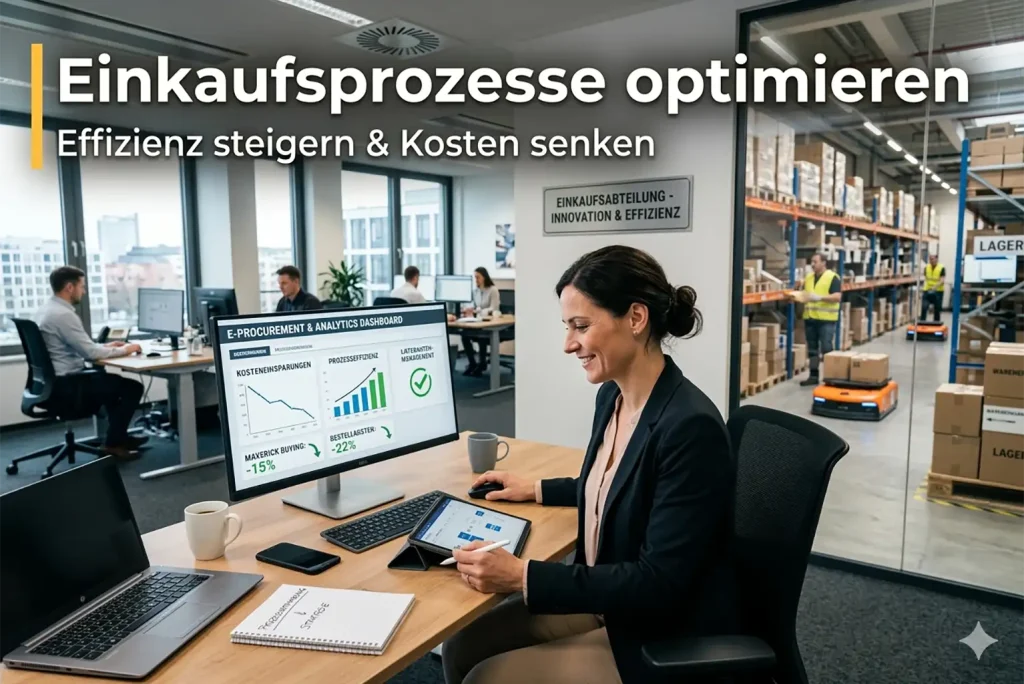
Businesses can their Significantly reduce procurement costs, by replacing manual workflows with digital e-procurement solutions, consistently consolidating demand and preventing so-called maverick buying (uncontrolled purchases). The focus is shifting away from pure price negotiation towards holistic process and value creation optimisation.
Key Facts on Optimising Purchasing Processes
- Process automation: Digital approval processes drastically reduce transaction costs per order.
- Centralisation: Pooling volumes strengthens the negotiating position with suppliers.
- Data Transparency: Clean master data enables precise analyses and prevents incorrect orders.
- Resilience: A diversified supplier portfolio minimises dependencies and failure risks.
1. Definition: What does it mean to optimise purchasing processes?
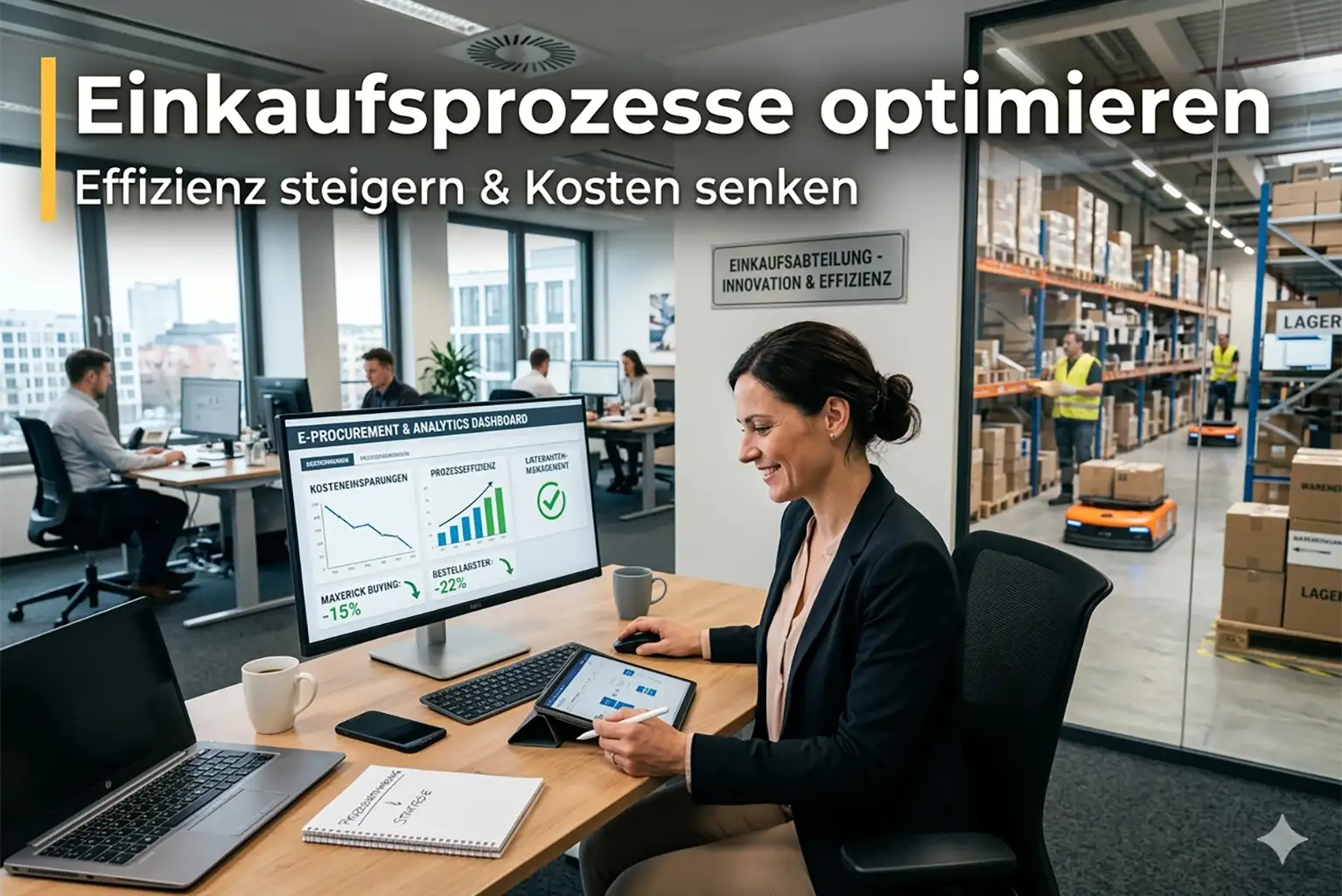
Optimising purchasing processes involves the systematic analysis and improvement of all procedures within the procurement cycle – from identifying a need to paying the invoice (Procure-to-Pay). This is not solely about reducing purchasing prices. Instead, the focus is on lowering process costs, increasing data quality, and enhancing transparency. The aim is to minimise administrative tasks so that purchasing can concentrate on value-adding, strategic activities.
2. The Status Quo: Where Procurement Efficiency is Lost
Many purchasing departments are still overwhelmed with administrative tasks. The biggest hurdles to efficient working are often:
- Fragmented data: Information on prices and stock levels is scattered across different systems or Excel spreadsheets.
- Long lead times: Manual approval loops via email delay procurement and tie up staff.
- Wild purchasing: When employees order without consulting purchasing, valuable volume discounts are lost.
3. The 5 pillars of process optimisation
Instead of complex structures, modern companies are focusing on these five key areas of action:
- Standardisation: Define clear standards for products and services. The fewer variants you purchase, the easier management becomes.
- Centralisation: Bundle the needs of all departments. This increases your volume and improves your negotiation power.
- Automation: Replace manual steps with digital workflows – from demand requisition to invoice verification.
- Transparency: Ensure a „single source of truth“. All stakeholders should have access to the same, up-to-date data.
- SustainabilityIntegrate ecological and social criteria early on. This mitigates legal risks and improves compliance.
Would you like a brief consultation on this?

4. Digitalisation and AI: The Leap into E-Procurement
The Digitisation is not an end in itself, but the lever for scalability. Modern e-procurement systems offer:
- Guided shopping experiences: Employees find required items in internal catalogues that already contain negotiated conditions.
- Automatic Matching: Systems can automatically match orders, goods receipts, and invoices (3-Way Matching).
- Artificial Intelligence: AI helps to find outliers in prices or predict future demand based on historical data.
5. Strategic Supplier Management as a Success Factor
A good purchase views suppliers as partners, not adversaries. Optimise your relationships by:
- Regular Audits: Assess not only price, but also quality, reliability, and innovative capacity.
- Risk managementIdentify critical suppliers and develop backup scenarios to avoid supply stoppages.
- Collaboration: Work closely with key suppliers to streamline processes together.
6. Making success measurable: The most important purchasing KPIs
Without key figures, no control is possible. Focus on these metrics:
- Cost Savings: The difference between the price paid and the market price or the prior year's value.
- Order costs per transaction: The sum of all administrative costs divided by the number of orders.
- Maverick Buying Quote: The proportion of purchases that bypass the official process.
- On-time delivery: What percentage of deliveries arrived on time and in the correct quality?
„The profit is in the purchase.“
7. Deep Dive: Total Cost of Ownership (TCO) – Keeping an eye on hidden costs
Those who really want to optimise their purchasing processes must look beyond the pure invoice price. This is where the Total Cost of Ownership (TCO) concept comes in.
The purchase price often only makes up a fraction of the total cost. A „cheap“ supplier can quickly become the most expensive choice due to high follow-on costs. The TCO consideration includes:
- Purchase costs: price, customs duty, transport.
- Operation & Maintenance: Energy, Repairs, Spare Parts.
- Process costs: Expenses for ordering, inspection, and storage.
- Disposal: End-of-life cycle costs.
8. Practical example: From paper-based administration to digital purchasing
A medium-sized company with 250 employees had a Maverick Buying rate of over 40 %. The process costs were approximately €90 per order due to manual invoice reconciliation.
The solution: Introduction of a cloud-based e-procurement system. Standard requirements were stored in catalogues, and approvals up to €500 were automated.
The result after 12 months:
- The process costs decreased from €90 to under €30 per order.
- Durch Bedarfsbündelung konnten 12 % Preisnachlass bei C-Teilen erzielt werden.
- Strategic purchasing gained 20 % more time for important supplier negotiations.
„He who stops wanting to improve stops being good.“
9. Conclusion: Strategy beats reactive action when optimising the purchasing process
The modernisation of procurement is a continuous improvement process. By shifting the focus from purely administrative processing towards data-driven, strategic procurement, not only are costs reduced in the short term. In the long term, purchasing becomes a competitive advantage that conserves liquidity and strengthens the innovative capacity of the entire company. Would you like to Optimise purchasing processes, the combination of digital tools, TCO consideration, and a clear strategy is the only sustainable path.
10. FAQ: Frequently Asked Questions about Optimising Purchasing Processes
How can I quickly reduce Maverick Buying?
The most effective way is to introduce a user-friendly e-procurement system. If the internal ordering process is simpler and faster than buying privately online, employees will voluntarily use the official channels.
What impact does data quality have on procurement?
A massive one. Without clean master data, demand cannot be correctly bundled and analyses will deliver incorrect results. Data hygiene is the basis for any automation if you want to optimise your purchasing processes.
Is optimisation worthwhile even for small purchasing volumes?
Yes, it is precisely there that the relative process costs are often highest. Through standardisation and simple digital tools, even smaller companies can achieve significant time and cost advantages.
How long does it take to achieve noticeable optimisation of purchasing processes?
Initial „quick wins“, such as the bundling of C-parts, can often be realised within 3 to 6 months. The complete digital transformation and establishment of strategic supplier management usually takes between 12 and 24 months, depending on the size of the company.