




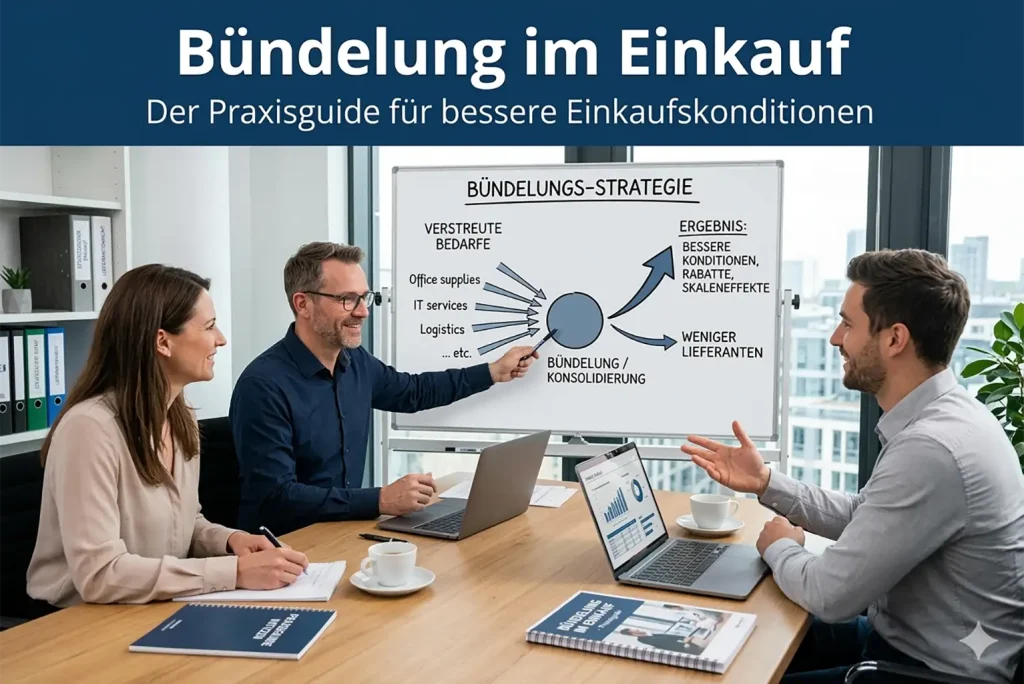
First and foremost:
The strategic Procurement bundling is one of the strongest levers for cost reduction. By aggregating volumes, companies achieve price savings of between 5 %and 15 %, reduce administrative effort, and gain massively in Bargaining power towards suppliers. Success stands or falls with data quality and the willingness for internal standardisation.
Key Facts about Demand Aggregation
- Core objective: Achieve greater economies of scale by consolidating individual requirements.
- Lever: Price advantages, Process optimisation and supplier reduction.
- Methods: Temporal, spatial, and factual (standardisation) bundling.
- Hurdles: Internal„Maverick Buying“and potential supplier dependency.
1. Definition: What is bundling in purchasing?
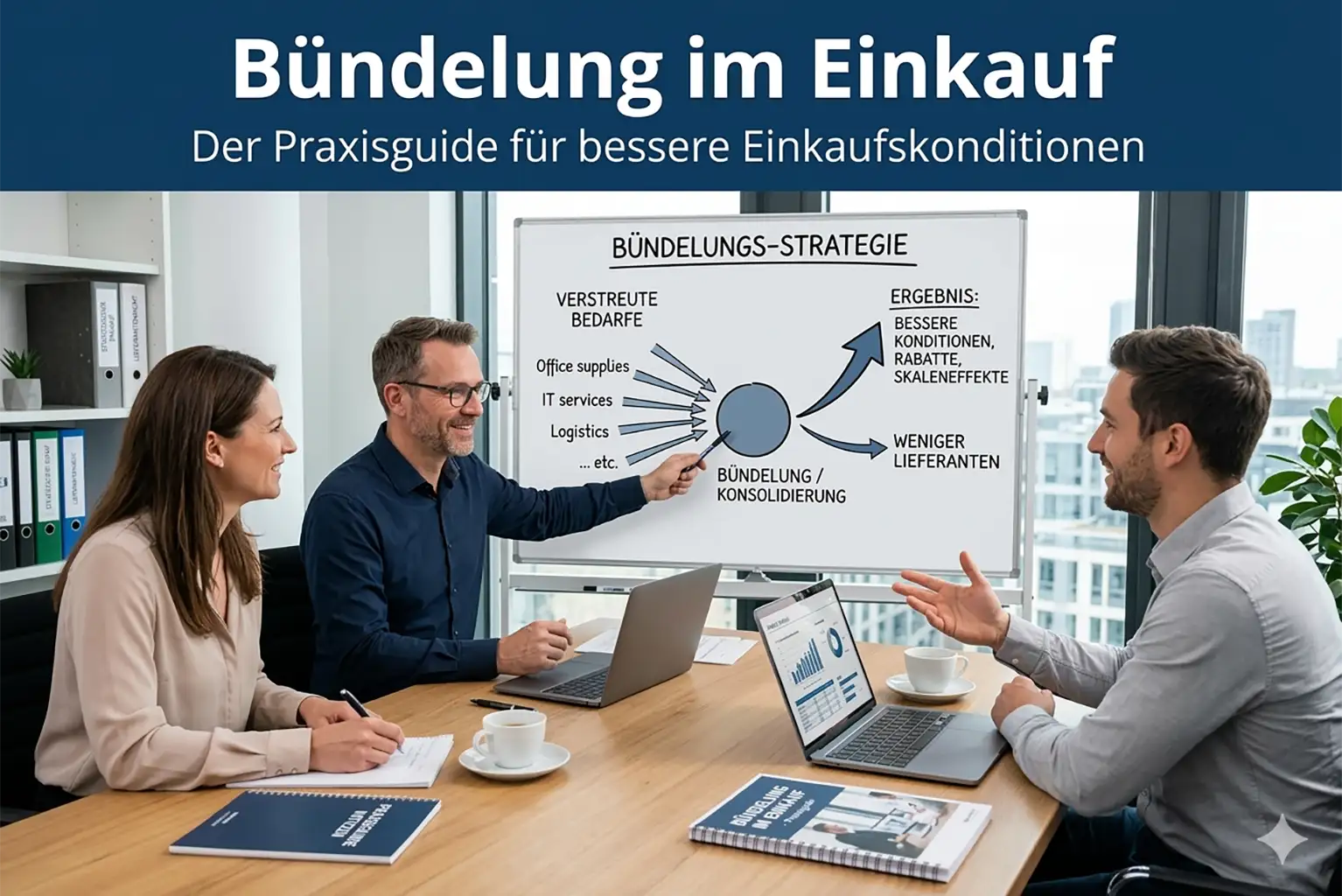
Instead of acting as a small supplicant, purchasing pools the entire company's power to be perceived as a major strategic customer.
2. The three pillars of the bundling strategy
To unlock their full potential, professionals focus on three areas:
- Temporal bundling: Instead of operating on a „just-in-time“ basis, demand is planned months or years in advance and ordered in larger batch sizes.
- Spatial bundling: Decentralised units (branches, plants) no longer order independently, but via a central purchasing department or a lead buyer model.
- Factual bundling (standardisation): This is the „Holy Grail“. Different variants of a product are reduced to a standard (e.g. a uniform notebook model for all employees).
3. The top benefits for your business
Why the effort? Because the results directly improve the P&L (Profit and Loss statement):
- Massive Price Reductions: Higher quantities trigger better discount tiers and bonuses.
- Lower process costs: Fewer order processes mean fewer invoice checks and less effort in goods receiving.
- Increased supplier priority: As a key account, you will receive goods before smaller customers in times of crisis (e.g., material shortages).
- Transparency instead of uncontrolled growth: bundling eliminates expensive „maverick buying“ (uncontrolled purchases bypassing specialist departments).
„Whoever pools their strengths not only multiplies their impact, but also halves their hurdles.“
Would you like a brief consultation on this?
4. Practical Guide: In 4 Steps to Implementation
The successful implementation of a bundling strategy is not a foregone conclusion. It requires a systematic approach to both dismantle internal hurdles and fully exploit external potential in the market. With the following four steps, you can transform your purchasing from mere order processing into a strategic value driver:
Step 1: Spend Analysis (Data Check)
Take a look in your ERP system. Analyse: Who buys what, from whom, and at what price? Identify product groups with high volume but many different suppliers.
Step 2: Implement cost-cutting measures (standardisation)
Critically review: Do we really need five different types of copy paper? Reduce the variety of options. Less complexity automatically leads to more volume per item.
Step 3: Supplier consolidation
Select your „A-suppliers“. The aim is to drastically reduce the number of creditors per product group in order to concentrate purchasing power.
Step 4: Finalise framework agreements
Negotiate contracts based on bundled annual volume, paying attention to flexible call-off options so as not to block unnecessary storage space.
5. Deep Dive: The Lead Buyer Concept as a Driver for Bundling
In decentralised organisations, bundling often fails due to resistance from individual sites wanting to retain their autonomy. This is where the lead buyer concept comes in – a highly efficient form of procurement bundling.
In this setup, a site (or department) with the greatest expertise or highest volume in a particular product group takes over the negotiation for the entire company.
Advantages of this deep-dive approach:
- Leveraging expert knowledge: The location that works most closely with the product knows the technical requirements best.
- Increasing acceptance: Since a department-specific unit makes the decision rather than an „anonymous central purchasing department“, internal resistance to standardisation decreases.
- Resource conservation: Responsibility is distributed across multiple shoulders, instead of overloading head office.
6. Practical Example: Increasing Efficiency through IT Standardisation
A medium-sized mechanical engineering company with three sites previously ordered laptops on an ad-hoc basis according to the needs of the respective department heads. The result: 15 different models from four different manufacturers and over 40 individual orders per year.
The solution through bundling:
Procurement, together with IT, defined two standard models for the entire company. Requirements were bundled quarterly and called off from a single partner through a framework agreement.
The result:
- Price saving: 12 % discount through guaranteed annual volume.
- Process costs: The IT department reduced the support effort by 20 %as only two system images needed to be maintained instead of 15.
- Negotiating power: During supply shortages, the company was given priority by the manufacturer because it was now considered a key account.
7. Challenges and Risk Management
Where there is light, there is also shadow. Beware of these pitfalls:
- Dependence (Lock-in Effect): Putting all your eggs in one basket makes you vulnerable. For critical components, use a dual-sourcing model.
- Internal resistance: Specialist departments often feel patronised. Involve stakeholders early on.
- Cost consideration: Please note that larger order quantities can influence storage costs. The objective is to minimise total costs:
Total cost = Ordering costs + Storage costs + Material costs
„True savings don't start with negotiating the price, but with questioning the need.“
8. Conclusion: Why bundling in procurement is your most important lever
The Procurement bundling is far more than a one-off project – it's a strategic mindset. It forms the basis for every modern, professional procurement process. Those who precisely understand their volumes and skilfully place them on the market not only achieve significant cost savings but also sustainably professionalise the entire supply chain. In times of volatile markets and fragile supply chains, consistent consolidation in procurement is often the crucial competitive advantage for positioning oneself as a preferred partner with top suppliers.
9. FAQ: Frequently Asked Questions about Bundling in Procurement
How do I start when I don't have clean data?
Start small. Choose a product group that everyone understands (e.g. fleet or office supplies), and manually request consumption overviews. Success there will serve as a „proof of concept“.
Does bundling destroy flexibility?
Not necessarily. Through intelligent framework agreements, you bundle price risks while retaining operational freedom through flexible call-off orders.
What is the biggest danger in demand aggregation?
That one loses sight of quality. Cheaper is not always better. Bundling must always be based on a clearly defined minimum quality.
Does software support bundling in purchasing?
Absolutely. E-procurement systems help to automatically collect requirements and only trigger orders once an optimal order volume is reached, which massively reduces manual effort.