




The most important thing in a nutshell
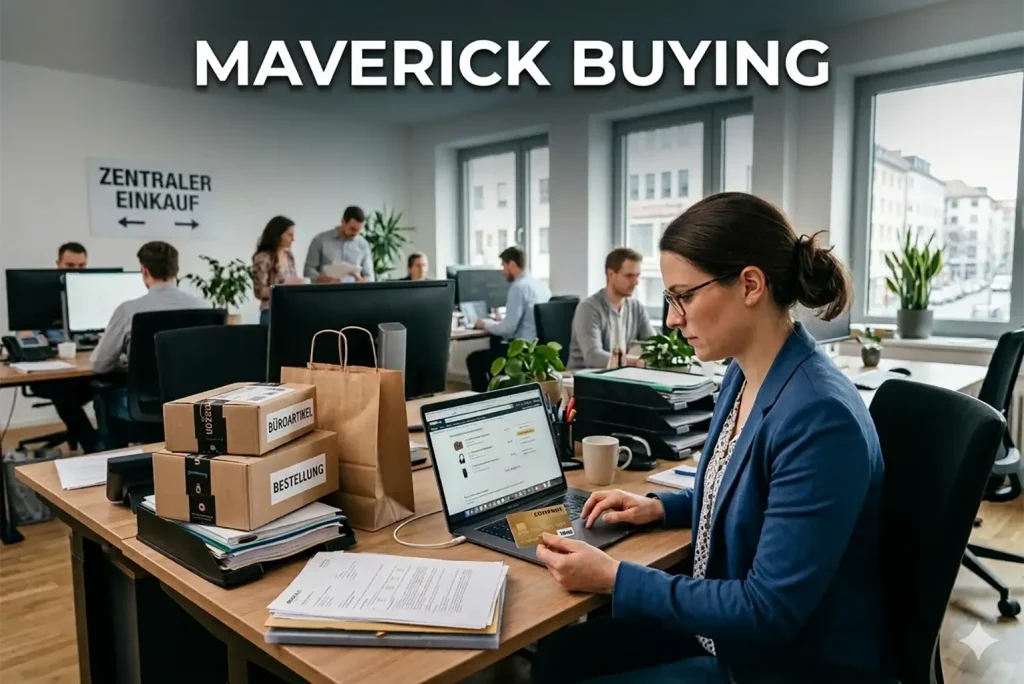
Maverick Buying describes the procurement of goods or services outside defined purchasing processes and framework agreements. For companies, this results in massive financial losses (often 10–20 % higher purchase prices) and uncontrollable compliance risks. The solution lies in The Transformation of Shopping To the internal service provider: Through e-procurement, intuitive guided buying and transparent communication, the official route will become the easiest route for all employees.
Key Facts on Maverick Buying
- Core phenomenon: Departments are buying „wildly“ outside of central purchasing.
- Main triggers: Lack of user-friendliness of official tools, time pressure, and a lack of awareness of contract terms.
- Economic Impact: Loss of economies of scale, lack of transparency (spend analysis impossible), and extremely high process costs in accounts payable.
- Strategic Lever: Digitalisation of C-part procurement and introduction of self-service portals.
What is Maverick Buying? An in-depth definition
Professionally, this is often referred to as a lack of contract compliance. In a modern purchasing organisation, maverick buying represents a break in the value chain. A distinction is often made between:
- Unconscious Maverick Buying: The employee acts in good faith but does not know the official channels or suppliers.
- Conscious Maverick Buying: The process is actively bypassed because internal hurdles are perceived as too high or official suppliers as unsuitable.
2. Psychology and Structure: Why Employees „Shop Wild“
Nobody buys „wildly“ with the deliberate intention of harming the company. Usually, there's a well-intentioned aim for efficiency behind it. If the IT department has to wait three weeks for a new keyboard, while it can be delivered by an online retailer in 24 hours, a conflict of motivation arises.
- Complicated ERP landscapes: when order entry screens resemble software from the 90s, acceptance plummets.
- Shadow Procurement: Similar to „Shadow IT“, departments build up their own supplier networks to maintain maximum autonomy.
- Missing Reporting: If employees cannot see the financial damage a single order causes, the behavioural correction is missing.
3. The Risks: Why Maverick Buying is a Burden on the Balance Sheet
The negative effects are often only visible on closer inspection in the profit and loss account (P&L), but there they hit with full force.
- Price disadvantages: Due to the fragmentation of purchasing power, volume discounts are lost.
- Process cost explosion: Manually entering a single invoice without a purchase order often costs five times as much in accounting as an automated EDI invoice.
- Law & Compliance: In times of Act on Corporate Due Diligence Obligations in Supply ChainsMaverick buying is a dangerous game. Those who buy „wild“ rarely check whether the supplier complies with environmental and social standards.
Would you like a brief consultation on this?

4. Prevention strategies: Proactively recover purchases
A ban usually just leads to even more creative detours. Strategic change management is required.
- Introducing Guided Buying: Use portals that work like Amazon, but only allow approved catalogues and suppliers in the background.
- Optimise catalogue management: Purchasing must ensure that catalogues are up-to-date and competitively priced.
- Spot buying solutions: For requirements that are not listed in any catalogue, defined express processes (e.g. using virtual credit cards) should exist so that purchasing can retain data sovereignty despite this.
„An efficient process isn't the one that can be most strictly controlled, but the one that employees prefer to use because it makes their day-to-day work easier.“
5. Deep Dive: Process Mining and Data Forensics for Uncovering
How does one find Maverick Buying when, by definition, it happens „invisibly“? Modern data analysis helps here.
Process mining tools shine a light on the digital footprints within your ERP system. They specifically look for patterns such as „invoice receipt before purchase order request.“ If the invoice is the first document in the system, it is 100 % Maverick Buying.
Data forensics: Analysing creditor data can also identify „shadow suppliers“. If 200 invoices from a DIY store are submitted via expense reports throughout the year, that is a clear signal for a volume that needs to be incorporated into a strategic framework agreement.
„Those who ignore the small expenses end up losing sight of the big budget – in modern purchasing, it's often uncoordinated C-parts that eat away at profits.“
6. Practical Example: Maverick Buying in a Reality Check
A medium-sized company in the Mechanical Engineering requires 50 high-quality power banks on short notice for a trade fair.
- The official way: The Head of Marketing creates a purchase requisition (BANF). Purchasing accesses the framework agreement with the promotional merchandise dealer. Price: €15 per item. Duration: 4 days. Total cost: €750.
- The Maverick Way: Out of fear of time constraints, the manager orders privately online for €22 each and submits the invoice. Total cost: €1,100.
- The consequence: €350 in direct additional costs + approx. €100 in additional processing costs in accounting due to manual clarification. Furthermore, proof of CE certification is missing, which leads to liability issues in the event of a defect.
7. Focus on C-parts: Where overgrowth is most common
In a Pareto analysis, it is shown that Maverick Buying occurs 80% of the time for C-items (office supplies, MRO needs, small parts) %. These items generate little sales volume but entail enormous administrative effort.
The Maverick Buying Quote (MBQ) as a KPI
To make the success of your measures measurable, use the following key figure:
MBQ = (Number of invoices without order reference / Total number of invoices) x 100
8. Conclusion: Maverick Buying as an Opportunity for Digital Procurement
Maverick Buying is not fate, but a clear indication of the digital gap in procurement. Anyone who wants to stop „uncontrolled purchasing“ must transform procurement from a strict controller into an agile service partner.
By combining technology (e-procurement), data analysis (spend analytics), and empathy for the end-user, you transform uncontrolled spending into strategic value creation. Transparent processes are ultimately not only cheaper but also make the entire organisation more resilient to legal and economic risks.
9. FAQ: Frequently Asked Questions about Maverick Buying
At what percentage does Maverick Buying become dangerous?
As a general rule, a quota of over 5 % is considered a warning sign. If it is in the double digits, the company is massively squandering capital, losing control of its supply chains and risking compliance with legal requirements such as the Supply Chain Act.
Is Maverick Buying ever sensible or justifiable?
In genuine emergencies, such as imminent production failures or safety-critical defects, speed can be more important than the standard process. However, defined „emergency workflows“ should be used here so that the purchase is subsequently legitimised and recorded for data management purposes.
Which software solutions can help to prevent impulse buying?
Modern e-procurement systems with „guided buying“ functionality are the most effective means. These tools directly integrate marketplaces, allowing employees to use the familiar look and feel of private online shops, while compliance is maintained in the background.
What's the best way to start with reducing the quota?
The first step is a comprehensive spend analysis of the supplier data from the last 12 months. Identify suppliers without a framework agreement who are nevertheless regularly used by various departments. This data is the best basis for arguments for new catalogues.