




First and foremost:
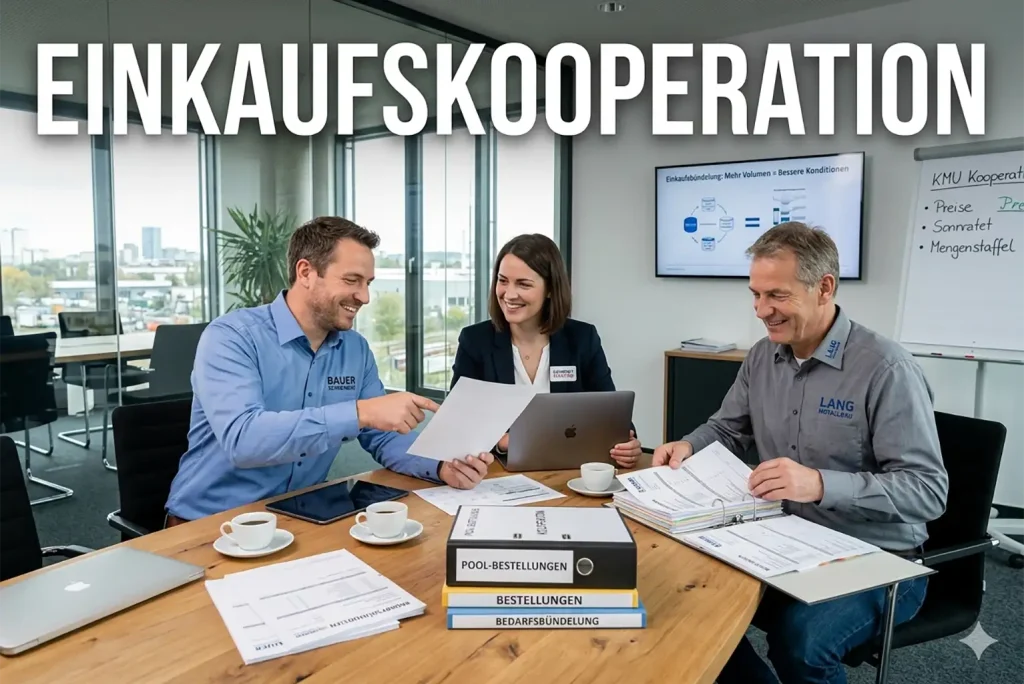
A Purchasing cooperation is the strategic merger of legally independent companies to Bundling to gain market power in demand. The aim is to achieve better purchasing conditions (prices, delivery times, quality) which would often be unattainable for a single company – especially for medium-sized ones. Buying together means: Reduce costs and sustainably strengthen competitiveness.
Key Facts on Purchasing Cooperatives
- Core objective: The purchasing cooperation serves to achieve massive cost reductions through volume effects (economies of scale).
- Participants: Mostly small and medium-sized enterprises (SMEs) from the same sector that want to appear stronger by acting together.
- Key advantages: Significantly lower purchasing prices, optimised processes, and valuable knowledge transfer.
- Challenge: Increased co-ordination effort and a certain loss of individual product choice.
- Success factor: A successful purchasing cooperation is based on trust and legally secure framework agreements.
1. Definition: What is a purchasing cooperative?
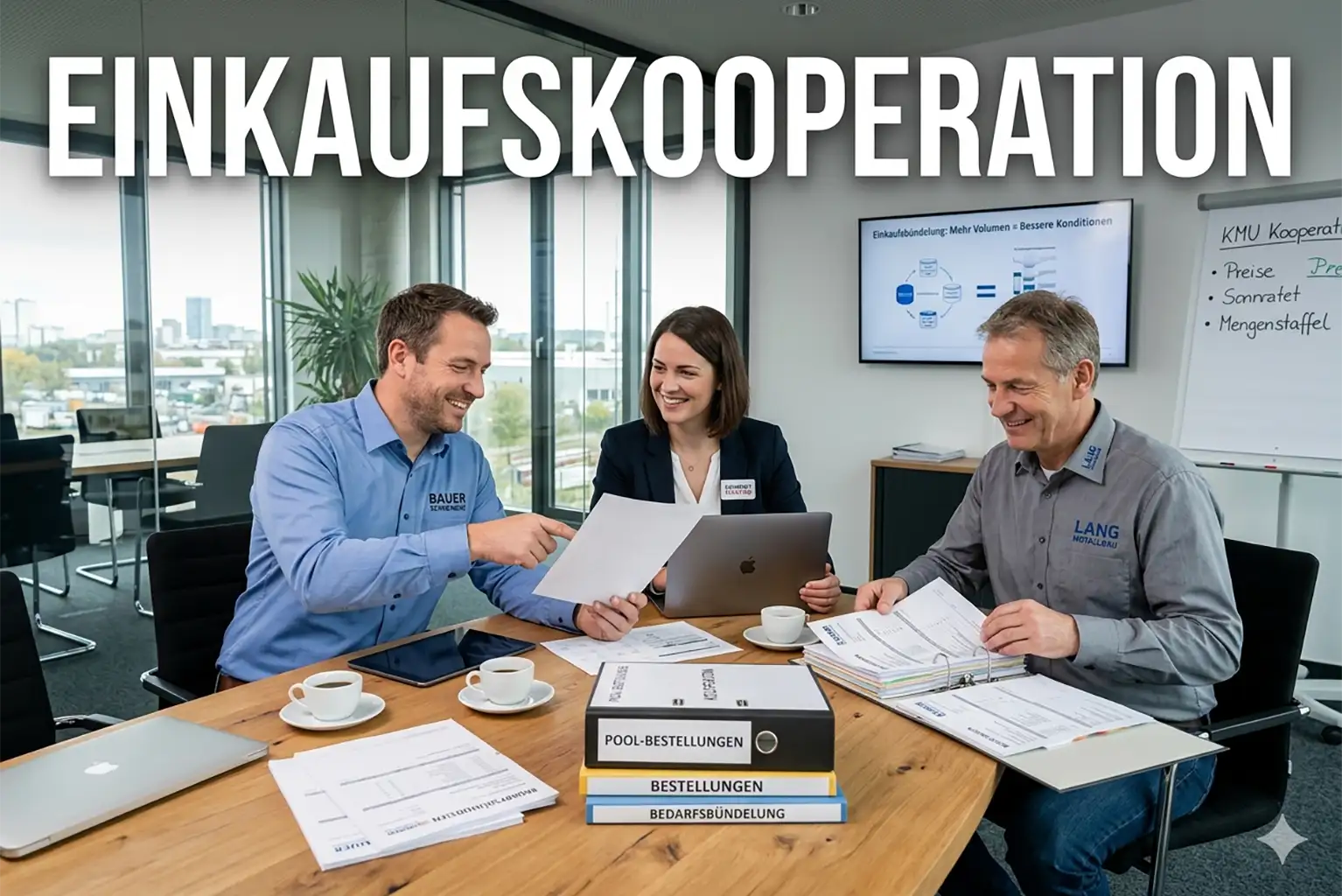
Instead of each company negotiating individually with suppliers, the partners bundle their requirements. This aggregated demand massively increases bargaining power. Such cooperations are particularly widespread in retail (e.g. Edeka, REWE) and in skilled trades, but are also increasingly gaining importance in industry and the service sector.
2. Forms of Purchasing Cooperations
Not every cooperation looks the same. A distinction is primarily made between two directions:
- Horizontal cooperation: Companies from the same industry and at the same stage of the supply chain work together (e.g. two specialist electrical retailers).
- Vertical Cooperation: Companies from different stages of the value chain cooperate (e.g., a manufacturer with its suppliers).
In addition, there are different levels of organisation:
- Loose cooperation: Occasional exchange and joint individual orders without a fixed structure.
- Purchasing group: A stable group with common framework agreements and fixed rules.
- Purchasing cooperative: A separate legal entity (GmbH or eG) that professionally handles all purchasing for its members.
3. The decisive benefits for companies
Those who join a co-operation usually benefit on three central levels:
„He who adds alone gets a sum. He who multiplies together creates market power.“
Economic advantages (hard facts)
- Better terms: Purchasing large quantities reduces the per-unit purchase price (economies of scale).
- Bonus Systems: At the end of the year, rebates are often paid based on the group's total turnover.
- Lower process costs: The administrative processing of purchasing is centralised, saving time and personnel.
Strategic advantages
- Market power: SMEs can negotiate on equal terms with large corporations or market-dominant suppliers.
- Ensuring supply capability: Cooperations are often prioritised by suppliers („key account“ status).
- Know-how transfer: The exchange of market trends within the group is often more valuable than simple discounts.
Would you like a brief consultation on this?


4. Challenges and risks in detail
Although the advantages of a purchasing cooperation outweigh the disadvantages, the path to achieving it is not a foregone conclusion. Companies must be aware that closer collaboration also requires strategic concessions. Without an honest analysis of the risks, the cooperation can quickly lead to internal conflicts.
- Strategic dependency: By joining, one often becomes tied to the group's product range and supplier selection. A quick switch to a new, innovative supplier outside the co-operation can be contractually difficult.
- Loss of individuality: If all partners buy the same components or products, the scope for an individual unique selling proposition (USP) beyond the product itself shrinks.
- Antitrust hurdles: The pooling of demand must not lead to an impermissible restriction of competition in the sales market. Legal safeguards for the cooperation agreements are therefore absolutely essential.
- High coordination effort: Agreeing on a common core assortment requires many compromises. The more partners involved, the more complex the coordination processes become.
💡 Expert Tip: Be meticulous about cartel law compliance when choosing partners. Professional communities have „clean team“ structures that ensure sensitive competitive data from members is not exchanged between them, but only incorporated into negotiations in an aggregated form.
5. Practical tips for successful implementation
For a purchasing cooperative to generate real profits in everyday business, a structured approach is necessary. Success as a group is not a matter of chance, but the result of professional organisation.
- Choose partners wisely: Look for partners who have similar quality requirements, but not necessarily the exact same customers. A similar company culture greatly facilitates long-term cooperation.
- Clear contractual framework: Define from the outset how bonuses will be distributed, who makes decisions (voting rights), and how a partner can leave the cooperation in the event of a dispute.
- Investment in digitalisation: make use of shared IT platforms or e-procurement systems. Process costs only noticeably decrease when data is shared transparently and orders are automated.
- The „low-hanging fruit“ approach: Start with so-called C-items (office supplies, energy contracts). The risk here is low, but the potential for savings is immediately visible. This builds trust for the later bundling of strategic raw materials.
💡 Expert tip: Don't just use cooperation as a price-reducer, but as an innovation hub. Many communities offer exclusive access to pilot projects from top suppliers, which remain closed off to individual buyers.
6. Deep Dive: Central Regulation & Delcredere – The Financial Heart
In professional purchasing cooperations, settlement often occurs through central settlement. The head office then pays all invoices collectively to the supplier.
Through the del credere guarantee (where the central body guarantees payment), the risk for suppliers is reduced so significantly that they grant additional discounts or longer payment terms. This is often the decisive financial lever that amortises the cooperation's membership fees through the improved payment conditions alone.
7. Practical example: How a craft business benefits
Let's imagine a medium-sized carpentry business with 15 employees. Up until now, the owner bought wood and fittings individually.
„Procurement efficiency is the invisible profit-driver of every modern calculation.“
Following accession to the cooperation:
- Price saving: The framework agreement immediately reduces the price of standard fittings by 12 %.
- Annual bonus: At the end of the year, the company receives a refund of 2.5 % on turnover.
- Process optimisation: The time spent on purchasing is reduced from 4 hours to 1 hour per week by the cooperation portal.
- Result: By optimising purchasing alone, the company significantly increases its margin without having to raise prices for end customers.
8. Checklist: The right purchasing cooperation in 5 steps
Before joining a community, you should critically examine the following points:
- [ ] Values check: Do the other members have a similar standard of quality and way of working?
- Cost-benefit analysis: Do the anticipated discounts and bonuses cover the joining fee and ongoing contributions in the first year?
- [ ] Range Check: Are my most important A-items included in the cooperation's portfolio, or do I still need to procure them individually?
- Transparency: Does the partnership offer a modern portal for orders and billing (e-procurement)?
- [ ] Contractual freedom: What are the notice periods and are there acceptance obligations that could restrict my flexibility?
9. Conclusion: Why a purchasing cooperative is worthwhile
In summary, a Purchasing cooperation a powerful tool for increasing profitability. Especially in times of volatile markets and unstable supply chains, it offers the necessary stability and financial leeway. While cost advantages are often the initial reason for joining, the strategic exchange of knowledge often proves to be an equally valuable competitive advantage for each member in the long term.
However, success largely depends on the chosen form of cooperation fitting precisely with one's own company structure and all parties pursuing a common vision of quality. Those willing to trade a degree of operational autonomy for collective market power will find cooperation to be one of the most effective levers for permanently asserting themselves against globally operating major corporations.
10. FAQ on Purchasing Cooperation: Frequently Asked Questions
When does a purchasing cooperative become worthwhile for a company?
There is no fixed minimum size. Even two sole traders can save costs through joint orders. Professional communities are usually worthwhile from an annual purchasing volume in the mid-six-figure range.
Is a purchasing cooperative legally permissible under cartel law?
Generally yes, as long as market shares do not exceed certain thresholds and no price-fixing agreements are made for end customers. A professional review is always advisable when starting out.
Can I remain with my old suppliers despite the purchasing cooperation?
That depends on the specific articles of association. Most collaborations allow for flexibility, but only grant the best terms and conditions when purchasing through the community's contracted suppliers.
What costs are incurred when participating in a purchasing cooperative?
Monthly contributions, an admission fee or business shares are common. The savings from better prices and bonuses generally outweigh these fixed costs very quickly, meaning the „return on investment“ is often achieved within the first year.