




First and foremost:
An efficient Supplier management is the backbone of global competitiveness in 2026. To sustainably improve SRM, companies must shift their focus from short-term purchasing prices to long-term value creation and risk resilience. The three crucial levers for this change are: data-driven transparency through AI-powered analytics, highly differentiated segmentation based on strategic relevance, and proactive compliance with complex regulatory requirements (such as the LkSG). Those who see their suppliers as strategic partners today secure a decisive advantage in terms of resources and innovation in volatile markets.
Key Facts on Supplier Relationship Management (SRM)
- Central Definition: SRM is the strategic orchestration of the entire supplier ecosystem for risk mitigation and innovation enhancement.
- Strategic Core: Achieving „Preferred Customer Status“ to receive priority supply during global shortages.
- Technology standard: Replacement of Excel with integrated SRM platforms with API interfaces for real-time monitoring.
- Compliance Focus: Automated Monitoring of ESG Criteria as an integral part of supplier evaluation.
- Competitive factor: Companies with optimised SRM achieve up to 15 % higher resilience to supply chain disruptions.
1. Definition: What Supplier Relationship Management (SRM) means at its core
While traditional purchasing often operates purely transactionally („goods for money“), modern SRM aims for holistic value creation. It considers the supplier over their entire lifecycle – from initial identification through strategic development to eventual offboarding. Well-managed SRM creates the structural conditions for both sides to benefit from each other, whether through cost efficiency, quality improvement, or access to market innovations.
„In a networked economy, the strength of your partners is the true measure of your own competitiveness.“
2. Strategic relevance: Why SRM makes the difference today
In a highly connected world, businesses are only as resilient as the weakest link in their supply chain. Previously, procurement was primarily seen as a cost-reducer. In 2026, it will operate as a central risk manager and innovation scout.
The relevance of an improved SRM arises today from three essential factors:
- Market volatility: Geopolitical crises and sudden shortages of raw materials necessitate extremely agile and resilient supplier relationships. Those who communicate solely on price will be ignored in times of scarcity.
- Innovation pressure: Groundbreaking product improvements often arise from the technological expertise of suppliers. Those who manage their partners poorly lose this direct knowledge advantage to the competition.
- Regulation: Laws like the LkSG demand complete transparency deep into the supply chain. Weak SRM today leads to legal consequences and massive reputational damage faster than ever before.
3. The Process Cycle: Towards operational excellence in 4 well-founded phases
To noticeably improve supplier management, a standardised control loop must be established that replaces arbitrariness with data-based decisions:
- Phase 1: Selection & Onboarding: Quality begins before the first order. Here, you don't just check suppliers on price, but on their future viability, financial stability, and compliance history.
- Phase 2: Performance Measurement (Monitoring): Utilise Balanced Scorecards that make KPIs such as delivery precision, complaint rates, and flexibility with regard to quantity changes objectively measurable.
- Phase 3: Supplier Development: Instead of immediately switching suppliers when problems arise, excellent companies work with their partners on process improvement. This creates more loyal „Preferred Partners“.
- Phase 4: Risk Management & Offboarding: The SRM requires early warning systems for insolvencies. At the same time, the end of a relationship („exit strategy“) must be professionally planned so as not to jeopardise operations.
Would you like a brief consultation on this?
4. Strategic Tools: Applying the Kraljic Matrix Correctly
The Kraljic Matrix helps you to deploy resources where they will have the greatest impact:
- Strategic Suppliers: (High Risk / High Value Contribution) – Foster the closest partnerships on an equal footing. These partners are often irreplaceable and require strategic roadmaps.
- Key Suppliers: (Low Risk / High Value Contribution) – Leverage market power and achieve best prices through regular tenders, as numerous alternatives exist in the market.
- Bottleneck suppliers: (High risk / Low value contribution) – Objective: Increase security of supply, build up inventory, or specifically develop technical alternatives to reduce dependency.
- Uncritical suppliers: (Low risk / Low value contribution) – Objective: Maximum automation of Procurement process (e-procurement), to minimise administrative costs.
5. Deep Dive: Total Cost of Ownership (TCO) & KPI Management
A common mistake when improving SRM is to focus solely on the net price. Experts consider the Total Cost of Ownership (TCO). A supplier with a higher price can be more economical if they reduce process costs.
Key metrics for mobile monitoring:
- OTIF (On Time In Full): Delivery reliability in quantity and time. Target value for A-suppliers: > 95 %.
- Quality rate: Percentage of defect-free units. Reduces costs for returns and production stoppages.
- TCO Saving: Total cost reduction through efficiency (e.g. reduced incoming goods inspection effort).
- Innovation rate: Number of improvement suggestions submitted by the supplier per year.
6. Practical Example: How a Small to Medium-Sized Enterprise Stabilised Delivery Reliability
A manufacturer of precision tools was struggling with massive delays from a specialised surface coater. Production was regularly brought to a standstill, leading to penalties from end customers.
The solution: Instead of merely pushing down the price or threatening to cancel, purchasing initiated a joint workshop. An analysis showed that faulty planning was often due to imprecise advance information from the mechanical engineer themselves.
Measure: Introduction of a cloud-based planning board accessible by both companies. The supplier now has a 4-week advance view of incoming batches.
Das Ergebnis: Die Liefertreue stieg innerhalb von sechs Monaten von unter 70 % auf konstant 96 %. Die Gesamtkosten sanken durch den Wegfall von teuren Eiltransporten um 14 %.
7. Digitalisation & AI: How intelligent tools are transforming purchasing
In 2026, the digitalisation of supplier management will no longer be an optional project, but a survival strategy. Modern SRM platforms now function as proactive ecosystems, going far beyond simple data management.
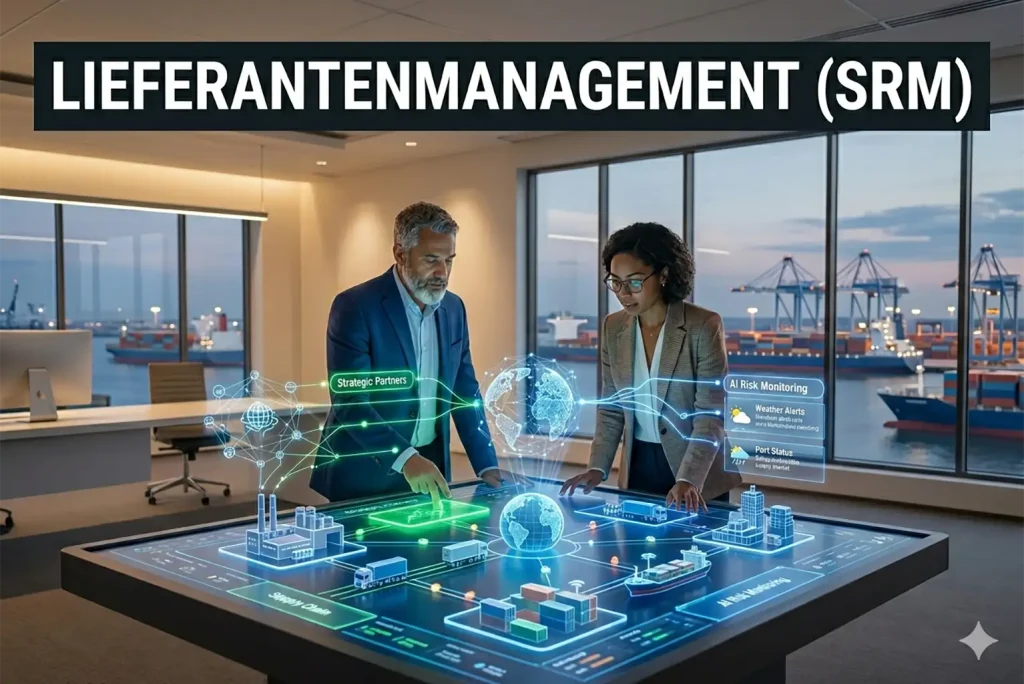
- AI-powered risk monitoring: Intelligent algorithms scan millions of global data sources in real time – from weather reports and port strikes to social media signals about a supplier's financial problems. This allows procurement to activate alternatives before the disruption reaches their own organisation.
- Automated compliance workflows: Modern tools take over the tedious „certificate hunting“. They automatically check the validity of ISO certificates or sustainability evidence and independently remind suppliers when they expire. This ensures LkSG compliance without tying up personnel.
- Predictive Analytics: Predictive Analytics & Pricing: AI models forecast price developments for raw materials and energy costs. They provide purchasing departments with concrete recommendations on when contracts should be concluded to mitigate volatility.
- API Connectivity: Today's SRM tool is not a silo. Data flows directly from the supplier's ERP system via interfaces (APIs), enabling real-time inventory visibility.
8. Practical pitfalls: Why SRM projects often fail
Despite sophisticated strategies, many companies fail to achieve their SRM goals. The reasons usually lie in implementation and corporate culture:
- Silo mentality: Often, purchasing will in isolation optimise for price, while quality assurance and production later struggle with the defects. SRM only works as a cross-departmental strategy, where all stakeholders pull together.
- Deficient data hygiene: „Garbage in, garbage out“. If the master data in the system is outdated, duplicated, or incomplete, even the best AI analyses will yield incorrect results. Master data maintenance is the unglamorous but necessary foundation for any SRM upgrade.
- Neglecting the „soft factors“: Technology is important, but SRM is ultimately relationship management. Those who treat suppliers solely as a cost factor and exert massive pressure for the slightest errors will not be preferentially supplied in a crisis. The human component and a fair negotiation culture remain irreplaceable.
- Overly complex processes: Too many KPIs and bureaucratic onboarding hurdles deter small, highly specialised innovators in particular. Effective SRM must remain lean and attractive to the partner.
9. E-E-A-T & Compliance: Building Trust through LkSG Conformity and Ethics
Trustworthiness is the most important currency in modern SRM. Since the tightening of the Supply Chain Due Diligence Act (LkSG), responsibility for human rights and environmental standards has been firmly anchored at the top management level.
Improved supplier management documents these efforts without gaps. It's no longer just about avoiding fines. Companies that offer transparency across their entire supply chain secure a competitive advantage with customers and investors who increasingly value ethically sound products. E-E-A-T here means: Documented expertise in risk management and demonstrable authority in compliance with global standards.
„True savings are not found on today's bill, but in tomorrow's process reliability.“
10. Conclusion: Your roadmap for resilient supplier management
The Optimisation of supplier management It's a strategic marathon. The shift from a „firefighter“ who only acts when problems arise, towards a proactive value creation manager is the key to success. Utilise the very latest AI tools for analysis and automation, but never forget to nurture the human relationship with your strategic partners. Because in a critical situation, the partner will first supply the company they trust.
Your next step: Identify your three most critical „bottleneck suppliers“ and have a conversation that focuses on joint process stability, rather than price.
11. FAQ on Modern Supplier Relationship Management (SRM)
What is the most important lever for improving supplier management in the short term?
Perform a thorough master data cleansing. Only with clean data can you identify dependencies and savings potential. Often, the same corporate groups are hidden behind different supplier names, which constitutes a significant concentration risk.
How to deal with difficult but irreplaceable suppliers.
The only solution here is to establish 'Preferred Customer Status'. Demonstrate to the supplier the strategic value of the collaboration for them (e.g. early access to new markets or joint development) in order to be prioritised if needed.
Is professional supplier management also worthwhile for SMEs?
Absolutely. Especially for medium-sized enterprises, SRM is vital for survival, as they often have less market power. Through excellent processes and reliability, SMEs can become more attractive to top suppliers than cumbersome large corporations.
What specific impact does AI have on day-to-day work in SRM?
AI acts as a „digital watchdog“. It takes over 24/7 monitoring of global risks and automated document review. This frees up your buyers' valuable time for strategic negotiations and personal supplier development.