




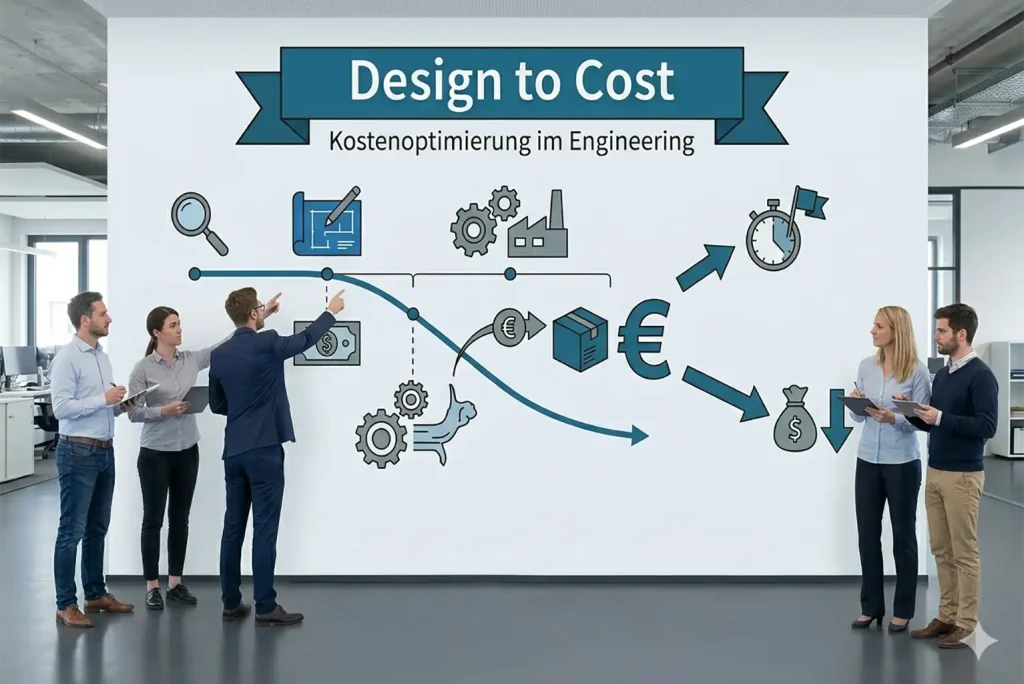
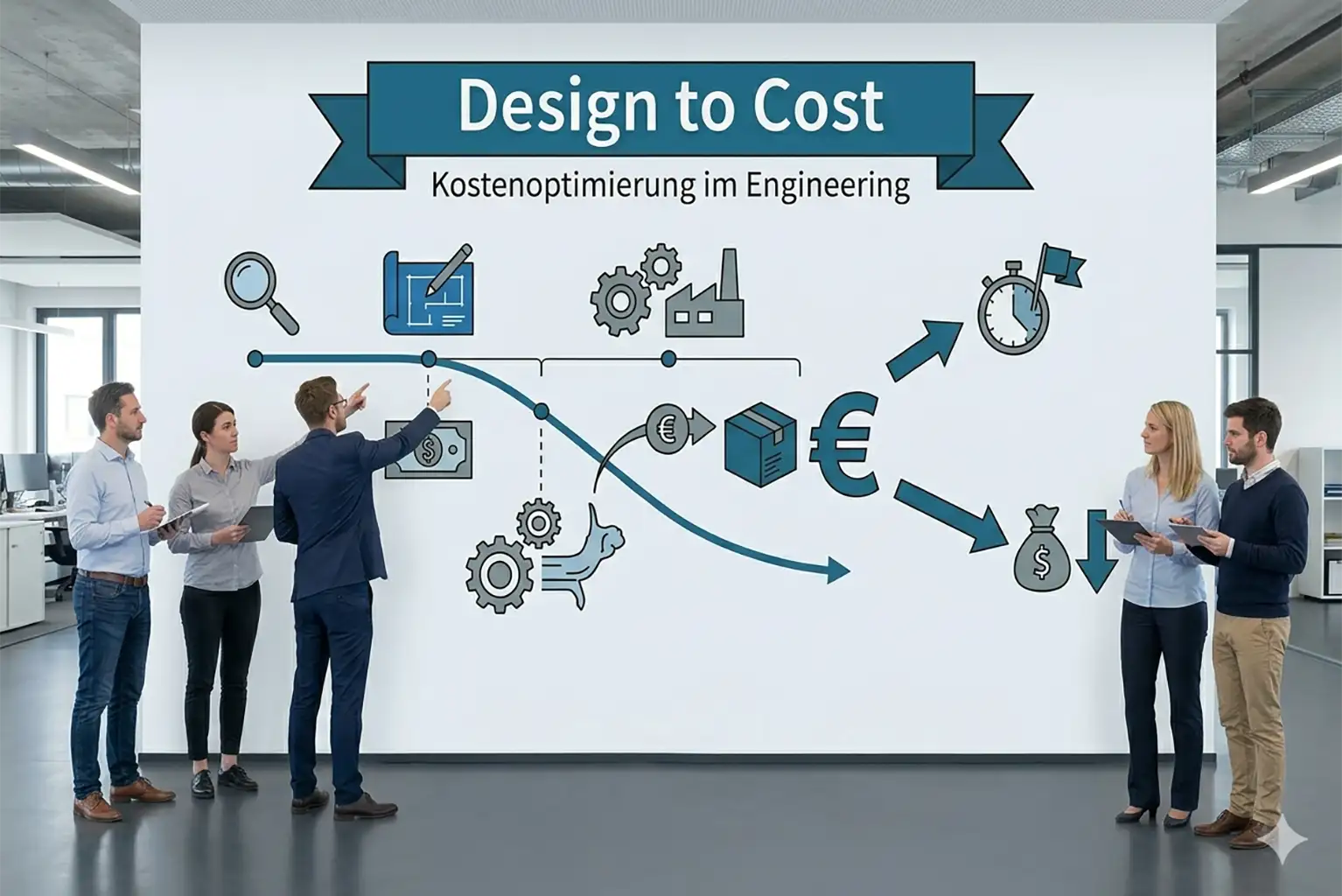
First and foremost:
Design to Cost (DtC) is not a classic savings programme, but a proactive development method in which the target costs are treated as a fixed technical requirement - on a par with performance or quality. As up to 80 % of the Product costs are already defined in the concept phase, DtC is the most effective tool for preventing margin losses due to subsequent corrections. If you do not „design“ the costs from the outset, you will lose your financial room for manoeuvre later on.
Key facts about Design to Cost (DtC)
- Core principle: Costs are a primary design parameter, not a downstream calculation variable.
- Leverage effect: The highest cost influence is in the early concept phase; later changes cost ten times as much.
- Mix of methods: Use of target costing, value analysis (value engineering) and production-orientated design (DfM).
- KPI focus: Monitoring the delta between forecast production costs (expected costs) and the cost limit (allowable costs).
1. definition: What design to cost really means
The mathematical basis: Target Costs = Target Price - Target Profit
„Engineering is the art of doing for one euro what anyone can do for two euros.“
2. the 80/20 rule: why engineering is responsible for costs
A critical paradox in engineering is the drifting apart of cost responsibility and cost generation. While the actual invoices are only paid in production, the course is already set on the drawing board.
Empirical studies show: By the end of the concept phase, more than 70 % to 80 % of the manufacturing costs are often already „frozen“. Anyone who only tries to cut costs when the prototype is finished is tilting at windmills. At this point, tools have been ordered, supplier contracts finalised and assembly processes defined. DtC therefore starts with the first draft in order to utilise the maximum scope for design as long as the modification costs are still minimal.
3. the DtC process: step by step to achieving the goal
A successful DtC approach is divided into four iterative phases:
- Target costing: Deriving the target price from a market and customer perspective. What is the customer willing to pay? The margin is deducted from this to obtain the „allowable costs“.
- Functional analysis: The product is broken down into its functions. Which components fulfil which purpose and are the costs for these components in a healthy relationship to the customer benefit?
- Concept competition: Engineers develop alternative technical solutions (e.g. different materials or manufacturing processes) and immediately evaluate them financially.
- Monitoring: Continuous tracking of cost development during detailed design through to the start of series production.
Would you like a brief consultation on this?


4. method deep dive: DFA, DFM and standardisation
To achieve the target costs, engineers need to master specific levers:
- Value engineering (value analysis): Each component is critically scrutinised. Would a cheaper material or a different process (e.g. bent sheet metal part instead of milled part) fulfil the same purpose without any loss of function?
- Design for Manufacturing (DfM): The design is optimised for efficient production. This includes the avoidance of unnecessary tolerances, the reduction of clamping in machining or the optimisation of draft angles in casting.
- Design for Assembly (DfA): The aim is to minimise assembly time. Strategies here include reducing the number of parts, integrating snap-on connections instead of screw connections and ensuring a clear installation position (poka-yoke).
- Modularisation & platform strategy: Use of common parts across different product lines to achieve economies of scale in purchasing and reduce complexity in logistics.
5. technical deep dive: functional value analysis and target cost splitting
In the „engine room“ of Design to Cost, target cost splitting (Target Cost Breakdown). The product is not evaluated according to components, but according to functions.
A value control chart visualises the relationship:
- X-axis: Share of the component in the total costs.
- Y-axis: Importance of the function for the customer.
Components in the „drift range“ (high costs with low benefits) are the primary targets for a redesign. If, for example, a purely aesthetic housing element generates 15 % of the costs, but the customer only values the precision of the measured values, there is a glaring imbalance. This is where the value analysis comes in: Can the visual appearance be achieved with a more favourable finish or functional integration (housing is also the carrier)?
6. practical example: From cost explosion to profitable series production
Let's look at the development of an industrial control housing for mechanical engineering. In the first concept phase, the preliminary calculation resulted in manufacturing costs of EUR 58.00 per unit. However, with a target market price of 150.00 EUR and a desired margin of 30 % as well as other distribution costs, the target budget was strictly 35.00 EUR.
The engineering team was faced with a seemingly impossible task, as the technical requirements (protection class IP67 and EMC shielding) were non-negotiable. Instead of cutting back on quality, the team went back to the value analysis:
- The findings: The original housing consisted of six precision-milled individual aluminium parts that were connected with 16 stainless steel screws. The assembly time was 12 minutes.
- The DtC optimisation:
- Concept change: Conversion from machining to a two-part aluminium die-casting concept. The initial tool costs were amortised after just 400 units.
- Functional integration: The cooling fins were moulded directly into the housing wall instead of being screwed on as separate components.
- Assembly check: Replacement of the 16 screws with 4 central bolts and a circumferential sealing geometry that fixes itself when closing.
- The result: manufacturing costs fell to EUR 32.50. The assembly time was reduced to 3 minutes. In the end, the product was not only 44 % cheaper, but also less error-prone in production due to the reduced variety of parts.
7. software & tools: The digital infrastructure for cost transparency
In modern engineering, design to cost can hardly be realised efficiently without digital support. Excel spreadsheets quickly reach their limits when it comes to complex assemblies with hundreds of individual parts. Today, we talk about cost engineering software that bridges the gap between CAD and finance:
- Product Cost Management (PCM): Solutions such as Teamcenter PCM or aPriori make it possible to analyse CAD models directly. The software recognises geometry features (such as holes, pockets or curves) and automatically calculates the production time and costs based on stored machine hour rates and material prices.
- Should-cost analyses: These tools give the engineer immediate feedback: „If you reduce this wall thickness by 0.5 mm, the material costs decrease by 4 %, but the risk of distortion in the casting increases by 12 %.“ Such simulations allow well-founded trade-off decisions to be made in real time.
- ERP and PLM integration: A direct interface to purchasing (e.g. SAP) ensures that engineers calculate with real prices and not with estimated values from the previous year. This creates the necessary transparency for make-or-buy decisions: Is it cheaper to manufacture the part in-house or buy it in as a standard component?
8. the DtC checklist: Strategic guidelines for the design review
A design review without a hard focus on costs is often a waste of time. Use this checklist for every milestone meeting to keep the team focussed on the economic goals:
- Functional audit: Are there any components or features that were not explicitly requested by the customer? (Avoidance of „gold plating“).
- Parts reduction: Can the number of components be reduced by at least 20 % through functional integration? Each eliminated part saves costs along the entire chain: purchasing, warehousing, quality assurance and assembly.
- Tolerance check: Is the selected tolerance really function-critical? Halving the tolerance specification can often quadruple the production costs of a component.
- Standardisation rate: How high is the proportion of identical parts? Do we use catalogue goods (COTS - Commercial off-the-shelf) or are we unnecessarily redeveloping the wheel?
- Assembly logic: Can the product be assembled intuitively and in one direction only (top-down assembly)? This drastically reduces handling time and the error rate.
9. the biggest hurdles: Why DtC often fails in implementation
Despite the obvious logic of Design to Cost, many initiatives fail in practice due to cultural and organisational barriers:
- Information asymmetry: Engineers often simply have no idea what their designs cost. Without a transparent cost database, they design „blindly“ and rely on gut feeling, which often leads to expensive solutions.
- The „not-invented-here“ mentality: Many developers see pride in in-house development. Using standard parts often feels less „innovative“ to them, but is almost always the superior strategy economically.
- Silo thinking: If purchasing is only assessed on the basis of savings on existing drawings, it has no incentive to get involved in the concept phase. However, DtC requires purchasing and production to be at the table from day one.
- Wrong incentive systems: If the targets for a project are only „adherence to deadlines“ and „technical performance“, cost optimisation is always the first thing to be sacrificed when time is tight. Cost-effectiveness must be a KPI that weighs just as heavily as the function.
10 Conclusion: Design to cost as a strategic success factor
Design to Cost is far more than a method of reducing costs - it is a cultural change in engineering. It forces companies to combine technical brilliance with economic rationality. Those who firmly anchor DtC in their development process not only reduce their manufacturing costs, but often also shorten their time-to-market thanks to simpler, standardised designs. In a market environment in which unique technological selling points are becoming increasingly short-lived, the ability to develop precisely to cost targets is no longer a „nice-to-have“, but a survival strategy.
Ultimately, DtC transforms engineering from a pure fulfilment entity to a proactive value creator within the company. It is the strategic answer to rising cost pressures and complex supply chains by building economic resilience directly into the product DNA and thus ensuring the long-term success of the company.
„True innovation is not about building the most expensive thing, but about creating the best for the price the world is willing to pay.“
11th FAQ - Frequently asked questions about Design to Cost
Does design to cost always mean poorer quality?
No. DtC eliminates waste (over-engineering). The aim is to deliver the quality required by the customer at the optimum price. Quality often even increases, as simpler designs are less prone to errors.
When is the best time for DtC?
In the early concept phase. As soon as the first firm tool decisions have been made, the leverage for significant cost optimisation falls rapidly towards zero.
What is the difference between DtC and value engineering?
Design to cost is the overarching process during development. Value engineering (value analysis) is a specific method within this process to optimise the value of a function in relation to its costs.
Who is responsible for DtC in the company?
It is a joint task. The lead is taken by Engineering, but it requires the data expertise of Purchasing, Controlling and Production.