




First and foremost:
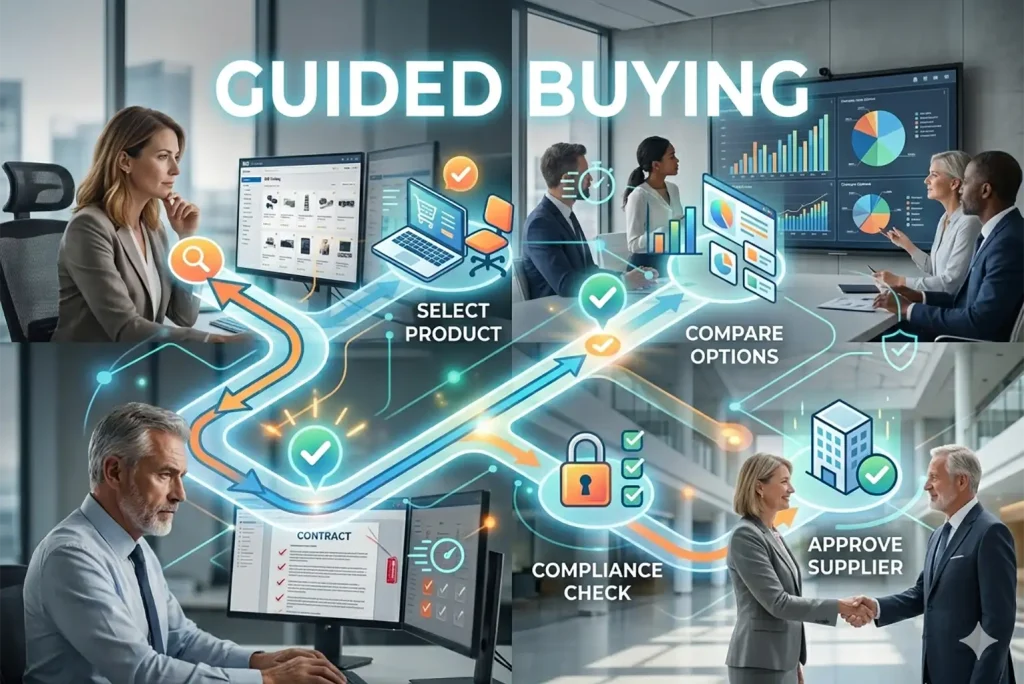
Guided Buying is a software-supported e-procurement strategy that guides employees intuitively to the right products and preferred suppliers. The aim is to Purchasing process as simple as possible („Amazon feeling“ in B2B) in order to minimise uncontrolled expenditure (Maverick Buying), ensure compliance and reduce process costs by an average of 25% to 40%.
Key facts about Guided Buying
- Core objective: 100% compliant purchasing through intelligent user guidance.
- Advantage: Drastic reduction in administrative queries in central purchasing.
- Technology: Use of OCI/punchout interfaces, search logics and AI-supported nudging.
- Strategy: Active management of requirements in the direction of favoured (e.g. sustainable) suppliers.
1. definition: What is Guided Buying?
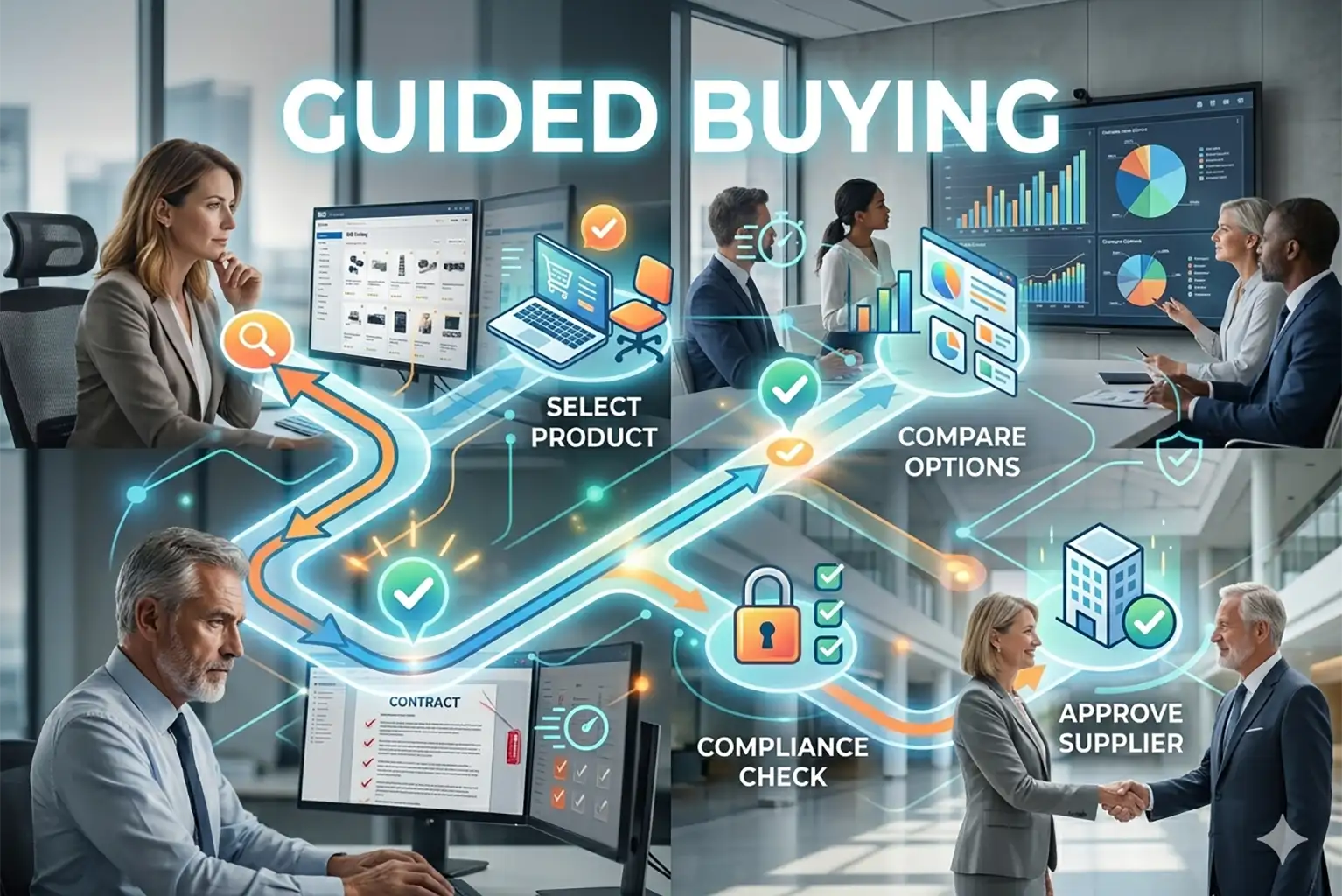
This intuitive guidance ensures that the hurdles for the end user are reduced, while the data quality for purchasing increases massively. It is the decisive step away from rigid, complex forms towards proactive user support that relieves the administrative burden on purchasing and strategically enhances it. The visual presentation and simple search logic democratise the purchasing process without losing central control. The aim is to break down barriers while maintaining data integrity for strategic analyses at an unprecedented level.
„The best Procurement process is the one that the employee does not perceive as a bureaucratic hurdle, but as a logical support in their day-to-day work.“
2 Why Guided Buying? The E-E-A-T perspective
Today, search engines and specialised users evaluate the depth of content and trustworthiness of a topic. Guided buying contributes directly to these E-E-A-T pillars:
- Experience: The system mirrors the real purchasing experience of professionals and makes it usable for all departments.
- Expertise: specialist knowledge about customs, security standards or IT requirements is stored directly in the workflow.
- Authoritativeness: The system acts as an internal authority that enforces guidelines not through prohibitions but through positive guidance („nudging“).
- Trustworthiness: Users trust the process, as incorrect purchases are technically almost impossible.
3. methods of guided buying: from catalogues to AI
The methodical implementation of Guided Buying varies depending on the technological infrastructure and the specific requirements of the product groups. While simple catalogues are sufficient for standard items, complex services or highly specialised technical components require differentiated approaches to guide users safely to their destination:
- Static catalogues: Internal lists with fixed prices for standard items (e.g. office supplies).
- Punchout catalogues (OCI/cXML): The user jumps directly to the supplier's optimised web shop. After the checkout, the order data automatically flows back into your own ERP system.
- Smart Forms: Dynamic forms for services that only display those fields that are relevant to the specific request.
- AI-supported nudging: Proactive suggestions such as: „Other users in your department have also ordered product X“ or „This product is 10% cheaper and has a better carbon footprint“.
Would you like a brief consultation on this?


4. deep dive: the technical logic and the decision tree
The technical superiority of Guided Buying lies in the linking of user profiles with metadata. The system works in the background with a complex decision tree:
- Identification: Who orders? (role, department, budget responsibility).
- Needs analysis: What is being searched for? The semantic search recognises requirements even for imprecise terms.
- Policy check: Is there an active framework agreement? Is the supplier certified?
- Validation: Does the selection match the budget and cost centre?
This real-time validation makes the purchasing process „self-correcting“. It is technically almost impossible to make a mistake, as the system does not lead the user to the wrong options in the first place.
5. sustainability: green procurement through guided buying
Modern purchasing arrives ESG Criteria (Environmental, Social, Governance). Guided buying is the most effective lever for sustainable action here:
- Prioritised display: Sustainably certified products are prioritised in the search results.
- CO2 transparency: The ecological footprint is already visualised in the shopping basket.
- Regional control: favouring local suppliers to reduce emissions.
6. performance review: the most important KPIs and benchmarks
A subjective gut feeling is not enough to objectively assess the success of a guided buying initiative. Only by linking process data with financial key figures can the actual added value for the company become visible. The following KPIs serve as a compass for measuring performance:
- Maverick Buying Quote: Target value should be below 5%.
- Touchless PO rate: Proportion of orders without manual intervention (target: > 70%).
- Cycle time: Reduction of the time from request to order to just a few minutes.
- Process costs: Savings of around €20 to €50 in administrative costs per process.
7 Roadmap: 5 steps to the implementation of Guided Buying
The transition to a guided purchasing process requires structured planning that goes beyond the mere installation of software. A clear roadmap helps to avoid technical hurdles at an early stage and ensure organisational acceptance right from the start. The following five steps form the foundation for a successful transformation:
- Pain point analysis: Identification of the product groups with the highest rate of incorrect purchases.
- Supplier onboarding: Selection of strategic partners (punch-out-capable).
- Content strategy: Creation of digital content that meets B2C standards.
- Workflow mapping: Digital mapping of internal approval chains.
- Change management: communicating the benefits to the workforce.
8. practical examples from everyday business life
Theoretical concepts only become fully convincing when applied in practice. The following scenarios illustrate how Guided Buying makes day-to-day work in various departments easier and at the same time ensures compliance with complex corporate guidelines:
- Example A (C-parts): An engineer requires specialised tools. The system recognises his cost centre and only displays tools that meet the occupational safety standards.
- Example B (Marketing): A manager wants to print advertising material. The system guides her through a „smart form“ that automatically checks compliance with the corporate design.
9. challenges during implementation
Every technological innovation brings with it specific hurdles that go beyond the purely technical aspect. Awareness of these stumbling blocks is the basic prerequisite for smooth implementation and a permanently high level of acceptance within the team:
- Data quality: Without clean master data, the system loses its leadership.
- Acceptance: If the system is more complicated than a private online shop, users will avoid it.
- Interface complexity: Smooth integration into existing ERP landscapes requires IT expertise.
„Efficiency in purchasing is not achieved through maximum control, but through the intelligent channelling of requirements to the right source.“
10 Conclusion: The strategic importance of guided buying
Guided Buying transforms purchasing from a controlling brake into a real business accelerator. It is the ideal tool for companies that want to master the balancing act between maximum control (compliance) and maximum user-friendliness. In a digitalised world, the user experience is the key to success in spend management - those who make purchasing simple ensure that rules are happily adhered to.
In addition, the clean database created by guided processes enables a completely new quality of spend management. In the future, guided buying will not only control purchases, but also proactively identify optimisation potential throughout the entire supply chain and make AI-based suggestions. It is the foundation for autonomous purchasing that supports people where routine processes can be automated, thus creating space for value-adding, strategic activities. Ultimately, the quality of user guidance determines the actual leverage effect of modern spend management.
11 FAQ: Frequently asked questions about Guided Buying
What is the key difference between classic e-procurement and guided buying?
While conventional e-procurement often requires a deep understanding of product groups, Guided Buying masks this complexity. It relies radically on the user experience. The user searches for a requirement and the system takes over the assignment to the right framework agreement in the background, without the need for expert knowledge.
How does Guided Buying support compliance with the Supply Chain Due Diligence Act (LkSG)?
It acts as a digital protective shield. The system can be configured so that orders can technically only be placed with suppliers who have successfully passed the necessary risk check. As all certificates are stored in the background, a breach is effectively prevented at source.
Which software providers are leaders in the field of Guided Buying?
The market leaders include SAP Ariba, Coupa, JAGGAER and Meplato. The choice usually depends on the depth of ERP integration and the desired range of functions. Market leaders such as SAP offer seamless embedding in existing S/4HANA landscapes.
Is the introduction of Guided Buying also worthwhile for small and medium-sized enterprises (SMEs)?
Definitely. By using cloud-based tools, SMEs can automate their operational purchasing, reduce process costs by up to 50 % and ensure that negotiated discounts are consistently utilised, which is a decisive competitive advantage, especially with smaller margins.