




First and foremost:
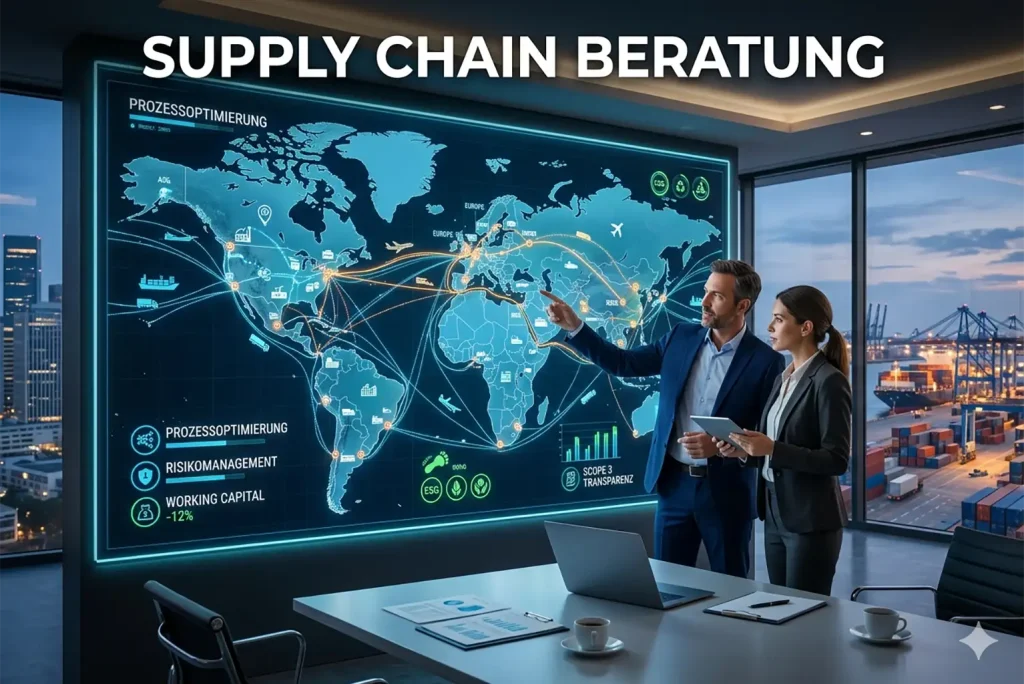
In 2026, a resilient supply chain will be the decisive lever for profitability and market power. Professional Supply chain consulting transforms logistics from a pure cost factor into a strategic driver of value creation. Through the use of AI-supported real-time transparency, optimised working capital and radical ESG Compliance (Scope 3), companies reduce their process costs by an average of 12 to 18 % and safeguard their supply capability against global disruptions.
Key facts about supply chain consulting
- Core objective: Maximising agility while simultaneously reducing capital commitment (working capital).
- Methodology: Data-based end-to-end analysis (E2E) using process mining and digital twins.
- Trends 2026: Cognitive supply chains, circular logistics models and automated LkSG compliance.
- ROI: Amortisation usually within 12 to 15 months due to measurable increases in efficiency.
1. definition: What does a supply chain consultancy do in detail?
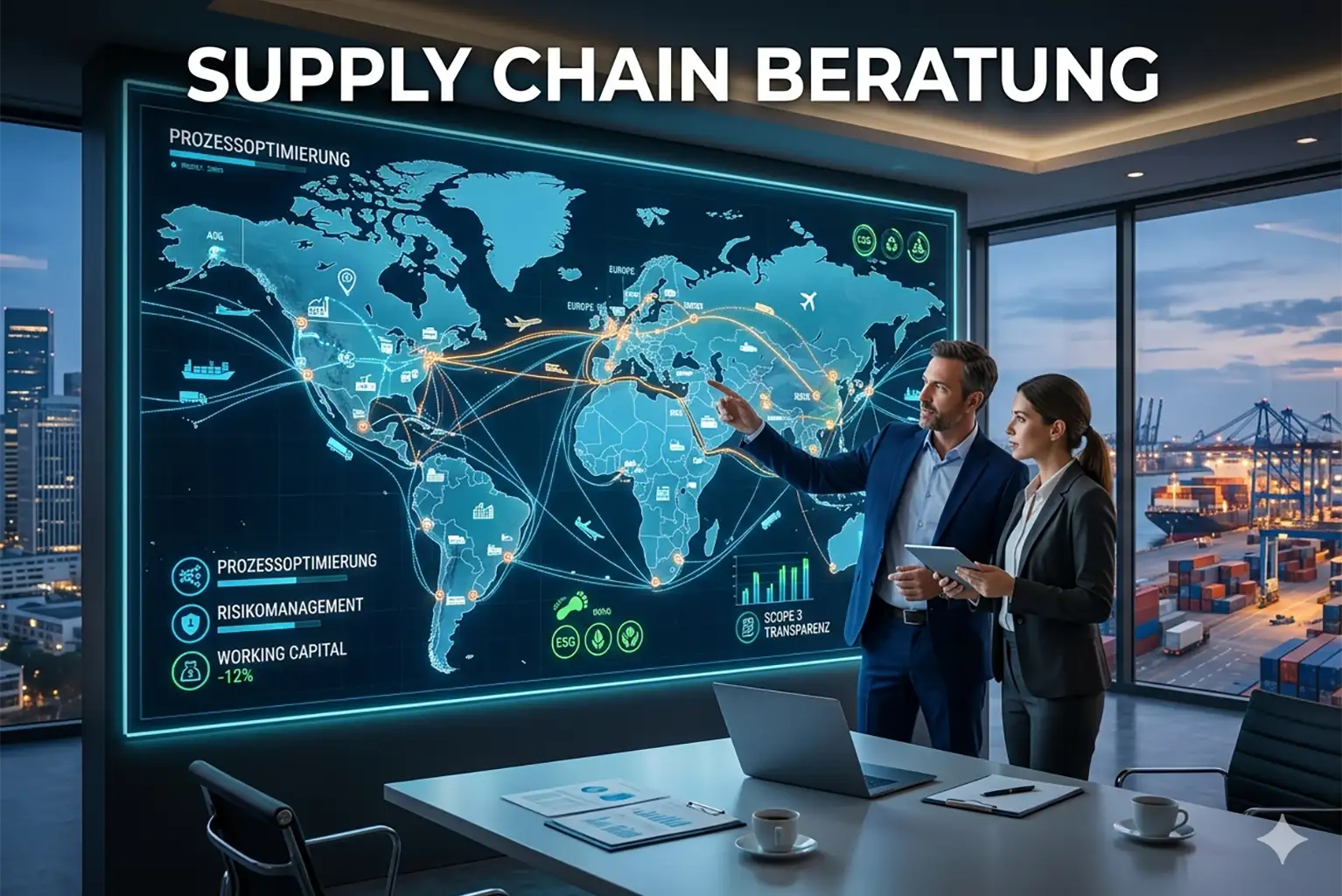
This means that the consultant synchronises material, information and financial flows from the raw material supplier to the end customer. Core tasks include identifying bottlenecks, reducing throughput times through value stream mapping and breaking down organisational silos between purchasing, production and sales. The aim is to create a „single source of truth“ so that decisions are based on valid real-time data instead of vague estimates.
2. why the pressure to act on supply chains is increasing massively
In 2026, we find ourselves in an era of „poly-crises“. Companies are under triple pressure:
- Regulation & ESG: The CSRD reporting obligation and the Supply Chain Due Diligence Act (LkSG) demand a level of transparency that can no longer be managed manually. Anyone who does not know their Scope 3 issues will lose access to the capital markets.
- Geopolitical volatility: Trade barriers and unstable transport routes require an immediate switch from „global sourcing“ to hybrid models such as nearshoring or friendshoring.
- Skilled labour shortage: There is a shortage of skilled workers in operational logistics. Consulting helps to reduce dependency on scarce human labour through automation and AI-supported planning.
3. the four pillars of a sustainable supply chain strategy
In order to make a chain crisis-proof and profitable, the consultancy focusses on these strategic fields:
- Strategic sourcing: moving away from pure „unit price“ purchasing towards Total Cost of Ownership (TCO) model. This also includes risk management through multi-sourcing strategies.
- Integrated Business Planning (IBP): The merging of S&OP (Sales & Operations Planning) with financial planning. The aim is rolling planning that synchronises sales forecasts and production capacities in real time.
- Network Design Optimisation: Mathematical modelling of the optimal network of warehouses, production sites and suppliers to minimise transport costs and carbon footprint.
- Inventory management 2.0: Use of methods such as DDMRP (Demand Driven Material Requirements Planning) to reduce excess stock and at the same time increase delivery readiness for A-items.
Would you like a brief consultation on this?

4 The counselling process: four steps to measurable success
Excellent consulting is not a theoretical construct, but follows a hybrid implementation path:
- Diagnostics & benchmarking: Use of process mining to visualise real process deviations in the IT systems (ERP). A comparison with industry benchmarks reveals immediate potential.
- Target design & simulation: Creation of a digital twin. Scenarios are simulated before physical changes are made: „What happens in the event of a 201TP4 increase in demand or the failure of a central port?“
- Transformation & change management: Supporting the implementation of new software tools and adapting role profiles. The focus here is on employee enablement.
- Value realisation: Continuous tracking of KPIs (e.g. cash-to-cash cycle time) to ensure that the targeted savings are actually reflected in the P&L.
5. deep dive: the strategic change from „lean“ to „resilient“
For decades, „lean management“ was the ultimate: minimum inventories, maximum efficiency. The disruptions of recent years have pushed this model to its limits.
„In a world of constant change, adaptability is the most valuable asset of any logistics network.“
The new guiding principle for 2026 is antifragility. Modern supply chain consulting helps companies to find the „sweet spot“ between cost efficiency and reliability. This means the targeted development of strategic buffers (safety stocks) for critical components and the creation of redundancies in the supplier structure. It moves away from the rigid chain towards a flexible supply chain web that can reconfigure itself dynamically in the event of disruptions.
6. practical example: Transformation of a medium-sized mechanical engineering company
Initial situation: An OEM with a turnover of €200 million was struggling with high capital commitment costs (inventories > €60 million) and at the same time massive missing parts in assembly.
Intervention of counselling:
- Clean-up of master data and introduction of AI-based requirements planning.
- Segmentation of the range of parts by criticality instead of just by value (ABC/XYZ analysis extended to include risk factors).
- Conversion of the top 20 suppliers to a VMI model (Vendor Managed Inventory).
Result after 14 months:
- Reduction in inventories by EUR 12.5 million (cash release).
- Reduction of logistics costs per unit by 9 %.
- Complete fulfilment of ESG reporting obligations through automated data collection.
7 Technological innovations: AI at the heart of modern logistics
Without a tech stack, supply chain consulting is ineffective today. We are talking about the cognitive supply chain in 2026:
- Generative AI in sourcing: AI negotiates standard conditions with suppliers and creates risk analyses from unstructured news sources worldwide.
- Predictive LogisticsAlgorithms calculate estimated times of arrival (ETA) incorporating weather, strikes, and traffic data with 99%curacy.
- Blockchain for circularity: Seamless evidence of material cycles and recycling rates to fulfil the requirements of the circular economy.
8 E-E-A-T: How to recognise excellent consulting partners
To guarantee the success of your project, pay attention to the following criteria:
- Expertise: Does the team have certifications such as APICS (CSCP/CPIM) or Six Sigma?
- Experience: Are there demonstrable project successes in your specific industry (e.g. automotive vs. FMCG)?
- Authority: Does the consultancy publish specialist articles on current trends such as autonomous intralogistics or resilience mapping?
- Trust: A reputable partner offers a transparent fee structure and focusses on the transfer of knowledge.
„The supply chain is no longer just a supporting function, but the backbone of the entire corporate strategy.“
9 Conclusion on supply chain consulting: a strategic investment case
An investment in professional Supply chain consulting in 2026 is far more than mere cost optimisation; it is a fundamental safeguard for the business model against global instabilities. Through the intelligent combination of human expertise and artificial intelligence supply chains that are not only efficient, but also truly adaptive. Companies that recognise their supply chain as a strategic core competence today secure a lasting advantage in terms of margins and customer satisfaction.
Ultimately, it is no longer the product alone that determines market victory, but the ability to bring this product to the customer reliably, sustainably and profitably under all circumstances. The transformation to a cognitive, resilient supply chain is therefore the most important milestone for competitiveness in the next decade. Those who neglect this process-related excellence risk not only short-term delivery failures, but also their entire positioning in an increasingly volatile global market in the long term.
10. FAQ on supply chain consulting: Answers to the most important questions
What is the biggest lever in supply chain consulting?
It is often inventory optimisation. Data-based planning can usually free up 15-25 % of tied-up capital without jeopardising delivery capability.
How long does a typical consulting project take?
An initial „quick scan“ takes around 2 to 4 weeks. An in-depth transformation of processes and IT systems usually takes 6 to 12 months.
Does the consultancy also help with the selection of software (ERP/SCM)?
Yes, independent consulting supports the requirements analysis (specifications) and the neutral selection process in order to avoid bad investments in unsuitable tools.
Can supply chain consulting also reduce CO2 emissions?
Absolute. Through network optimisation (shorter distances) and better capacity planning, CO2 emissions can often be reduced by 10 to 20 % at the same time as costs are reduced.