




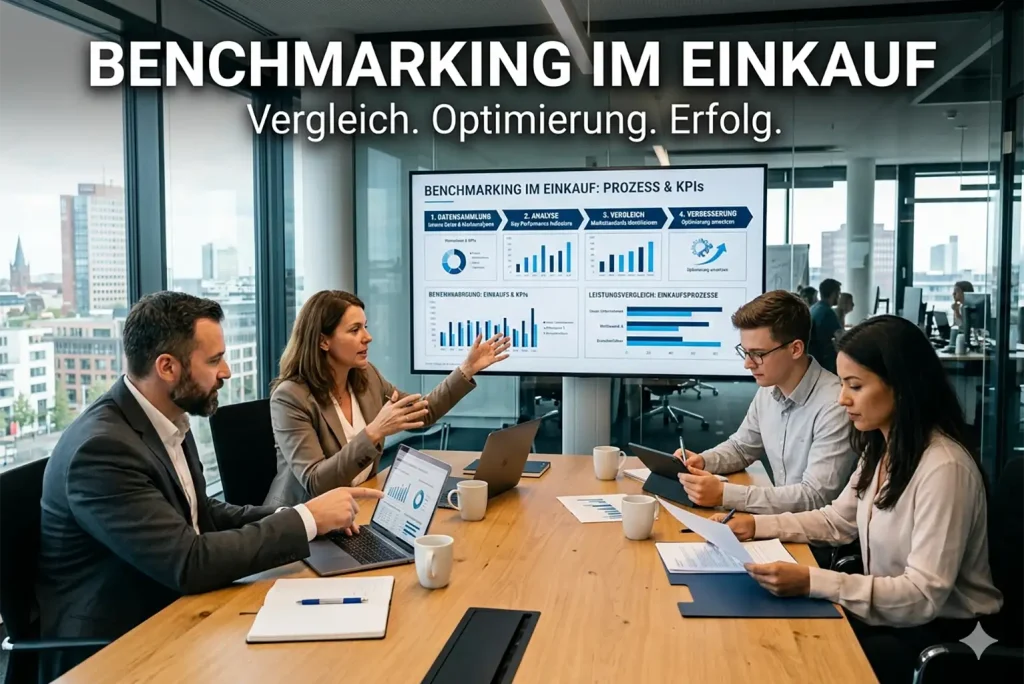
First and foremost:
Purchasing benchmarking is the systematic comparison of prices, processes and services with competitors or market leaders. Companies that consistently use benchmarking achieve sustainable results through optimised conditions and more efficient processes Savings from 10 % to 20 %. Success depends entirely on data quality and a willingness to actively adopt proven best practices.
Key Facts about Procurement Benchmarking
- Core objective: Identification of performance gaps and cost drivers in the procurement process through external benchmarking.
- Savings potential: Average of 15–20 % on direct and indirect costs and associated process costs.
- Methodology: Structured comparison of key performance indicators (KPIs) with internal departments, direct competitors, or industry-leading companies in unrelated sectors.
- Key performance indicators: Purchase price variance, process costs per order, supplier reliability, and maverick buying rate.
- Success factor: A clean, standardised database and continuous monitoring rather than one-off projects.
1. Definition: What is benchmarking in purchasing?
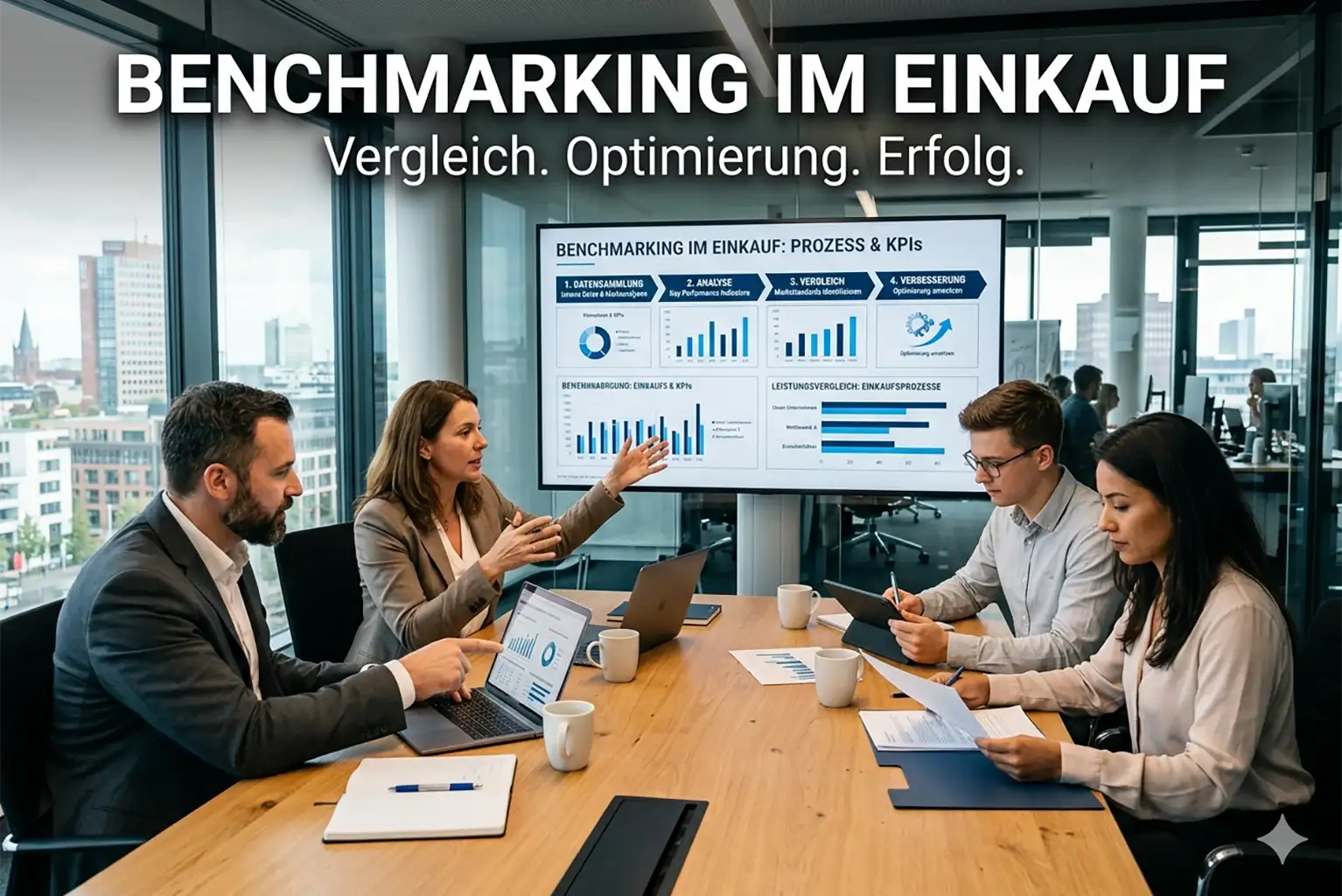
„You can only improve what you can measure.“
At its core, it's about identifying performance gaps not just on the pricing level, but also in the procedural execution. Expertise in procurement today means actively using this „reality check“ to sustainably increase one's own value creation by transferring proven success concepts. This uncovers weaknesses that often remain hidden in day-to-day operations, and sets clear targets for optimisation.
2. The 3 types of benchmarking in detail
To fully leverage a benchmarking strategy, companies should choose between different approaches, each providing different insights:
- Internal benchmarking: This involves comparing different sites, departments, or teams within the same corporate group. The major advantage lies in the easy access to data and high acceptance among employees. It serves to quickly identify internal best practices and transfer them to other areas.
- Competitive Benchmarking: This is the direct comparison with competitors from your own industry. It shows the exact market positioning and helps to objectively assess the competitiveness of your own purchasing conditions. As direct data from competitors is difficult to access, anonymised databases or market research reports are often used for this.
- Functional Benchmarking: Here, the company looks beyond the confines of its own industry. Functions (such as logistics or IT procurement) are compared with market leaders from unrelated industries. This approach offers the highest potential for innovation, as highly efficient processes can be adapted that may not yet be established in the company's own industry.
3. Step-by-step guide to success
A structured approach is crucial to ensure a benchmarking project doesn't get bogged down in a „data swamp“ but instead delivers tangible results:
- Preparation: Precisely define the object of investigation. Initially, focus on a product group with high leverage, such as the C-parts management or the fleet costs.
- Analyse: Collect your own actual "as-is" data comprehensively. For example, what are your current administrative process costs per order? No comparison is possible without an honest assessment.
- Comparison: Find suitable comparison partners or use anonymised data pools from industry associations and specialised platforms.
- Identification: Analyse the causes of deviations (gap analysis). Why is the competitor 15 % more efficient or cheaper, despite identical quality? Is it due to technology, contracts, or processes?
- Implementation: Develop concrete action packages, such as the Bundling supplier volumes or the introduction of digital e-procurement tools, and regularly monitor their success.
Would you like a brief consultation on this?


4. The most important KPIs for comparison
Numbers form the foundation for any successful benchmarking. In procurement, you should focus on key figures that reflect both costs and efficiency:
- Savings Percentage (Savings): The percentage difference between the old and the newly negotiated purchase price.
- Cost of process per order: The total administrative costs of an order. Top performers achieve values well below 50 Euros here.
- Maverick Buying Quote: The proportion of purchases that bypass central procurement. A high quote indicates inefficient structures.
- Supplier concentration: A key performance indicator for risk assessment. How dependent are you on individual key suppliers?
- Timeliness: The percentage of deliveries that arrive exactly on the agreed-upon date, which is essential for smooth production.
5. Challenges and how to overcome them
Despite the clear advantages, benchmarking is not a foregone conclusion. The biggest hurdle is usually the lack of data quality. Anyone who works with unclean or incomparable data will obtain misleading results.
- Solution for data problems: Use international classification standards such as eCl@ss or UNSPSC to make your product groups comparable.
- Solution for internal resistance: Skepticism towards change is common („We've always done it this way“). The only solution here is active change management: involve the specialist departments in the project early on and communicate the benefits – such as relief from bureaucratic tasks – clearly and transparently.
6. Deep Dive: Digital Benchmarking through Process Mining
While classic benchmarking often relies on manual queries and static Excel lists, process mining elevates the method to a completely new level. It uses digital traces from ERP systems (such as SAP or Oracle) to reconstruct the actual procurement process in real-time.
The decisive advantage: Traditional benchmarking only shows you what's going wrong (e.g. excessively high costs). Process Mining shows you why it's happening. You can directly compare your digital process flow diagrams against the „happy path“ of a market leader or a more efficient location. Bottlenecks, unnecessary approval loops, or deviations from the standard process become immediately visible and can be specifically eliminated.
7. Sustainability Check: ESG Benchmarking as a New Standard
In a modern procurement strategy, the factor of sustainability must no longer be missing in 2026. The ESG Benchmarking (Environmental, Social, Governance) complements the classic price comparison with crucial factors:
- CO2 footprint per product group: How do your main suppliers compare to the industry average?
- Risk Score according to the Supply Chain Due Diligence Act (LkSG): How transparent and secure is your supply chain compared to your direct competitors?
- Sustainability Performance: Benchmarking helps to make the transformation to a „Green Supply Chain“ measurable and to position oneself as a responsible company towards customers.
8. Practical Example: Cost Reduction for Indirect Materials
A medium-sized engineering company found that the procurement costs for C-items (office supplies, tools, small parts) were disproportionately high compared to the competition.
- The initial situation: An analysis revealed process costs of 115 Euros per order with a Maverick Buying rate of 35 %.
- The benchmark comparison: A comparison with industry best practices showed that leading companies achieve costs of just €40 and keep the Maverick rate under 5 %.
- The measure: The company introduced a cloud-based catalogue system, consolidating 80 % of the volume with three strategic core suppliers.
- The result: After just 12 months, processing costs dropped to €45 per order. Overall, purchasing achieved total savings of €18 % in this area and was able to free up staff for more strategic tasks.
9. Quick checklist: Ready for procurement benchmarking?
Before you start, check these five points:
- Are our product groups cleanly sorted according to a standard (e.g. eCl@ss)?
- Do we have access to current market price or benchmarking databases?
- Is management prepared to radically change processes based on the results?
- Do we have the capacity to implement the identified measures operationally?
- Beyond price, should we also consider quality and sustainability KPIs?
10. Conclusion on Procurement Benchmarking
Purchasing benchmarking is far more than just troubleshooting – it is a necessary engine for the transformation of procurement. Those willing to look beyond their own immediate concerns can realise savings of up to 20 %. The method allows strategic decisions to be made based on hard facts rather than imprecise gut feelings.
„Comparing yourself to the best is not a sign of weakness, but the first step towards true excellence.“
Ultimately, through consistent benchmarking, purchasing transforms from a mere ordering department into a true value-adding partner within the company. Those who create this transparency today secure the necessary resilience to remain competitive in the long term, even in volatile global markets. Benchmarking is not a goal in itself, but the path to a highly efficient, crisis-proof, and future-oriented purchasing organisation. Start with a clear focus on one product group and utilise modern approaches such as process mining and ESG data to make your purchasing future-proof.
11. FAQ: Frequently Asked Questions about Purchasing Benchmarking
How often should benchmarking be conducted in procurement?
An annual cycle is ideal for strategically important product groups. In highly volatile markets (e.g. energy or raw materials), even quarterly checks can be sensible in order to react immediately to market changes.
Is benchmarking in procurement also worthwhile for SMEs?
Yes, absolutely. Small and medium-sized enterprises in particular can learn from the high standards of large corporations through functional benchmarking, without having to finance expensive pilot projects themselves. It helps SMEs to deploy their often limited resources where they will achieve the greatest impact.
Where can I get external comparative data?
Industry associations, specialised corporate consultancies, and modern cloud-based benchmarking platforms often provide access to anonymised data pools. Regularly attending industry conferences also offers valuable insights into current market standards.
What should be considered regarding antitrust law and benchmarking in procurement?
The direct exchange of sensitive pricing data with competitors is strictly prohibited. Therefore, always use neutral third parties (trustees, consultants or analysis platforms) to compare data in an anonymised and aggregated manner, so that no conclusions can be drawn about individual conditions.