



First and foremost:
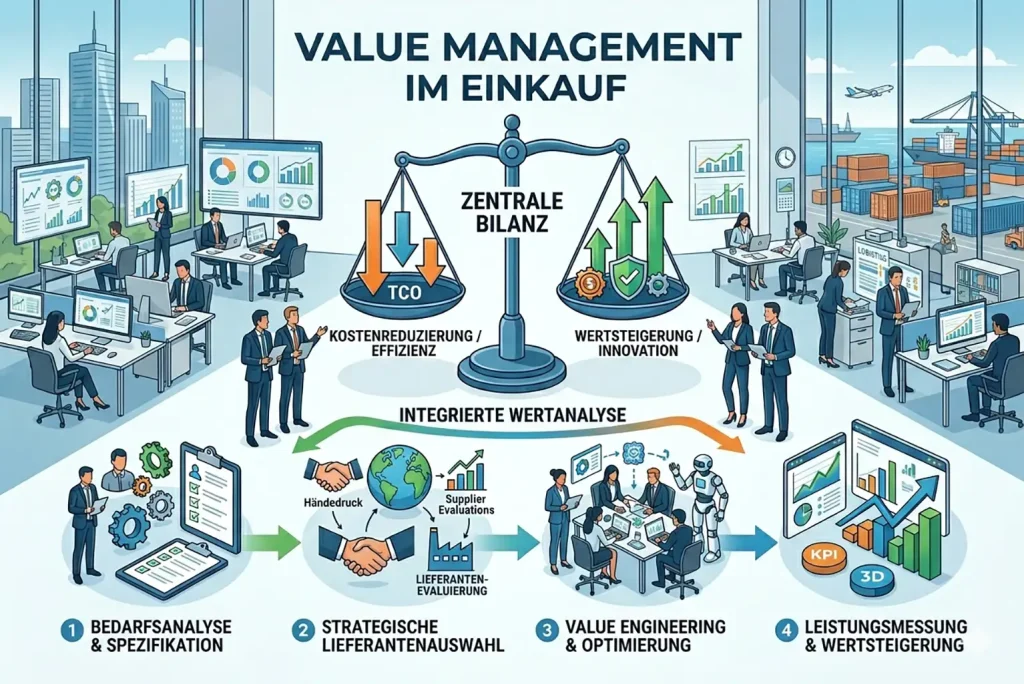
Value Management (VM) in procurement is the strategic key to increasing profitability without sacrificing product quality. Unlike classic cost-cutting, which often only aims for price reductions, VM optimises the ratio between function and cost. By involving procurement early in development and working closely with suppliers, companies can Manufacturing costs reduce costs by an average of 10 to 25 per cent whilst strengthening our innovative capacity and market position.
Key Facts on Value Management
- Holistic management approach for maximising benefits with minimal resource utilisation.
- Core formula: Value equals the sum of all functions divided by the total cost of ownership (TCO).
- Main advantage: Sustainable margin protection and reduction of „over-engineering“.
- Success factor: Cross-functional collaboration between purchasing, engineering, and suppliers.
- Timing: Maximum impact in the early product development phase (Value Engineering).
What is Value Management in procurement?
Value Management (Wertmanagement) is a holistic approach that aims to systematically enhance the value of a product. In purchasing, this means a departure from a sole focus on the acquisition price. Instead, the question takes centre stage: What function does a component fulfil, and what is that function worth?
„The price is what you pay. The value is what you get.“
In doing so, purchasing not only considers the pure purchase price but the total lifecycle costsTotal Cost of Ownership, TCO, to eliminate unnecessary costs that do not provide direct benefit to the end customer.
2. The Strategic Difference: Cost Cutting vs. Value Management
Classic Cost Cutting:
The focus is primarily on the price per unit. It is often a reactive measure that only comes into play after the product launch or in cases of acute margin pressure. Negotiations are usually conducted confrontationally, which can jeopardise quality or the supplier relationship in the long term.
Value Management:
The focus is on the functions and the overall costs. It is a proactive approach that ideally begins in the concept phase. Work is carried out cross-functionally within the team (procurement, engineering, production) to find smarter solutions rather than just cheaper components.
3. The methodology: Function analysis as the core
The core of value management is functional analysis. This involves breaking down a product into its functions, rather than simply looking at it as a sum of its parts:
- Functional requirements: What must it absolutely be able to do? (e.g., hold a load).
- Applicability functions: What contributes to image or design? (e.g., a high-quality feel).
- Redundant features: Which characteristics are present for which the customer is unwilling to pay? (Over-engineering).
Through this analysis, purchasing often recognises that expensive materials or overly tight tolerances are not actually necessary for the component's intended purpose.
Would you like a brief consultation on this?
4. Strategic levers for increasing value in procurement
To increase value sustainably, modern procurement utilises key levers such as Early Procurement Involvement (EPI). Since a large proportion of costs are determined in the design phase, procurement must be involved before the drawing is complete.
„Real efficiency in purchasing means not paying less, but investing more wisely in functions.“
Further levers include supplier integration, where top suppliers contribute their expertise, as well as standardisation to maximise economies of scale through common parts across different product lines.
5. Step-by-step implementation in practice
- Preparation: Identification of high-volume or low-margin products.
- Team Setup: Formation of a working group comprising Procurement, Engineering, and Quality Management.
- Analyse: Recording of actual costs and carrying out of functional analysis.
- Ideation: Creative workshops to find alternatives (same function at lower cost).
- Evaluation: Review of ideas for technical feasibility and savings potential.
- Implementation: Carrying out the changes and monitoring the results.
6. Deep Dive: Calculating the Value Factor – The Function-Cost Matrix
To make Value Management measurable, experts use the Value Index. Here, each function is assigned a percentage weighting that reflects its importance to the customer. In parallel, the actual cost proportions of the components are determined.
An ideal Value Index of 1.0 means that the cost of a function exactly matches its significance. An index significantly below 1.0 indicates functions that incur high costs but have little relevance to the customer – this is where the greatest potential for optimisation lies.
7. Practical Example: Successful value optimisation of a housing component
A medium-sized mechanical engineering company previously manufactured a protective housing from solid machined aluminium for 450 euros each.
The analysis: The extreme precision of the milling was, for the sole protective function (dust/splash water), effectively „over-engineering“.
The solution: Following a workshop with a supplier, the component was switched to a die casting process with powder coating.
The result: costs fell to €180 per unit (a saving of €60). The protective function remained the same, and the coating actually made the product appear to be of higher quality.
8. Green Value Management: Sustainability as a New Value Factor
In 2026, the Sustainability (ESG compliance) plays a crucial role in the overall value of a product. In Green Value Management, functional analysis is supplemented with ecological criteria:
- Material efficiency: Fulfilling the function with less resource input.
- Longevity: Increasing lifespan to reduce TCO and carbon footprint.
- Circular Design: Construction for Easy Disassembly and Reuse at End of Life.
9. Conclusion: From price cutter to value creator with Value Management
Value Management Transforms purchasing from an administrative function into a genuine value driver. Companies that consistently focus on value rather than just price not only secure better margins but also build more stable supply chains and offer customers precisely the benefits they need. In volatile markets, this approach is existential for competitiveness.
Value management is not a one-off project, but a permanent management discipline that requires close integration between technology and commerce. Those who overcome this cultural hurdle and make purchasing an active co-creator of products will make their company crisis-proof and secure a decisive lead in the global innovation competition.
10. FAQ on Value Management in Purchasing
When is the best time for value management?
The greatest leverage lies in the early product development phase (Value Engineering). However, considerable potential can often be realised with existing products (Value Analysis).
Does Value Management require specific software?
There are tools for product costing, but success primarily depends on the methodology and collaboration. Structured workshops are often sufficient to get started.
How do suppliers react to this approach?
Very positive if communicated in a partnership. This allows suppliers to distinguish themselves through innovation rather than just the lowest price.
Which key performance indicators (KPIs) measure the success of value management?
Key indicators include the reduction in Total Cost of Ownership (TCO), the lowering of component variance, and an increase in sales margin. The improvement of the CO2 footprint is also increasingly being tracked.