




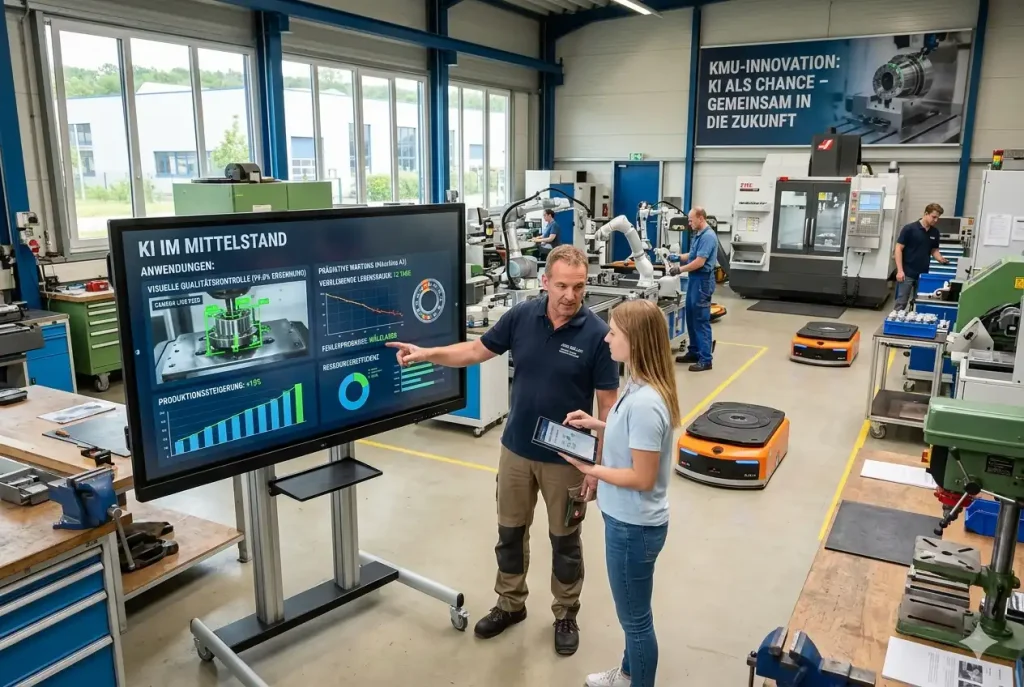
The successful implementation of AI in Small and Medium-sized Enterprises is no longer an exclusive privilege of tech giants, but the decisive lever for the future competitiveness of small and medium-sized enterprises. Those who today AI strategically integrated into existing processes – be it in administration, Production or in customer service – reduces process costs by up to 30 % and effectively mitigates the acute shortage of skilled workers. The key to success lies not in expensive in-house developments, but in pragmatic hybrid models and clear implementation strategies that comply with data protection regulations.
Key facts on AI in Germany's small and medium-sized enterprises at a glance
- The current situation: Over 60 % of small and medium-sized enterprises are already using AI tools or plan to do so within the next 12 months.
- The top opportunities: Automation of routine tasks (Generative AI), more precise market forecasts (Predictive Analytics) and supply chain optimisation.
- The Hybrid Model: The combination of standardised out-of-the-box solutions (e.g. Microsoft Copilot) and specialised, internal AI models offers the best cost-benefit ratio.
- Overcoming hurdles: Data protection (GDPR compliance & EU AI Act) and team change management are the most critical success factors.
Table of Contents
- 1. Why AI is now vital for survival for SMEs
- 2. The biggest opportunities: Where AI creates immediate added value
- 3. The Hybrid Model: The Smart Strategy for SMEs
- 4. Data sovereignty and relevance through RAG (Retrieval-Augmented Generation)
- 5. Step-by-step roadmap for AI integration
- 6. That's how small and medium-sized businesses do it
- 7. Challenges: Data Protection, EU AI Act & Acceptance
- 8. Conclusion: Making AI simple for SMEs, but systematically
- 9. FAQ – Frequently Asked Questions about AI in the Mid-Market
1. Why AI is now vital for survival for SMEs
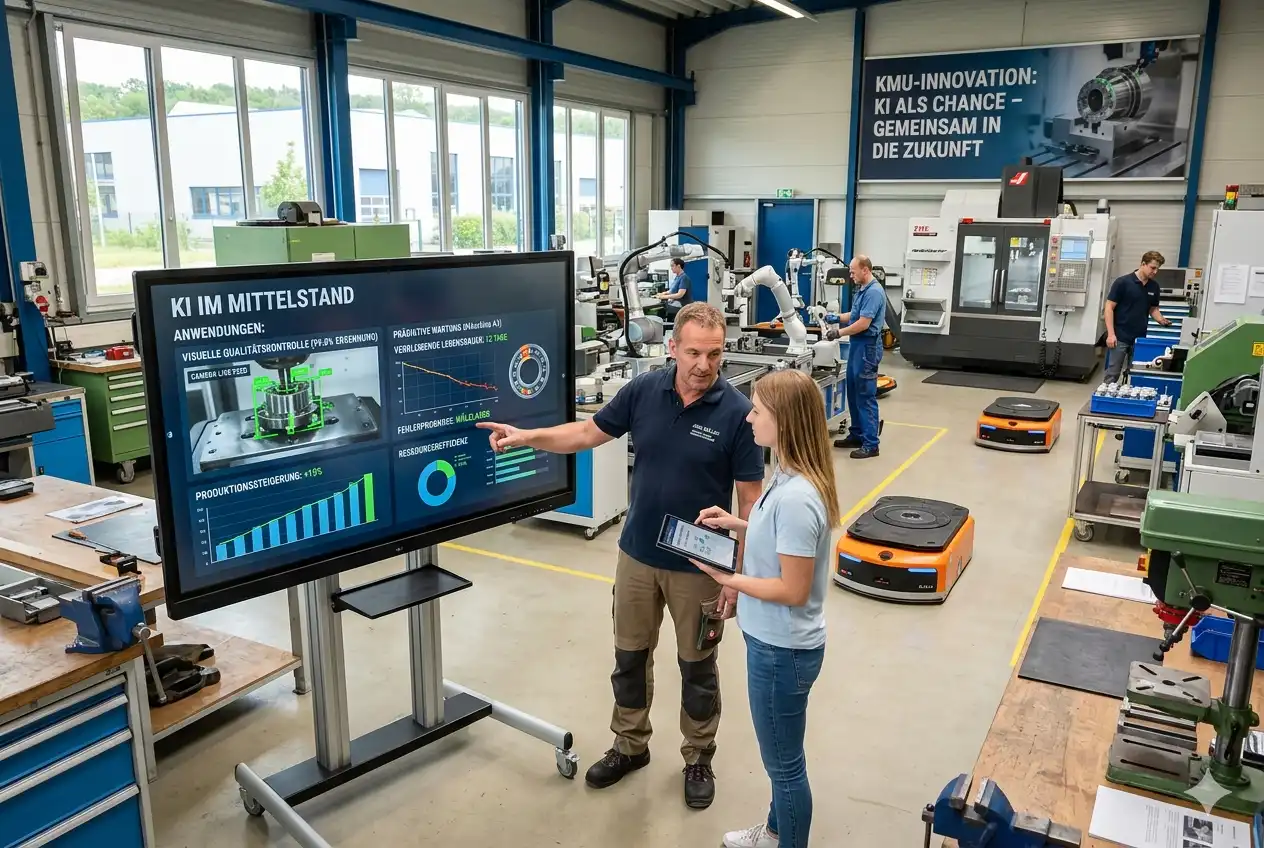
This is where artificial intelligence comes into play: it doesn't act as a job killer, but as a digital assistant and efficiency booster. While large corporations are funding their own AI research projects with million-pound budgets, small and medium-sized enterprises (SMEs) can and must act more agilely. Those who ignore AI now risk losing touch with international competitors and tech-savvy start-ups within a few years.
„Artificial intelligence will not replace companies that cherish traditional values, but rather those that refuse to lead these values into the future with modern tools.“
2. The biggest opportunities: Where AI creates immediate added value
AI is not an end in itself. Its use must be reflected in the business figures. In SMEs, immediate effects are particularly evident in three core areas:
Improving efficiency in administration
- Automated invoice management: AI systems read out receipts, match them with orders and prepare the booking independently.
- E-mail and Text Assistance: Customer support inquiries are pre-sorted via Large Language Models (LLMs) and draft responses are automatically generated.
Smart Production & Logistics (Predictive Maintenance)
By analysing machine data via sensors, AI models precisely predict when a component will fail. This prevents expensive downtime in production.
Sales and Marketing
AI-powered CRM systems analyse the purchasing behaviour of existing customers and recognise patterns to suggest tailored upselling offers at the perfect moment.
3. The Hybrid Model: The Smart Strategy for SMEs
For medium-sized enterprises, the „hybrid approach“ is the most economical way to achieve AI transformation. They don't need to reinvent the wheel. The three essential approaches in direct comparison, prepared for mobile use:
- Standard AI (SaaS)
Description: Use of existing tools such as ChatGPT, Microsoft Copilot or DeepL.
Advantage: Ready to use immediately and extremely cost-effective.
Disadvantage: No in-depth individualisation possible; high data protection risks if internal data is entered unprotected. - Special AI (Self-built)
Description: Complete in-house development and programming of specific models for exclusive production or logistics processes.
Advantage: Absolute data control and a maximum, proprietary competitive advantage.
Disadvantage: Very expensive, maintenance-intensive, and requires specialised in-house IT experts. - The Hybrid Model (Recommendation)
Description: The linking of established standard models (SaaS) with a protected, internal company knowledge base via a so-called RAG architecture (Retrieval-Augmented Generation).
Advantage: Maximally cost-effective, absolutely data-secure and precisely customisable to your own company data.
Disadvantage: Requires a clean initial data structure and targeted strategic advice during setup.
Would you like a brief consultation on this?
4. Data sovereignty and relevance through RAG (Retrieval-Augmented Generation)
The biggest problem with conventional large language models (LLMs) in corporate use is so-called „hallucination“ – that is, the invention of plausible-sounding but false facts – as well as the lack of specific company knowledge. For medium-sized businesses, a RAG (Retrieval-Augmented Generation) architecture is the technological bridge to solve this problem cost-effectively.
How does RAG work in practice?
Instead of laboriously retraining an AI model for hundreds of thousands of euros with your own data, an existing, secure standard model is coupled with an internal, digital librarian, so to speak.
- The Data Safe: All internal documents (such as ERP data, quotes, QM handbooks, technical drawings, or process guides) are stored encrypted in an internal vector database.
- The request: An employee enters a query (e.g. „What delivery terms did we agree with supplier X in 2024?“), the system retrieves the relevant text passages from the internal documents within milliseconds.
- The synthesis: Only after this are these specific facts passed to the LLM along with the question. The AI then formulates a precise answer – based exclusively on the verified, internal sources.
Warum RAG der Gamechanger für kleine und mittlere Unternehmen ist
This approach ensures absolute data sovereignty for the company, as data processing takes place in a protected cloud environment or on-premise. At the same time, AI error rates drop to near zero, and employees in purchasing, sales, or service receive reliable answers from the entire company knowledge base in seconds, without having to manually search through folder structures.
5. Step-by-step roadmap for AI integration
How to get started without breaking the bank? This 5-step plan has proven successful in practice:
- Step 1: Identify Pain Points
Where do employees spend most of their time on monotonous tasks? Where are the bottlenecks in the process chain? Create a list of these quick-win potentials. - Step 2: Check data basis
AI needs data. Are your customer data, production logs, or HR processes already digitised and stored in a structured manner? A poorly maintained foundation will lead to poor results, even with the best AI. - Step 3: Draw up the AI Policy
Define clear rules for your team: Which data can be entered into public AI tools? How will the two-eyes principle be maintained for AI-generated content? - Step 4: Launch the pilot project
Select a single, manageable project (e.g. an AI-powered chatbot for internal knowledge management) and test it with a small group of employees. - Step 5: Scale & Train
Capitalise on the learnings from the pilot project. Provide continuous training for the workforce to reduce anxieties and specifically strengthen their ability to guide AI correctly (prompt engineering skills).
6. That's how small and medium-sized businesses do it
Example 1: The mechanical engineer from Baden-Württemberg
A medium-sized company with 150 employees has integrated AI-based image recognition into its quality control process. Cameras capture manufactured components in milliseconds. The AI sorts out rejects with an accuracy of 99.8 % – significantly faster and with fewer errors than the human eye.
Example 2: The Craft Business with a Smart Office
A plumbing company is using an AI voice assistant to take customer calls outside of business hours. The AI understands the customer's issue (e.g., „heating failure“), categorises the urgency, retrieves customer data from the CRM, and directly books the emergency appointment into the on-call engineer's calendar.
Example 3: Technical wholesale in strategic purchasing
A medium-sized distributor of industrial components implemented an AI-supported system for predictive procurement. The AI continuously analyses historical order data, seasonal market fluctuations, and global supply chain reports. Based on this, the system automatically generates precise ordering suggestions for the C-parts management. The measurable result: stockholding costs fell by 22 % within six months, whilst on-time delivery rates were increased to a consistent 99.5 % – without the need for time-consuming, manual routine planning data.
7. Challenges: Data Protection, EU AI Act & Acceptance
Despite all the euphoria, small and medium-sized enterprises must not underestimate the legal and human hurdles.
- GDPR & Data Security: Personal data of customers or employees must never flow unfiltered to servers outside the EU (e.g. the USA). The use of local, European LLMs or contractually secured enterprise licenses is mandatory.
- The EU AI Act: The law regulating AI divides systems into risk classes. Companies must check if the AI they deploy (particularly in HR or for credit scoring) is subject to strict documentation requirements.
- The Human Factor: The best technology is useless if the workforce sabotages it out of fear of job loss. Transparent communication and highlighting potential relief are the responsibility of management.
„The true value of technology is not shown in the complexity of its code, but in the simplicity with which it noticeably eases people's working lives.“
8. Conclusion: Making AI simple for SMEs, but systematically
Artificial intelligence is here to stay. The strategic establishment of AI in Small and Medium-sized Enterprises offers companies the historic opportunity to grow sustainably and radically optimise processes, despite a shortage of skilled workers and bureaucratic hurdles. Success does not depend on utopian budgets, but on the courage to start small with smart hybrid solutions (such as RAG systems) and to take your own workforce along on this journey from the outset.
9. FAQ – Frequently Asked Questions about AI in the Mid-Market
Is AI far too expensive for small businesses with under 50 employees?
Answer: No. With modern Software-as-a-Service (SaaS) models, the entry price is often only a few pounds per user per month. It only becomes expensive if you have your own models developed from scratch without a strategy, where established standard solutions or hybrid scenarios would be perfectly adequate.
How secure are our business secrets when we use AI?
Response: When using free consumer versions (such as free ChatGPT), entered data is often used for model training. However, those who opt for "Enterprise" licences or use European providers (e.g. DeepL or Aleph Alpha) receive contractually guaranteed data security, where no information leaves the protected environment.
Will AI soon replace my employees?
Answer: In the rarest of cases. AI does not replace employees in the SME sector, but employees who skilfully use AI will, in the long term, replace those who resist the technology. The goal in the SME sector remains to relieve the burden of routine tasks in order to free up valuable resources for core strategic tasks.
Answer: What does the first concrete step for introducing AI into your own company look like?
The optimal starting point is an honest assessment (process audit) of the most time-consuming and constantly recurring routine tasks within the company. After this, begin with a narrowly defined pilot project – such as AI-assisted text creation in marketing or automated pre-sorting of support emails – to achieve quick wins and reduce team apprehension.