




Procurement Risk Management
An effective Procurement Risk Management secures the stability of your supply chains against global volatility and sustainably protects your profit margins. By proactively identifying, assessing, and managing supplier and market risks, you transform potential crises into predictable competitive advantages and ensure your company's continuous supply capability.


Strategic advantages through professional procurement risk management
In an increasingly interconnected and volatile global market, supply chain disruptions are not a question of „if,“ but „when.“ Companies need robust processes to identify financial, operational, and regulatory risks early on, before they impact production or the group's earnings. Kloepfel Consulting helps you bring transparency to your procurement structures and anchor resilience as a fundamental component of your corporate strategy.
Key Facts on Purchasing Risk Management:
- Early warning systems: Timely identification of impending supplier failures or market shortages.
- Compliance security: Fulfilment of statutory requirements, such as the German Supply Chain Due Diligence Act (LkSG), without any gaps.
- Cost protection: Minimisation of price and currency risks through strategic hedging and diversification.
- Resilience Enhancement: Building Multi-Sourcing Strategies to Reduce Single-Sourcing Dependencies.
Excellent as BEST ADVISORS – 11th time in a row
Sustainable procurement strategies and long-term supply contracts
To avoid obvious risks, companies often choose sustainable procurement strategies, which involve obliging several equally qualified suppliers for materials, parts, and services.
If this fails, companies rely on single-source suppliers with whom they conclude long-term supply contracts. This ensures supply even in the event of unexpected bottlenecks and avoids short-term price increases. As the supply chain is broadly diversified, the risks are manageable.
Nevertheless, business interruptions, including supply chain disruptions, pose a significant business risk. This is reflected in the Allianz Risk Barometer with a value of 37% in 2017.
Three risky trends
The changing role of purchasing in industrial manufacturing.
As manufacturing depths are reduced across many industries and companies, procurement is becoming increasingly important and dependencies are growing due to a loss of know-how.
Global sourcing and its impact on supply chains
By accessing global procurement markets, intricate, sensitive global supply chains are developing.
Efficiently managed logistics and increasing supply risks
To reduce capital tied up in inventory, stock levels are optimised, which, however, increasingly leads to supply risks due to tightly scheduled value chains.
Methods for risk identification and proactive assessment
Arrange your free initial consultation now and find out how you can prevent supply bottlenecks and your Procurement stabilise in the long term.

ISO Standard 31000 – Structured Risk Management
Two risk groups in purchasing: operational and strategic risks
In the area of operational risks, the issue of „quality problems“ with suppliers is paramount. To minimise risks and thus also remediation costs in this regard, purchasing must examine and select suppliers based on process stability. Functioning, and therefore pragmatic and institutionalised quality assurance, where individual process steps are clearly defined and assigned responsibilities, is another risk-minimising factor.
Currency risks or rising raw material and energy prices have a direct impact on companies' assessment of strategic risks.
The greatest strategic risk potential for companies lies in economic market uncertainties. However, this is a snapshot. In the future, the risks of „dependency through single-sourcing“ and „supplier insolvencies“ will be seen as constant companions. For purchasing managers, a structured supplier risk management system is therefore becoming ever more essential in order to effectively protect the company from negative effects.
Would you like to learn more about risk management, or do you have other questions about KLOEPFEL Consulting?

Assess risks
Most risks can be assessed, proactively managed, and consistently controlled through strategic supplier management. Potential opportunities and risks must be evaluated equally and taken into account when making decisions. The probability of a risk occurring depends on the company's risk strategy, which is indispensable for procurement. Training can increase risk awareness in strategic purchasing as well as in operational procurement.
In purchasing, recognised methods and tools for identifying potential can also be used to assess risks. Kraljic developed a two-dimensional portfolio analysis to identify procurement risks, as Pareto's ABC analysis focuses solely on measuring the importance of a supplier. Generally, the risk matrix is the fundamental tool for risk assessment. This allows relevant risks to be classified according to probability of occurrence and potential damage.
Minimal day-to-day effort
The need for functional risk management in procurement is therefore very great.
Kloepfel Consulting supports its clients with the necessary expertise, organisational capabilities and, above all, with the time that is often lacking in a purchasing department to establish a holistic risk management system. To successfully implement this, clearly defined processes and responsibilities, as well as links between different functions, are required.
Once a risk management system has been implemented within a company, the „additional“ effort in daily business is minimal. However, costs that could be incurred, for example, by the sudden insolvency of a supplier, are significantly higher than the expenditure for implementing and operating a sound supplier risk management system.
It is important to us that the tightening of the risk situation does not lead to a general strategy of risk minimisation with the simultaneous exclusion of opportunities. Entrepreneurial action is inextricably linked with risks, and it is only by taking on risks that companies can grow.
Side effect rating optimisation
What is often underestimated: Alongside quantitative credit criteria such as balance sheet figures, banks always base their lending decisions to a certain extent on qualitative factors. These include, among other things, operational efforts to establish risk management. A stress test in purchasing can therefore be a good starting point for discussing rating optimisation opportunities with your primary bank.
Further services relating to
The topic of structural and process optimisation

Digitalisation in purchasing

Negotiations
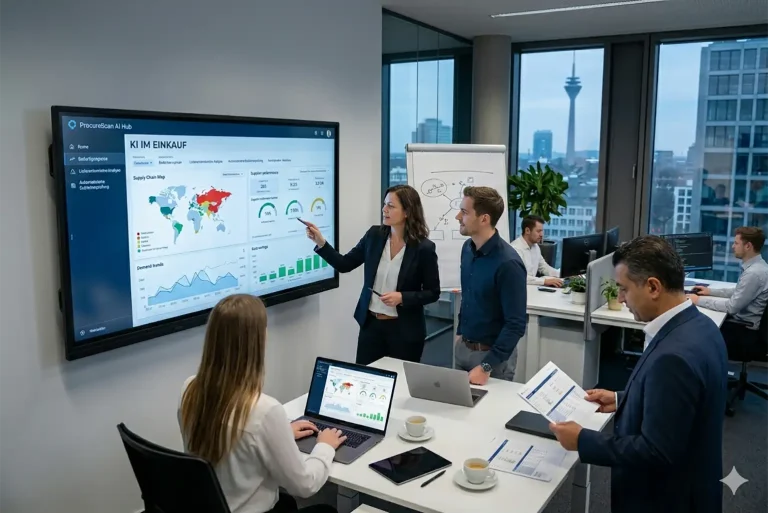
Artificial intelligence
FAQ: Important questions about procurement risk management
What risks are most critical in purchasing?
The most critical risks include the total failure of suppliers (economic or due to force majeure), drastic increases in raw material prices, quality defects, and breaches of compliance and sustainability guidelines within the supply chain.
How to start the implementation of risk management?
The process begins with a comprehensive risk assessment of the current supplier portfolio. Dependencies are evaluated and a risk matrix is created to establish priorities for preventive measures.
What role does the German Supply Chain Due Diligence Act (LkSG) play?
The LkSG obliges companies to monitor human rights and environmental due diligence. Modern risk management in procurement is the central tool for legally documenting and implementing these requirements.
How often should risk analyses be carried out?
Risk analyses should not be seen as a one-off project, but as a continuous process. A review is mandatory at least once a year, and on an ad-hoc basis in the event of significant market changes or the onboarding of new key suppliers.
What measurable benefits (ROI) does risk management offer?
Besides avoiding high costs from production downtimes, optimised risk management often leads to better insurance terms, a higher credit rating, and more stable purchasing prices in the long term.