


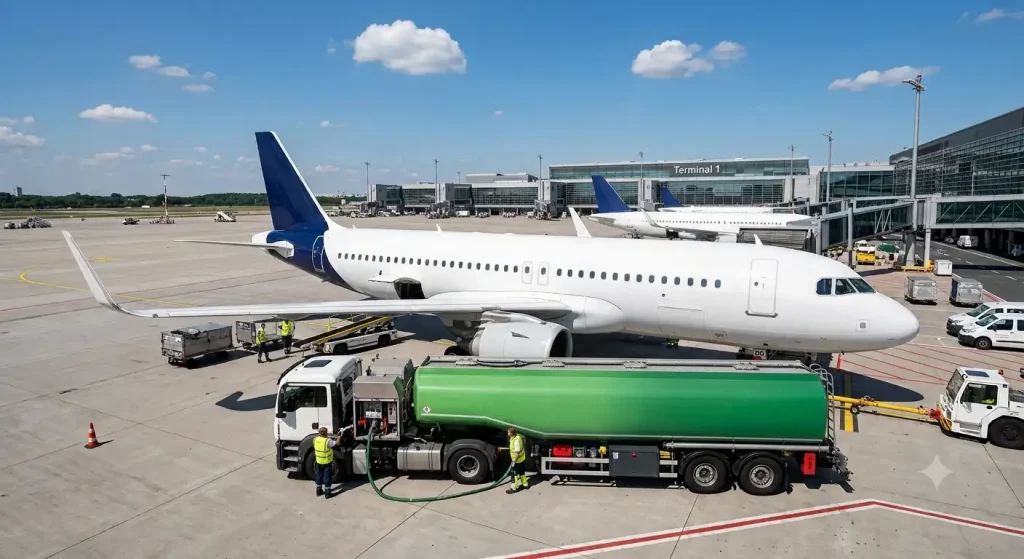
Deutsche Bank is further expanding its commitment to more climate-friendly business travel and is investing together with the Lufthansa Group in sustainable aviation fuel (SAF).. According to the press release, around 1,600 tonnes of SAF will be used. This is expected to save around 5,500 tonnes of CO₂ compared to conventional kerosene, which is roughly equivalent to the emissions of 520 flights between Frankfurt and London on an Airbus A320neo.
Key Facts Deutsche Bank & Lufthansa Group
- Investment in SAF: Deutsche Bank is opting for around 1,600 tonnes of Sustainable Aviation Fuel from the Lufthansa Group for its business travel.
- CO₂ Savings: The use of sustainable aviation fuel is expected to save approximately 5,500 tonnes of CO₂.
- Climate targets in focus: Deutsche Bank aims to nearly halve its Scope 3 emissions by 2030 compared to 2019.
- Rising Demand: By 2025, around 1,700 companies worldwide had already used Lufthansa Group's SAF offerings.
- More sustainable travel: Private customers are also increasingly opting for more climate-friendly flight options. Last year, more than five percent of passengers used these services.
- Long-term strategy: In addition to SAF, the Lufthansa Group is investing in modern aircraft, more efficient processes, and the expansion of rail-fly connections, among other things.
Sustainable partnership for business travel
According to the press release, Deutsche Bank and Lufthansa Group intend to further expand their cooperation in the area of sustainability. The emission of business travel is to be significantly reduced through investment in Sustainable Aviation Fuel. At the same time, both companies want to show that investments in alternative fuels can make an important contribution to more climate-friendly aviation.
SAF should make aviation more climate-friendly
According to Deutsche Bank, sustainable aviation fuel is a key component in reducing emissions across its own supply chain. At the same time, rising demand is expected to encourage companies to invest more heavily in the production of sustainable aviation fuels. The greater the demand, the more readily available and cost-effective such fuels are likely to become in the long term.
Sustainable offers are in greater demand
The Lufthansa Group is also continuously expanding its offering for more sustainable travel. Companies can specifically invest in SAF, while private customers can contribute to reducing future CO₂ emissions through special flight tariffs. According to the press release, around 1,700 companies had already opted for corresponding SAF offers by 2025. Interest is also growing among passengers: more than five percent chose a more sustainable travel option last year. For the Lufthansa Group, this is a sign that climate-friendly mobility is gaining increasing importance.