


Heterogeneous systems: How AI bridges the understanding gap
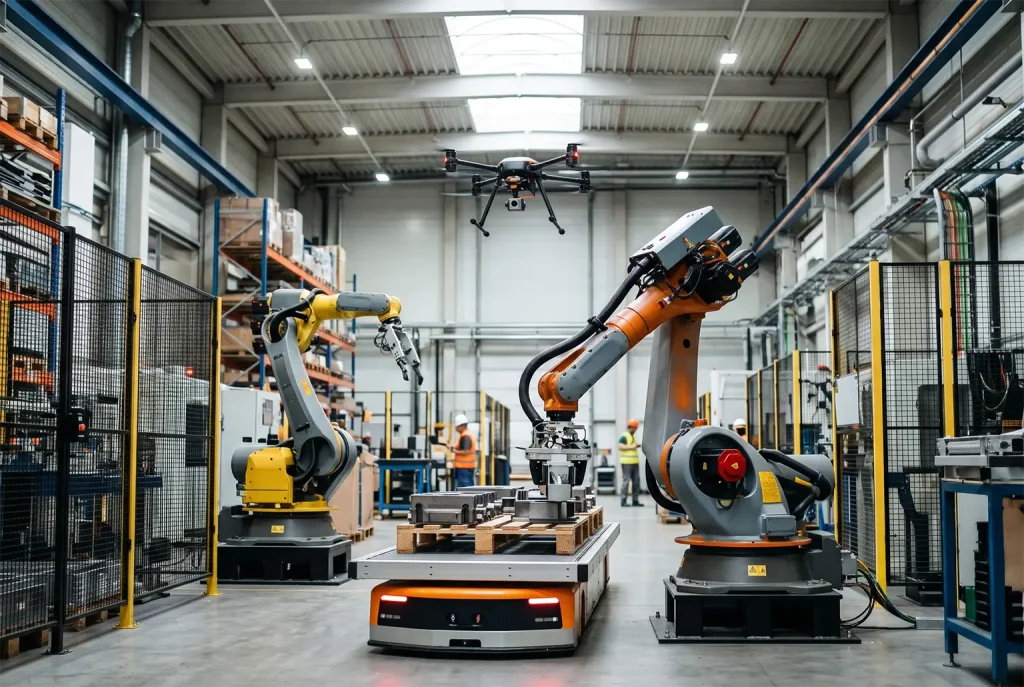
When drones, autonomous forklifts, and stationary grippers work together in logistics or production, the collaboration usually ends in incompatible software architectures. Classic interfaces fail to connect heterogeneous systems flexibly. Large AI models for language, image processing, and logic fill this gap: they enable machines to interpret work orders in the context of the respective business environment. However, developers still need to resolve fundamental questions regarding functional reliability before the system can be put into production.
The main points in summary:
- The interface problem: Conventional standards simply connect systems technically. What is missing from the data packets is the situational context of the respective task.
- The AI approach: Multimodal models combine visual recognition, speech processing, and logical conclusions. They serve as a flexible control center within the heterogeneous robot network.
- Meaning instead of a flood of data: In addition to the mere data transmission, the models also capture the concrete consequences of actions – they translate commands into appropriate actions in the situation.
- Real risks: Previous systems often lack the ability to recognize physical laws. If a model draws incorrect conclusions about cause and effect, it jeopardizes ongoing operations.
- Next steps: To bring the technology into the production halls, research and industry must validate the models using reliable real-time simulations.
Why classic interfaces encounter limitations
When a drone explores a factory site while a driverless transport system simultaneously delivers components, the direct exchange often fails due to the data format. The working group of the platform Lernende Systeme points out that different IT architectures regularly hinder collaboration in industrial practice.
True interoperability requires four steps:
- Technically: The physical connection between the machines.
- Syntactically: Uniform protocols and data formats.
- Semantically: A shared understanding of the meaning of the content transmitted.
- Pragmatic: Determining the specific consequence that an information requires in its respective context.
While the technical and syntactic foundations are manageable today, rigid regulations reach their limits at the semantic and pragmatic level.
AI as translator and coordinator in the machine park
Modern AI architectures address this gap in understanding. A white paper from the platform Lernende Systeme (Learning Systems) illustrates how generative systems can control heterogeneous machine fleets. Jürgen Beyerer from Fraunhofer IOSB illustrates the principle: Since the models bring enormous amounts of world knowledge, they dynamically adapt sensor and order data during operation. They act like a superior planner in the background, analyzing changing situations and distributing work orders appropriately to the available robots.
Functional safety: Barriers before field deployment
The transition from the test lab to the production hall requires strict proofing. The current basic models often still lack the specific process and domain knowledge of industrial plants. If a control system misinterprets physical limits or incorrectly interprets measurement values, the chain breaks down – with direct dangers for people and material.
Pure language or image data are not sufficient for security proofs. What is required are multimodal systems that countermand commands before execution in virtual environments and physically verify them. Johannes Hinckeldeyn from the KION Group sees the responsibility primarily in collaboration between science, manufacturers, and industrial users: Only when research teams and plant practitioners feed real operational data into the simulation models can robust industrial products be created from theoretical approaches.