


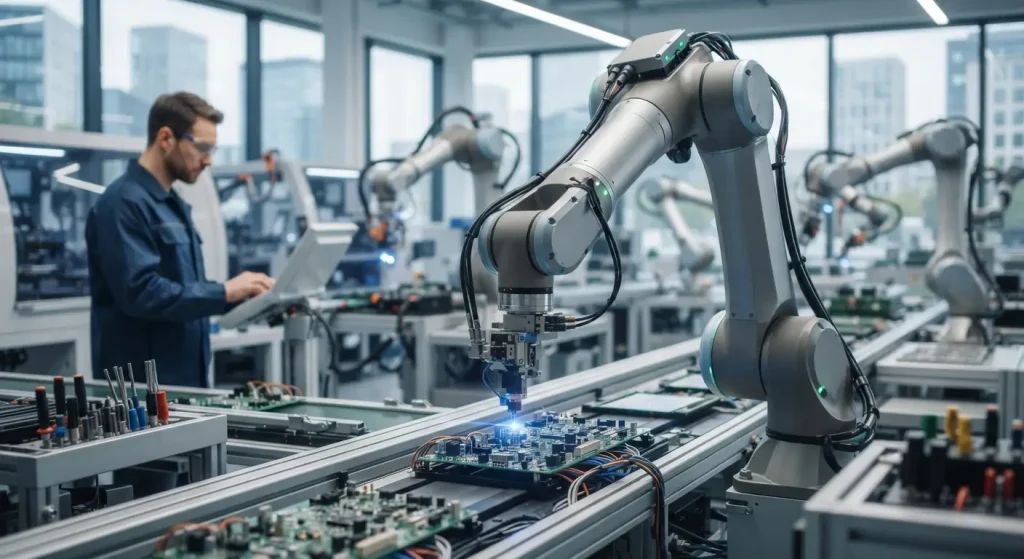
Global automation reaches a new record in the manufacturing sector
In the global industry, robots are working more than ever before: In 2025, the global average was 152 industrial robots per 10,000 employees. While South Korea, Singapore, and Germany continue to lead the international ranking, China in particular is setting an enormous pace.
- The top 3 worldwide: South Korea (1,066 robots), Singapore (873) and Germany (469) are well above the global average of 152 units per 10,000 employees.
- Strong EU performance: In the European Union, density has increased by around 35% since 2020 to a record level of 240 units. Five of the ten most automated countries are members of the EU.
- Rapid growth in China: Asia as a whole increased by around 47% (144 units). China increased its value by 147% in just five years to 193 robots (ranking 19th worldwide).
- Solid growth in North America: Here, the robot density grew by around 24% to 214 units – led by the USA at number eight (323 units).
The leaders in the international comparison
According to the press release of the International Federation of Robotics (IFR), the use of robots in global manufacturing has reached a new peak. According to the current report „World Robotics 2026“, the global average rose to 152 industrial robots per 10,000 employees in 2025. South Korea remains at the forefront with 1,066 units, followed by Singapore (873) and Germany in third place (469). As IFR President Jane Heffner emphasizes, this figure helps to fairly compare the level of automation in economies of different sizes.
Europe and North America: Different speeds
Looking at the individual world regions, the press release shows a particularly high level of dynamism within the European Union: between 2020 and 2025, the robot density there grew by around 35 percent to a new record of 240 units. With this, the EU ranks five of the ten most automated economies – alongside Germany, Sweden, Denmark, Slovenia, and the Netherlands are also among the top ten. In North America, the development was somewhat more subdued with a growth of around 24 percent to 214 units. According to IFR data, the USA holds the eighth place with 323 robots worldwide, while Canada comes in at 242 and Mexico at 64 units.
Asia is catching up – China is growing at a record pace
In Asia, automation is advancing rapidly: In the same five-year period, the regional average climbed by about 47 percent to 144 robots per 10,000 employees. In addition to the leaders South Korea and Singapore, another Asian country, Japan (452 units, fourth place), managed to make it into the top ten. However, according to the data, the development in China is particularly noteworthy: Although the world’s largest robot market currently ranks 19th in international comparison with 193 units, the country was able to increase this value by an impressive 147 percent between 2020 and 2025.