


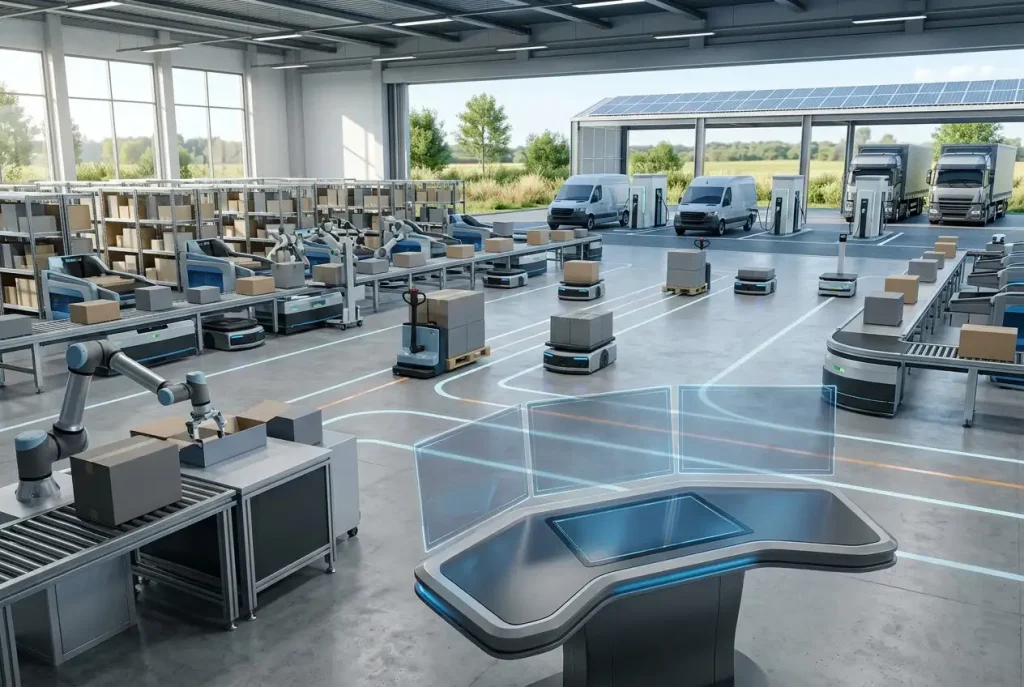
Artificial intelligence, robotics, and automation are fundamentally changing global logistics – this is highlighted by the eighth edition of the DHL Logistics Trend Radar. AI systems are evolving from purely assistance programs to autonomous actors along the entire supply chain. Despite this technological leap, DHL emphasizes that humans remain the heart of the industry. New applications are intended to primarily relieve teams and make processes more resilient and sustainable.
- Autonomous systems (agentic AI): AI increasingly takes on planning, coordination, and decision-making tasks independently in real time.
- Focus on people: Wearables, collaborative robotics and intelligent assistants are changing hundreds of professions. This increases job safety, but also requires targeted further training for employees.
- Security and sustainability: Growing autonomy requires reliable guidelines (AI Ethics, Cybersecurity 2.0). At the same time, green technologies such as fleet electrification and decarbonization remain core priorities.
Evolution of AI: From pure analysis to autonomous action
Digital logistics is moving away from purely observational systems towards true autonomy. The so-called Agentic AI plays a key role in this process: These systems independently pursue predefined goals and make operational decisions without requiring human intervention at every step. Coupled with predictive analytics, disruptions can be detected early enough to redirect shipments in real time or proactively adjust inventory levels. For the first time, the Trend Radar also takes into account developments such as AI Commerce, the rapidly growing demand for data center capacity (Compute Economy), and humanoid robots to illustrate the close interconnection between physical and digital supply chains.
Man and machine: New profiles and changing work environments
Despite the high degree of automation, logistics remains a people-to-people business. Wearable sensor systems, remote controls (remote operations), and digital workplace assistants are intended to free employees from the daily grind by taking on repetitive tasks and reducing the risk of accidents. This shift affects hundreds of job profiles across all sectors. For managers, this means that training becomes a central task: Only when teams are specifically prepared to handle intelligent systems can human experience and technological precision seamlessly integrate.
Governance, security and sustainable logistics as the foundation
The more leeway given to IT systems, the more important a reliable organizational framework becomes. Initiatives around AI Ethics and Cybersecurity 2.0 ensure that ethical guidelines and protection mechanisms keep pace with the rapid pace of innovation. In parallel, the environmental footprint remains a focus: the rapid electrification of fleets, consistent decarbonization, and approaches to circular economy continue to form the foundation for permanently reducing emissions and ensuring future-proof global supply chains.