




First and foremost:
The consistent application of TCO in Procurement is the key to real cost efficiency in 2026. Instead of just looking at the purchase price, this method reveals all costs over the entire product lifecycle. Those who master TCO (Total Cost of Ownership) reduce long-term expenses by up to 30 %, minimise hidden risks, and make procurement a strategic value driver for the entire company.
Key Facts on TCO in Procurement
- Definition: Holistic cost consideration („Total Cost of Ownership“), which goes beyond the pure purchase price.
- Objective: Identification of hidden costs in the operational, maintenance, and decommissioning phases.
- Relevance: Essential for Make-or-Buy Decisions and the selection of sustainable suppliers.
- Lever: Better comparability of offers through inclusion of energy efficiency and lifespan.
1. What is TCO? – The definition explained simply
Total Cost of Ownership is a model that sums up all these costs even before the purchase contract is signed. Modern procurement is about evaluating the value of an asset over its entire lifetime, rather than chasing short-term discounts.
2. The Iceberg Model: The Invisible Cost Factors
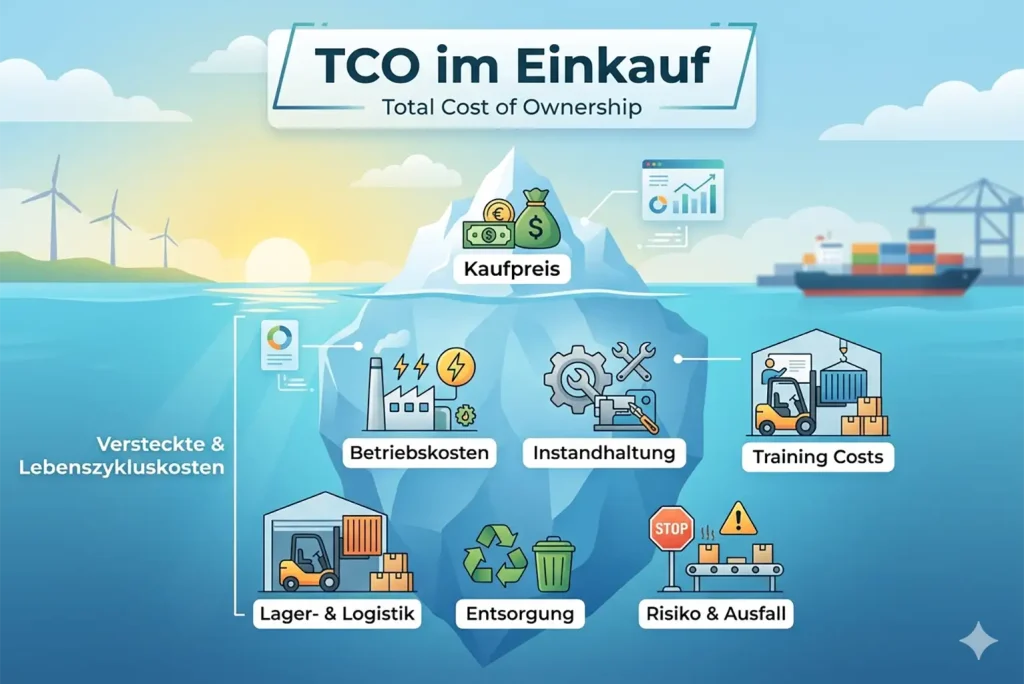
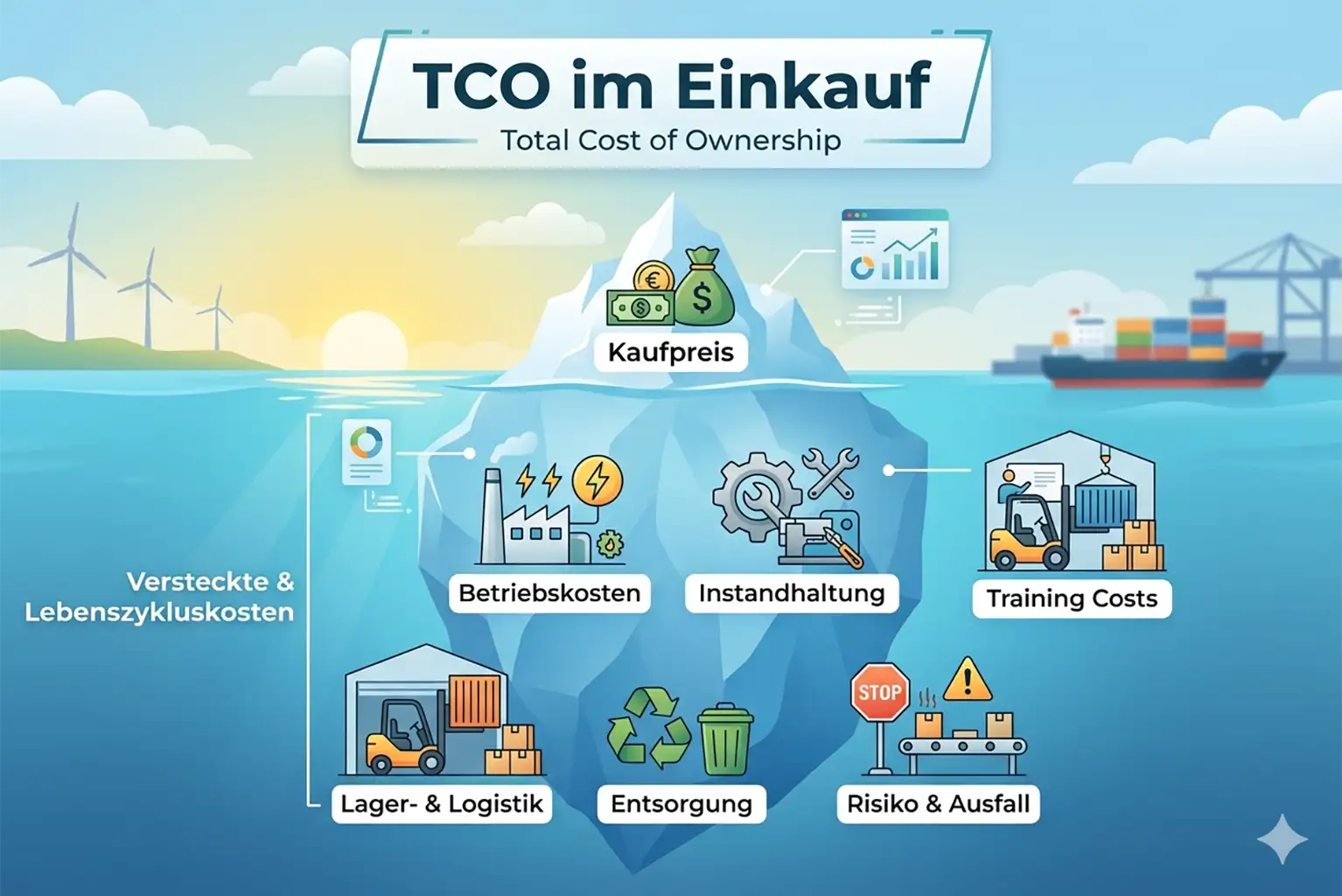
In business management, TCO is often represented as an iceberg.
The visible tip (acquisition costs):
This includes the list price, minus discounts, as well as direct transport costs. This is the amount that is usually the focus of price negotiation.
„The most expensive purchase is often the one that seems cheapest on the day you buy it.“
The hidden part (hidden costs):
- Operating costs: Energy, fuel, rent.
- Maintenance: Servicing, repairs, downtime costs.
- Administration: Costs for supplier qualification, ordering, and warehousing.
- Decommissioning costs: dismantling, recycling, and CO2 levies for disposal.
Calculating TCO in Purchasing: The formula as text
A precise calculation of the TCO requires data from various departments. In daily practice, however, the calculation can be summarised in a simple logic:
TCO = Purchase Price + (Annual Operating Costs x Useful Life) + (Annual Maintenance Costs x Useful Life) + Disposal Costs – Residual Value
In 2026, ecological factors will also be increasingly incorporated. The formula is often expanded to include risk costs (e.g., potential penalties for delayed delivery) and sustainability costs (e.g., CO2 certificates) in order to obtain a realistic picture of the overall burden.
Would you like a brief consultation on this?


4. Strategic advantages for modern procurement
The consistent use of TCO in purchasing offers clear competitive advantages:
- Greater transparency: You're comparing apples with apples. A cheap product with high failure rates loses out to a premium product with high reliability.
- Optimal Supplier Selection: You identify partners who not only supply cheaply but also reduce overall costs through quality and service.
- Budget certainty: As follow-on costs are factored in, there are no nasty surprises during ongoing operation.
- Promoting sustainability: energy-efficient products perform better in TCO analysis, directly supporting your ESG goals.
„True value is not measured by the price tag, but by the sum of all expenditures until the end of its use.“
5. Practical Example: The „Cheap Trap“ for Production Facilities
Let's assume the purchasing department compares two machines for a runtime of 5 years:
Machine A (The „Price Winner“):
- Purchase price: 100,000 EUR
- Energy & maintenance costs per year: EUR 30,000
- Disposal/Dismantling after 5 years: 5,000 EUR
- TCO after 5 years: €255,000
Machine B (The Premium Model):
- Purchase price: €130,000
- Energy and maintenance costs per year: €15,000 (due to high efficiency)
- Disposal/dismantling after 5 years: EUR 2,000 (high residual material value)
- Total cost of ownership after 5 years: €207,000
The result: Although machine B was €30,000 more expensive to purchase, the company saves €48,000 over its lifespan. Without a TCO (Total Cost of Ownership) consideration, purchasing would have incorrectly chosen machine A.
6. Deep Dive: Risk-Adjusted TCO & ESG Costs (2026)
In 2026, a purely static cost calculation will no longer suffice. Modern purchasing departments today use risk-adjusted TCO.
Risk factors: Probabilities for supply chain disruptions are being factored in. An overseas supplier may have a low baseline value, but the risk of a six-week supply stop often shifts the picture in favour of regional partners.
The ESG factor: Carbon pricing has become a significant cost block. A TCO analysis that does not consider emissions costs over the lifecycle is effectively incomplete today.
7. Checklist & KPIs: How to Measure Success
To ensure a successful transition to TCO in purchasing, you should proceed in a structured manner.
5-Step Checklist for Introduction:
- Select a strategic product group: start where high follow-on costs are incurred (e.g. IT or machinery).
- Team building: Get engineering, production, and controlling around the table.
- Define cost drivers: Capture all factors from power consumption to training.
- Validate data: Use real operational values instead of just manufacturer specifications.
- Decision paper: Consistently compare offers based on the 5- or 10-year TCO.
Key Performance Indicators (KPIs)
- TCO-Savings-Rate: Savings over the total operating period compared to the pure price benchmark.
- Forecast Accuracy: How close are the calculated TCO values to the actual costs after two years of operation?
8. Challenges and Best Practices
The biggest stumbling block for implementation is data quality. Often, purchasing doesn't know how much electricity a machine in production actually consumes.
Best Practices
- Pareto Principle: Apply TCO analyses to your top 20 capital assets first.
- Digitisation: Use modern SRM tools that can centrally record lifecycle data.
9. Conclusion: Why TCO is indispensable in procurement by 2026
The days when purchasing had to achieve only the lowest price are over. In a world with rising energy prices and strict regulatory requirements, the TCO in Procurement the only tool that enables informed economic decisions. Those who invest in TCO models today secure tomorrow's profit margin and position procurement as a key success factor within the company.
This is no longer just about pure cost reduction, but about actively shaping a resilient and value-adding supply chain. This strategic shift requires the courage for data transparency, but pays off through drastically more stable budget planning and significantly increased profitability. Ultimately, this holistic approach transforms procurement from a purely operational function into a strategic authority that contributes significantly to the long-term competitiveness and future viability of the entire operation.
10. FAQ on TCO in Procurement
Why is TCO analysis so important right now?
Due to global supply chain issues and fluctuating energy costs, operating costs are often more unpredictable than the purchase price. The TCO consideration makes these risks calculable.
Does Gilt TCO also apply to software and services?
Yes, absolutely. Especially with software (SaaS), the implementation costs, training, and integration efforts are often many times higher than the monthly licence fee.
From what investment size is TCO worthwhile in purchasing?
Utilise TCO for all A-items and strategically critical machines. For cheap C-parts, the effort involved in data acquisition is generally disproportionate to the savings.
What influence does sustainability have on TCO?
In 2026, sustainability is a cost factor. Products with a high carbon footprint incur higher duties and disposal costs, which must be included in a modern TCO calculation.