


First and foremost:
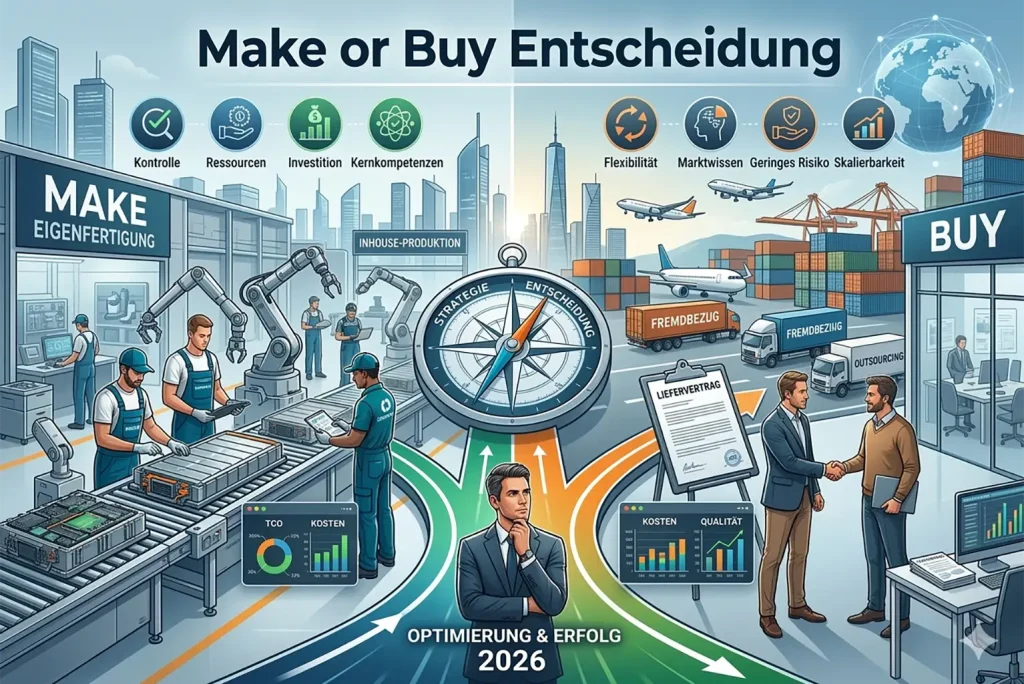
The Make-or-buy decision is far more than a mere cost comparison. While in the short term the Total Cost of Ownership (TCO) ultimately, core competencies, security of supply and the protection of know-how will decide success. In a volatile global economy, the trend is currently shifting away from pure cost savings towards strategic resilience and technologically sovereign in-house production.
Key Facts on the Make-or-Buy Decision
- Core question: In-house production (Make) or external procurement (Buy) of services.
- Decision factor No. 1: Is the activity a core competence? (If yes: Make).
- Financial Basis: Break-Even Analysis and Total Cost of Ownership (TCO) Comparison.
- Risk Management: Avoiding Dependencies (Lock-in Effects).
- Trend 2026: Increase in reshoring and hybrid sourcing models.
1. Definition: What is the make-or-buy decision?
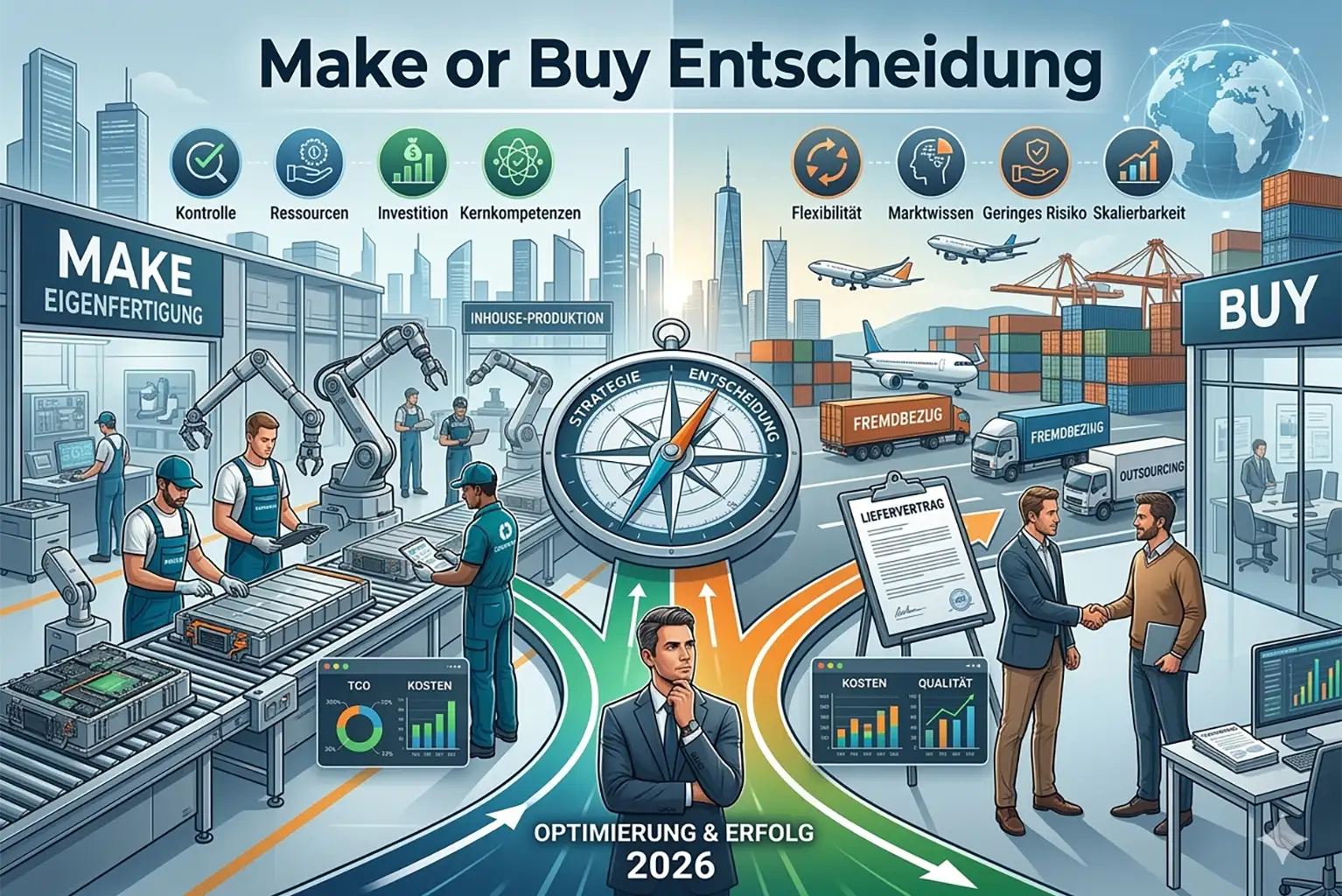
- In-house production: The service is created using the company's own resources.
- External purchase (Fremdbezug): The service is purchased from external specialists on the market (outsourcing).
In times of global supply bottlenecks, this decision is highly dynamic today. What was considered a classic „buy“ part for years is now often brought back in-house to protect supply capability.
2. Key decision criteria at a glance
A well-informed choice rests on two essential pillars:
Hard facts (quantitative):
- Production costs: personnel, materials and energy for in-house production.
- Investment needs: Do you require new machinery or software licences?
- Logistics costs: freight, customs duties, and warehousing costs when purchasing.
Strategic Factors (Qualitative)
- Core competence: Does the component belong to the „heart“ of your business? (If so: Make).
- Market power: Are there enough alternative suppliers, or is there a risk of a monopoly?
- Quality Assurance: Can external partners maintain your standards?
- Sustainability (ESG): Do you have better CO2 control with in-house production?
3. Analysis methods: TCO and the break-even formula
Professional buyers rely on valid data models to check economic viability.
The Break-Even Analysis (Critical Quantity):
To calculate the point at which in-house production is more cost-effective than purchasing, the following formula is used:
x = Fixed costs of in-house production / (Purchase price external procurement – Variable costs in-house production)
Here, „x“ denotes the quantity above which investing in one's own machinery or processes becomes cost-effective. If demand is higher than x, „make“ is theoretically more profitable.
„A low purchase price is often just the bait that hides the long-term costs of strategic dependency.“
Total Cost of Ownership (TCO)
The price on the invoice is just the tip of the iceberg. The TCO approach additionally considers upfront costs (supplier search), direct costs, and follow-on costs (maintenance, quality losses).
Would you like a brief consultation on this?


4. Strategic Concurrent Sourcing: The Best of Both Worlds
In modern industry, there is often no hard „either/or“. An advanced model is concurrent sourcing.
Hereby, the company produces part of its requirements itself, while the rest is sourced from external suppliers.
- Advantage 1: You keep the technological know-how in-house.
- Benefit 2: You know the real manufacturing costs and can negotiate prices on an equal footing.
- Advantage 3: During peak capacity, the market serves as a buffer, whilst the base load runs stably in-house.
5. Deep Dive: The Hidden Costs of Switching
It is often underestimated that a switch from „buy“ to „make“ (insourcing) or vice versa causes massive friction.
- Knowledge loss: Those who switch from „Make“ to „Buy“ often lose deep process knowledge within a few months. Bringing production back in-house later is then extremely expensive.
- Cultural resistance: Outsourcing can demotivate the workforce. Conversely, building up one's own manufacturing requires completely new management skills.
- IT integration: Connecting one's own systems with those of a supplier (EDI) incurs costs that are often missing from simple price comparisons.
6. The strategic portfolio logic for informed decisions
For a quick assessment, the categorisation of the components is helpful:
- Strategic key products: High importance for the end product + few suppliers on the market. Recommendation: Make.
- Bottleneck products: Low importance, but difficult to procure. Recommendation: Buy with high safety stocks.
- Standard products (commodities): Low significance + many suppliers (e.g. standard parts). Recommendation: Consistent buy.
- Hebel products: High importance + many suppliers. Recommendation: Buy through intensive negotiation of the best terms.
„Whoever loses control over their most important components, will in the long run lose control over their own innovative strength.“
7. Practical example: E-bike manufacturer facing the system question
A medium-sized e-bike manufacturer is faced with the choice of developing the bike's display software in-house (make) or purchasing a standard solution (buy).
- Analyse: The software controls the driving experience and connectivity with the app – an absolute differentiator (core competency).
- Costs: The add-on is initially 30 % cheaper, if you only take licence fees into account.
- Decision: The company chooses Make.
- Reason: Reliance on a software supplier would slow down innovation. By developing in-house, the manufacturer retains full control over updates and customer data, which significantly increases the brand's long-term market value.
8. Process steps for safe decision-making
- Identification: Which part or service is up for inspection?
- Data Collection: Obtaining Quotes vs. Calculating Internal Full Costs.
- Risk Assessment: Examination of Dependencies and Protection of Know-how.
- Decision: Aligning economic figures with long-term strategy.
- Re-evaluation: Regular review, as technological innovations (e.g. AI) can alter cost structures at any time.
9. Conclusion: Making the Strategic Make-or-Buy Decision with Confidence
The Make-or-buy decision In modern procurement, this is not a one-off project but a permanent management process. While standard components should be consistently outsourced to benefit from economies of scale, technological innovations and critical interfaces often require in-house control.
In 2026, the right balance between cost-effectiveness (buy) and strategic control (make), as well as the use of hybrid models, will be the decisive competitive factors for resilient companies.
10. FAQ: Frequently Asked Questions about the Make-or-Buy Decision
What is the biggest risk of outsourcing (buy)?
The most critical risk is the outflow of know-how and the creation of a strategic dependency. If a supplier becomes the sole provider, you lose price control and risk your entire production process in the event of the partner's inability to supply.
When should you opt for in-house production (make) despite higher costs?
This makes sense if you need to protect intellectual property (IP), if the quality on the market doesn't meet your standards, or if the component is a unique selling point that sets you apart from the competition.
What influence does the supply chain law have on the decision?
The German Supply Chain Due Diligence Act (LkSG) is a significant driver for make-or-buy decisions. As companies are liable for the standards throughout their entire supply chain, many are opting for in-house production domestically. This minimises liability risks and makes the carbon footprint more transparent.
What is the difference between outsourcing and a make-or-buy decision?
The make-or-buy decision is the analytical process. Outsourcing, on the other hand, is the concrete implementation of a buy decision, where a service previously provided internally is permanently transferred to an external service provider.