




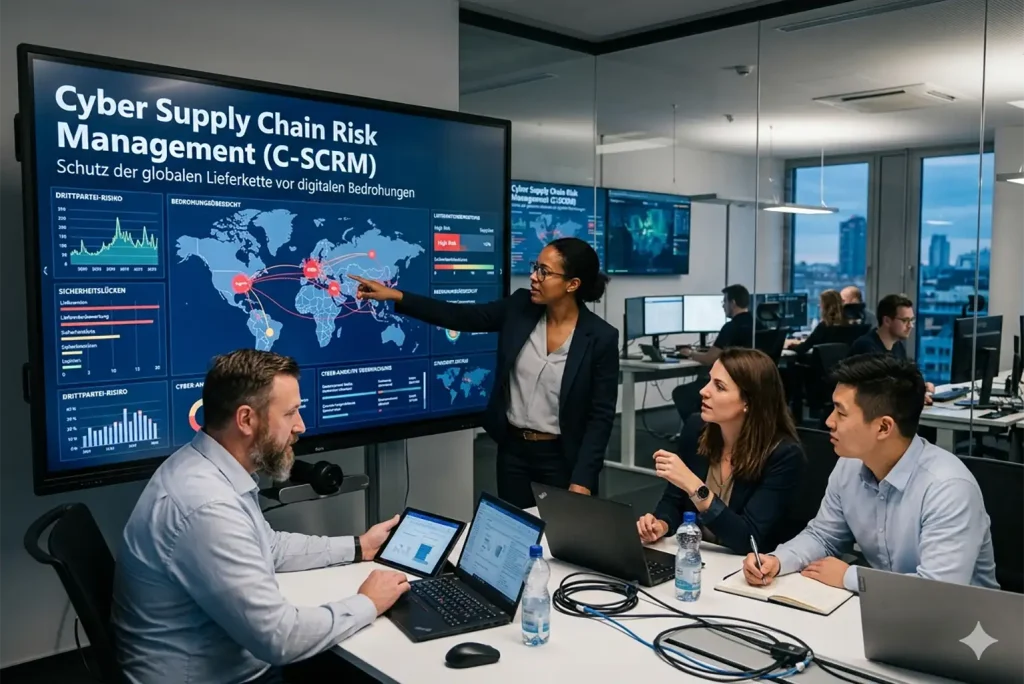
The most important points at a glance
Cyber Supply Chain Risk Management (C-SCRM) is the indispensable strategy for securing modern corporate ecosystems in 2026. With over 80 % of value-generating IT processes today relying on external cloud services, software libraries, and global hardware, the internal firewall alone is ineffective. C-SCRM identifies and minimises risks across the entire product lifecycle. Those who do not rely on SBOMs and continuous monitoring today will not only fail to comply with NIS2 but also risk complete business disruption in the event of a supply chain attack.
Key Facts about C-SCRM
- Definition: Strategic process for securing the digital supply chain (hardware, software, managed services).
- Status Quo 2026: Supply-chain attacks are the main cause of ransomware infections in Europe.
- Methodology: Combination of automated risk scores and human expert analysis (hybrid model).
- Regulation: NIS2, CRA (Cyber Resilience Act), and DORA demand proactive third-party risk management.
- Key tools: SBOM (Software Bill of Materials), VEX statements, and continuous API monitoring.
What exactly is C-SCRM?
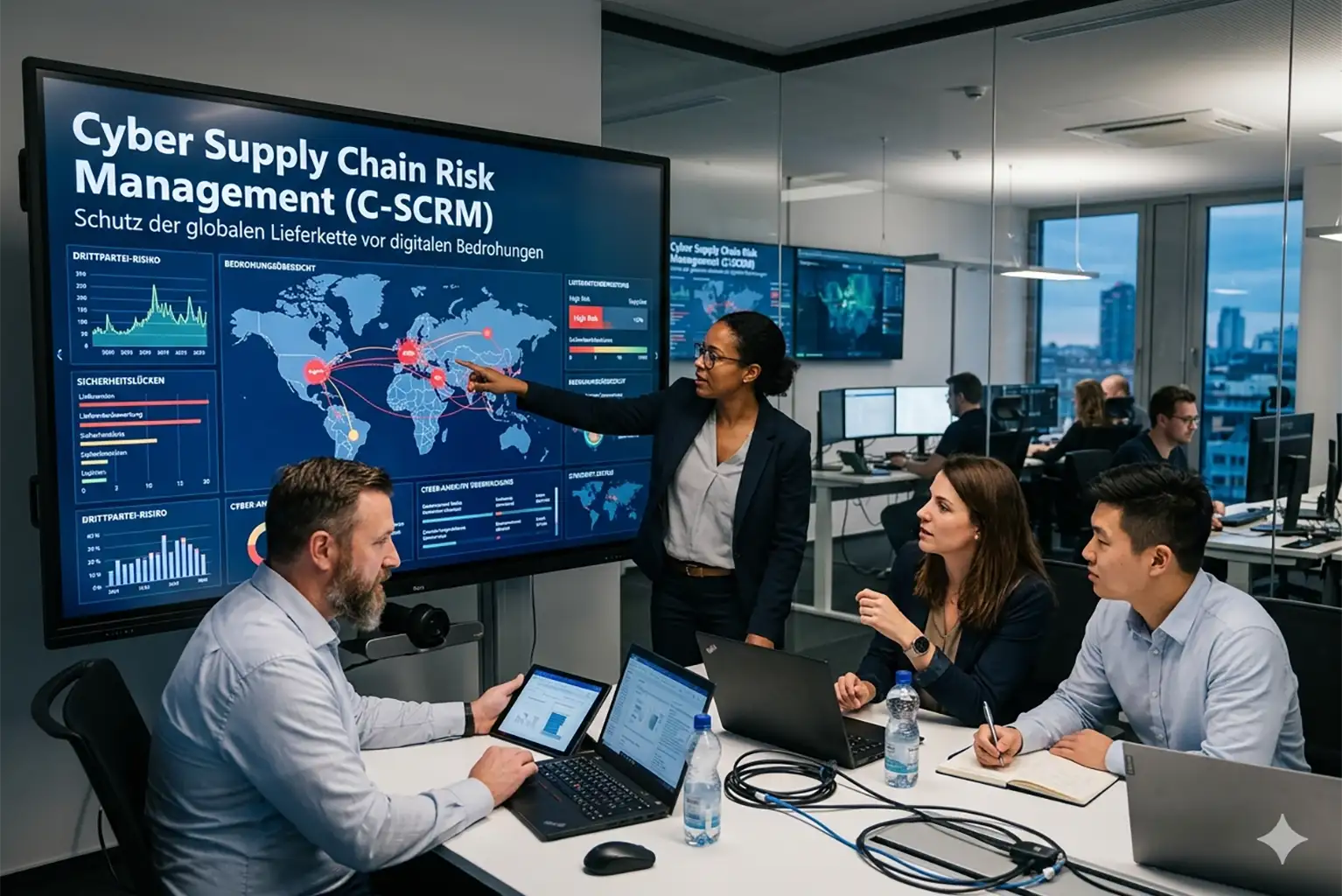
- Software level: What open-source components are included in your ERP system? Are these libraries up-to-date or abandoned? Since modern software often consists of 90% % of foreign code, the greatest risk is hidden here.
- Hardware layer: Where are your server chipsets manufactured? Is there a risk of „hardware Trojans“ or tampering during transport or manufacturing?
- Service Level: What privileged access do your cloud provider's maintenance technicians have to your sensitive data? It's often external service providers who hold the „key to the kingdom.“.
The core of C-SCRM is the realisation that trust must be replaced by verification. It is the consistent application of the zero-trust principle to external infrastructure.
2. Why C-SCRM 2026 is mission-critical
We are in an era where attackers no longer choose the „front door“ (your firewall), but come through the „back door“ of a small, perhaps less well-secured, supplier. A single compromised software partner's update server can infect thousands of companies simultaneously today.
The regulatory tsunami (compliance)
With the full implementation of the NIS2 Directive and the Cyber Resilience Act (CRA), companies are legally obliged to demonstrate the cybersecurity of their supply chains. Responsibility for this often lies directly with senior management. Those who have not established C-SCRM processes risk not only fines in the tens of millions but also the loss of insurance claims in the event of damage.
The E-E-A-T Perspective (Experience, Expertise, Authoritativeness & Trustworthiness)
- Expertise: Knowledge of global dependencies is more important today than pure IT knowledge. One must understand how software is „built“.
- Having experienced supply chain incidents (like Log4j), companies know that without documentation, finding affected systems takes weeks instead of hours.
- Trust: In B2B relationships, the submission of a C-SCRM report in 2026 is often a prerequisite for closing a contract. Those who do not have control over their supply chain will lose their supply rights with large corporations.
3. The Hybrid Model: The Symbiosis of Technology and Humans
A modern C-SCRM must be neither purely manual nor purely automated. The hybrid model combines both worlds, optimised for mobile use:
The Role of Automation (AI & Monitoring):
- Continuous scans: Tools monitor the dark web, technical forums, and GitHub repositories around the clock for leaked credentials or new security vulnerabilities of your partners.
- Security Rating: Automatic calculation of risk scores based on parameters such as patch level, SSL configurations, and IP reputation.
- Immediate Defence: Automated interruption of API interfaces in the event of a critical incident being reported by a service provider.
The role of human experts
- Contextual assessment: An analyst checks whether a vulnerability with the supplier actually poses a risk to your company.
- On-site audits: Experts assess a partner's security culture that no scan in the world can capture.
- Risk assessment: Decision on strategic measures if a supplier permanently fails to meet security specifications.
Would you like a brief consultation on this?


4. Strategic Core Components for Your Business
To build a C-SCRM programme with scalability, you need to implement the following four pillars:
- A. Vendor Tiers & Inventory: Categorise your suppliers. Tier 1 (Critical) has access to customer data; Tier 2 (Important) supports core processes; Tier 3 (Standard) has no direct IT risk.
- B. Continuous Monitoring: An annual questionnaire will no longer suffice by 2026. You will require real-time feeds to alert you immediately to threats.
- C. Incident Response & Business Continuity: What do we do if our cloud provider goes offline for 48 hours? They need alternative communication channels and backup strategies for third-party failures.
- D. Contractual Governance: Security must be legally enshrined. Clauses covering the „Right to Audit“, the obligation to provide SBOMs, and guaranteed incident reporting deadlines (within 24 hours) are now standard.
5. The Gamechanger: Software Bill of Materials (SBOM)
The SBOM has revolutionised how we think about software security. It is the detailed „ingredients list“ for your software. As modern software consists of 90% % open-source components, the SBOM tells you in seconds if your deployed tools are affected by a newly discovered vulnerability. By 2026, customers will demand machine-readable SBOM formats like CycloneDX. Without an SBOM, you would have to request from each manufacturer individually and wait for a response – valuable time that attackers would exploit.
6. Deep Dive: VEX and the Management of False Positives
One of the biggest pain points in C-SCRM is the sheer volume of reported vulnerabilities. A typical SBOM can contain hundreds of known vulnerabilities (CVEs). This is where the Vulnerability Exploitability eXchange (VEX) comes into play.
VEX documents are the manufacturers' answer to the SBOM deluge. In them, manufacturers state in a machine-readable format whether a discovered vulnerability is actually exploitable in their specific product.
- Example: A library has a vulnerability, but the affected part of the code is not called at all in the application. VEX reports „Not Affected“ here.
- The benefit: Your team saves up to 80 % of time by not having to manually investigate „dead“ alerts and can immediately focus on genuine, dangerous vulnerabilities.
7. Practical Example: Responding to a Critical Zero-Day Vulnerability
How does this interplay work in reality? A scenario from 2026:
- Monday, 09:00: A critical zero-day vulnerability in a widely used encryption library becomes public.
- Monday, 09:15: Your C-SCRM system scans all stored SBOMs. It identifies three cloud providers using this library.
- Monday, 10:30: The system is reconciling the VEX data. Provider A is already reporting „Fixed“. Provider B is reporting „Not Affected“. Provider C is silent.
- Monday, 11:00: As supplier C is your most critical logistics partner, the CISO decides to temporarily isolate the API connection until confirmation is received.
- Tuesday, 08:00: Provider C delivers the patch and a new SBOM. The connection is restored.
8. Checklist: 5 Immediate Actions for Launch
If you want to build your C-SCRM today, start here:
- Inventory: List your 10 most critical software and service partners.
- SBOM requirement: Request an up-to-date Software Bill of Materials (SBOM) from these partners in CycloneDX format.
- Monitoring Tool: Implement a tool for automated security ratings of your partners.
- Contract check: Check if your supply contracts include a 24-hour reporting requirement for security incidents.
- Team Briefing: Define who makes the decision to disconnect a system in the event of an incident with the service provider.
9. Conclusion: Cyber Supply Chain Risk Management as a Competitive Advantage
Cyber Supply Chain Risk Management is far more than a technical necessity or a tedious compliance exercise. It is a tool of modern corporate governance. In 2026, digital resilience will be a real selling point. Companies that can demonstrate they have their supply chain under control will gain the trust of major customers and investors. C-SCRM not only protects your data but secures your very existence in a hyper-connected world where „Zero Trust“ is the only way forward.
10. FAQ – Frequently asked questions about C-SCRM
Do I need to check every small supplier individually?
No. An effective C-SCRM uses a risk-based approach. Focus your resources on the 'critical nodes' – partners who have access to sensitive data or whose failure would immediately halt your production. For non-critical suppliers, automated basic scans are often sufficient.
KI hilft beim Lieferkettenrisikomanagement, indem sie Unternehmen in die Lage versetzt, potenzielle Störungen zu erkennen, zu bewerten und auf diese zu reagieren. Sie kann dabei helfen: * **Vorhersage von Risiken:** KI-Algorithmen können riesige Datenmengen analysieren, einschliesslich historischer Daten, Echtzeitinformationen von Sensoren, Nachrichten und Social-Media-Trends, um Muster zu erkennen, die auf potenzielle Risiken wie Naturkatastrophen, geopolitische Instabilität, Lieferantenausfälle oder Nachfrageschwankungen hindeuten. * **Bewertung von Risiken:** KI kann die Wahrscheinlichkeit und die potenziellen Auswirkungen von identifizierten Risiken quantifizieren. Dies ermöglicht es Unternehmen, sich auf die kritischsten Risiken zu konzentrieren. * **Automatisierte Reaktion:** KI kann automatisierte Massnahmen auslösen, um auf Risiken zu reagieren. Dies kann von der Anpassung von Lagerbeständen und Lieferrouten bis hin zur Suche nach alternativen Lieferanten reichen. * **Verbesserte Transparenz:** KI kann Einblicke in die gesamte Lieferkette liefern, Engpässe und Schwachstellen aufdecken, die traditionelle Methoden möglicherweise übersehen. * **Optimierung von Prozessen:** Durch die Analyse von Lieferkettenoperationen kann KI Engpässe identifizieren und Empfehlungen zur Prozessoptimierung geben, was die Effizienz steigert und Kosten senkt. * **Szenarioanalyse:** KI kann dabei helfen, verschiedene Szenarien zu simulieren und die potenziellen Auswirkungen von Störungen zu verstehen, sodass Unternehmen effektivere Notfallpläne entwickeln können.
AI models can today recognise 'weak signals', such as decreasing code quality in an open-source project or unusual staff changes at a supplier. This allows for warnings, often before an actual cyber attack takes place.
What is the difference between SCRM and C-SCRM?
The classic Supply Chain Management Classic supply chain management primarily deals with physical risks such as logistics bottlenecks, natural disasters, or supplier insolvency. In contrast, C-SCRM focuses purely on digital integrity, protection against software manipulation, and unauthorised data leaks. However, in practice by 2026, these disciplines must work in close conjunction to ensure holistic resilience.
What role does the NIS2 Directive play for my C-SCRM?
NIS2 is the legal driving force. It obliges companies to actively assess the security of their supply chain relationships. A missing or incomplete C-SCRM will be considered gross negligence under NIS2, which can result in fines and personal liability for management.