


Key facts about supply chain management
- Integrated planning, control, and optimisation of inter-company supply chains.
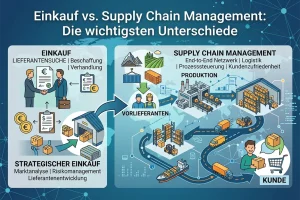
- The core difference from logistics: Logistics organises transport and storage (operational execution); SCM strategically controls the entire network, including finances and information.
- Success model „Hybrid-SCM“: Combines cost-effective mass production (push) for basic components with flexible, order-related final assembly (pull) via a defined customer order decoupling point.
- Top KPIs: OTIF (On-Time In-Full delivery rate), Cash-to-Cash Cycle Time, and Inventory Turnover.
- Future Trends: Real-time Transparency via IoT, AI-based Demand Forecasting, and Fulfillment of ESG Directives (e.g., Supply Chain Act).
1. What is Supply Chain Management? (Definition & Scope)
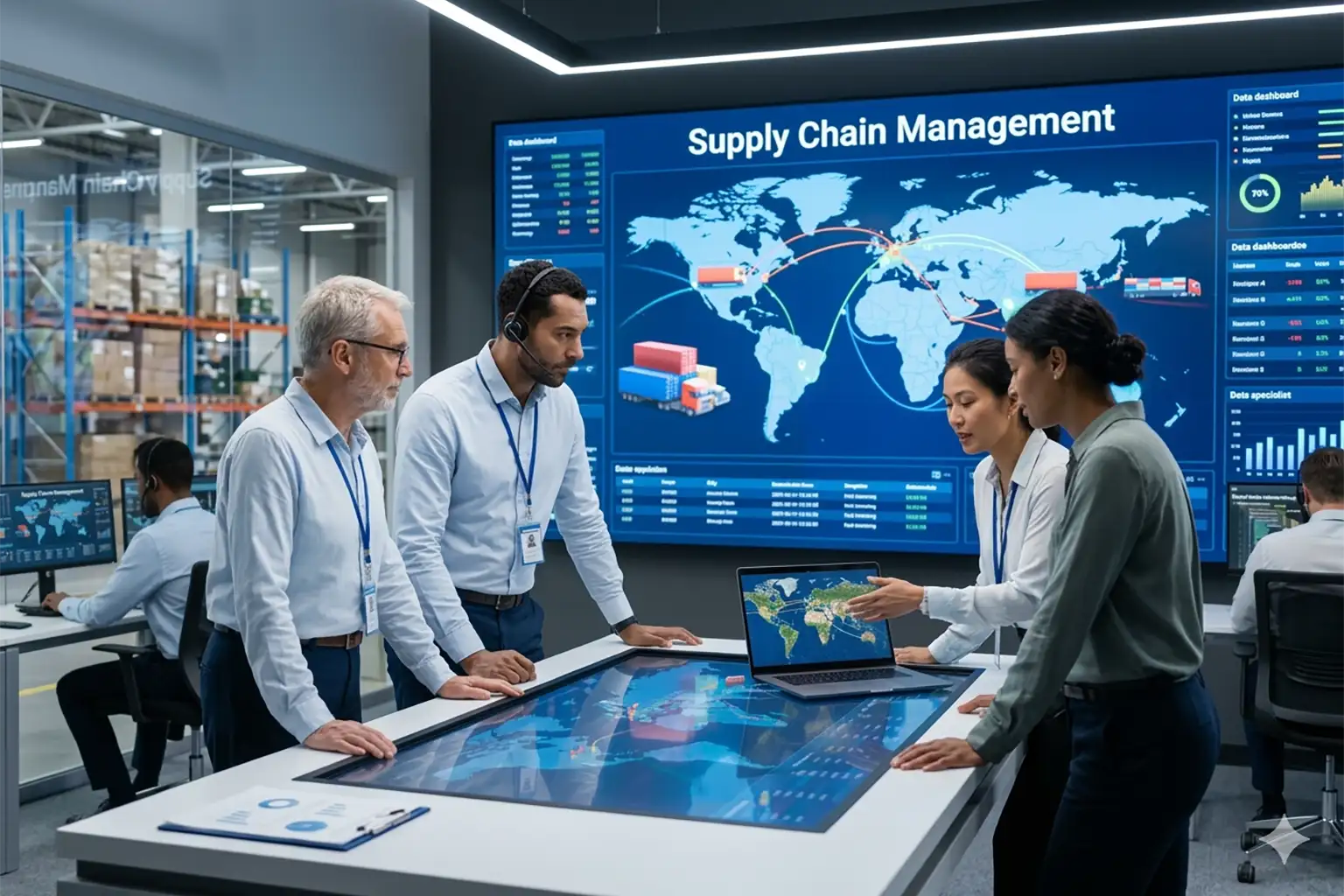
Effective SCM harmonises three synchronous flows:
- Material flow: Forward transport of raw materials, semi-finished goods and finished products (as well as reverse flow for returns/recycling).
- Information flow: Bi-directional exchange of demand data, inventory, delivery status, and capacities in real-time.
- Financial flows: Processing of payment flows, credit conditions and ownership transfers.
SCM vs. Logistics: What's the difference?
In practice, the terms logistics and SCM are often used interchangeably, but they differ fundamentally in scope and strategy:
„Logistics moves goods from A to B – Supply Chain Management controls the entire value creation network from the initial idea to the end customer.“
- Logistics
- Focus: Operational & Local (Transport, Storage, Handling)
- Goal: The right goods at the right time in the right place
- Reach: Often limited to a company or segment
- Perspective: Material and goods movement
- Supply Chain Management (SCM)
- Focus: Strategic & Holistic (Network Optimisation)
- Objective: Maximum value creation, cost reduction & resilience
- Scope: Cross-company (from upstream supplier to customer)
- Perspective: Integration of Material, Information and Financial Flows
2. The 5 Core Phases of the Supply Chain (SCOR Model)
To standardise the management of complex supply chains, practice relies on the internationally established SCOR model (Supply Chain Operations Reference).
-
Planning (Plan) – Requirements Assessment & Resource Allocation
Balancing supply and demand. This involves calculating capacities, inventory levels, and production volumes based on historical data and AI-powered forecasts.
-
Procurement (Source) – Supplier Management & Purchasing
Selection, qualification, and auditing of suppliers. Negotiation of terms and conditions, as well as ensuring an uninterrupted supply of raw materials.
-
Manufacturing (Make) – Production & Manufacturing Control
Processing of raw materials into intermediate or final products. Key metrics for this phase include lead times, scrap rates, and capacity utilisation.
-
Delivery – Distribution Logistics & Fulfilment
Order processing, warehousing, and transport logistics through to handover to the end customer (last mile).
-
Returns & Service – Reverse Logistics & Sustainability
Processing of returns, repairs, warranties and the re-entry of valuable materials into the circular economy.
3. Comparing SCM strategies: The hybrid approach
In volatile markets, classic pure supply chain strategies often face challenges: pure Lean concepts falter quickly with unexpected disruptions, while pure Agile concepts can cause extremely high process costs.
Pure forms at a glance
- Push strategy (lean): Production is based on sales forecasts (Make-to-Stock). Offers high economies of scale, but carries the risk of excess inventory in the event of demand changes.
- Pull strategy (Agile): Production only starts after receipt of a specific order (Make-to-Order). Minimises inventory costs, but requires highly flexible production structures and short lead times.
The hybrid model: „Leagile SCM“
The most modern and resilient concept is the hybrid model. It combines the cost efficiency of the lean strategy in the upstream area with the agility of the pull strategy in the downstream area.
Raw material supplier ➔ Push / Lean (Forecast) ➔ Decoupling point (Customer order) ➔ Pull / Agile (Demand) ➔ End customer
The Customer Order Decoupling Point (CODP)
The lynchpin of the hybrid model is the decoupling point:
- Up to the decoupling point (push): Standardised modules or intermediate products are manufactured and stored in large quantities and at low unit costs, based on forecasts.
- From the decoupling point (Pull): As soon as a specific customer order is received, the end product is assembled to customer specification from pre-manufactured modules (Configure-to-Order).
Real-world example: Car manufacturers produce platforms, engines, and basic bodies in highly efficient batches at stock (push). The final painting, interior fittings, and optional extras are only carried out precisely according to customer configuration orders (pull).
Would you like a brief consultation on this?


4. Deep Dive: The Bullwhip Effect – Causes & Elimination
One of the most costly phenomena in SCM is the bullwhip effect. It describes the observation that minimal demand fluctuations at the point of sale (POS) escalate dramatically step-by-step through retailers, intermediaries, and manufacturers right up to the raw material supplier.
End customer (+- 5 % demand) ➔ Retail (+- 15 % variance) ➔ Wholesale (+- 35 % variance) ➔ Manufacturer (+- 80 % production fluctuation)
The 4 main causes in detail
- Updating demand forecasts: Each player in the chain calculates its own safety stock based on the orders from the direct upstream supplier – not on the actual consumption of the end customer.
- Order Batching: To save on transport and processing costs, retailers don't order continuously, but in large batches. This creates artificial peaks and troughs in demand.
- Price fluctuations & promotions: Short-term discount promotions tempt retailers into stocking up (forward buying), which creates artificial demand that collapses completely in the following month.
- Shortage Gaming: When a supply shortage looms, dealers pre-emptively order several times their actual needs in order to receive sufficient goods after proportional allocation.
Tactical counter-measures for neutralisation
- Real-time sharing of POS data: By integrating EDI (Electronic Data Interchange) systems, all supply chain partners see actual sales at the till, rather than just delayed reorders.
- Vendor-Managed Inventory (VMI): The supplier takes responsibility for inventory management in the retailer's warehouse. They deliver continuously as needed rather than on large orders.
- Smaller order batch sizes: Reduction of fixed costs per order enables high-frequency, smoothed supply.
- Stable Pricing (EDLP – Every Day Low Price): Dispensing with extremely fluctuating promotional prices eliminates artificially generated forward buying.
Practical Example: Transformation to Hybrid SCM in the Electronics Industry
The practical example of a medium-sized manufacturer of industrial hardware shows how the switch from a rigid push supply chain to an intelligent hybrid model works in practice:
Starting position & problem statement
The company produced 45 different variants of control computers entirely make-to-stock.
- The consequence: High capital investment due to finished devices worth several million euros.
- The risk: Nevertheless, there were regular supply bottlenecks for specific in-demand variants, while other slow-moving items became obsolete in the warehouse.
The implementation of the SCM restructuring
- Product modularisation: The hardware has been redesigned so that 80 % components (casing, power supplies, base boards) are identical across all 45 variants.
- Relocation of the Customer Order Decoupling Point (CODP)
- Upstream (Push): The assemblies are pre-manufactured in large quantities in Asia at low cost and shipped to the central warehouse in Germany (lean principle).
- Downstream (Pull): Only when a customer orders a specific configuration in the online portal, the logistics centre installs the specific expansion cards and memory modules within 24 hours (Agile principle).
The measured successes after 12 months
- Reduction in inventory value: The capital tied up in finished goods stock fell by 31 %.
- Delivery time: The average turnaround time per customer order was reduced from 12 working days to 48 hours.
- Flexibility: New customer requirements and component upgrades could be immediately integrated into the portfolio without scrapping old stock.
6. The most important SCM KPIs for performance measurement
Successful supply chain management requires data-driven performance measurement. The selection of balanced Key Performance Indicators (KPIs) prevents conflicting objectives between purchasing, production, and sales.
- OTIF (On-Time In-Full)
- Category: Delivery Quality
- Formula: (On-time and complete deliveries / Total deliveries) × 100
- Target value / benchmark: ≥ 95 %
- Cash-to-Cash Cycle Time (C2C)
- Category: Financial Efficiency
- Formula: Days Sales Outstanding + Days Inventory Outstanding – Days Payables Outstanding
- Target value / Benchmark: As low as possible (industry-dependent)
- Inventory turnover
- Category: Inventory Management Efficiency
- Formula: Cost of goods sold / Average inventory
- Target value / Benchmark: 8-12 envelopes/year (trade higher)
- Order Cycle Time (OCT)
- Category: Process Speed
- Lead time from order placement to customer goods receipt
- Target value / Benchmark: Industry-specific short-term
- Perfect Order Rate (POR)
- Category: Overall Efficiency
- Formula: Number of error-free orders (on time, undamaged, correctly documented) / Total orders
- Target value / benchmark: ≥ 90 %
6. Current Trends: Resilience, Digitalisation & ESG
The past few years have shown how vulnerable global just-in-time supply chains are to external shocks (geopolitics, climate change, pandemics). Supply chain management priorities are therefore noticeably shifting:
Traditional focus: Pure cost minimisation ➔ Modern SCM focus: Resilience, digitalisation & ESG
„A system optimised for minimal costs breaks at the first tremor. True strength is shown in the ability to flexibly absorb disruptions.“
1. Risk Management & Multi-Sourcing
Instead of single sourcing (a sole main supplier to maximise volume discounts), companies are increasingly relying on nearshoring (relocating production to nearby regions) and dual/multi-sourcing to mitigate supply bottlenecks.
2. Control Towers & Predictive Analytics
Using intelligent control towers and AI-powered forecasting models allows for real-time monitoring of supply chains. Disruptions on transport routes are detected early and autonomous rerouting is initiated.
3. ESG & Legal Compliance (Supply Chain Act)
The German Act on Corporate Due Diligence in Supply Chains (LkSG) and the EU-wide Corporate Sustainability Due Diligence Directive (CSDDD) oblige companies to monitor human rights and environmental standards throughout the entire chain. Traceability has therefore become a legal requirement rather than a marketing argument.
7. SCM Checklist: Status Quo & Maturity Assessment
To determine how future-proof your own supply chain is, it is recommended to classify it according to the 4-stage maturity model.
The 4 maturity levels in SCM
- Stage 1 (Reactive – Silo Mentality):
- Purchasing, production and sales operate as separate departments.
- High safety stocks compensate for a lack of forecasting accuracy.
- Planning is done manually via Excel; disruptions immediately lead to supply shortages.
- Level 2 (Integrated – Process orientation):
- Deployment of a central ERP system for master data-based Material Requirements Planning (MRP).
- Initial key figures such as OTIF are regularly recorded.
- Suppliers are primarily managed through contracts and prices.
- Stage 3 (Collaborative – Hybrid model established):
- A clearly defined decoupling point separates push and pull processes (Leagile SCM).
- Suppliers and customers are digitally connected via EDI or supplier portals.
- Risk management and dual sourcing secure critical supply chains.
- Level 4 (Autonomous – AI-assisted Ecosystem):
- End-to-end real-time transparency across SCM Control Towers.
- AI-based demand forecasts (Predictive Demand) reduce stockouts to almost zero.
- Full automatic ESG compliance and traceability all the way to the raw material origin.
5-Question Quick Self-Assessment
Check with the following criteria where there is potential for optimisation:
- POS transparency: Are end-customer sales data fed directly into production planning to prevent the bullwhip effect? (Yes / No)
- Decoupling point: Is your Customer Order Decoupling Point chosen so that standard components can be manufactured inexpensively in advance, with customer wishes assembled flexibly? (Yes / No)
- KPI Management: Are OTIF and Cash-to-Cash Cycle Time assessed at least monthly across departments? (Yes / No)
- Resilience: Are there qualified second or third-tier suppliers for all A-materials (multi-sourcing)? (Yes / No)
- ESG Audit: Can you demonstrate compliance with environmental and human rights standards across your Tier 1 and Tier 2 supply chains without gaps? (Yes / No)
Evaluation: The more questions you can answer 'Yes' to, the closer your company's SCM is to target level 4.
9. Conclusion on Supply Chain Management (SCM)
Supply Chain Management has transformed from a purely operational processing function into one of the crucial strategic competitive advantages. Companies that break down rigid push structures and switch to a flexible hybrid model secure the best of both worlds: rapid scalability and low production costs combined with maximum customer orientation. Those who continuously monitor their key figures such as OTIF and cash-to-cash times and use digital tools for risk prevention build a future-proof and sustainable value chain.
9. Frequently Asked Questions (FAQ) about Supply Chain Management (SCM)
1. What does “Supply Chain Management” mean in German?
Supply Chain Management is usually translated into German as 'Lieferkettenmanagement' or 'Wertschöpfungskettenmanagement'. It encompasses the coordination of all participants in a supply chain, from raw material extraction to the end customer.
2. What is the bullwhip effect in SCM?
The bullwhip effect describes a phenomenon where small fluctuations in end-customer demand lead to cascadingly magnifying swings in order quantities up the supply chain (to the raw material supplier). Causes include a lack of transparency, time delays, and safety margins for reorders.
3. Why is the hybrid model particularly efficient in SCM?
The hybrid model (Leagile) separates value creation at a defined decoupling point. Upstream, it uses cost-effective mass production for basic components (Lean/Push), while downstream it is assembled to customer specifications only upon a specific order (Agile/Pull). This drastically reduces the risk of inventory value without compromising delivery speed.
4. Which SCM system is right for my company?
The choice depends heavily on company size and complexity. Small to medium-sized businesses frequently use integrated SCM modules of modern ERP systems (e.g., SAP S/4HANA, Microsoft Dynamics 365, or Oracle SCM Cloud). For highly complex networks, specialised add-ons for inventory optimisation, transport management (TMS), and advanced planning (APICS) are employed.
5. How does Artificial Intelligence (AI) help in modern supply chain management?
AI optimises SCM primarily through more precise demand forecasting (predictive forecasting), automated inventory management and dynamic risk management. Machine learning algorithms analyse historical sales data as well as external factors such as weather, market trends or raw material prices to identify supply bottlenecks early and to automatically reroute shipments.