


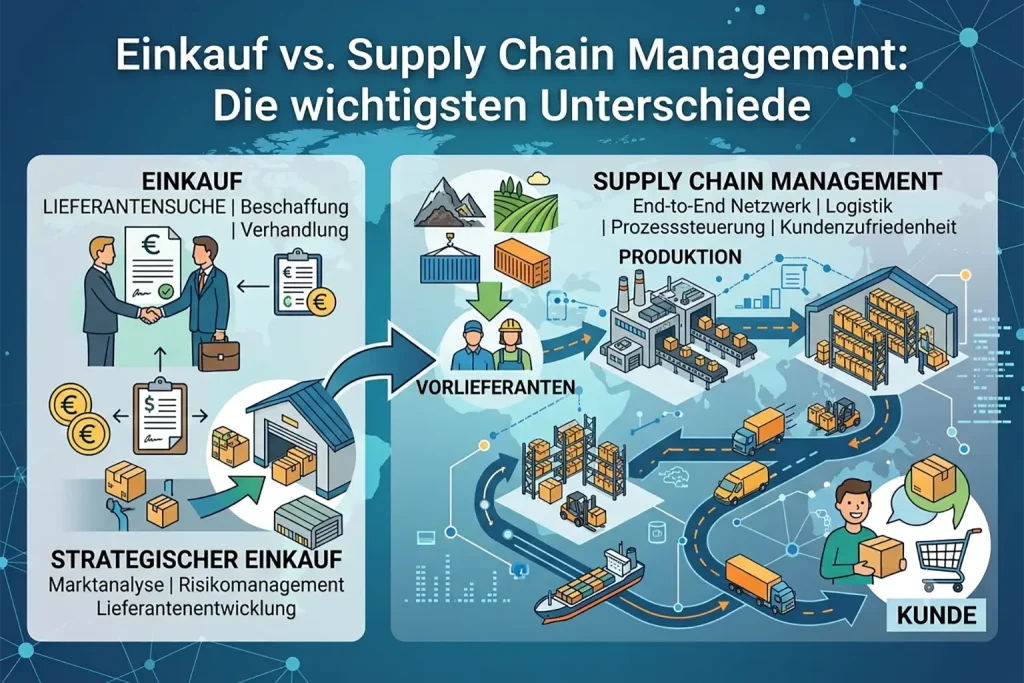
Key facts: Purchasing vs Supply Chain Management at a glance
- Focus: Purchasing is input-oriented (procurement of goods); SCM is holistically process- and output-oriented.
- Scope: Purchasing primarily operates at the interface with the direct supplier (Tier 1). SCM encompasses the entire network of all actors (Tier n suppliers, producers, logistics providers, end customers).
- Objective: Procurement ensures favourable purchase prices, terms and quality. SCM maximises overall network efficiency, reduces lead times and guarantees customer satisfaction.
- Time horizon: Purchasing operates predominantly on an operational to tactical level. SCM is strategic and geared towards long-term resilience and value creation.
1. What is purchasing? (Definition & tasks)
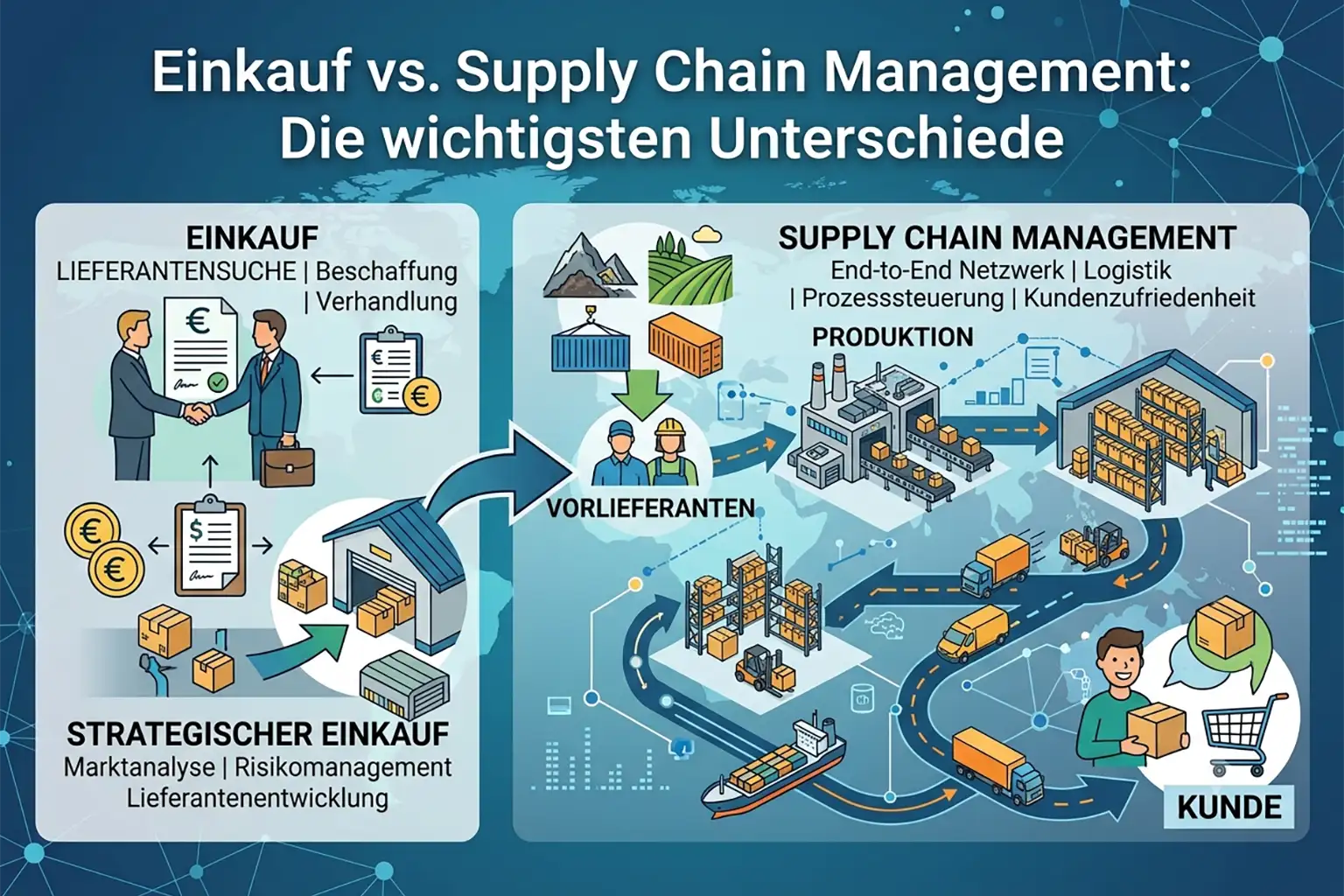
The central areas of action include:
- Supplier selection & evaluation: Identification of qualified partners and conducting audits.
- Negotiation: Enforcing optimal prices, payment terms and delivery conditions.
- Contract management: Legally compliant structuring of framework agreements and purchase orders.
- Operational order processing: monitoring delivery dates and quality inspections upon goods receipt.
2. What is Supply Chain Management (SCM)? (Definition & Tasks)
Supply Chain Management manages the entire flow of goods, data and finances along the complete value chain. It does not view the company as an isolated entity, but as part of an interconnected ecosystem.
The main areas of responsibility include:
- Demand Planning & Forecasting: Reconciling sales forecasts with capacities.
- Production and inventory planning: Optimisation of inventory levels to prevent tied-up capital and stockouts.
- Distribution & transport logistics: Efficient management of goods transport to the customer.
- Risk management: early detection of disruptions in the global supply network.
3. The key differences at a glance: Purchasing vs SCM
„Purchasing negotiates the price – Supply Chain Management secures the actual value along the entire chain.“
- perspective
- Procurement: Selective (focus on the company ↔ supplier relationship)
- Supply Chain Management: End-to-End (Focus on the end-to-end network from raw material to consumer)
- Main goal
- Procurement: Minimisation of procurement costs and securing material availability
- Supply Chain Management: Maximising overall efficiency, customer satisfaction and responsiveness
- Area of responsibility
- Purchasing: procurement market, negotiations, contracts and supplier relationships
- Supply Chain Management: material, information and financial flows across all stages
- logistical range
- Procurement: Inbound logistics (delivery up to goods inwards)
- Supply Chain Management: Inbound, intralogistics (storage/production) and outbound logistics (distribution/customer)
- Key performance indicators (KPIs)
- Procurement: Savings, on-time delivery, defect rate, purchase price variance
- Supply Chain Management: lead time, inventory turnover rate, OTIF rate (On-Time In-Full), total supply chain costs
Would you like a brief consultation on this?
4. Strategic vs. Operational Alignment in Detail
A key difference lies in the temporal and substantive focus of both areas:
- Operational purchasing: Focuses on day-to-day business, individual orders, invoice verification and master data maintenance.
- Strategic Procurement: Develops commodity group strategies, builds long-term supplier relationships and carries out risk assessments.
- Supply Chain Management: Operates at the highest strategic level. It determines warehouse locations, manages global logistics networks, and ensures the digital integration of all interfaces.
5. Deep Dive: Total Cost of Ownership (TCO) vs End-to-End Value Creation
The conceptual differentiation of both disciplines is most evident in business management and control.
While purchasing traditionally strongly on the Total Cost of Ownership (TCO) takes into account – meaning that in addition to the pure purchase price, it also calculates the freight, customs, quality and disposal costs of the respective product –, Supply Chain Management expands this perspective by the dimension of Total Value Optimisation (TVO).
- Misleading incentives of the pure TCO approach: A procurement department chooses an overseas supplier because the unit price, including sea freight (TCO), is 12 % cheaper than that of a regional supplier.
- The end-to-end perspective in SCM: SCM evaluates the overall impact on the value chain. Longer transit times mean higher capital tie-up in floating stock, lower flexibility regarding demand fluctuations, and an increased risk of failure due to global logistics bottlenecks.
The deep dive makes it clear: only when purchasing and SCM synchronise their KPIs can it be prevented that local savings in purchasing lead to higher process and inventory holding costs across the entire supply chain.
6. Practical example: Procurement and SCM in times of crisis
The interaction and precise division of labour are best illustrated by a real-world scenario: an electronics manufacturer is facing the sudden failure of a main supplier for control chips.
- Procurement response: Procurement immediately initiates renegotiations with alternative suppliers (second source), checks existing framework agreements for penalty clauses, and procures emergency quotas on the spot market on the best possible terms.
- Response of the supply chain management: SCM simultaneously analyses the impacts on ongoing production, simulates remaining stock levels, redistributes raw materials between different production sites and adjusts delivery promises to end customers.
Conclusion of the example: Purchasing saves physical material availability and negotiates prices; SCM saves the production flow and ensures customer satisfaction.
7. Interfaces & Synergies: Why both functions need each other
Procurement and SCM are not in competition with each other, but complement one another:
- Data-driven procurement: Supply chain management provides accurate demand forecasts that enable purchasing to secure better negotiating positions with suppliers.
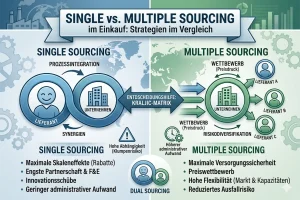
- Resilience through diversification: Purchasing identifies alternative suppliers (dual sourcing) to ensure the supply chain stability demanded by SCM.
- Total Cost of Ownership (TCO): If purchasing decides purely on the cheapest unit price, this can lead to higher freight or storage costs in SCM. Only close coordination prevents such misaligned incentives.
8. Future trends: AI & sustainability in procurement and logistics
Both disciplines are undergoing dynamic changes driven by technological and regulatory requirements:
- Generative & Predictive AI: Artificial intelligence carries out automated price analysis in procurement and forecasts supply chain disruptions in SCM in real time.
- ESG & Supply Chain Acts: Compliance with environmental and social standards forces purchasing into rigorous supplier vetting and SCM into end-to-end traceability across all tiers.
9. Conclusion: The interaction between procurement and SCM
„A product is only as competitive as the terms of its procurement, but only as reliable as the architecture of its supply chain.“
The Shopping is the tool for effective procurement, whilst the Supply Chain Management represents the orchestrator for the entire value creation process. Companies do not benefit from favouring either of the two functions. The decisive factor for long-term success, cost efficiency and supply resilience is seamless integration: strategic procurement that is firmly embedded in the overarching supply chain architecture.
10. Frequently Asked Questions (FAQ) about Purchasing vs. Supply Chain Management
Is purchasing subordinate to supply chain management?
In many modern organisational structures, purchasing is located organisationally as a subdivision within supply chain management. In more traditional structures, both areas exist on an equal footing alongside each other and report to the executive board.
Why is good purchasing alone no longer enough today?
Low procurement prices are no use if the goods cannot be delivered due to transport bottlenecks or storage costs eat up the price advantage. Only SCM optimises the chain as a whole.
What qualifications are in demand in these fields?
In procurement, negotiation skills, legal knowledge and market analytics are central. In SCM, process understanding, data analysis, systems thinking and logistics knowledge are paramount.
What is the difference between procurement, purchasing and supply chain management?
Purchasing often refers to operative order processing. Procurement is the English or strategic term for the entire sourcing process, including supplier management. SCM goes even further, controlling the entire value chain from the raw material supplier to the final customer.
Which IT systems do purchasing and SCM use?
Purchasing primarily uses e-procurement systems, SRM (Supplier Relationship Management) software and spend analytics tools. SCM works intensively with ERP systems, Advanced Planning Systems (APS) as well as warehouse (WMS) and transport management systems (TMS).