


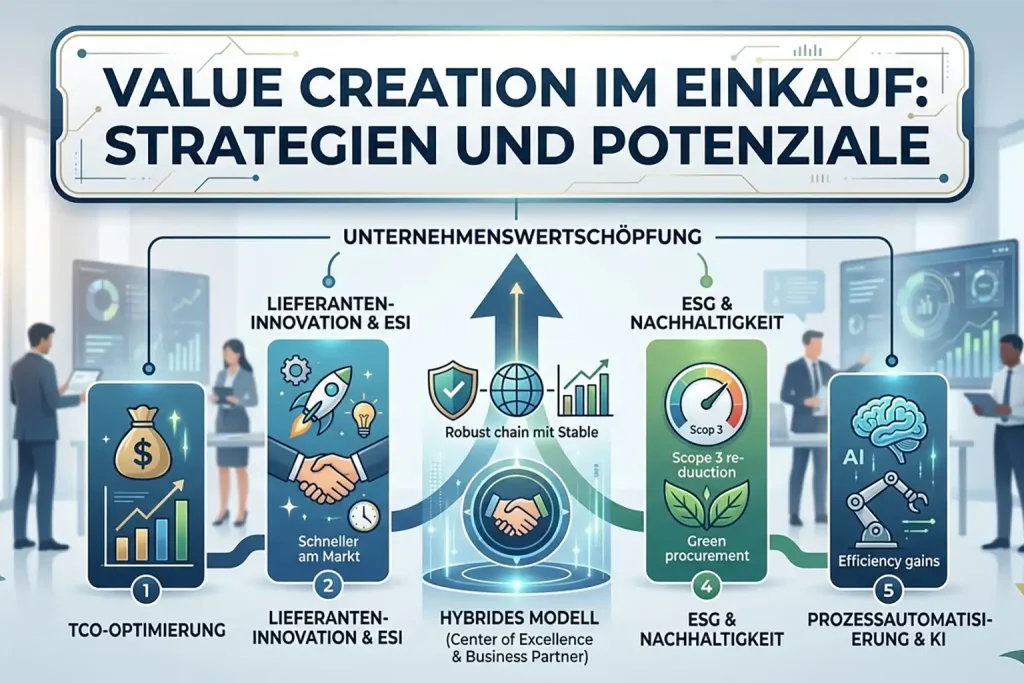
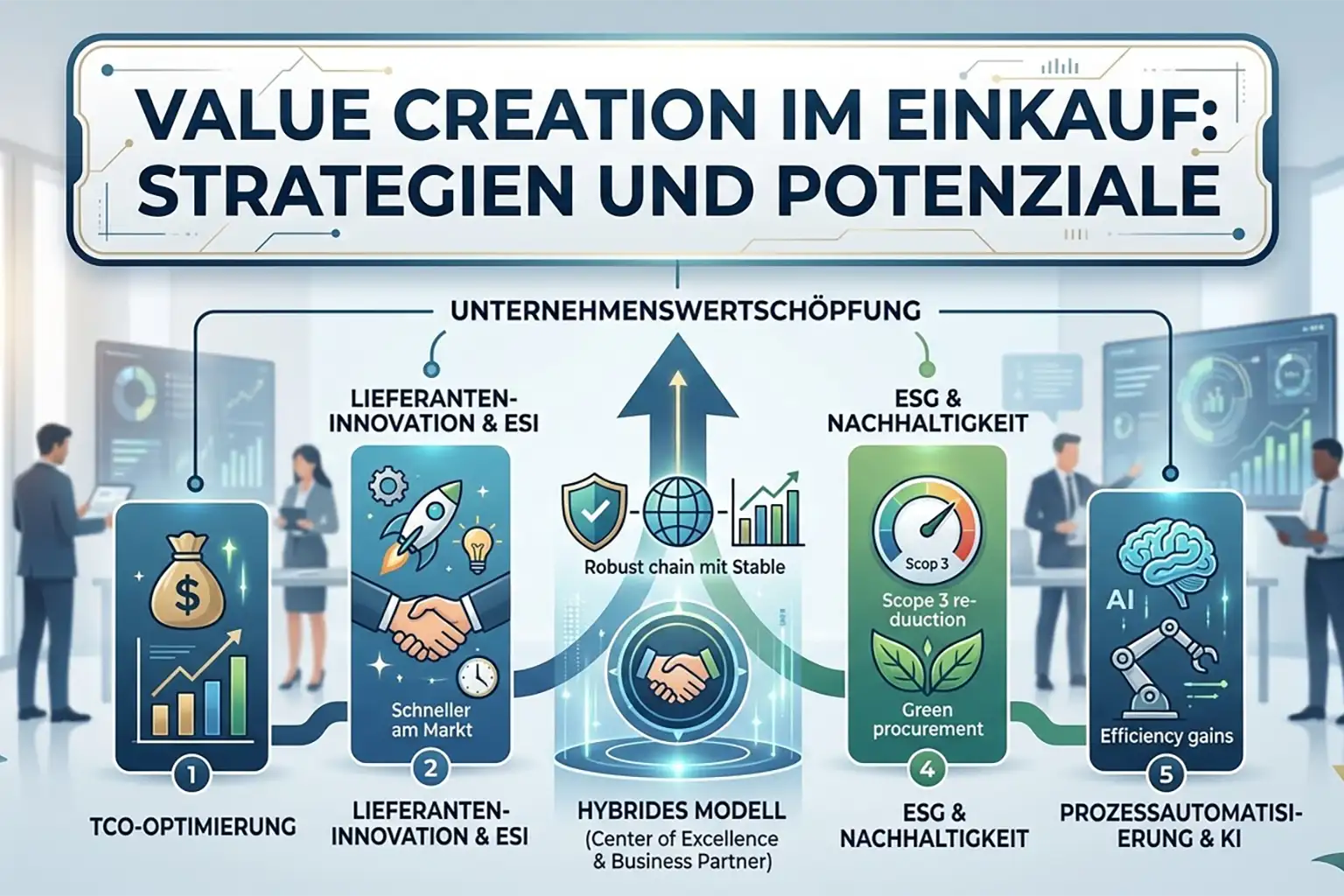
Purchasing decisions no longer solely determine how much money a company spends today, but how competitive it will be in the market tomorrow. A strategically anchored Creating Value in Purchasing highlights values that go far beyond classic P&L reporting: companies give away up to 70% of % their value potential when they measure the success of their business. Procurement continue to focus on isolated success stories and reduce annual savings quotas. Through a hybrid operating model – the combination of powerful central competence centers and procurement business partners directly embedded in the functional areas – purchasing ensures real competitive advantages: from shorter development times through early supplier involvement (Early Supplier Involvement), to fail-safe supply chains, and the achievement of tough ESG goals.
Quick facts about value creation in procurement
- Definition: Holistic value creation through purchasing that goes beyond simply reducing purchase prices.
- Classic & modern levers: product group strategies, volume and demand bundling, fact-based negotiation, TCO optimization, partner-based supplier management, and working capital management.
- Extended value drivers: Co-innovation with key suppliers, supply chain resilience, and scope 3 decarbonization.
- Organizational structure: Hybrid purchasing model (central center of excellence plus decentralized business partners in the plants and divisions).
- Measurement logic: Complementing traditional savings through holistic Value Scorecards (impact on revenue growth, cash flow, risk costs, and sustainability).
- Innovation potential: Up to 40 percent of % all industrial product innovations originate from collaboration with external suppliers.
1. Paradigm shift: From a cost cutter to a strategic value creator
The classic perspective:
- Primary focus on the unit price in the offer
- Working in internal silos with isolated budget requirements
- Inclusion of the procurement process only at the very end, when contracts have to be signed
- Hectic firefighting as parts are missing or suppliers falter
Strategic Value Creation:
- Consideration of the total cost of ownership over the entire lifecycle
- Close partnership at eye level with development, manufacturing and finance
- Joint development projects and reliable alliances with key suppliers
- Systematic risk management, predictable resilience, and clear ESG leadership
Anyone who reduces purchasing to purely negotiating discounts creates structural weaknesses in their business: In an emergency, the cheapest supplier quickly becomes the most expensive one if there are delays in production or increased scrap rates. At the same time, companies seize enormous opportunities: Technology leaders among suppliers prefer to share their best ideas and prototypes with customers who act reliably and in partnership.
„Anyone who just quotes prices in purchasing today is saving paper today and paying for failures, quality defects, and missed innovations tomorrow.“
A modern one Value Creation This is where the purchasing process really comes into play: Purchasing sees itself as a partner in the entrepreneurial process. In addition to saving money, it drives sales growth, strengthens returns on capital, and removes barriers that make new products unnecessarily expensive or time-consuming.
2. The hybrid operating model as an organizational foundation
In practice, strategic value creation rarely fails due to a lack of ideas, but rather due to sluggish structures. Neither a purely centralized nor a completely decentralized purchasing department can meet the complex requirements of today’s markets alone.
- Pure centralization almost always leads to long service routes, angry plant managers, and a purchasing process that loses its connection to reality on the shop floor.
- Pure decentralization leads to fragmented purchasing volumes: Five locations purchase from the same suppliers at five different prices, but the synergies remain untapped.
The viable solution is the hybrid Shopping model (often built as a Center of Excellence in conjunction with embedded business partners):
- Center of Excellence (Central Axis): Here the company brings together methodological expertise, market analyses, cross-cutting IT and AI tools, regulatory guidelines (such as the Supply Chain Act), and strategic product group management. It is here that standards are created that apply to all.
- Procurement Business Partner (Centralized Axis): Experienced buyers sit directly in the business units, factories, or project teams on-site. They know the internal customers, are present at development meetings, and bring the procurement expertise right there where decisions about materials and concepts are made.
The hybrid model ensures that recurring processes run in a standardized and automated manner, while leaving the necessary scope for action in place for complex initiatives on site.
3. The methodological foundation: The 6 key levers of operational excellence
Genuine value creation does not go unnoticed; it remains firmly rooted in the tried-and-tested craft of purchasing. Only when the basic tasks are structured in a structured manner do strategic programs take effect:
3.1 Category management
Without thoughtful product group management, procurement remains reactive:
- Targeted differentiation: Direct production materials require completely different approaches and risk profiles than indirect needs such as IT, logistics, tools, or marketing services.
- Questioning specifications: In many companies, historically grown special requests drive costs. Category managers compare specifications with the market and eliminate unnecessary variants.
- Evaluate the make-or-buy structure: Not everything that a company can produce itself necessarily belongs in its own production facility. Thorough market comparisons provide clarity in this regard.
3.2 Volume Bundling & Demand Management
Bundle In modern procurement, it means much more than simply throwing quantities into a pile:
- Site-wide aggregation: Requirements from different plants and subsidiaries are transparently combined. This allows the company to negotiate significantly better terms with suppliers.
- Stop buying from Maverick Buying: When departments order over the frame agreements without the proper approval procedures, the agreed-upon conditions are wasted. Clear approval chains and simple catalog systems bring these costs back on track.
- Demand management before purchase: The most cost-effective order is the one that never needs to be placed in the first place. Before negotiations take place, it must be determined: Do we need this quantity, this quality, or this level of service in this exact configuration?
3.3 Fact-based negotiation
Instead of relying on gut feeling, volume, or standardized discount requirements, shopping through data and methodical preparation provides reassurance:
- Cost breakdown transparency: Offers are broken down into raw materials, production times, machine hourly rates, transportation, and margins. This allows for a factual discussion of where the real cost drivers lie.
- Game-theoretic approaches: In large auctions, clearly defined auction rules and negotiation structures create fair competition and prevent tactical poker play.
- Equal footing instead of confrontation: Good negotiators do not push suppliers into survival-threatening margins, but work together to reduce process costs on both sides.
3.4 Holistic cost optimization & TCO (Total Cost of Ownership)
The pure purchase price often only accounts for a fraction of the total costs:
- Considering the life cycle: A favorable tool or a low-cost machine is not worth it if maintenance, energy consumption, downtime, and replacement part costs later blow the budget.
- Should-cost calculations: Our own cost calculations show what a component would cost in efficient production. Based on this, purchasing talks on an equal footing with development and suppliers about component tolerances and production-friendly design (design-to-cost).
3.5 Strategic supplier management (SRM)
Suppliers are not adversaries, but the extended workbench of one's own company:
- Systematic segmentation: Who supplies standard components, who holds key technologies? The Kraljic matrix helps to focus time and resources specifically on critical partners.
- Reliable performance evaluation: Delivery reliability (OTIF), complaint rates, and credit data are continuously monitored – not to harass customers, but to mitigate risks before they threaten one’s own production.
- Shared development: When important suppliers have quality issues or fall short of their potential, a strong purchasing department with process experts on site supports them.
3.6 Working Capital & Cashflow Optimization
Purchasing has a direct impact on the company’s liquidity:
- Harmonized payment terms: Clear, fair payment targets across the entire portfolio create predictability in cash management.
- Supply Chain Finance & Dynamic Discounting: Through digital discounting platforms, suppliers can get their money immediately when needed, while their own company realizes attractive discount revenues – a real relief especially for medium-sized suppliers.
- Consignment storage: Critical parts are stored directly on-site in the factory, but are only paid for upon retrieval. This saves on the company’s own liquidity and ensures the availability of materials at the same time.
Would you like a brief consultation on this?
4. Extended value drivers: Innovation, resilience, and ESG
Those who are in control of the operational tasks use the procurement process specifically as a growth and security lever:
4.1 Innovation Sourcing & Early Supplier Involvement (ESI)
Up to 80 % of the manufacturing costs and product specifications are already determined in the concept phase. If the procurement department only gets involved when the drawings are approved, it often can only negotiate on cents.
- Early involvement (Phase 0): Strategic suppliers are already at the table when the design team draws up the first drafts.
- Common protection rights: Clear agreements regulate from the outset who owns which development results and which exclusivity periods apply.
- Supplier Innovation Days: Selected partners present their latest developments and product roadmaps directly to the internal R&D and product management teams.
4.2 Supply Chain Resilience & Predictive Risk Management
Gaps in the supply chain can cripple entire works in an emergency. Resilience is therefore not a theoretical concept, but a strict risk prevention measure:
- Beyond transparency for Tier-1 suppliers: Anyone who wants to understand their supply chain must know where their upstream suppliers (Tier-2 and Tier-3) obtain their raw materials and semiconductors from.
- A healthy mix of global and local: The targeted combination of competitive global sourcing and flexible regional sources (nearshoring) protects against geopolitical shocks.
- Commodity Hedging: Hedging strategies for key commodities, energy, and currencies provide timely protection against extreme market fluctuations.
4.3 Sustainability (ESG) as a measurable value dimension
Regulatory requirements such as the CSRD or the Supply Chain Due Diligence Act (LkSG) can be dismissed as a mandatory task in a defensive manner – or used as an opportunity to profile the market:
- Addressing Scope-3 emissions: Since the vast majority of many companies’ carbon footprint occurs in the supply chain, purchasing is directly responsible for climate protection.
- Think circular economy: The use of recyclates, standardized collection systems, and recycled components reduce disposal costs and save primary raw materials.
- Protection of the company brand: A well-audited supplier base protects against scandals, ensures access to affordable financing (green finance), and convinces end customers who demand verified sustainability.
5. Digitalization and AI as catalysts of value creation
Strategic initiatives often fail in everyday life simply because buyers don’t have the time. When the team is busy processing orders, chasing up order confirmations, and signing invoices in the day-to-day business, there isn’t a minute to spare for supplier discussions or market analyses.
- Operational relief: Standard orders and account audits are handled via modern P2P systems, ideally fully automatically without manual intervention (dark processing).
- Analytical support: AI systems clean up product group data, detect erroneous spending patterns, and support what-if calculations in should-costing.
- Strategic assistance: Generative AI helps screen hundreds of pages of contracts, warns of risky clauses, and searches global patent databases for potential new suppliers.
- Predictive early warning: Intelligent risk tools analyze weather data, strike reports, and financial news to make material shortages visible long before the official delivery delay arrives in the mailbox.
6. Deep Dive: The „Customer of Choice“ framework for maximizing supplier innovations
„Suppliers are not mere accomplices in fulfilling obligations. Their reliability and their spirit of development determine, in the event of doubt, whether their own product will arrive first or last in the market.“
In tight markets, even the largest budgets are of little use if components are scarce or key capabilities are lacking. Today, good suppliers carefully select their customers: They make very conscious decisions internally about which companies they assign their best developers, who they allocate scarce resources to, and who they open the door to new technologies.
To achieve the status of a preferred customer (Customer of Choice), you must meet four specific requirements:
- 1. Reliability and clean planning: Suppliers prefer to work with customers who make realistic requests for supplies, adhere to agreements, and pay invoices reliably. On the other hand, predictability reduces risk premiums and creates the trust that is essential for joint investments.
- 2. Quick decisions and direct channels: Suppliers avoid customers where every detail question has to go through three committees. Short response times between the external development team, the purchasing department and the internal engineers keep the pace high and save both parties money.
- 3. Fair sharing of profits and risks (gain-sharing): Joint projects regularly fail because one side tries to take all the patents and savings for itself. Functional models rely on clear exclusivity periods and involve the supplier fairly in the economic success when a joint development reduces costs or boosts sales.
- 4. Honest strategic orientation: By providing key partners with insight into the long-term product strategy, you enable them to align their own R&D investments in a timely manner with future requirements.
In practice, introducing simpler tools is worthwhile:
- Focused partner selection: Identify the 5 % of your supplier base that are technologically indispensable for your own future.
- Regular high-level discussions (Supplier Advisory Board): Meet with the top executives of these core partners at least once a year, outside of ongoing price negotiations, to discuss future topics and markets.
- Mirror-like feedback: Regularly ask your most important suppliers for an anonymous feedback: Where are we getting in the way of each other internally? Where are we holding back from achieving common goals?
7. Practical Example: Successful Value Creation in an Industrial Company
The case of a medium-sized machine manufacturer with annual sales of around 450 million euros illustrates how this transformation looks in reality.
The starting position:
The company suffered from strong margin pressure due to rising steel and component prices. New machines regularly arrived late on the market. The purchasing department functioned as a pure order department: Only when the design plans were finalized and approved were offers accepted. The result: Extremely expensive special parts, rigid specifications for production, and massive delays in the mass production phase.
The steps taken:
- Introduction of the hybrid approach: Two experienced strategic buyers were brought directly into the project team for the next machine generation as permanent business partners.
- Early involvement of partners: The most important supplier of hydraulic drive units was already involved in the concept phase. In joint workshops, designers and supplier specialists disassembled the module and adapted it consistently to economical production processes (Design-for-Manufacturing).
- Open cost structures: Instead of demanding a flat ten percent discount, both sides made the calculations transparent. It turned out that extremely tight tolerances in the internal design drawings for the function were completely irrelevant, but the supplier required complex grinding processes.
- Share of success: The savings achieved through the simplification were contractually fixed to be divided equally (50/50) between the machine manufacturer and the supplier.
The result after 18 months:
- Five months earlier on the market: By coordinating the component and manufacturing method in parallel, the development time was shortened by 22 %.
- 14 % TCO reduction: The manufacturing costs of the entire assembly unit decreased significantly, despite the use of state-of-the-art technology, because extensive rework during assembly was unnecessary.
- Smooth start of the series production: Since the supplier was able to order tools early and block capacities, there was not a single component stoppage during the start of production.
- 18 % fewer component CO₂ emissions: Through targeted material optimization and a reduction in material usage, the product's carbon footprint was significantly reduced.
8. Performance Measurement: KPIs beyond traditional savings
Anyone who wants to change the behavior in purchasing must adapt the reporting system. If the buyer’s bonus depends solely on savings in negotiations, he will continue to act like a classic buyer. A modern Value Scorecard covers the entire range of performance:
- Area: Cost & Value
- Previously: PPV (Purchase Price Variance)
- Today: TCO reduction, Should-Cost achievement, and Life-Cycle costs
- Effect: Permanent reduction in production and follow-up costs instead of short-term booking benefits.
- Area: Innovation
- Previously: Number of concluded framework contracts
- Today: Reduction in time to market, share of jointly developed patents, and revenue share for new products
- Effect: Faster market entry and measurable sales boosts through external expertise.
- Area: Resilience
- Previously: Missing part rate (first measured when the band is in place)
- Today: Time-to-Recover, Single-Source Share, and Transparency Level over Tier-n-Chain
- Effect: Targeted prevention of costly production disruptions and damage compensation payments.
- Area: Liquidity
- Previously: Fixed payment targets in days (DPO)
- Today: Contribution to Net-Working-Capital Optimization and Discounted Revenue through Dynamic Discounting
- Effect: Targeted relief of own liquidity while simultaneously securing suppliers.
- Area: Sustainability (ESG)
- Previously: Attachment of self-declarations (formal examination)
- Today: Reduction rate for Scope-3 emissions, audit results and share of certified recycled materials
- Effect: Compliance with legal requirements, avoidance of fines, and better terms on the capital market.
9. Roadmap: In 4 Phases to a Value-Creation Organization
A well-established purchasing department does not become a strategic creator of value overnight. Experience shows that a step-by-step approach is the safest way to achieve this goal:
- Phase 1: Inventory review & potential analysis (Months 1–2): Structure spending in detail by product groups and suppliers; conduct honest discussions with internal stakeholders (Development, Production, Finance); identify the ten most important leverage projects with real TCO and innovation potential.
- Phase 2: Close cooperation with the management (Months 3–4): Clear agreement reached between the CPO and CFO: What is considered a saving in the future, what is considered cost avoidance, how is strategic added value recognized? Introduce new metrics and start two to three showcase projects involving earlier suppliers.
- Phase 3: Establish hybrid structure (Months 5–8): Form a central competence center for methods, tools, and data analysis; appoint business partners and assign them firmly to the relevant departments; introduce systematic supplier management.
- Phase 4: Rollout & embedding into daily operations (Month 9+): Fully utilize automation and AI tools for routine tasks; establish regular supplier reviews; share successes transparently within the company; and continuously fine-tune collaboration.
10. Conclusion on value creation in procurement: redefining the CPO mandate
Creating Value in PurchasingPurchasing managers face a decision on the direction to take: Those who continue to restrict themselves to acquiring offers and negotiating terms will lose importance as automation progresses.
The future belongs to procurement as an active creator of external value creation networks. By hybridizing their teams—those who master the classic art of product group management and negotiation—while simultaneously focusing on TCO, shared innovation, resilience, and sustainability, CPOs unlock potential that extends far beyond the next annual financial results. They protect the company’s margin and make it resilient to the challenges of the coming years.
11. Frequently Asked Questions (FAQ) on Value Creation in Procurement
What distinguishes value creation in purchasing from classic cost savings?
Classic cost savings primarily aim to reduce the purchase price at the time of ordering. Value creation in purchasing goes much further: it lowers the total cost of ownership (TCO), opens up additional revenue through early integration of supplier innovations, protects the company from costly downtime, and actively contributes to achieving climate goals.
How does the purchasing manager convince the CFO of non-monetary value contributions?
It is crucial to translate strategic successes into the language of finance. Risk prevention must not remain a vague concept; it is quantified as the cost of downtime. Shorter development times through partner integration can be evaluated through the earlier contribution to the market. When purchasing control and the finance department jointly define these criteria, the achievements are also heard in the finance committee.
What distinguishes a hybrid shopping model in practice?
It combines the advantages of two worlds: A central team (Center of Excellence) brings together methodological expertise, data, software tools, and overall product group strategies. At the same time, decentralized procurement business partners work directly on-site in the development and manufacturing teams. This ensures that guidelines and negotiating power are maintained without compromising the operational strength on-site.
Why is the ESG issue so important for the value contribution of purchasing?
Up to 80 % % of the total ecological footprint of many industrial companies arises in the upstream supply chain (Scope 3). To seriously implement sustainability and comply with laws such as the LkSG or the CSRD, companies absolutely need purchasing. Furthermore, banks and customers increasingly reward clean, transparent supply chains with better financing rates and targeted contract awards.
Where is the best place to start the transition to Value Creation?
The best way to start is not through abstract strategy documents, but through concrete pilot projects: Choose two or three important procurement projects, involve the suppliers early on, and calculate the total cost of ownership (TCO), shorter development time, and quality. When management sees concrete figures for what is possible, support for the company-wide realignment grows on its own.