


Key Facts on PE Value Creation
- The targeted increase in the equity value of a portfolio company during the typical holding period of 4 to 7 years until the exit.
- The three sources of return:
- EBITDA growth: Revenue growth and margin expansion now account for 60 to 75 % of total earnings.
- Deleveraging: Systematic debt repayment from operating cash flow makes a solid contribution of 15 to 25 %.
- Multiple expansion: an increase in valuation multiples upon sale is unpredictable in the current interest rate environment and usually only accounts for 0 to 15 %.
- Core instrument: The Value Creation Plan (VCP), driven by hands-on in-house operating partners.
- Key lever: buy-and-build approaches for the targeted use of multiple arbitrage (acquisition of smaller add-ons at lower valuations than the core company).
What is value creation in private equity? (Definition)
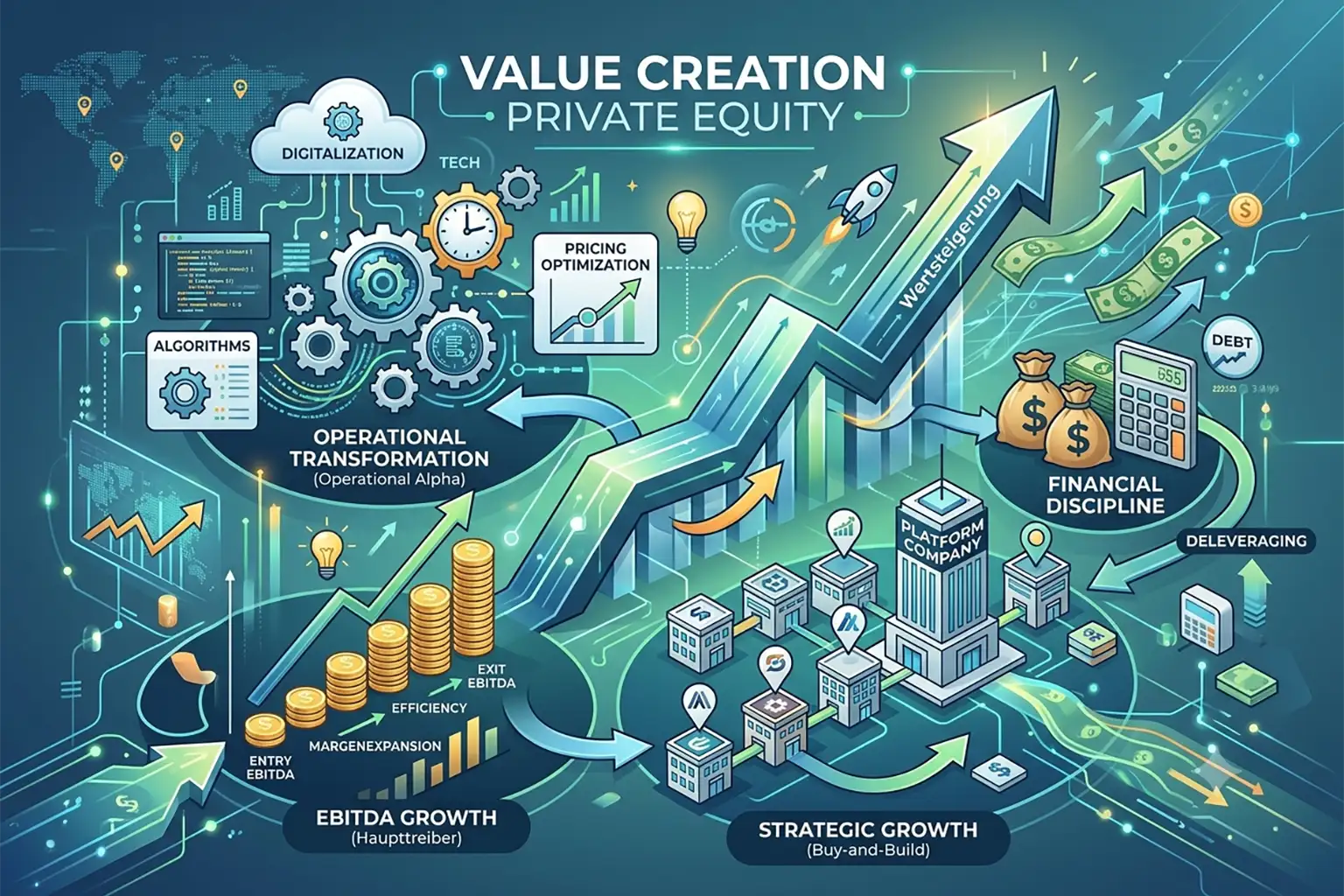
Unlike passive financial investments, this is an active value creation approach (active ownership). The aim is not to hope that the company will grow solely through general market trends. Instead, private equity funds use structured transformation programmes: they optimise existing business models, improve margins, develop new markets and systematically prepare the organisation for a profitable sale (exit) to a strategic buyer or follow-on investor.
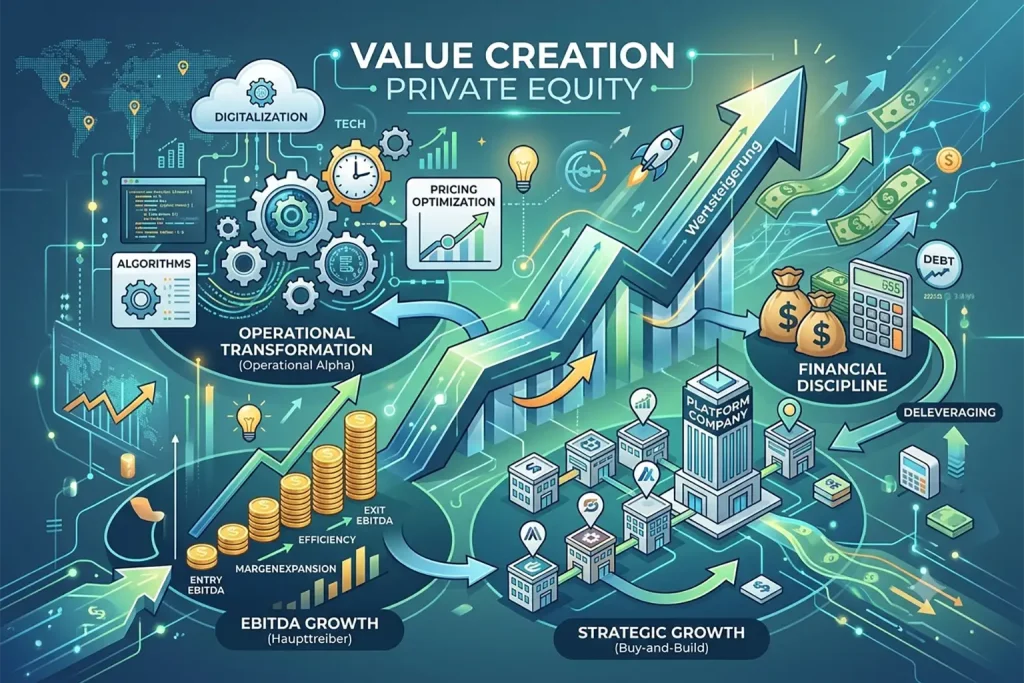
Value Creation consists essentially of three dimensions:
- Operational value creation: Tangible efficiency gains in day-to-day business – from B2B price optimisation and purchasing synergies to the reduction of lead times and inventory levels.
- Strategic value creation: realigning the company through buy-and-build acquisitions, international expansion and the divestment of unprofitable non-core areas.
- Financial discipline: professional cash flow management, continuous repayment of acquisition loans and transparent, data-driven metric systems.
The paradigm shift: why financial engineering alone fails
For many years, private equity followed a familiar pattern: a high proportion of debt (leverage) boosted the return on equity, while steadily rising market valuations (multiple expansion) ensured solid exit proceeds even with moderate operational performance. Cheap money masked inefficiencies.
„Anyone who still relies on rising valuation multiples and cheap loans is speculating – true value is only created where companies operate more effectively than they did before the investment.“
This environment has changed fundamentally. Higher base interest rates, more cautious bank lending and more challenging exit markets are forcing investors to rethink:
- Classic LBO phase (pre-2008):
- Primary yield driver: aggressive debt reduction and financial structuring
- Debt ratio: Typically 65 to 80 %
- Investment team focus: transaction management, tax structuring and leverage
- Low-interest-rate period (2010 to 2021):
- Primary yield driver: General market expansion and rising valuation multiples
- Debt ratio: 50 to 65 %
- Focus of the investment team: rapid sourcing, riding megatrends and multiple arbitrage
- Current market phase (from 2022 onwards):
- Primary yield driver: Operational margin and earnings improvement
- Debt ratio: Conservative 35 to 50 %
- Investment team focus: Close cooperation with management, operating partner, data-driven pricing models and platform consolidation
Successful investment firms therefore no longer see themselves as mere financial intermediaries. They act as experienced sparring partners who systematically develop portfolio companies with specialist expertise, process discipline and industry contacts.
The Hybrid Model: The Three Pillars of Modern Value Generation
The hybrid model combines the financial discipline of traditional investors with industrial and operational execution capabilities. Value creation is based on three main pillars:
- Pillar 1: Operational Excellence (Margin Expansion) – Realising direct return potentials through value-oriented pricing, stringent cash and working capital management, and bundled procurement.
- Pillar 2: Strategic growth and M&A – Accelerated expansion through buy-and-build concepts, opening up new foreign markets and rigorous divestment of unprofitable peripheral activities.
- Pillar 3: Tech, Data and ESG (multiple levers) – securing valuation premiums upon sale through transparent data architectures, modern ERP systems and credible ESG standards.
1. Operational Excellence (Margin Expansion)
- Value-based Pricing: In medium-sized businesses, historical cost-plus pricing still dominates. If prices are instead differentiated according to true customer value, condition models are streamlined and unprofitable orders are consistently renegotiated, this is reflected in the operating result without any significant delay.
- Working capital optimisation: Reducing the capital tie-up (cash conversion cycle) through targeted receivables management, extended purchasing payment terms and leaner inventory immediately frees up liquidity. This capital serves to reduce debt or finances acquisitions without additional shareholder funds.
- Procurement and overheads: Standard requirements such as IT licences, logistics services and insurance can be pooled across portfolio boundaries to secure large-customer rates. At the same time, legacy administrative structures are being streamlined.
2. Strategic growth and buy-and-build
- Platform strategy: A well-positioned company with a stable management team and viable IT serves as the nucleus, into which smaller competitors are successively integrated.
- Multiple Arbitrage: Smaller acquisitions are often significantly cheaper to buy than established platforms. If smaller competitors are acquired at, for example, 5x EBITDA and integrated into a platform that is valued at 10x upon exit, substantial value is created simply through this valuation uplift.
- Sales structure and go-to-market: Sales are being shifted from personal networks to scalable systems: clear pipeline management, CRM-supported lead generation and commission models that reward contribution margins rather than pure revenue.
3. Digital transformation and ESG as multiple levers
- Transparent data control: The creation of reliable dashboards ensures that key metrics such as customer churn, acquisition costs and contribution margins per product line are available in real time, instead of waiting months for financial statements.
- ESG as a value driver: sustainability in modern portfolio management is not a tick-box exercise, but has a direct impact on exit value. Buyers pay demonstrable premiums for companies with a transparent supply chain, energy-efficient production and robust governance, as this minimises future risks.
Would you like a brief consultation on this?


The Return Deconstruction: The PE-EBITDA Bridge
In order to provide a clear explanation of how capital appreciation has come about, investment professionals systematically break down the total return into its constituent parts.
The total increase in the value of equity is calculated as the difference between the value of equity at exit and the equity originally invested at the time of acquisition. It is calculated as the adjusted exit EBITDA multiplied by the exit multiple achieved, less the remaining net financial debt, compared with the same calculation at the time of the initial investment.
This increase in value can be broken down into three measurable factors:
- Operating impact (EBITDA growth): The net increase in operating profit between the point of entry and exit, valued using the original entry multiple. This item reflects the value created by the team through margin improvement and organic growth.
- Multiplier effect: The exit EBITDA achieved, multiplied by the change in the valuation multiple. This factor measures the extent to which the market values the company more highly at exit – whether due to changed market conditions, a leading market position or a strengthened equity story.
- Deleveraging effect: The difference between net debt at the beginning and at the end of the holding period. This shows how much debt the company was able to repay using its own resources via the generated free cash flow.
The Operational Cycle: From the 100-Day Plan to Exit
Operational value creation is not an ad-hoc process, but follows a fixed rhythm over the entire life cycle of the investment:
1. Pre-Signing: Operational Due Diligence (ODD)
Long before the completion of the transaction, the deal team evaluates the actual opportunities for improvement together with operational partners:
- Which margin potentials can be identified immediately in an industry comparison?
- Where is there scope for manoeuvre in terms of prices and terms and conditions?
- What investments in IT and management are essential to support the planned growth?
Day 2: Days 1 to 100 – Finalising the Value Creation Plan (VCP)
- Aligned interests: introduction of substantial equity participation programmes (sweet equity) to ensure management and investor are pulling in the same financial direction.
- Focus on a few initiatives: establishment of a maximum of three to five core projects for the first few months. Typically, value creation does not fail due to a lack of concepts, but rather due to staff overload.
- Binding tracking: Setting up a project management office (PMO) to monitor deadlines, milestones and cash flow impacts on a weekly basis with precision.
3. Transformation and add-ons (months 4 to 48)
- Rigorous implementation of sales, pricing and efficiency programmes.
- Targeted acquisition and swift integration of two to four smaller bolt-on companies.
- Standardisation of core systems (ERP, accounts, CRM) to capitalise on economies of scale.
4. Exit Readiness (6 to 12 months before exit)
- Sharpening the future story: Clear presentation of the next development phase for the successor (e.g., new regional market or additional service segment).
- Vendor Due Diligence (VDD): The early preparation of independent reports on finance, IT, legal matters and tax to rule out purchase price adjustments in the final negotiations.
Deep Dive: Operational B2B pricing as the strongest EBITDA lever
Among all the levers in the value creation plan, operating profit reacts most strongly to price optimisations. While cost reductions often require painful cuts and product development takes years, every additionally realised percentage point in price goes straight to the bottom line with practically no delay.
„Pricing is the most direct lever in the portfolio: every percentage point gained flows directly into operating profit, without any detours or delay.“
Particularly in owner-managed SMEs, one frequently encounters similar vulnerabilities: historically grown discount structures, blanket calculations and sales teams that shy away from price increases.
1. Analysis of the pocket price waterfall (closing margin leaks)
The first step is to identify the actual remaining profit per product and customer. A great deal of money is often lost between the official list price and the net proceeds (pocket price):
- Unverified special discounts and concessions granted as a gesture of goodwill without any consideration in return
- freight charges, small order surcharges and packaging costs borne by the company itself
- Hidden bonuses, discounts and end-of-year payments
- Costly additional services and customisations that are never charged to the customer
If this chain is broken down in detail, it quickly becomes apparent that so-called major customers often generate hardly any profit on balance, or even result in losses.
2. The 4-step pricing playbook for practical application
An experienced operating partner adopts a clear approach during the first few months:
- Step 1: Implement immediate measures (Months 1 to 2)
- Cacellation of non-contractual special discounts and enforcement of minimum order values.
- Introduction of clear surcharges for increased raw material, freight and energy costs.
- Step 2: Segment customer groups (months 2 to 3)
- Waiver of flat-rate price increases across the entire product range.
- Deliberate separation between interchangeable standard items and essential core products with high price acceptance.
- Step 3: Define binding approval processes (months 3 to 4)
- Definition of clear limits: Additional discounts may only be granted with the approval of sales management or the executive board.
- Introduction of simple calculation guidelines so that sales can see the margin impact directly when creating quotes.
- Step 4: Change sales compensation to contribution margins
- Variable salary components are no longer measured on pure turnover, but on the gross profit generated.
- Conducting practical negotiation training so that account managers lead price discussions confidently and with value-based arguments.
Experience shows that these measures can increase the operating margin in the portfolio by 150 to 300 basis points within 6 to 12 months – an effect that boosts the proceeds from the sale disproportionately.
Case study: Value enhancement of a medium-sized industrial supplier
The example of a traditional industrial company in the precision parts sector shows what the interlinking of these levers looks like in practice:
1. Initial situation upon entry
- Key figures: 60 million euros in revenue, 7.2 million euros EBITDA (12 % EBITDA margin).
- Valuation and financing: Investment at 8.5 times EBITDA, corresponding to a total enterprise value of 61.2 million euros. Financed with €30.6 million in bank loans (50 % LTV) and €30.6 million in equity from the fund.
- Challenges: Highly incumbent-centric leadership, rigid costing, fragmented purchasing with over 450 suppliers, and outdated IT without customer contribution margins.
2. Implementation of the value creation initiatives (5-year holding period)
- Year 1 (immediate lever): The cancellation of uncoordinated discounts and the introduction of material cost surcharges generated an EBITDA increase of 1.4 million euros. By reducing excessive safety stock, 3.8 million euros of liquidity was released and used directly for special repayments.
- Years 2 to 3 (buy-and-build): Acquisition of two regional competitors, each with 15 million euros in revenue and 1.5 million euros in EBITDA. Both acquisitions were completed at a valuation multiple of just 5.0x (multiple arbitrage). By centralising procurement, the cost of materials ratio fell by 2.1 percentage points.
- Year 4 (Digitisation and Sales): Introduction of a unified ERP and CRM system, alignment of sales commissions with gross profits and standardised quotation processes.
3. Outcome on sale (exit)
- Key figures at exit: Revenue rose to 115 million euros, and consolidated EBITDA grew to 18.4 million euros (a margin increase from 12 % to 16 %).
- Proceeds from sale: Thanks to a leading market position, streamlined organisation and standardised IT, an international strategic buyer acquired the company for 11.0 times EBITDA.
- Total financial result:
- Total value upon sale: €202.4 million
- Remaining debt: Reduced to 12.0 million euros thanks to strong cash flow
- Realised equity value: €190.4 million
- Fund return: The 30.6 million euros of equity invested grew to 190.4 million euros. This corresponds to more than 6.2 times the invested capital (MoIC) with an annual return (IRR) of over 40 %.
This practical example illustrates that the lion's share of the value growth was not generated by passive market movements, but through measurable operational improvements in sales, purchasing and portfolio expansion.
Typical pitfalls in portfolio practice
Even experienced teams encounter typical hurdles during implementation if the practical side is underestimated:
- Smartarse behaviour instead of partnership: when operating partners act as a controlling authority and patronise the managing director, management loses motivation. Good partners work as supporters, not as substitute managing directors.
- Bolt-on acquisitions without real integration: companies are formally acquired, but remain in separate silos with duplicate administration and their own software systems. The synergies fizzle out.
- Hesitation in personnel decisions: If a manager does not match the requirements of the growth phase, shareholders often wait 12 to 18 months too long before making a change. This loss of time can scarcely be made up for within a limited holding period.
- Lack of sustainability in one-off effects: cost reductions are celebrated, but are not anchored in processes. If a buyer scrutinises the figures carefully before an exit, they immediately strip these profits out of the valuation.
Conclusion and outlook: Value creation in private equity
Value creation in private equity is no longer just a question of gut feeling, but requires a methodical approach. Anyone wanting to generate reliable returns for their investors in times of normalised interest rates must develop companies further at their core.
Successful private equity funds therefore continuously build up their own capabilities – from pricing experts and digitalisation specialists through to integration teams for acquisitions. The final exit proceeds are not decided in the final rounds of negotiation before the exit, but are generated through disciplined, hands-on work on every single day of the investment.
Frequently Asked Questions (FAQ) on Value Creation in Private Equity
What distinguishes financial engineering from operational value creation?
Financial engineering relies on capital leverage, high debt financing and favourable market phases upon resale. Operational value creation, on the other hand, tackles day-to-day business: accelerating processes, negotiating purchasing prices, making customer relationships more profitable and strategically expanding the company through acquisitions.
What specific role does an operating partner have?
An operating partner brings their own industry or consulting experience and supports the portfolio company's management team with the practical implementation of the development plan. They do not intervene in day-to-day operations, but manage key projects, resolve bottlenecks and act as a bridge between the executive board and the investment team.
How is profit generated through multiple arbitrage in buy-and-build?
Smaller companies are often available on the market at significantly lower prices than large platforms. If a fund buys a smaller competitor for 5x EBITDA and integrates it into its core business, this acquisition is valued at the higher platform multiple (for example, 10x or 11x) upon the subsequent sale of the whole. The resulting valuation uplift flows directly into the return.
What does the 100-day plan (Value Creation Plan) regulate?
The 100-day plan bundles the most important immediate measures right after onboarding. It sets out responsibilities, deadlines and budgets for the most important three to five projects so that the momentum of the transaction seamlessly translates into concrete operational improvements.
Why is price optimisation considered the fastest lever for return on investment?
Price adjustments usually require neither long lead times nor expensive investments. If, for example, a company with a 10 % operating margin successfully raises its realised prices by just 2 % without losing customers, its operating profit increases mathematically and immediately by 20 % while the cost base remains the same.