


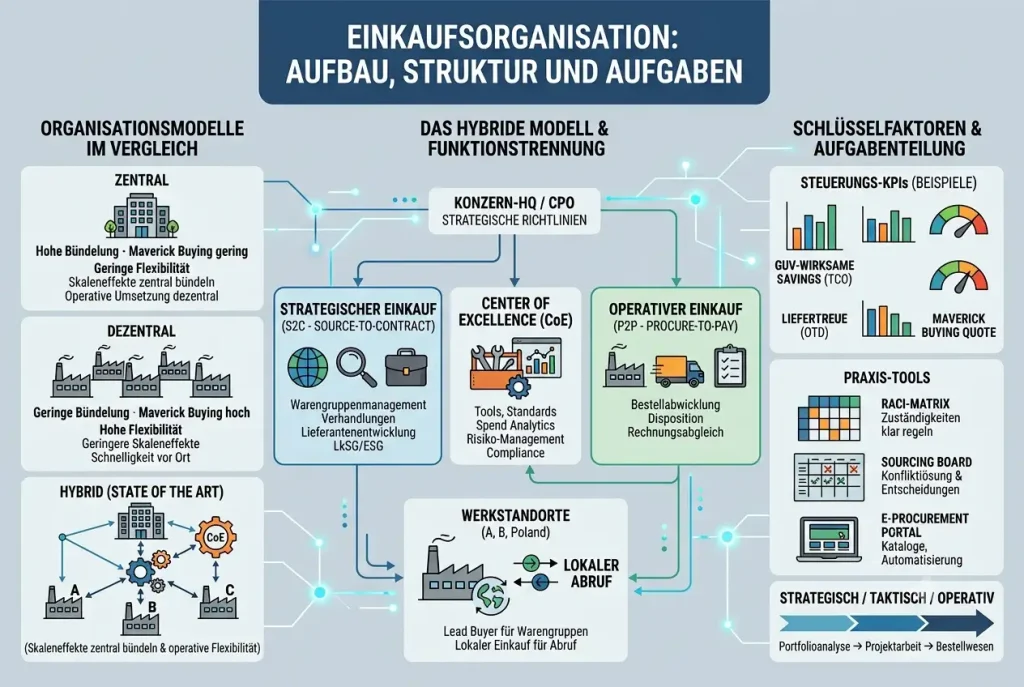
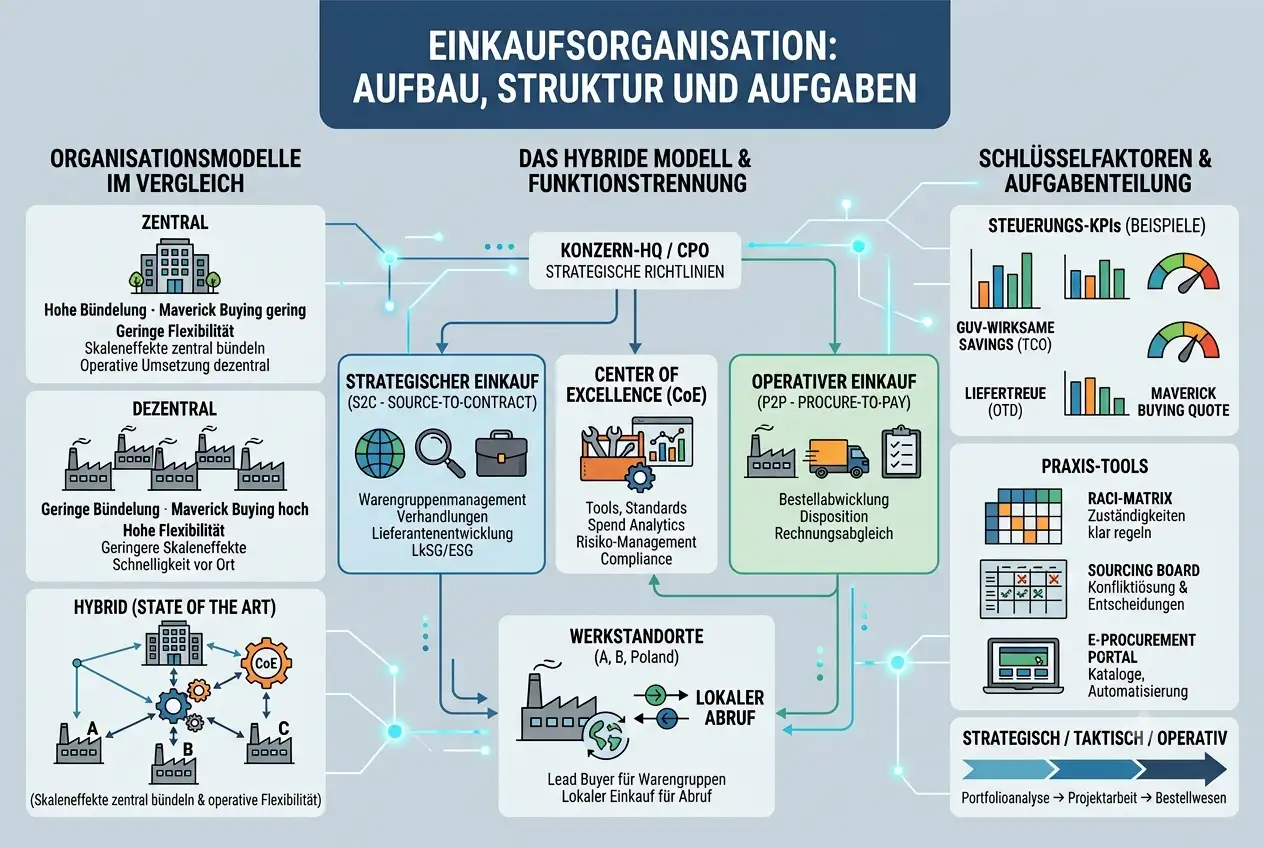
Key facts about the purchasing organisation
- Definition: Binding organisational framework (roles, processes, approvals and interfaces) for the company-wide procurement of direct and indirect goods and services.
- Best-practice model: The hybrid model (matrix/lead buyer) minimises goal conflicts by centrally pooling economies of scale while leaving operational implementation decentralised.
- Strict separation of duties: Clear division between strategic purchasing (source-to-contract: commodity groups, negotiations, supplier development) and operational purchasing (procure-to-pay: order processing, inventory management, invoice matching).
- Management KPIs: P&L-effective savings (TCO analysis), maverick buying rate, on-time delivery (OTD) and the degree of automation (e.g. no-touch rate for C items).
1. Definition and strategic importance of the purchasing organisation
„Anyone who views purchasing purely as operational order processing is burning cash and risking the ability to deliver – true value creation only happens where procurement operates on an equal footing with executive management.“
In competitive markets, the deciding factor is purchasing structure largely via the operating margin. Three objectives are central here:
- Measurable cost reduction & TCO: Consistent negotiation of total cost of ownership instead of pure purchase prices, as well as reduction of process and transaction costs.
- Risk minimisation & resilience: Targeted avoidance of single-sourcing dependencies and securing robust supply chains during bottlenecks.
- Legal certainty & compliance: Compliance with regulatory requirements (incl. Supply Chain Due Diligence Act / LkSG, ESG criteria and CSRD reporting obligations).
2. The three organisational models in direct comparison
Companies choose their procurement model primarily on the basis of site distribution, product complexity and homogeneity of purchasing volumes.
Central purchasing
- Place of decision: Headquarters / Central purchasing management
- Negotiating power: Maximum, as all volumes are pooled at one table
- Reaction speed: Rather sluggish due to standardised approval workflows
- Maverick Buying: Very low thanks to uniform authorisation hurdles
- Suitability: Ideal for single-site businesses or companies with a highly homogeneous material requirement
decentralised procurement
- Place of decision: Directly in the individual plants or foreign subsidiaries
- Bargaining power: Low; locations operate in the market in isolation
- Reaction speed: Very high thanks to short consultation channels directly at the workbench
- Maverick Buying: High; departments frequently make rogue purchases
- Suitability: Useful for entirely self-sufficient business areas or extremely location-specific special needs
Hybrid shopping (state of the art)
- Place of decision: strategy and negotiation central, operational call-off decentralised
- Negotiating power: Very high through worldwide commodity group pooling
- Reaction speed: High, as local teams manage day-to-day business independently
- Maverick Buying: Minimised through closed catalogue systems and defined framework agreements
- Suitability: The standard for growing medium-sized enterprises and multi-site corporations
3. Focus: The hybrid model (lead buyer and centre of excellence approach)
The hybrid model resolves the classic dilemma between proximity to the plant and corporate purchasing power via a matrix structure.
The lead buyer concept
In this context, the location with the greatest demand or the deepest technical know-how assumes group-wide leadership for a specific product group (e.g. Plant A for drive technology, Plant B for operating supplies):
- Role of the Lead Buyer: market analysis, global tenders, price and contract negotiations, and supplier qualification for the respective commodity group.
- Role of local purchasing: pure call-off from negotiated framework agreements, ensuring on-time delivery and direct feedback on supplier performance to the lead buyer.
Structural design of the hybrid organisation:
- Head of Procurement / CPO: Overall strategy, target setting and budget responsibility.
- Centre of Excellence (Staff Unit): Provision of software tools, group-wide spend analytics, legal templates and process standards.
- Lead Buyer (e.g. Site A): commodity group strategy, pooling of requirements from all sites and conducting framework agreement negotiations.
- Operational Buyer (Locations A, B and C): local call-off orders, claims processing at the plant and operational interface to production.
The Centre of Excellence (CoE)
The CoE relieves procurement of routine tasks and ensures standards:
- Introduction and support of e-procurement systems and automated approval workflows.
- Creation of valid spend dashboards and supplier scorecards.
- Monitoring of statutory documentation obligations (e.g. LkSG audits, sanctions list checks).
Would you like a brief consultation on this?

4. Deep Dive: Governance, Role Allocation and RACI Matrix in Practice
In the matrix organisation, plant interests and global cost-saving targets inevitably collide. A buyer who has a disciplinary reporting line to the plant manager, but a functional reporting line to the lead buyer, quickly falls between two stools. Clear guardrails prevent friction losses.
RACI matrix for clear responsibilities:
- Category strategy & sourcing: The lead buyer makes the binding decision (Accountable / Responsible). Local buyers and engineering contribute requirements (Consulted). Management is informed about the outcome (Informed).
- Contract Conclusion & Pricing: Lies solely with the Lead Buyer (Responsible / Accountable), supported by the CoE for standard legal clauses (Consulted).
- Local call-off order: Local buyer manages independently (Responsible / Accountable). Lead buyer sees aggregated figures in reporting (Informed).
- Complaints: Local quality assurance records defects (Responsible), CoE enters the data into the group-wide supplier rating (Accountable).
Binding value limits in everyday life:
- Up to €5,000 (catalogue requirements): Direct ordering by authorised employees via e-catalogues (punch-out). No manual involvement of strategic procurement.
- €5,000 to €50,000 (local sourcing): the local buyer invites tenders, but may only select from the supplier pool approved by the lead buyer.
- From €50,000 (strategy reservation): Mandatory handover to the lead buyer for tender, negotiation and executive board approval.
Conflict resolution via the sourcing board:
If a plant manager habitually pushes for a more expensive local supplier, a neutral sourcing board (CPO, CoE leadership, affected plant manager) makes the decision. The criteria applied are exclusively overall cost-effectiveness (TCO) and security of supply – with no personal preferences involved.
5. Division of Labour: Strategic, Tactical and Operational
Only those who free strategic thinkers from operational paperwork can fully exploit leverage in the procurement market.
Strategic Procurement (Source-to-Contract / S2C)
- Category management: portfolio analysis (e.g. Kraljic matrix), development of procurement strategies per commodity group.
- Supplier management: Targeted selection, strategic negotiation, annual reviews and building development partnerships.
- Contract management: Long-term framework agreements, bonus tiers, index clauses and hedging against currency risks.
Tactical purchasing (interface)
- Processing of one-off, site-specific requirements (machine investments, specific maintenance work).
- Supplier comparisons for projects within existing framework agreements.
- Liaison between internal requestors (R&D, maintenance) and external suppliers.
Operational Purchasing (Procure-to-Pay / P2P)
- Review and conversion of purchase requisitions (PR) into purchase orders.
- delivery date monitoring, order confirmations and dunning.
- Resolution of price, quantity and invoice discrepancies between the factory gate and accounting.
6. Guideline: Step-by-step development or restructuring of the purchasing organisation
The realignment of an existing procurement structure can be achieved in five pragmatic steps:
- Create spend transparency: Cleanse all expenditure from the last 12–24 months by commodity group, supplier and location. Ruthlessly uncover non-transparent expenditure („maverick buying“).
- Determine organisational model: define thresholds, designate lead buyers and establish competencies in a RACI matrix.
- Establishing digital tools: sharpening ERP approval processes, rolling out catalogue systems for C-parts and dismantling manual interfaces.
- Involve departments: integrate engineering, production and IT at an early stage. Purchasing must act internally as a problem solver, not as a bureaucratic control authority.
- Measuring success: introduce meaningful KPI reporting (hard P&L savings, degree of automation, on-time delivery) and review it monthly with management.
7. Practical example: Transformation to a hybrid procurement organisation in the SME sector
Initial situation: A medium-sized special-purpose machinery manufacturer (€280m annual turnover) operates three locations in Germany and Poland. Previously, each plant purchased completely autonomously.
- The core problem: identical standard parts, steel beams and pneumatic components were ordered from the same suppliers – with price differences of up to 18 % between the plants. The maverick buying rate stood at 22 % because skilled workers were purchasing screws and tools locally without authorisation.
The realignment:
- Lead Buyer appointed: Plant A, as the largest consumer, is consolidating the steel/semi-finished products commodity group, Plant B is taking over electronics and sensor technology, and Plant C is managing logistics, packaging and indirect requirements.
- CoE established: A two-person team at headquarters took over group-wide spend reporting and standardised purchasing contracts.
- Catalogue solution rolled out: C-items up to £5,000 have been moved to a standardised e-procurement portal.
Result after one financial year:
- Net saving: 6.8 % sustainable overall cost reduction across all bundled product groups.
- Discipline: The rate of uncontrolled orders fell from 22 % to below 4 %.
- Speed: The operational lead time for a routine order fell from four days to under two hours.
8. Conclusion: Success factors of the modern purchasing organisation
„Even the most powerful procurement strategy is rendered ineffective in day-to-day business if local sites lack the rulebook or purchasing is perceived as a toothless paper tiger.“
A successful purchasing organisation rests upon three indispensable pillars:
- Clear governance: local teams need leeway for day-to-day business, but must strictly adhere to the lead buyer's contracts when it comes to strategic items.
- Consistent digitalisation of routine processes: standard procurement must run largely touchlessly (no-touch PO) via catalogues. This gives buyers the freedom for hard negotiations and strategic supplier management.
- Looking beyond the purchase price: negotiation success today is measured by security of supply, contractual flexibility and collaborative development – no longer solely by the short-term discount on the invoice.
Those who properly balance corporate purchasing power and local agility through the hybrid model turn procurement into a reliable profit and stability factor for the entire business.
9. Frequently Asked Questions (FAQ) regarding the purchasing organisation
How does direct procurement differ organisationally from indirect procurement?
Direct procurement sources raw materials, auxiliary materials, operating supplies, and assemblies that go directly into the end product. It works hand in hand with production, engineering, and the supply chain. Indirect procurement sources goods and services that keep business operations running (e.g. IT infrastructure, marketing agencies, vehicle fleets, tools). Here, the focus is on automated catalogues and lean approval processes.
What is maverick buying and how can it be effectively prevented?
Maverick buying refers to the unauthorised purchasing of goods directly by departments, bypassing official procurement. The consequences are missed discounts, unmanaged liability risks and duplicated administrative effort. Remedies include clear approval limits in the ERP system, user-friendly ordering catalogues for employees and the strict directive from financial accounting no longer to approve invoices without a valid purchase order (PO) number.
At what company size is it worth switching to a hybrid procurement model?
Generally from two to three operational locations and an external purchasing volume of around 20 to 30 million euros. As soon as locations negotiate independently with the same suppliers or noticeable pooling advantages remain unutilised, the implementation costs of the lead-buyer model usually pay for themselves within the first year.
What tasks does the Centre of Excellence (CoE) undertake in day-to-day procurement?
The CoE acts as an internal service and methods centre. It relieves operational and strategic buyers of time-consuming special tasks: it operates the software platforms, analyses spend data, monitors supply chain risks, standardises contract templates and ensures that legal requirements such as the Supply Chain Due Diligence Act (LkSG) are properly documented.
How are conflicts between local plant managers and global lead buyers resolved?
Through clear value thresholds and a binding arbitration body (Sourcing Board). If a plant manager wants to deviate from a central framework agreement for regional reasons, they must justify this special approach to the board using objective total cost of ownership (TCO) and risk criteria. Personal preferences or long-standing habits are thus neutrally reined in.