


Key facts about supplier tenders in procurement
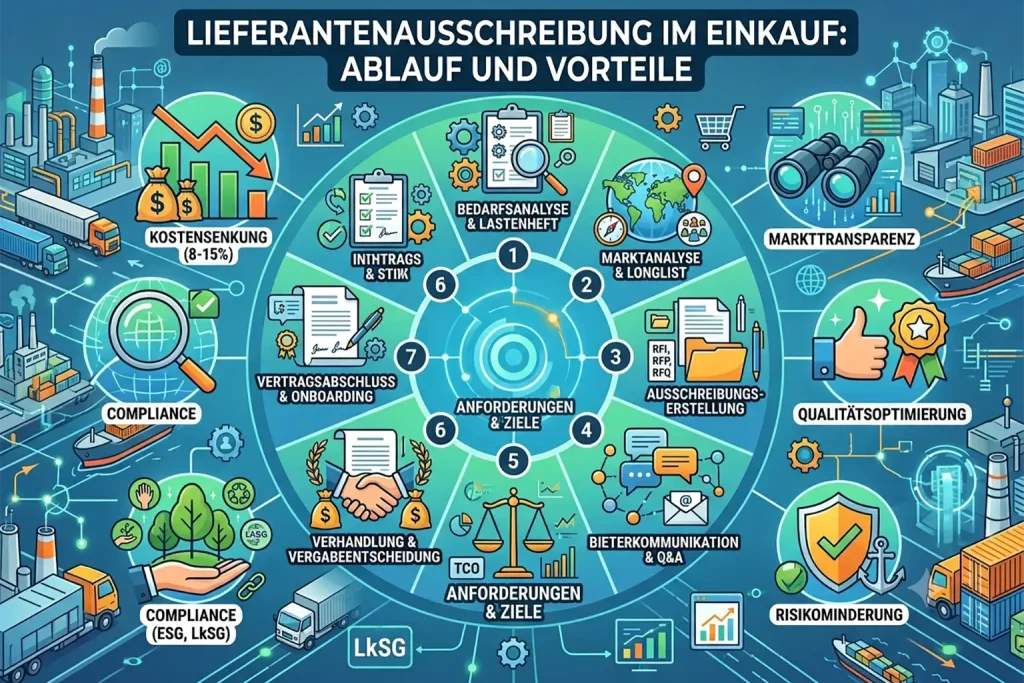
- Typical saving: 8 to 15 % direct savings potential; up to 25 % lower process costs through e-sourcing tools
- Lead time: 4 to 12 weeks (heavily dependent on product group and technical complexity)
- Three core formats: RFI (Request for Information) → RFP (Request for Proposal) → RFQ (Request for Quotation)
- decision criterion: total cost analysis based on the TCO principle rather than a pure focus on the unit price
- Success factor number 1: a fully defined evaluation matrix with weighting before opening the first bids
- Compliance focus: Mandatory knockout criteria for ESG, IT security and requirements under the Supply Chain Due Diligence Act (LkSG)
1. What is a supplier tender? Definition and differentiation
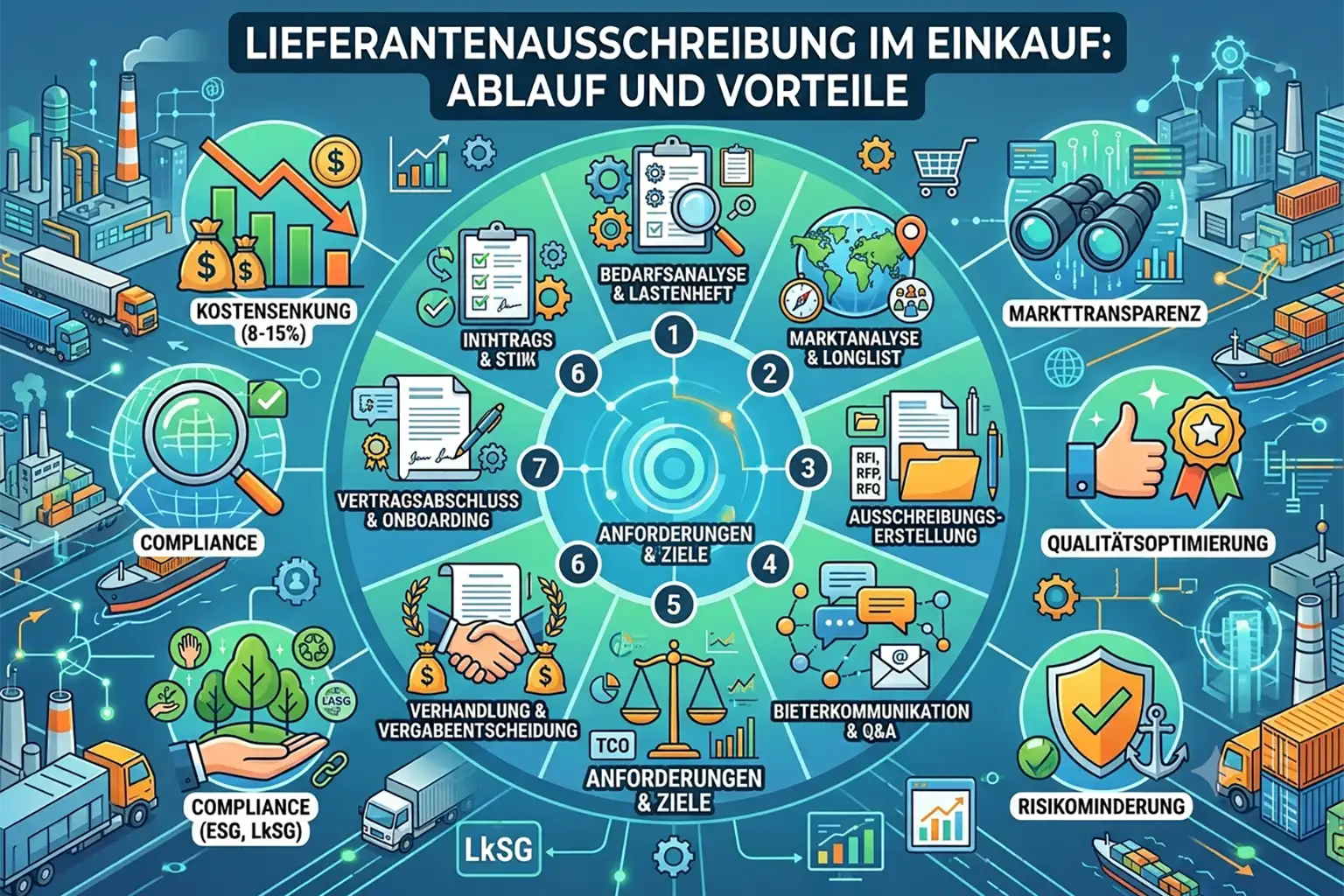
In strategic procurement, this is about far more than quick price comparisons. Regular tenders are the most effective tool for actively testing markets, breaking up comfortable monopolies held by regular suppliers, and contractually establishing clear service level agreements (SLAs).
RFI, RFP and RFQ: An overview of the three tools
Depending on the level of market knowledge and the maturity of your own requirements, three different instruments are used:
- Unclear market / rough requirement: RFI (Request for Information) → Market consultation and qualification
- Open / complex methodology: RFP (Request for Proposal) → Concepts and proposed solutions
- Specification precisely defined: RFQ (Request for Quotation) → Binding prices and terms
- RFI (Request for Information): Used for initial market exploration. Here, purchasing requests general company data, manufacturing capacities, locations and certifications. The goal is to narrow down a broad longlist of market participants to a manageable shortlist.
- RFP (Request for Proposal): Used for complex projects for which there is no ready-made internal blueprint yet (for example, software implementations, logistics concepts, or outsourcing projects). Bidders enrich their proposals with individual solution concepts and rough cost estimates.
- RFQ (Request for Quotation): The classic price enquiry. Based on precise specifications or technical drawings, buyers request binding tiered prices, tooling costs, payment terms and delivery times.
2. Why run a tender? The 6 key benefits for procurement
A cleanly prepared tender ties up internal capacity. Properly set up, however, this effort almost always pays for itself within the first year of procurement.
1. Verifiable cost reduction and TCO transparency
Direct competitive bidding reliably ensures market-standard conditions. The decisive factor here is the focus on the Total Cost of Ownership (TCOA well-founded tender does not only compare the net purchase price at the loading bay, but also takes into account packaging costs, transport routes, customs clearance, payment terms, risk surcharges and any tooling costs.
2. Creation of genuine market transparency
Anyone who has been ordering from the same supplier for years loses touch with the market. A tender brings to light how capacities, raw material surcharges, new manufacturing processes and the general price level have developed in the competitive environment.
3. Quality and performance optimisation
Through the specification document, purchasing defines binding key performance indicators: maximum scrap rates, guaranteed delivery times, availability levels and escalation paths. Suppliers must confirm these parameters in their quotation – this provides an effective way to correct outdated contracts with vague performance commitments.
4. Risk diversification and dual sourcing
One-sided dependencies on individual suppliers (single sourcing) quickly develop into an operational risk in volatile times. Tender processes create the data basis needed to build targeted dual- or multi-sourcing strategies, secure back-up capacity, and harden the supply chain against disruptions.
5. Compliance, ESG and LkSG Security
Legal requirements such as the Supply Chain Due Diligence Act (LkSG) or European directives (CSDDD) require proof of environmental and social standards along the entire supply chain. Procurement can embed codes of conduct (Supplier Code of Conduct), carbon footprints and certificates (such as ISO 14001 or EcoVadis) directly as mandatory knock-out criteria in the tender process.
6. Objectivity and Audit Trail Security
A structured cost-benefit analysis removes gut feeling from procurement decisions. This protects purchasing from accusations of favouritism and provides comprehensive documentation that withstands internal audits, specialist departments and executive management.
„Anyone who focuses solely on the price when purchasing loses sight of the total costs. True cost-effectiveness only becomes apparent in the smooth interplay of quality, reliability and cooperative partnership.“
3. The 7-phase process of a successful supplier tender
Anyone who goes through the phases in a structured manner saves time during negotiations and avoids costly variations after the contract has been signed:
Phase 1 (Needs Analysis) → Phase 2 (Market Analysis) → Phase 3 (Tender Preparation) → Phase 4 (Bidding Phase & Q&A) → Phase 5 (Bid Evaluation) → Phase 6 (Negotiation & Award) → Phase 7 (Contract & Onboarding)
Phase 1: Requirements analysis and specification of requirements
Before the market launch, internal coordination is required:
- Involving stakeholders: engineering, manufacturing, quality management, logistics and the legal department must be brought to the table.
- Locking in volumes: processing historical data and rejecting realistic volume structures for the contract term (usually 12 to 36 months).
- Drafting a specification: Clearly describe what the product or service must be able to do (quality grades, tolerances, interfaces, standards). Important: do not restrict the solution path unnecessarily, in order to allow room for innovative supplier approaches.
Phase 2: Market analysis and longlist definition
Systematic recording of potential sources of supply:
- Research: Screening via supplier databases, industry networks, trade fairs and existing purchasing networks.
- Compile a longlist: identification of roughly 10 to 20 fundamentally suitable vendors.
- Pre-selection (screening): Credit checks (Creditreform, Dun & Bradstreet) and rough capacity checks reduce the field to a strong shortlist of 4 to 8 bidders.
Phase 3: Preparation and dispatch of the tender documents
Only precise tender documents lead to directly comparable bids:
- Non-disclosure agreement (NDA): Strictly required prior to the release of engineering drawings or business-critical data.
- Cost Breakdown Template: A standardised template in which bidders must separately itemise material costs, production times, machine hourly rates, freight, and packaging.
- Contract terms: Our own purchasing T&Cs and the draft of the intended framework agreement belong directly in the package.
- Schedule: Clear deadlines for queries, submission dates and negotiation appointments create commitment.
Phase 4: Bidder communication and tender phase
During the bidding period (usually 2 to 4 weeks), strict equal opportunities apply:
- A single point of contact: All queries go exclusively through the responsible buyer or the sourcing tool.
- Anonymised Q&A catalogue: If a bidder asks a technical question, all other bidders receive the question and the answer – without any mention of the sender.
- Meeting deadlines: Tenders received after the deadline will be systematically excluded. The opening of tenders should ideally be carried out using the four-eyes principle.
Phase 5: Tender evaluation and utility analysis
The tenders are checked for completeness and conformity. For the overall evaluation, a weighted scoring model is recommended:
- Cost (TCO): 40 % weighting (unit price, cash discount, payment terms, logistics costs, incidental costs; maximum 40 points)
- Quality & Technology: 25 % weighting (compliance with specifications, scrap and complaint rates, quality certificates; maximum 25 points)
- Delivery reliability: 15 % weighting (lead times, safety stocks, proximity to location, emergency concepts; maximum 15 points)
- ESG & Compliance: 10 % weighting (sustainability certificates, LkSG questionnaire, working conditions, Code of Conduct; maximum 10 points)
- Service and flexibility: 10 % weighting (key account support, EDI capability, complaint response times; maximum 10 points)
- Overall rating: 100 % (maximum 100 points)
Phase 6: Negotiation, e-auction and award decision
The top two or three bidders in the scoring are heading into the final round:
- Negotiations: Targeted renegotiation of individual cost components based on the cost breakdown, optimisation of payment terms and buffer stocks.
- Electronic auction (e-auction): An effective tool for standardized, well-specified parts to transparently determine the final market price through a competitive bidding process.
- Sourcing Decision: Finalisation of the contract award recommendation for management or the sourcing board.
Phase 7: Contract Conclusion and Supplier Onboarding
Following the contract award, operational implementation begins:
- Sign contract: Finalise framework agreement, quality management agreement (QMA) and price escalation clauses.
- Onboarding: entering master data into the ERP, testing interfaces (such as EDI), and processing initial sample inspection (FAIR / PPAP).
- Rejections with feedback: Rejecting unsuccessful bidders promptly, appreciatively and with constructive reasoning – that keeps the door open for future rounds.
Would you like a brief consultation on this?


4. Traditional tendering vs. e-sourcing compared
Still, many procurement departments manage tenders manually via email and spreadsheets. Dedicated Sourcing Platforms (for example Coupa, SAP Ariba, Jaggaer or modular SME tools) offer clear operational benefits:
- Transparency & Revision:
- Manual: Email mailboxes are disorganised; versions get mixed up, and auditability is poor.
- E-Sourcing: Complete digital audit trail for all bids, questions and processing steps; tamper-proof and secure against manipulation.
- Data consolidation:
- Manual: Quotations have to be copied together by hand from PDF files and Excel spreadsheets – high risk of errors.
- E-Sourcing: Automated price and service comparisons at the touch of a button, standardised variance reports.
- Lead time:
- Manual: High coordination effort, time-consuming follow-up rounds, lengthy cycles.
- E-Sourcing: Up to 40 to 50 per cent shorter lead times through automated deadline and bidder management.
- Bidder management:
- Manual: From five suppliers onwards, the workload increases exponentially.
- E-Sourcing: Scalable; 15 or 20 bidders can be managed with the same effort as three.
- Compliance security:
- Manual: Risk that bidders have unequal access to information or that deadlines are tacitly extended.
- E-sourcing: standardised deadlines via the system, anonymised Q&A modules and time-controlled bid openings.
5. Deep Dive: AI-assisted tenders and automated proposal analysis
Artificial intelligence is fundamentally transforming tender processes. While e-sourcing has previously been primarily about distributing forms digitally, machine learning and modern language models (LLMs) are now deeply involved in content review and decision support.
Automated specification matching and requirements check
Manually reviewing complex service specifications takes days, sometimes weeks:
- Semantic analysis: algorithms scour offers in free-text or PDF format and automatically match them against the specifications.
- Deviation check: If a supplier alters a tolerance in the small print, uses an alternative material or shortens warranty periods, the system immediately highlights this discrepancy in colour.
- Data harmonisation: Unstructured quotes from various sources are automatically converted into standardised cost grids.
AI-powered should-cost modelling
Instead of merely comparing who is the cheapest among the bidders, AI determines the mathematically fair price:
- Bottom-up calculation: Algorithms use global commodity market prices, regional machine hourly rates and current energy costs to determine what a turned part or an assembly should realistically cost to manufacture (clean sheet).
- Detecting outliers: If a bidder exhibits unusually high setup costs, exorbitant freight flat rates or suspicious similarities to competing bids, the system raises the alarm.
Optimisation of procurement scenarios
When it comes to tender processes involving dozens of works and hundreds of individual items, spreadsheets reach their limits:
- Combinatorial awarding: Sourcing algorithms calculate the most cost-effective split-awarding solution (approximately 70 % primary supplier, 30 % secondary supplier) in fractions of a second while complying with minimum order values, freight limits and capacity limits.
- Negotiation guides at the touch of a button: the systems identify weak points in supplier cost calculations and provide buyers with concrete lines of argument for the negotiation meeting.
Human and algorithm working together
AI does not replace the negotiator in procurement, but rather takes over repetitive checking steps (augmented sourcing). The evaluation of strategic supplier relationships, business risks and the personal negotiation conclusion remain firmly in the hands of experienced buyers.
6. Practical example: Successful retendering in medium-sized mechanical engineering
The fact that the methodology also works for medium-sized industrial enterprises is demonstrated by the example of a special-purpose machinery manufacturer with an annual volume of 4.5 million euros in the CNC turned and milled parts product group.
The initial situation
The company had been purchasing around 240 different components from two regional suppliers for nearly seven years. There was de facto single-sourcing for the respective product families. The consequences:
- Cumulative price increases of 18 per cent within three years with a blanket reference to energy and raw material costs.
- A drop in delivery reliability to 76 per cent, which regularly led to delays in final assembly.
- No binding service agreements, no quality agreements, no index-linked clauses.
The execution of the project
Purchasing formed a project team with representatives from design and production management:
- Phase 1 & 2 (Clustering & Market Scan): The 240 items were grouped into four manufacturing families by materials and dimensions. A longlist of 14 suppliers from Germany, Austria and Eastern Europe was drawn up.
- Phase 3 & 4 (RFQ with Cost Breakdown): All bidders received a standardised template with the mandatory requirement to show raw material, manufacturing hourly rates, setup costs and coatings separately. Eight suppliers submitted on time.
- Phase 5 & 6 (TCO calculation & negotiation): The team factored in transport costs and payment terms and requested a consignment warehouse. The detailed cost breakdown revealed: The two main suppliers charged around 30 percent more than the market average for machine hourly rates.
The result after 10 weeks
- Cost reduction: 11.2 per cent total savings based on the commodity group volume (around 504,000 euros per year).
- Risk minimisation: Introduction of a 70/30 split between a high-performing new supplier from Eastern Europe and the incumbent supplier willing to negotiate.
- Availability: Establishment of a consignment warehouse for fast-moving items at the main site; reduction of replenishment time from eight weeks to 48 hours.
- Process quality: Introduction of contractual penalties for delayed delivery and transparent raw material price escalation clauses. On-time delivery rose back to 96 percent within six months.
7. The 5 most common mistakes in the tendering process (and how to avoid them)
- Inaccurate or over-regulated specification:
- Vague descriptions lead to massive risk margins from bidders; overly detailed specifications exclude proven standard solutions.
- Solution: Functional tendering: Precisely define the desired outcome and performance requirements, but do not unnecessarily restrict the technical solution path.
- The pure focus trap on the unit price:
- The supposedly cheapest supplier ends up causing the highest overall costs due to poor packaging, rework, delayed deliveries or expensive setup costs.
- Solution: Establish a consistent TCO calculation as a binding benchmark for the award decision.
- Deficient internal interface coordination:
- Purchasing concludes contracts that bypass the practical requirements of manufacturing or quality assurance. The consequence is maverick buying.
- Solution: Cross-functional sourcing teams: Involve specialist departments on a mandatory basis right from the requirements specification stage.
- Lack of respect for bidders (sham tendering):
- Invitations to tender are only drawn up to put pressure on the incumbent supplier, even though it has long been decided internally that there is no intention to switch.
- Solution: Maintain fairness in the market. Bidders invest a lot of time and money in well-founded bids. If it gets around that a company is running sham tenders, good suppliers will stay away from future rounds.
- Missing price escalation clauses in volatile markets:
- Problem: Rigid fixed prices lead to renegotiation chaos or insolvencies on the supplier side when raw material and energy costs rise.
- Solution: Transparently link major cost blocks (metals, plastics, energy) to official market indices via mathematical price adjustment clauses.
8. Conclusion: Tenders as a strategic value driver
A well-run supplier tendering in procurement is far more than a price reduction measure. It serves as a strategic lever to bring external innovation into the company, seamlessly secure regulatory obligations such as the Supply Chain Due Diligence Act (LkSG) and ESG, and make supply chains resilient.
Procurement organisations that structure their tender processes through phase discipline, traceable TCO assessments and modern digital tools create sustainable contributions to results and reliably secure their supply in volatile markets.
„A professional tender is not an instrument of distrust towards suppliers, but rather the fair benchmark for mutual excellence and sustainable competitiveness.“
9. FAQ: Frequently Asked Questions regarding the Supplier Tender
When should a supplier tender be carried out?
A tender is always sensible when existing framework agreements expire (usually every two to three years), new product launches are pending, or sudden volume increases are recorded. Further triggers are insufficient delivery reliability, poor quality from the incumbent supplier, and significant market price shifts for raw materials.
What is the difference between a specification of requirements and a requirements specification?
The user requirements specification is drawn up by the client (procurement together with the business units). It describes all the requirements, standards and general conditions – in other words, what is to be supplied. The functional specification is the supplier's response. It describes in detail how and by what means the provider intends to implement the requirements.
How many bidders should be invited to a tender?
For the pre-qualification (RFI/longlist), 10 to 15 suppliers is a solid guideline. For the actual bidding phase (RFQ), a shortlist of 3 to 6 bidders has proven effective. This ensures intense competition without driving up the internal evaluation effort for the procurement team to an uneconomical level.
How is the Supply Chain Due Diligence Act (LkSG) integrated into the tender process?
The requirements are already anchored in the pre-qualification questionnaire (RFI) via mandatory questionnaires on environmental, labour and human rights standards. In addition, the company's Supplier Code of Conduct is made a non-negotiable part of the contract. Bidders who refuse to meet minimum requirements are directly excluded via a knock-out criterion.
From what procurement volume is a structured tender worthwhile?
As a rule of thumb: from an annual product group volume of approx. 50,000 to 100,000 euros or in the case of strategically mission-critical components (A and B goods), the benefits achieved clearly outweigh the personnel effort of a structured tender. For small-scale C-items, simplified 3-quote comparisons or electronic catalogue systems are recommended.