


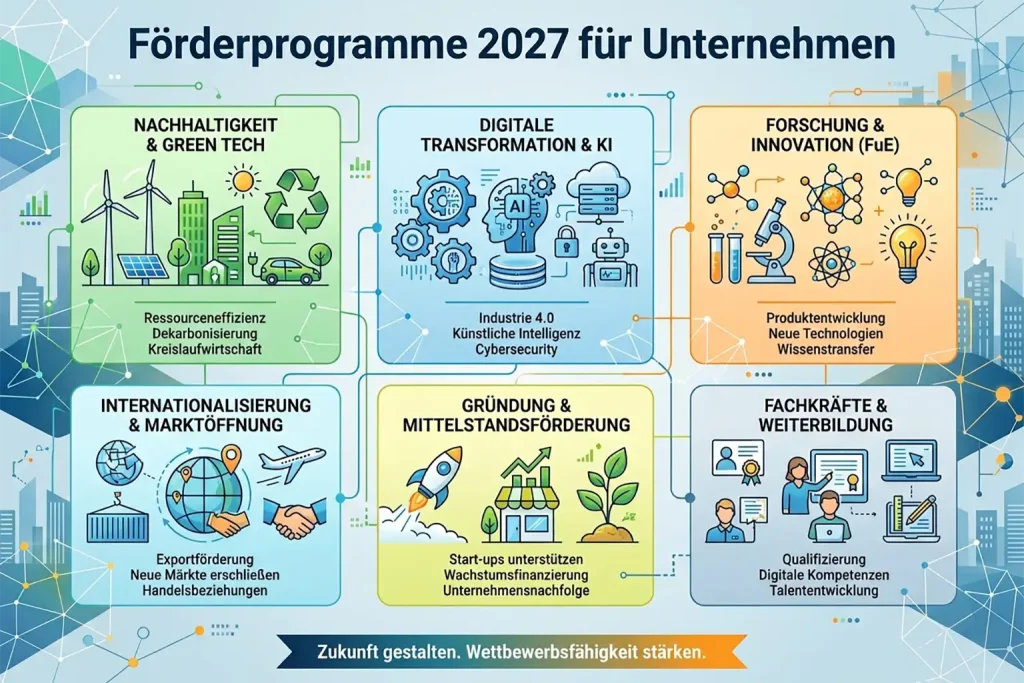
Keyfacts: Funding 2027 at a glance
- Budgetary situation: 2027 is the final year of approval for ERDF and ESF funds under the current EU period, as well as for the core calls of Horizon Europe. Accordingly, the disbursement rate is high for the federal and state levels.
- The focus areas of the testing facilities are: practical AI integration, cybersecurity according to the NIS-2 standard, process heat decarbonization (EEW), and market-oriented R&D developments (ZIM).
- Common financing routes:
- Non-refundable bar charges: Direct cost reimbursement for defined hardware, software, and third-party services.
- Interest-subsidized loans from KfW or state-funded institutions with partial cancellation of the debt:.
- Research allowance (FZulG): Right to tax credit (up to 35 percent for SMEs for personnel costs and 70 percent of the contract costs).
- Key success factor: structured combination („cumulation“) of various funding components, while strictly adhering to the de-minimis and AGVO limits.
Support landscape 2027: Why this year is strategically crucial
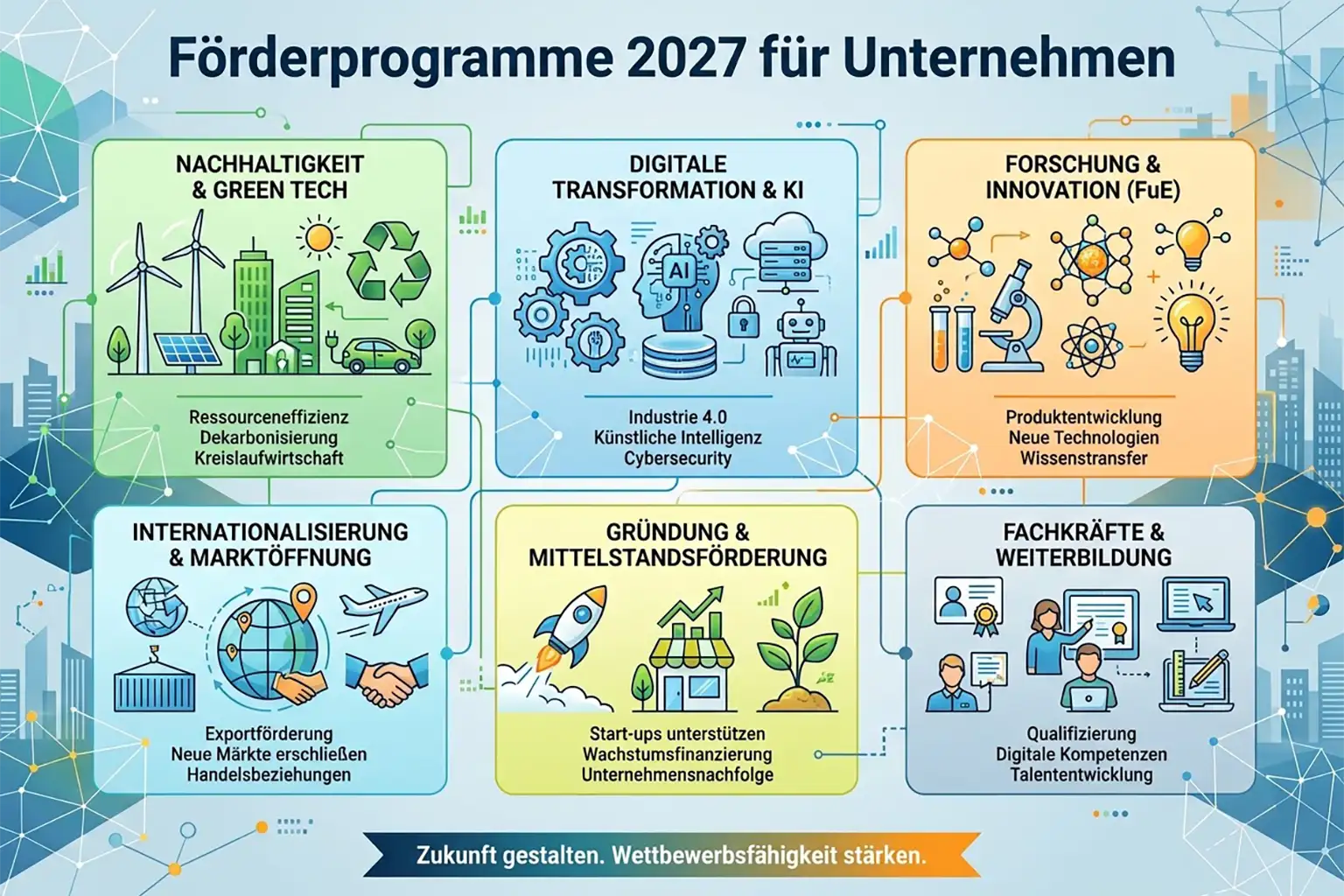
Ministries and regional banks are under considerable pressure to contract approved budgets before the turn of the year, as any remaining funds would otherwise flow back to Brussels. At the same time, the era of pure „pot money“ is over. Auditors are now looking very closely: Does the project generate real productivity gains? Does it demonstrably reduce energy consumption? Is new technological know-how being created in the operation?
„Funding must not be a mere afterthought in corporate management. Anyone who wants to use the year 2027 as the final phase of the European funding period must already now plan their innovation and transformation projects in a systematic manner. The budgets are there – but they flow where there is planning certainty and strategic clarity.“
— Efe Duran Sarikaya, CEO of EPSA Deutschland GmbH
Anyone who starts projects only in the autumn of 2027 risks facing closed doors or empty coffers. Therefore, forward-thinking companies are already compiling their application documents in advance.
Overview: The most important funding programs in 2027 compared
ZIM (Central Innovation Program for SMEs)
- Institution/Organization: BMWK / VDI/VDE-IT
- Type of funding: Non-reimbursable grant
- Maximum funding rate / amount: Up to 45–55 (% max. 450,000 € per sub-project)
- Target group: SMEs, small and medium-sized enterprises (< 500 employees), research partners
Research grant (FZulG)
- Institution/entity: Tax office / Certificate issuing body (BSFZ)
- Type of aid: Tax credit (legal entitlement)
- Maximum funding rate / amount: Up to 35 % for SMEs (max. base amount €10 million)
- Target group: All companies, regardless of size or industry
EEW (Federal funding for energy and resource efficiency)
- Institution/Organization: BAFA / KfW
- Type of funding: Grant or reimbursement grant
- Maximum grant rate / amount: Up to 40–60 % depending on the module (up to 15 million €)
- Target group: Commercial companies of all sizes
ERP funding for digitalization & innovation
- Beneficiary/Institution: KfW (through the home bank)
- Type of funding: Interest-free loan
- Maximum grant rate / amount: Up to €25 million in loan volume
- Target group: SMEs, freelancers, mid-caps
Regional digitalisation subsidies (EFRE co-financing)
- Funder/Institution: State funding banks (e.g. NRW.BANK, L-Bank, ILB, SAB)
- Type of funding: Lost bar subsidy
- Maximum grant rate / amount: 30 % to 60 (% typically €10,000 to €100,000)
- Target group: Regional SMEs and craft businesses
EIC Accelerator
- Institution/Organisation: European Commission / EISMEA
- Type of funding: Mixed financing (grant + equity)
- Maximum grant rate / amount: Up to €2.5 million in grant + up to €15 million in equity contribution
- Target group: Deep-tech start-ups and high-risk SMEs
Digitalization, AI & Cybersecurity
Anyone who submits an application today for office laptops or standard software licenses will immediately receive a rejection. The funding providers demand significant increases in value.
1. Artificial Intelligence & Machine Learning
The implementation of intelligent algorithms in existing processes is subsidized: from automated quality control via computer vision to machine learning-based material disposition to secure, in-house language models.
- At the federal level: thematic calls for funding under the Digital Europe program, as well as targeted initiatives for small and medium-sized businesses by the BMWK.
- At the regional level: state programs such as the Digital Bonus (Bavaria), the Digitalization Premium Plus (Baden-Württemberg), or BIG-Digital (Brandenburg). In addition to software development costs, external consulting and implementation fees are also funded.
2. Cybersecurity & NIS-2 compliance
The implementation of the European NIS-2 directive is forcing many businesses to make significant retrofits in their defense and surveillance infrastructure.
- Subject matter: Penetration tests, SIEM and SOC integrations, network segmentation, and preparations for certifications (e.g., ISO 27001 or TISAX).
- Funding options: Regional digital programs often offset these costs with subsidies of 40 to 50 percent (usually capped at 20,000 to 50,000 euros).
Would you like a brief consultation on this?
Energy efficiency, sustainability & decarbonization
Rising CO₂ costs and regulatory requirements make energy efficiency a perennial issue. The central funding priority at the federal level remains the federal funding for energy and resource efficiency in the economy (EEW).
The 6 modules of the EEW in overview:
- Module 1 – Cross-sectional technologies: Replacement of pumps, compressed air stations, fans, and electric motors with state-of-the-art models. Feed rates of 15 % to 30 % for SMEs.
- Module 2 – Process heat from renewable energy sources: Conversion to commercial heat pumps, biomass systems or solar thermal for production processes.
- Module 3 – Measurement, Control and Regulation Technology (MSR) & Sensors: Up to 40 % grants for management systems and monitoring tools for energy monitoring.
- Module 4 – Process optimization: The strongest leverage for manufacturing companies. Upgrades to entire production lines are supported if it is proven that the end energy consumption per unit decreases noticeably.
- Module 5 – Transformation Plans: Subsidies for well-thought-out greenhouse gas neutrality roadmaps (up to 50,000 euros, for SMEs with up to 60 % quota).
- Module 6 – Electrification: Support in the transition from gas- or oil-fired industrial furnaces to electric alternatives.
Practical advice: A certified energy efficiency expert listed by dena is mandatory for Module 4 as well as for modifications to company buildings. Engage this specialist before suppliers finalize offers.
Research, Development & Innovation (R&D)
Two tools are available for in-house development efforts that complement each other perfectly: the project-specific application process and the tax relief.
ZIM (Central Innovation Program for SMEs)
The ZIM remains the classic choice for technology-oriented medium-sized companies.
- Structure: As a single project or in cooperation with other companies or universities.
- Key criterion: There must be a genuine technical development risk. Routine product enhancements are not sufficient for the examiners.
- Volume: Eligible costs up to 450,000 euros per company, with grant rates up to 45 (% in structurally disadvantaged regions up to 55). %.
The tax research allowance (FZulG)
The Research grant Works without individual case competition: Anyone who meets the legal criteria has a legal right.
- What counts towards this? Experimental development, applied research and basic research.
- Cost basis: The funding covers internal personnel costs of the R&D employees as well as 70 % of the invoice amount for externally contracted research (up to 10 million euros of eligible expenditure).
- Advantage: The allowance can be claimed retroactively for up to four years. If the company incurs losses, the tax office pays the amount directly in cash.
EU funding in the final stretch: ERDF, Horizon Europe & EIC
At the European level, projects are funded that go beyond the technological limits of what is feasible or strengthen regional economic areas:
- ERDF (European Fund for Regional Development): It is managed by the individual federal states. The calls for applications for the current period end in 2027. Here, attractive investment subsidies for expansion of operations are often available in designated GRP funding areas.
- EIC Accelerator: The prestigious program for groundbreaking deep-tech projects (TRL 5 to 9). Up to 2.5 million euros in grant funding plus up to 15 million euros in equity capital from the EU. The hurdles are extremely high, but unbeatable for scalable innovations.
- Eurostars: A significantly leaner application procedure for cross-border research initiatives between two or more European SMEs.
Deep Dive: Funding allocation and aid law (De-minimis vs. AGVO)
The actual financial leverage rarely arises from a single isolated application. It arises where investments are structured into several funding pots. However, this requires absolute control over aid law, as improper combinations lead to claims in the context of an audit.
„The strongest leverage effect today arises at the interface of various instruments. The art lies in seamlessly linking non-repayable subsidies from the federal and state governments with fiscal instruments such as the research grant, without incurring aid law risks.“
— Efe Duran Sarikaya, CEO of EPSA Deutschland GmbH
1. Observe the ban on double funding
No invoice and no employee salary may be funded twice. Anyone who calculates the personnel costs of a programmer for six months using a ZIM project may not simultaneously claim the same hourly rate in the research allowance.
2. Legal and secure funding scheme according to work packages
The clean solution lies in the horizontal separation of the overall project:
- Package 1 (Algorithms & Core Development): Pure R&D activities of the software and design departments are included in the tax-based research allowance.
- Package 2 (Equipment technology & hardware): Measuring instruments, waste heat utilization and spare parts are covered by investment subsidies (such as EEW Module 4).
- Package 3 (System Integration & Cybersecurity): External consulting and implementation services are covered by a regional digitalization grant.
3. De-minimis versus General Group Exemption Regulation (AGVO)
- De-minimis rule: Small grants, advisory services and guarantees often fall under the de-minimis threshold of 300,000 euros within three years (based on the entire corporate group). Businesses must keep records of how much of this exemption has already been used.
- AGVO: Larger projects such as the ZIM or energy efficiency investments are managed through AGVO. Here, there are no rigid lump-sum limits, but project-specific funding intensities (e.g., a maximum of 50 % for medium-sized companies). Several AGVO measures may coexist as long as the maximum quota for the respective sub-package is not exceeded.
Practical example: How a medium-sized company realized a grant of 151,000 euros
The scenario of a metalworking company illustrates how the interplay works in industrial practice:
Situation of the business:
- Industry: CNC precision technology
- Employees: 78 employees (SME status)
- Annual turnover: 14 million euros
- Investment project: Development of an AI-based inline error detection system and simultaneous retrofitting of a heat recovery system on the machines used for heating the halls.
- Total budget: 380,000 euros
Step 1: Separation of cost items
- Internal development effort: 180,000 euros (salaries for developers and mechatronics engineers to create the image processing algorithms over 12 months).
- Energy efficiency hardware: 120,000 euros (heat exchangers, insulated piping networks, MSR sensors).
- External services: 80,000 euros (connection to the ERP/MES system and network hardening compliant with NIS-2).
Step 2: The selected funding combination
Building block 1 – Federal funding for energy efficiency (EEW Module 4)
- Funding base: 120,000 euros in investment costs for the use of waste heat.
- Grant rate for SMEs: 40 % grant.
- Payment: 48,000 Euro in cash (after submission of an application and approval before construction begins).
Sub-project 2 – Regional Digitalization Grant from the State
- Funding base: 80,000 euros for external system integration and cybersecurity.
- Grant rate for small businesses: 50 % (covered by the de-minimis scheme).
- Payment: 40,000 Euro in cash bonus.
Building 3 – Tax Research Grant (FZulG)
- Funding base: 180,000 euros in verifiable internal R&D personnel costs.
- Support rate for SMEs: 35 % tax credits.
- Tax refund / credit: 63,000 euros (submitted retroactively to the tax office after the end of the fiscal year).
Overall financial result:
- Total investment: 380,000 euros
- Total of subsidies & tax credits: 151,000 euros
- Actual own contribution: 229,000 euros (total funding rate just under 40 %%)
- Additional effect: By recovering the heat, the operation saves around 28,000 euros in natural gas per year. This reduces the amortization period of the remaining equity to less than three years.
Step-by-step roadmap for successful application
Process of the funding process: Project application form & scope -> Funding program matching & criteria review -> Preparation of project description & financial calculation -> Official submission of application / confirmation of receipt (NOTE: THE PROJECT STARTING LIMIT APPLIES HERE!) -> Award of contract, agreements & implementation -> Disbursement of funds & proof of expenditure
- Strengthen project brief: What problem is being solved? What is the technical innovation or energy saving? Realistic assessment of time horizon and total costs.
- Check SME status: Do you have fewer than 250 employees and either a turnover of less than 50 million euros or a balance sheet total of less than 43 million euros? Note: Associated companies and shareholdings are counted proportionally.
- Request offers (strictly non-binding): Request offers from suppliers and software companies. Do not sign any binding pre-agreements or option contracts.
- Submit the application digitally: Submit documents about the respective platforms (easy-Online, BAFA portal, state portals).
- Wait for confirmation of receipt: Only when the official confirmation of receipt („Early start of project at own risk permitted“) or the grant approval is received may ordering be made.
- Document audit compliance: Monthly recording of time sheets for project employees, clear separation of invoices, and archiving of payment receipts.
The 5 most expensive mistakes in grant applications
- Early start of project: The absolute classic. Anyone who signs a contract confirmation or makes a deposit before the formal confirmation from the funding provider is excluded from the funding. Subsequent rectification is not possible.
- Inappropriate shareholder structures: Whoever hides financial investor or parent company interests from the SME declaration is committing subsidy fraud. The funds are claimed back along with interest.
- Declaring product maintenance as innovation: Pure software updates, layout adjustments, or routine maintenance work are not R&D. Evaluators recognize this immediately and reject the project.
- Exceeding the de-minimis limits: Anyone who applies to several Landesbanken and loses track of the rolling three-year limit (300,000 euros) risks having the sums exceeding that amount repaid.
- Poor time recording: In projects with personnel cost subsidies, inspection bodies require complete proof of working hours. Anyone who simply enters 40 hours per week without a description of tasks will be disqualified when verifying the use of funds.
Conclusion: Strategic use of funding programs for companies in 2027 as a lever
The year 2027 rewards well-organized businesses: With the expiration of the EU funding period and targeted federal initiatives, substantial funds are available to offset entrepreneurial risks associated with future investments.
Corresponding Funding programs for companies 2027 The business model should never determine the strategy. It serves its purpose best when it accelerates investments that were already planned from a business perspective. Those who structure projects early, pre-screen offers thoroughly, and combine direct subsidies with tax instruments like the research grant, gain a measurable liquidity and competitive advantage.
Frequently asked questions (FAQ) about the 2027 funding programs for companies
1. Can I combine funding programs (cumulation)?
Basically, yes, as long as the respective program guidelines do not explicitly prohibit it. Typically, this involves a combination of interest-rate-friendly loans (KfW) and non-repayable subsidies (BAFA), or a separation into work packages. The most important limit: An identical invoice may never be reimbursed twice (exclusion of double funding), and the total ceiling for aid entitlement must be adhered to.
2. What happens if a funded development project fails?
In real R&D projects (such as the ZIM program), technological risk is a basic prerequisite for approval. If a solution approach proves technically infeasible despite diligent work, the funds properly accounted for will generally not have to be reimbursed. What is crucial is the proof that the plan was followed and that all documents were properly documented.
3. How much lead time is required for the approval process?
Processing times vary significantly depending on the awarding body:
- Regional digitization subsidies from the states: Often 6 to 12 weeks.
- Energy efficiency programs (BAFA / EEW): Usually 8 to 16 weeks.
- Federal Technology Programs (ZIM): Between 4 and 6 months.
- EU funding (e.g. Horizon / EIC): Multi-stage, in practice 6 to 9 months.
4. Does the research grant also apply to projects that have already been completed?
Yes, that is one of the greatest advantages of this instrument. The application for a certificate with the BSFZ and the subsequent enforcement application with the tax office can be submitted retroactively for all fiscal years whose tax assessments are still subject to legal proceedings (usually up to four years retroactively).
5. Do received subsidies have to be taxed for companies?
Real subsidies to cover ongoing operating expenses are tax-treated as operating income in the year of accrual. In the case of investment subsidies for the fixed assets, companies have a choice: they can set the subsidy as income or reduce the purchase costs of the asset on a nominal basis, thereby reducing the annual depreciation. The tax research allowance (FZulG), on the other hand, is tax-free and is immediately deducted from the determined corporate or income tax liability.